HVAC Technician Interview Questions (Plus the Practical Test No One Explains)
HVAC technician interview questions and answers, EPA 608 certification checks, the on-the-spot practical test, and how state licensing rules actually vary.
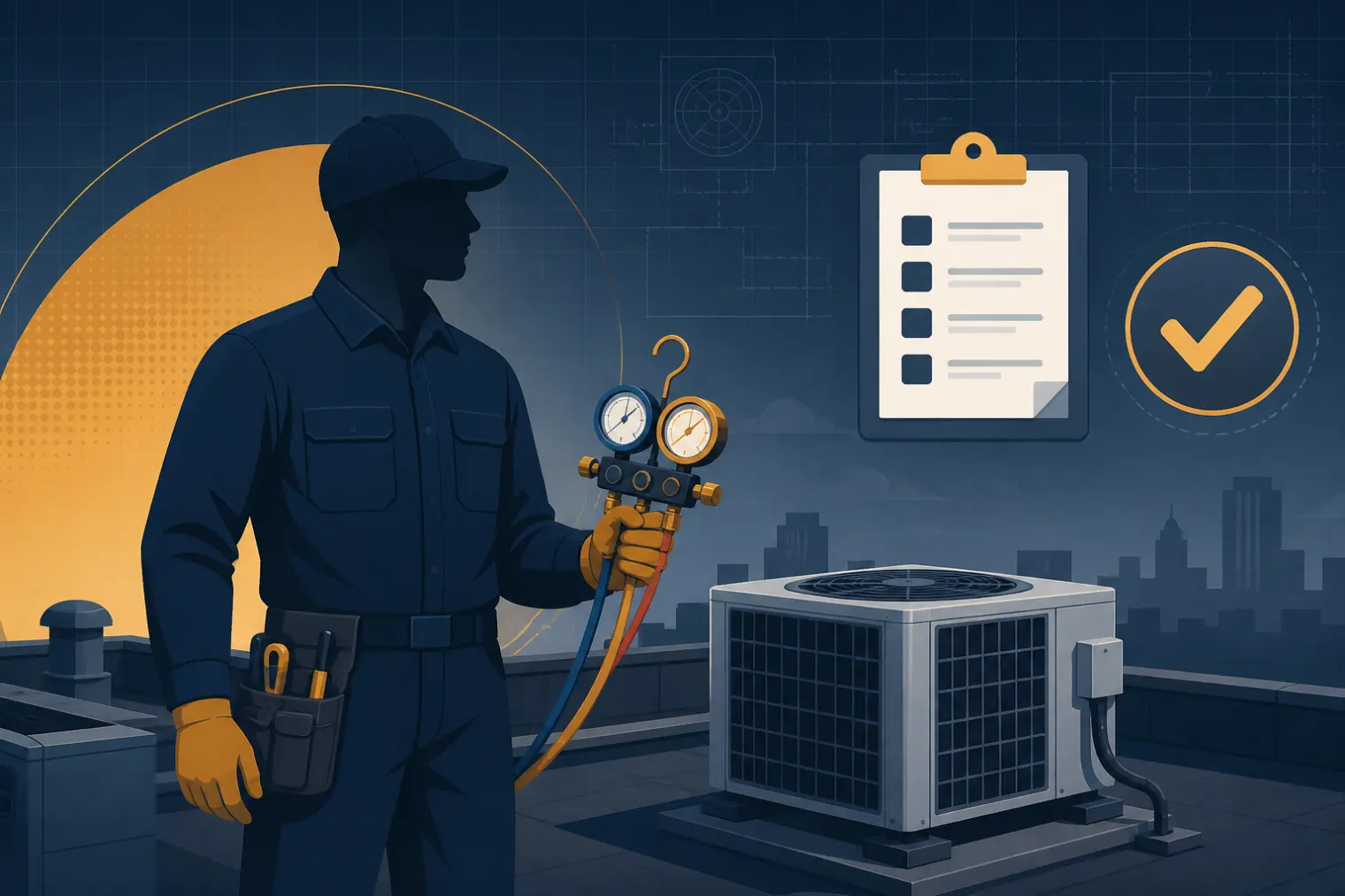
TL;DR: HVAC technician interview questions split into background, technical knowledge, diagnostic scenarios, and behavioral — but the format most competitor guides skip is the on-the-spot practical test, where a foreman walks you to a real unit and asks you to talk through a diagnosis. EPA Section 608 is a federal refrigerant permit, not a state license — the two get confused constantly, and state licensing rules vary from "none required" to "thousands of supervised hours." AI prep helps with the phone and video pre-screen stage; it can't and shouldn't claim to help during a hands-on practical test.
Most "HVAC technician interview questions" articles read like they were written for an office job with a different word swapped in. They cover the standard behavioral and background questions fine, but they skip the thing a lot of working techs actually get asked about on Reddit: "the interview process wasn't hard at all, they just showed me a paper with t-stat wires and asked me to match them to what they go to." Some HVAC interviews are closer to a pop quiz with tools than a conversation.
What Makes an HVAC Interview Different
An HVAC technician interview is judged on real technical fluency as much as how you present yourself — refrigerant handling knowledge, basic electrical troubleshooting, and EPA certification status all get checked, sometimes directly, sometimes through a scenario question. Interviews also vary a lot by employer type: a residential service company might run a straightforward sit-down, while a commercial or industrial shop is more likely to walk you out to an actual unit. Knowing which kind of interview you're walking into matters more here than in most office roles.
Common HVAC Technician Interview Questions
Background and motivation
- Why did you get into HVAC?
- What draws you to this company specifically?
- Walk me through your training, apprenticeship, or prior shop experience.
Technical and certification
- What refrigerants have you worked with, and what's your EPA 608 certification level?
- Walk me through checking a capacitor or contactor on a unit that won't start.
- What's your process for checking refrigerant charge on a system?
Scenario and diagnostic
- A customer says their AC is running but not cooling — what do you check first?
- Walk me through diagnosing a unit that's short-cycling.
- Tell me about the hardest diagnostic call you've had, and how you figured it out.
Behavioral
- Tell me about a time you had to explain a repair cost to a frustrated customer.
- Describe working under a senior tech or supervisor whose approach differed from yours.
The On-the-Spot Practical Test: What to Expect
A pattern shows up repeatedly in real HVAC candidate accounts that almost no generic interview guide mentions: the interviewer, often a shop foreman rather than HR, walks you out to a real unit — sometimes deliberately broken — and asks you to find the problem, identify components, or trace refrigerant lines. One HVAC-specific guide describes it as being told: "that unit isn't running, find the bug."
What tends to matter most isn't a perfect diagnosis under pressure — it's whether you narrate your process the way you would on a real service call: "I'm checking voltage at the disconnect first, then I'd check the capacitor, then look at the contactor." Talking through your reasoning out loud, in order, safely, is what a foreman is actually listening for. Silence while you poke around is a worse look than a wrong first guess spoken clearly.
EPA 608 vs. State License: What Employers Actually Check For
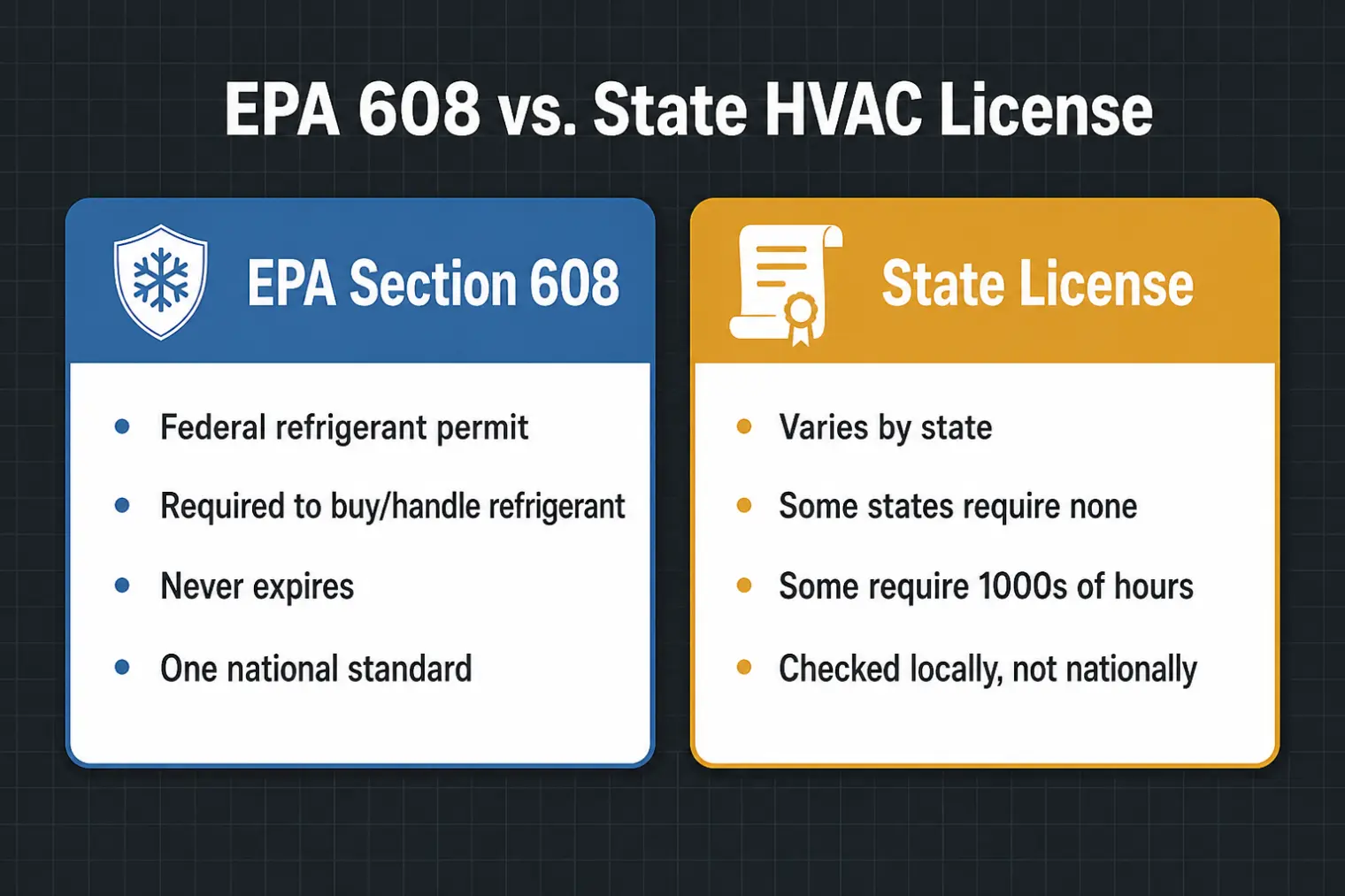
This is where a lot of candidates — and even some competing interview guides — get confused. EPA Section 608, under the Clean Air Act, is a federal refrigerant-handling permit, not a state trade license. It comes in four types — Type I (small appliances), Type II (medium/high/very-high pressure), Type III (low pressure), and Universal (all three) — and once earned, it never expires. Apprentices working under direct supervision of a certified technician are generally exempt from needing it themselves yet.
State licensing is a separate, and far more inconsistent, layer:
- Some states require no separate HVAC technician license beyond EPA 608 and working under a licensed contractor.
- Some states require thousands of supervised hours (roughly 18 months in certain states) before you're eligible for licensure.
- Licensing reciprocity is handled state-to-state, not through one national system — so "am I licensed here" genuinely depends on where "here" is.
Knowing your specific state's rule before the interview — and being able to correctly explain the difference between your EPA 608 card and any state license — signals real professionalism that a lot of candidates fumble.
Where AI Interview Prep Actually Helps (and Where It Can't)
Be honest about this one: a real-time AI copilot can't and shouldn't claim to help you diagnose a live unit or identify a refrigerant line in front of a foreman — that's real technical skill built through training and hands-on hours, not something to fake in the moment.
Where AI prep genuinely helps is earlier in the process: rehearsing your background and motivation answers before a phone screen with a staffing agency or HR recruiter, practicing how you'd explain a past diagnostic story clearly and in order, and reviewing EPA 608 basics so you don't blank when asked your certification level. That's the honest scope — and most HVAC candidates get zero structured practice before either interview stage.
How to Use AceRound for an HVAC Technician Interview
For the phone-screen and video pre-screen stages, AceRound listens in real time and surfaces structured suggestions for background, motivation, and behavioral questions as they come up — so you're not scrambling to structure an answer to "tell me about a difficult customer" on the spot. It won't substitute for actually knowing your trade, but it can help you rehearse how to explain what you already know, clearly and under a little less pressure.
For a similar trade-interview breakdown, see our guide to electrician interview questions, and for more on how real-time AI interview help works during a live call, check our AI phone screen interview tips.
FAQ
What questions are asked in an HVAC technician interview?
Expect four buckets: background and motivation (why HVAC, why this employer), technical knowledge (refrigerant handling, electrical basics, EPA 608 certification), scenario/diagnostic questions ("walk me through how you'd troubleshoot a unit that's not cooling"), and behavioral questions (handling a difficult customer, working under a senior tech). Apprentice interviews lean toward aptitude and motivation; experienced-tech interviews lean harder into real diagnostic reasoning.
Do I need my EPA 608 certification before the interview?
Not always, but it helps. Many employers will interview and even hire apprentices without it, since apprentices can legally work under a certified technician's supervision. But for anything beyond an entry-level apprentice role, not having it — or not knowing what it actually covers — is a real disadvantage in the room.
Does EPA 608 certification mean I'm a licensed HVAC technician?
No, and this trips up a lot of candidates. EPA Section 608 is a federal refrigerant-handling permit under the Clean Air Act — it says nothing about your state's requirements to work as, or start, an HVAC business. Some states require no separate technician license at all beyond EPA 608; others require thousands of supervised hours before you're licensed. It's worth knowing your specific state's rule before you walk into the interview.
What happens during an HVAC practical test in an interview?
It varies, but a common format is: the interviewer or shop foreman walks you out to a real (often intentionally broken) unit and asks you to diagnose it, or asks you to identify tools, refrigerant lines, or components on the spot. What matters most isn't necessarily solving it perfectly — it's narrating your troubleshooting process clearly and safely, the way you would on a real job.
Can AI help me prepare for an HVAC technician interview?
For the parts that happen over a phone call or video pre-screen with a staffing agency or HR recruiter, yes — rehearsing your background and behavioral answers, and reviewing EPA 608 basics so you don't blank, both genuinely help. AI real-time help during an in-person practical test or a hands-on diagnostic walk-through isn't realistic to promise — that depends on real technical skill, not something a copilot can feed you in the moment.
What should I bring to an HVAC technician interview?
Bring your resume, any certifications you hold (EPA 608 card, state license if applicable, OSHA cards), and if you're an experienced tech, consider bringing your own basic tools — some shops genuinely notice and ask about it, since owning and maintaining your own tools is treated as a signal of how seriously you take the trade.
Author · Alex Chen. Career consultant and former tech recruiter. Spent 5 years on the hiring side before switching to help candidates instead. Writes about real interview dynamics, not textbook advice.
Related Articles
OpenAI's AI Interview Policy: Banned, Required, or Team-Dependent
OpenAI sells AI coding agents, then bans most candidates from using one. Here's the round-by-round policy, including the new agentic round that flips it.
Does Harver Detect Cheating? What Its Proctoring Actually Checks
Does Harver detect cheating on its pre-employment assessments? A candidate look at Harver's Proctoring add-on, what gets logged after a flag, and what happens next.
Micro1's Zara AI Interview: What It Actually Tests (And Why Timing Gets Flagged)
Micro1's AI interviewer Zara has run 300,000+ interviews for remote roles. Here's why it flags response latency as a cheating signal, and what that means for AI prep.