What Would You Do in Your First 90 Days? A Better Way to Answer
"What would you do in your first 90 days?" The generic 30-60-90 day plan template no longer works — here's how to build a live, JD-specific answer instead.

TL;DR: "What would you do in your first 90 days?" isn't testing whether you memorized the 30-60-90-day-plan template — every interviewer has heard that one before. It's testing whether you can diagnose a real team's situation and adjust your plan out loud when they push back, instead of reciting something you wrote in the parking lot.
The question lands about forty minutes in, usually right after the interviewer has just described their team's actual situation — a migration that's half-done, a support queue that's backed up, a process nobody quite owns. "So, what would your first 90 days here look like?" You have a template ready. Learn in the first 30, contribute in the next 30, deliver by day 90. It's clean, it's structured, and — if you say it exactly like that — it tells the interviewer nothing they didn't already know you'd say.
Why This Question Still Gets Asked at Every Level
Interviewers keep asking the first 90 days interview question because it's one of the few moments in an interview where they can watch judgment happen instead of just hearing about it afterward. A dedicated 90-day-planning tool built specifically around this question frames it well: the test isn't whether you have a plan, it's whether you diagnose before you commit to one — whether you ask what's already been tried, what the team's tooling looks like, or where the current bottleneck actually is, versus jumping straight to solutions.
That framing traces back to Michael Watkins' The First 90 Days (Harvard Business Review Press), the book most of this advice ultimately derives from, whether or not the article citing it says so. Watkins' core argument is that transitions fail not from a lack of effort but from applying the wrong plan to the wrong situation — a turnaround plan on a team that needed steady realignment, or a "just keep it running" plan on a team that was quietly falling apart. The interviewer isn't checking your calendar. They're checking whether you'd have known which situation you walked into.
The Template Everyone Uses — And Why It's Starting to Backfire
The standard 30-60-90 day plan interview answer has the same shape everywhere you look: 30 days to learn and build relationships, 60 days to start contributing, 90 days to deliver measurable impact. Indeed's own career-advice guide walks through this exact structure, and it's not bad advice — it's just advice so common that reciting it verbatim gives the interviewer zero new information about you.
The Muse's interview with Eliot Kaplan — an 18-year VP of Talent Acquisition at Hearst Magazines — makes a narrower point: don't walk in with a rigid plan, walk in with a few specific ideas that show your thought process, your agility, and your proactiveness. Where that leaves a gap, from the hiring side, is what happens next. A plan built entirely in advance, with no reference to anything specific about the actual team, reads as rehearsed the moment it starts — and a rehearsed answer to "what would you do here" quietly answers a different question: whether you were actually listening to the rest of the interview.
Build a Scaffold, Not a Script
The fix isn't a better script — it's a lighter structure you fill in live, using what the interviewer has already told you.
- One diagnostic question or assumption for the first 30 days. Not "I'll learn the codebase" in the abstract — name the specific thing you'd need to understand first, based on what they described. If they mentioned a half-finished migration, your 30-day answer is about understanding why it stalled, not just "getting ramped up."
- One concrete, believable contribution for 60 days — sized to what an actual new hire could realistically ship in two months, not a transformation. Overpromising here is a bigger tell than underpromising.
- One measurable signal for 90 days that maps to something they'd actually check — a metric they mentioned, a recurring pain point, a stated goal for the quarter — not a generic "deliver impact" line.
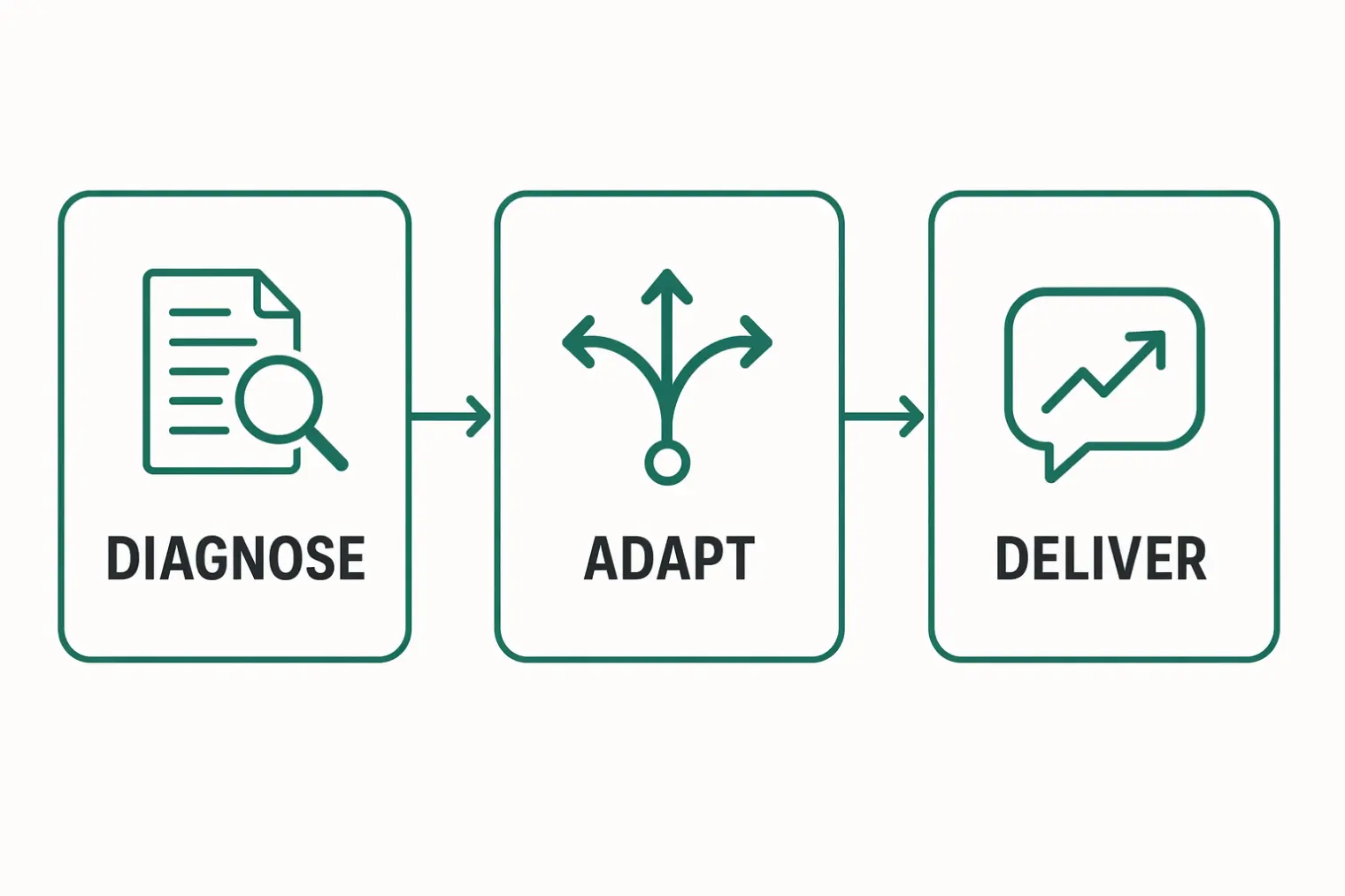
The difference between this and the standard template isn't the phase structure — it's that every phase points back at something specific to this conversation. That's also why a scaffold survives follow-up questions and a memorized script doesn't: there's nothing to defend, because you built it from what they told you in the first place.
First 90 Days Interview Answer Examples by Experience Level
Early career, first real job search: "Before I'd commit to specific output, I'd want to understand how support tickets currently get triaged, since you mentioned the queue's been backing up — that's what I'd spend the first few weeks on. By 60 days, I'd want to be handling a category of tickets independently. By 90, I'd want to have proposed one small change to the triage process, even if it's just a tagging convention, based on what I'd actually seen go wrong."
Mid-career, moving for more scope: "Given what you said about the migration stalling around the data-layer piece, my first 30 days would be understanding specifically why that stalled — whether it was a tooling gap, a dependency nobody owns, or just deprioritization. Sixty days in, I'd want to have unblocked that one piece. By 90, I'd want the migration to at least have a credible finish date again, which it sounds like it doesn't right now."
Management or senior IC, expected to lead a written plan: "I'd hold off on committing to specific initiatives until I've had 1:1s with the team — not as a formality, but because you mentioned attrition's been a concern, and I don't want my 90-day plan to solve a problem I haven't actually confirmed exists yet. What I can commit to now is the structure: diagnostic weeks first, one visible fix by 60 days that the team itself flagged as painful, and a retention or output metric by 90 that we'd agree on together in week one."
Handling the Follow-Up That Actually Tests You
The real test rarely stops at the first answer. It's the follow-up: "What if IT won't prioritize that migration fix?" or "The last person who said something similar didn't work out — why would it go differently for you?" Nearly every piece of advice on this question stops at the version you rehearse beforehand; almost none address what happens when the interview pushes back on it live.
The move here isn't to defend your original plan — it's to restate the new constraint out loud and adjust one specific part of your answer to fit it. "If IT can't prioritize it, then my 60-day milestone shifts from 'fix shipped' to 'workaround documented and IT ticket filed with a clear business case' — the diagnosis doesn't change, just what's achievable in that window." That single sentence demonstrates the thing the question was actually testing: not planning ability, but whether you can revise a plan mid-conversation instead of restating it louder.
This is also where practicing with a live interview copilot genuinely helps rather than just feeling like a crutch — it's not about scripting the perfect 90-day answer in advance, since a scaffold has to flex to what the interviewer says anyway. It's closer to having a second set of ears catching the specific detail — the tool they mentioned, the metric they care about — that your scaffold should be built around, in the moment you actually need it, not three questions later when you realize you missed it.
Before Your Next Interview
Whether or not you get asked this exact question, the underlying test — can you take in new information about a real situation and adjust your thinking on the spot — shows up constantly, including in questions about what you're looking for in your next role or how you'd approach your management style on day one. Build the scaffold once, and it travels to all three.
Frequently Asked Questions
How do I answer 'What's your plan for the first 90 days'? Don't recite the standard learn-contribute-deliver template. Build a lightweight scaffold from what the interviewer just told you about the team: one diagnostic focus for the first 30 days, one believable contribution by 60, and one measurable signal by 90 — each tied to a specific detail from this conversation, not a plan you could give at any company.
What are your 30, 60 and 90 day goals? Frame each phase around this team's actual situation instead of generic milestones: 30 days to diagnose the specific problem they described, 60 days to make one concrete contribution sized to a realistic new hire, and 90 days to hit one measurable outcome they'd actually check.
What will you accomplish in the first 90 days of work? Less than a generic answer promises, and stated more specifically. Overpromising a transformation is a bigger red flag than committing to a modest, believable win — one diagnostic focus, one contribution, one measurable signal — and being ready to revise them out loud if the interviewer pushes back.
Is It a Red Flag? Presenting a 30-60-90 day plan can be a red flag, if it's obviously generic. Experienced interviewers have seen the same three-phase template hundreds of times and recognize a memorized script within the first sentence. The red flag isn't the format — it's a plan that could be copy-pasted into any other company's interview unchanged.
Do I Need to Bring It? You only need to bring a written 30-60-90 day plan if the role is senior enough that a leadership-transition plan is expected (management, VP-level, or roles explicitly asking for a presentation). For most individual-contributor interviews, a written plan reads as over-prepared and can work against you — a clear verbal scaffold is safer.
Author · Alex Chen. Career consultant and former tech recruiter. Spent 5 years on the hiring side before switching to help candidates instead. Writes about real interview dynamics, not textbook advice.
Related Articles
Virtual Onsite Interview Loop: How to Survive 4-6 Back-to-Back Rounds
What a virtual onsite interview loop is, why round 4 is where candidates fall apart, and how to prepare for 4-6 back-to-back video rounds in one day.
Interviewing While Employed: How to Actually Prepare With Zero Time
Job searching while employed means near-zero prep time, not just staying discreet. Here's a 20-minute prep script, plus what the counteroffer statistics actually show.
CTC Negotiation for Freshers in India: What's Actually Negotiable
Most fresher CTC negotiation advice ignores that TCS, Infosys, and Wipro set fixed pay bands. Here's what's really negotiable, and where lowball offers hide.