When You Disagree With an AI Recommendation
A new 2026 interview question tests whether you defer to AI or actually check it first. Here's how to structure a real answer, with scenarios.
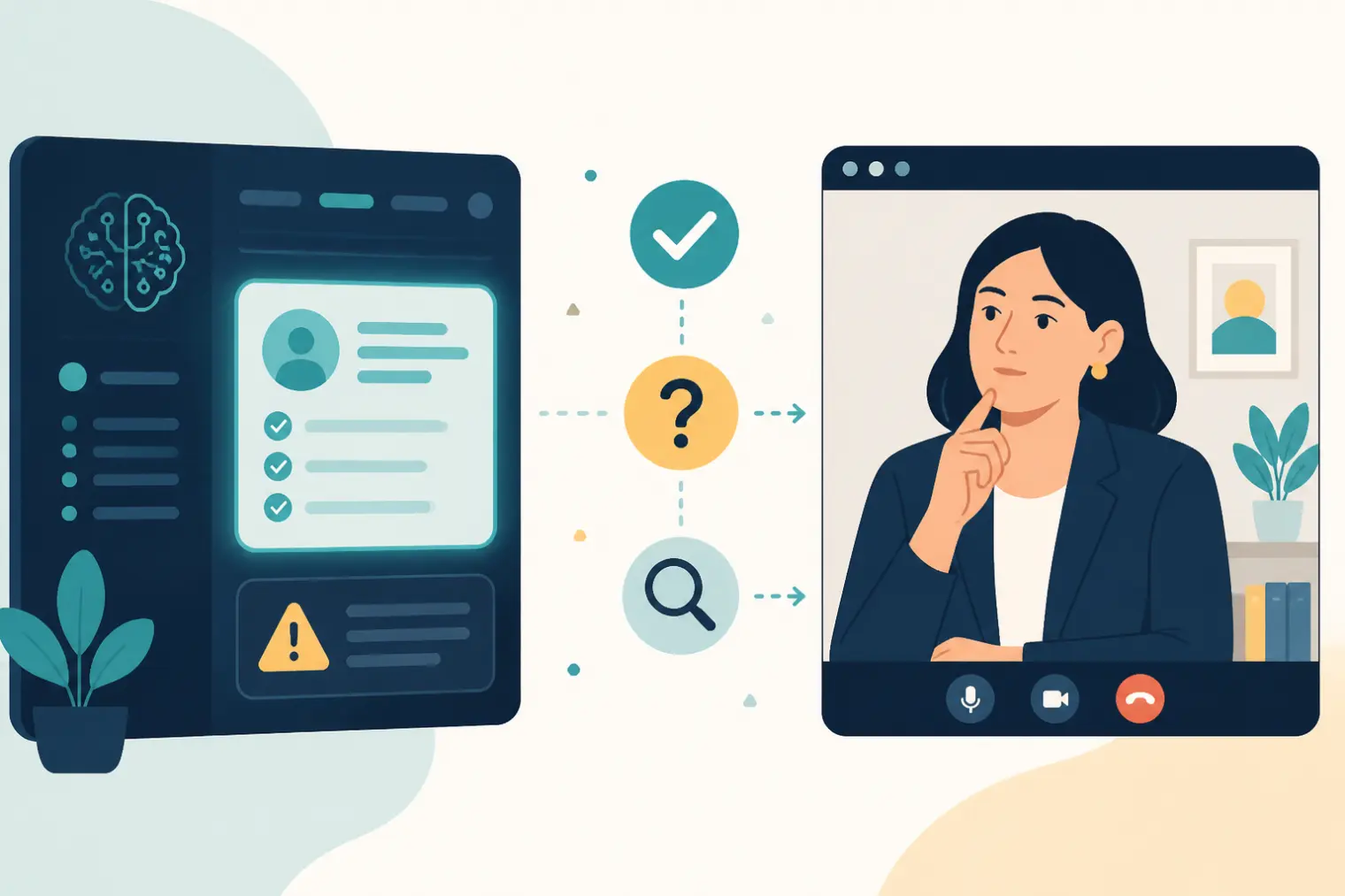
TL;DR: "Tell me about a time you disagreed with an AI recommendation" is a fast-spreading 2026 interview question testing whether you defer to AI output or actually check it before acting. The strongest answers separate an obviously wrong recommendation from a subtly wrong one that looked plausible, name the specific context the AI was missing, and end with what changed about how you use that tool afterward. Skip the "I don't trust AI" framing entirely — the question is grading verification habits, not skepticism.
A hiring manager posting in a recruiting forum in early 2026 described a candidate who answered this question with: "The forecasting model said flat demand for next quarter. I knew we had a promo calendar the model wasn't trained on, so I flagged it before the plan locked." She said it was the cleanest fifteen seconds of the whole interview — no hedging, no AI-bashing, just a specific gap the candidate caught and closed.
Most candidates don't have that answer ready. They either haven't thought about it, or they reach for something generic like "I disagreed with my manager once" and hope the interviewer doesn't notice it's not really about AI at all.
Why interviewers are asking this now
The logic is straightforward once you see it from the other side of the table. AI recommendation systems are now embedded in hiring screens, sales forecasts, incident triage, code review, and scheduling — quietly making calls that used to require a person to think. PwC's 2026 Global AI Jobs Barometer documents the shift from the employer side: as AI absorbs more of the execution work, the skills companies pay a premium for move toward judgment and critical thinking, not raw AI fluency.
There's a specific failure mode driving this. Peer-reviewed research on automation bias in AI-based personnel selection shows that once people start relying on an algorithmic recommendation, they tend to defer to it even when their own judgment would have caught the error — the convenience of "the system said so" quietly erodes the habit of checking. Regulators have taken this seriously enough to write it into policy: the EU's guidance on human oversight of automated decision-making explicitly requires meaningful human review, not rubber-stamping, precisely because rubber-stamping is what happens by default.
Put together, interviewers ask this question because they've learned that "comfortable using AI tools" and "willing to override AI tools when it matters" are two different traits, and only one of them protects the company from a bad AI-influenced decision.
The real skill this question is testing
Most existing advice treats this like a standard "tell me about a disagreement" question with AI swapped in for a manager. That misses the harder and more interview-relevant part: distinguishing between an AI recommendation that's obviously wrong and one that's subtly wrong.
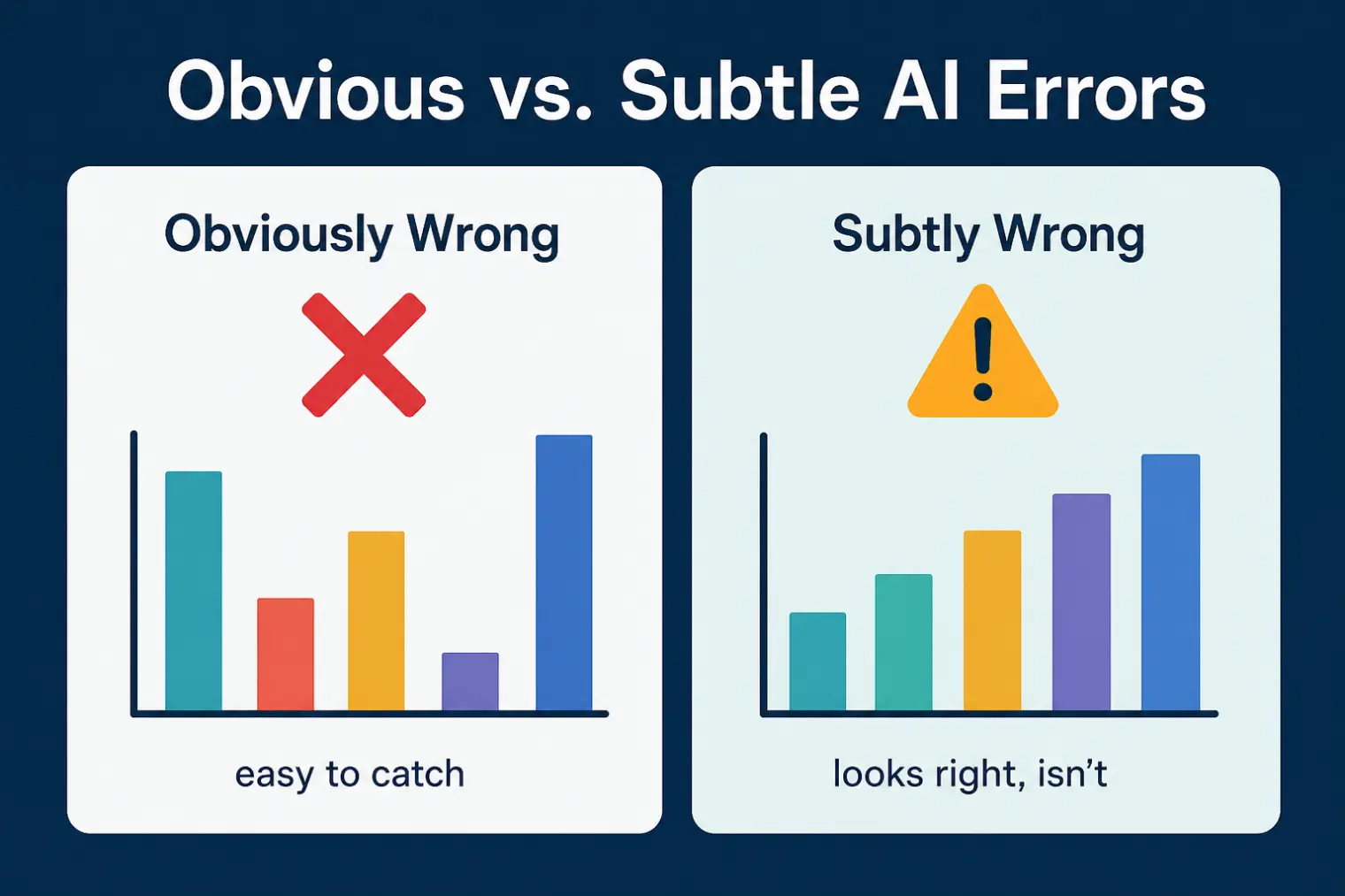
Obviously wrong is the easy case: the AI hallucinates a source, cites a number that contradicts something you already know, or produces output that fails a basic sanity check. Anyone paying attention catches this eventually.
Subtly wrong is the case interviewers actually want to hear about: the recommendation looks internally consistent, fits the pattern of everything else the tool has told you, and would sail through if you didn't happen to have context the model didn't have. This is the harder, more valuable skill, because it requires you to notice something feels off before you have proof, and go verify instead of shrugging it off. If your example only covers the obvious case, it's a fine story, but it's not the strongest possible answer to this question.
How to structure your answer
Use STAR, but load the "action" step with the actual judgment call, not just "I disagreed":
- Situation — What was the AI tool, and what decision did its output feed into? Be specific about the tool's function (forecasting model, code reviewer, resume screener, incident-response assistant), even if you don't name the brand.
- Task — What made you pause? Name the exact context the AI didn't have access to. This is the part that proves the disagreement was judgment, not vibes.
- Action — What did you actually do to verify it, and who did you tell? "I checked the primary source" or "I cross-referenced against the promo calendar" is concrete. "I felt like it was wrong" is not.
- Result — What happened, including if you were later proven right or wrong. Close with what changed about how you use that tool going forward. That last sentence is what separates "I caught one mistake once" from "I have a durable habit."
Four scenarios, if you're stuck for material
Pick the one closest to your actual work and rebuild it with your real details:
- Incident response. An AI-generated root-cause analysis pointed to a plausible-looking service dependency. Your own log review found the real cause was a deploy-timing race condition the pattern-matching missed.
- Sales or demand forecasting. A forecasting model trained on historical data predicted flat demand. You knew about an upcoming promo or market event the model had no visibility into, and flagged the gap before the plan locked.
- Code review or refactoring. An AI coding assistant proposed a "cleaner" refactor that passed local tests but introduced a subtle concurrency bug only visible if you traced through simultaneous access paths by hand.
- Hiring or resume screening. An AI screening tool downranked a candidate with a nonlinear career path — a gap, a pivot, a nontraditional background. You recognized the pattern-matching bias and manually advanced the candidate, who went on to interview well.
None of these need to be dramatic. A forecasting gap you caught in ten minutes is just as usable as a production incident, as long as you can walk through what you actually checked.
The trap: don't sound anti-AI
The single most common way candidates blow this question is turning it into a referendum on AI's flaws. A long explanation of why hallucination happens, or why forecasting models struggle with novel events, answers a different question than the one being asked. The interviewer wants to hear about your behavior, not your understanding of the underlying technology.
The framing that works is "selective trust with verification," not "healthy skepticism of AI." Something you use daily and generally trust, but that you know when and how to check, reads as far stronger judgment than something you treat as broadly unreliable. If your story implies you double-check everything the AI ever tells you regardless of stakes, that's not judgment either — it's just slow. The strongest answers make clear you knew this particular recommendation, in this particular context was worth a second look, and most others aren't.
This is a narrower, more personal question than "how do you use AI in your work?", which is mostly testing fluency, or "how do you work with AI agents?", which tests delegation judgment on semi-autonomous tasks. It's also a different angle than "tell me about a time an AI tool made a mistake", which is about catching an error after the fact rather than disagreeing with a recommendation before you act on it. If you're prepping for one of these, prepare for the others too — interviewers increasingly ask more than one from this cluster in the same round.
The same instinct matters live, not just in the retelling
The habit this question is testing — pausing on a plausible-sounding suggestion long enough to check whether it actually fits your situation — isn't only useful for the story you tell about your last job. It's the same instinct you need live, including during the interview itself, if you're using any kind of real-time interview help to work through a tough question. A suggestion that's 80% right for a generic version of the question but misses a detail specific to your actual experience is exactly the kind of "subtly wrong" recommendation this question is about.
AceRound is built around that distinction. It surfaces a structured starting point during a live interview, not a script to read verbatim, precisely because a suggestion you haven't sanity-checked against your own experience is the same failure mode this interview question exists to screen out. Worth saying plainly: that includes AceRound's own suggestions. Treating any AI output — ours included — as a starting draft to verify against what you actually know, rather than a final answer to repeat, is the exact muscle this question is checking for.
FAQ
Is this a common interview question yet, or still rare? It's spreading, but unevenly. It shows up most in roles where an AI tool already makes a real recommendation someone has to act on: sales forecasting, incident response, hiring screens, code review, scheduling. If your job touches any AI-generated output that feeds a decision, prepare an answer. Pure execution roles with no AI-assisted decision layer see it less often, for now.
What if the AI recommendation I disagreed with turned out to be right? That's a usable story too, and honestly a more interesting one if you tell it right. The question isn't testing whether you're always correct, it's testing whether you check before acting. Describe why the recommendation looked wrong to you, what you did to verify it, and what you learned when the verification showed the AI was right. Ending with "I updated how much I trust that specific tool in that specific context" is a strong close.
Won't disagreeing with AI make me look anti-AI or hard to work with? Only if you tell it wrong. The failure mode isn't disagreeing, it's how you frame it. Center the story on evidence and process, not on distrust of AI as a category. "I checked because the stakes were high enough to check" reads completely differently from "I don't really trust AI outputs." The first is judgment. The second is a red flag.
I've genuinely never overridden an AI recommendation. What do I do? Look harder before assuming that's true. Most people who use any AI-assisted tool regularly have quietly corrected, ignored, or double-checked an output at some point, even something small like not sending an AI-drafted email as-is. If you truly can't find one, that's worth noticing before the interview, not during it — it usually means you've been treating AI output as final rather than as a draft.
How is this different from "tell me about a time an AI tool made a mistake"? Related but not the same. That question is about catching an error after the fact. This one is about disagreeing with a recommendation before you act on it, sometimes when you can't even prove it's wrong yet, just that it doesn't sit right given context the AI didn't have. It's testing judgment under uncertainty, not just error detection.
Should I mention a specific AI tool by name in my answer? Only if it's true and relevant. Naming the actual tool (an ATS scoring system, a forecasting model, a coding assistant) makes the story more credible than a vague "an AI told me." If naming it risks sounding like you're badmouthing your last company's tooling, describe the tool's function instead of its brand.
Author · Alex Chen. Career consultant and former tech recruiter. Spent 5 years on the hiring side before switching to help candidates instead. Writes about real interview dynamics, not textbook advice.
Related Articles
OpenAI's AI Interview Policy: Banned, Required, or Team-Dependent
OpenAI sells AI coding agents, then bans most candidates from using one. Here's the round-by-round policy, including the new agentic round that flips it.
Does Harver Detect Cheating? What Its Proctoring Actually Checks
Does Harver detect cheating on its pre-employment assessments? A candidate look at Harver's Proctoring add-on, what gets logged after a flag, and what happens next.
Micro1's Zara AI Interview: What It Actually Tests (And Why Timing Gets Flagged)
Micro1's AI interviewer Zara has run 300,000+ interviews for remote roles. Here's why it flags response latency as a cheating signal, and what that means for AI prep.