How to Answer 'Describe Your Biggest Failure' in a Job Interview
The real challenge isn't how to structure your answer — it's knowing which failure to pick. Learn the selection framework for biggest failure interview questions that most guides skip.

When asked to describe your biggest failure in a job interview, most candidates make a fatal error before they open their mouth — they choose the wrong story. This guide gives you the story-selection framework interviewers never explain, then shows you how to build the answer, with real examples across career levels and cultures.
A hiring manager at a Series C startup once told me she could predict in 30 seconds whether a candidate had done serious reflection or was about to give her a canned answer. The trigger? Not how they answered the failure question — but which story they chose.
Candidates who picked trivially small failures looked like they were hiding something. Candidates who chose catastrophic failures looked like they couldn't recover from setbacks. The candidates who got offers had an almost uncanny ability to pick exactly the right failure story — significant enough to be credible, contained enough to demonstrate recovery.
That selection skill is something no STAR method guide teaches. This article does.
Why "Biggest" Changes Everything
When an interviewer asks you to describe a time you failed, any failure story can technically answer the question. When they ask for your biggest failure, the bar shifts — and so does what they're really evaluating.
"Biggest" signals that the interviewer wants to see how you handle consequential mistakes, not a safe story about missing a minor deadline. They want evidence of three things:
- Self-awareness at scale — Can you accurately assess the magnitude of your own mistakes without minimizing or catastrophizing?
- Resilience under real pressure — A small failure story doesn't test this. A big one does.
- Growth proportional to the failure — If your biggest failure was significant, your learning should be proportionally meaningful.
This is why you can't just swap in a STAR story from your "describe a time you failed" prep. The same structure applies, but the selection criteria are completely different.
The Selection Framework: Choosing Which Failure Story to Share
Most guides tell you to "choose a real failure, but not something too big." That's useless advice without a rubric. Here's the actual decision framework:
Step 1: Magnitude Calibration
Think of failure magnitude on a dial from 1 to 10, where 1 is "forgot to CC someone on an email" and 10 is "lost the company's biggest client."
The sweet spot for "biggest failure" is 6 to 8 on that dial. Stories in this range have:
- Real consequences (a delayed launch, a failed product feature, a significant client complaint)
- Clear causal link to your individual decisions
- Enough impact that your recovery required genuine effort
A level 3-4 story sounds evasive when tagged as your "biggest" failure. A level 9-10 story — unless you have a very strong recovery arc — can make an interviewer question your judgment.
Step 2: Recovery Arc Completeness
A failure story without a complete recovery is a liability in an interview. Ask yourself:
- Full arc: The failure happened, you understood why, you made specific changes, and you can point to a measurable outcome that improved. This is the strongest story.
- Partial arc: The failure happened, you learned something, but you haven't yet had a chance to prove the learning in a similar situation. This is acceptable but weaker.
- Open wound: The failure still stings and you haven't fully processed it. Avoid this one — the emotional charge will show.
The single most important filter for your biggest failure story is: can you describe the recovery in concrete, observable terms?
Step 3: Role Relevance
A failure that connects to a skill or challenge relevant to the role you're interviewing for is 2x more persuasive than a generic one. A project management failure for a PM role. A communication breakdown for a client-facing role. A technical misjudgment for an engineering role.
This doesn't mean you can only use role-relevant failures — but if you have two equally good stories, pick the one that resonates with what the interviewer cares about.
Practice your chosen story with AI before the interview. AceRound AI gives you real-time feedback on your pacing, specificity, and whether your recovery sounds concrete or vague — the three things interviewers actually notice. Use it to rehearse the failure question live, not just in your head.
STAR Method for the Biggest Failure Question
Once you've selected the right story, structure it with STAR. The STAR method works here because it forces you to be concrete at every step.
Situation: Set the context in 2–3 sentences. What were you working on? What was at stake?
Task: What were you specifically responsible for? (This is where you establish individual accountability — critical for a "biggest failure" story.)
Action: What did you do (or fail to do) that led to the failure? Then — and this is the part most candidates rush — describe the specific actions you took to recover. This section should be at least as long as the failure description.
Result: Two parts. First, the consequence of the failure (honest, not minimized). Second, the concrete outcome of your recovery effort.
Worked example (mid-level product manager):
"Two years into my PM role, I pushed to launch a feature on our mobile app without completing usability testing — I was under pressure to hit a quarterly release target and convinced myself we'd catch issues post-launch. We shipped it, and within 48 hours support tickets for that feature were up 400%. We had to roll it back after three weeks.
I owned the post-mortem directly with the engineering team and VP of Product. The root cause was my decision to cut the testing window, and I said so explicitly. Going forward, I proposed — and got approved — a 'no-launch without testing sign-off' rule that became part of our team's release checklist. Since implementing it, we've had zero forced rollbacks in 18 months."
That's a level 7 failure (real consequences, visible to leadership) with a full recovery arc (specific system change, measurable result).
What Interviewers Actually Want to See
Harvard Business Review's research on failure disclosure in interviews found that candidates who frame failure as a learning event rather than a negative outcome get rated significantly higher on leadership potential.
Career coach Madeline Mann, cited in CNBC Make It, adds an important nuance: the failure doesn't need to be dramatic. "Missed a data point in a key analysis" qualifies as a real failure — as long as you treat it seriously and describe the recovery with specificity.
The signals interviewers actually look for:
- Individual ownership — "I" statements, not "we" or "the team"
- Specificity — Dates, metrics, names of deliverables (not "a project")
- Emotional stability — The ability to discuss failure without visible regret or defensiveness
- System-level learning — Not just "I learned to double-check" but "I implemented a verification step that became standard on my team"
Common Mistakes on the Biggest Failure Question
The perfectionist dodge: "My biggest failure was caring too much about quality." This answer is so widely recognized as evasive that using it in 2026 actively signals low self-awareness. Interviewers know this pattern and it will hurt you.
The team failure deflection: "We missed the launch deadline as a team." Even if the failure was genuinely collective, you need to identify your specific role in it. What decisions did you make? What did you personally miss?
The catastrophic story with no recovery: Sharing a 9/10 failure where you "learned a lot but the project was cancelled" is a risk unless you can demonstrate concrete recovery in a subsequent situation. Without it, you leave the interviewer with unresolved doubt.
The chronically recent failure: Stories from the last 6 months carry extra emotional weight and can feel unresolved. Unless you have a very clean recovery arc, pick something from 1–3 years ago where you can point to demonstrable growth since.
Rushing the recovery: Most candidates spend 70% of their answer on the failure and 30% on the recovery. Flip that ratio. The failure is context — the recovery is the point.
How to Adapt This Answer Across Interview Cultures
For candidates interviewing across borders, the "biggest failure" question requires cultural calibration — not just language translation.
Japan (就活 / 転職)
Japanese interview culture values humility (謙虚さ) and collective accountability, but be careful: excessive self-flagellation reads as emotionally unstable, while minimizing failure reads as dishonest. The preferred tone is brief acknowledgment of the failure, then a rapid pivot to what you did to support your team better as a result. Frame the lesson as a contribution to group effectiveness, not just personal growth. "Thanks to this experience, I was able to support my colleagues more reliably going forward" lands better than "I became a stronger individual performer."
Korea (취업준비생 — especially Naver, Kakao, Samsung)
Large Korean companies have historically had low tolerance for open failure disclosure — the hierarchical culture made admitting mistakes professionally risky. Newer tech companies (Kakao in particular) are shifting toward psychological safety norms, but the expectation in interviews is still that failure should be reframed as a driver of diligence (성실함) and team contribution. Avoid dramatizing. If you can frame the failure as a situation that ultimately showed your commitment to meeting team expectations, it will land better than a Western-style "I owned it and changed the system" narrative.
Vietnam (phỏng vấn việc làm)
Vietnamese interview culture places high value on "face" (thể diện) and hierarchical respect. The "biggest failure" question is handled best by attributing it partially to a learning curve under senior guidance ("as a newer team member, I was still building judgment in X area") rather than exposing pure individual error. The recovery should always end on a note that demonstrates how you contributed to the collective team outcome. Keep the failure brief and the resolution team-oriented.
Brazil (entrevista de emprego)
Brazilian HR culture prizes authenticity and emotional maturity. Interviewers — especially at multinationals — will see through the perfectionist dodge immediately and actively penalize it. What they want to see is leveza (lightness, equanimity) in how you discuss setbacks: you take it seriously but you're not defined by it. Aligning the failure story with company values ("in a company that moves fast and iterates, I learned that this kind of mistake is part of the process — and here's how I managed it") demonstrates cultural fit more effectively than any polished script.
Overseas Chinese in North America (北美面试 / 求職)
This is the sharpest cultural gap. Chinese professional culture rewards modesty and collective attribution, while US and Canadian behavioral interviews explicitly reward confident individual ownership and direct "I" statements. A common error for Chinese diaspora candidates is framing failures as "we"-statements ("the team struggled with...") or understating the failure to avoid appearing incompetent. Both patterns read as evasive to Western hiring managers.
The adjustment: practice saying "I made a decision that led to X" rather than "the situation resulted in Y." Explicit individual accountability is not seen as arrogant — it's seen as self-aware. Resources like the peer community at 一亩三分地 have extensive discussion threads from candidates who've navigated this exact cultural shift.
Example Answers at Different Career Levels
Entry level (1–3 years experience):
"During my second month as a data analyst, I submitted a weekly report with an error in the revenue calculation — I had referenced the wrong column in a pivot table. The mistake went to the CMO before I caught it. I corrected it within two hours and sent a revised version with an explanation. I then created a peer-review checklist for our team's reports that I still use today — and that others on my team now use."
Mid-level (4–8 years experience):
(See the PM example above — this is a strong mid-level template.)
Senior / leadership (8+ years):
"I once approved a vendor contract for a critical integration without completing the security review — we were behind schedule and I judged the risk acceptable. Six weeks into the engagement, the vendor had a data breach that required us to immediately terminate the contract and rebuild the integration in-house. Cost to the business was significant, plus six weeks of lost progress. I led the internal review, took full responsibility to the board, and worked with legal and IT to redesign our vendor vetting process. That process has since been adopted company-wide and we haven't had a similar incident."
FAQ: What People Actually Ask About This Question
Do they really ask "biggest failure" in professional interviews these days?
Yes — it's still common, especially in behavioral interviews at tech companies, consulting firms, and any company running structured hiring processes. It's one of the highest-signal questions in the interview toolkit because it's so hard to fake well.
What if I can't think of a real big failure?
You have one. Everyone does. The issue is usually that you're filtering out the honest answers because they feel too risky to share. Work backwards: what's a project or decision that still stings a little when you think about it? That's your story. Then apply the selection framework to check whether it's appropriate.
Can I say my biggest failure was a missed promotion or a job I didn't get?
These are technically failures but they're weak choices for this question because they're outcomes, not decisions. Interviewers want to see a failure caused by a choice or action you took — not a result that happened to you. Stick to professional situations where your specific decisions led to a measurable negative outcome.
What if I become emotional talking about my biggest failure?
This is a real concern — and it's exactly why you need to practice this story repeatedly before the interview. The emotional charge diminishes with rehearsal. AI interview tools like AceRound let you run through this answer live until the story becomes comfortable to tell. If you still feel the charge during the interview, a brief pause and "this one's still significant to me" is honest and actually signals genuine reflection.
Should I say if the team was also at fault?
You can acknowledge shared context, but lead with your individual role. "The project had several contributors, and my specific part was X — which is where I made the call that led to Y." Don't use the team to dilute your accountability.
How long should the answer be?
90 seconds to 2 minutes is the target. Long enough to be specific; short enough to hold the interviewer's attention. The recovery section should take roughly 40% of your answer time.
Author · Alex Chen. Career consultant and former tech recruiter. Spent 5 years on the hiring side before switching to help candidates instead. Writes about real interview dynamics, not textbook advice.
Related Articles
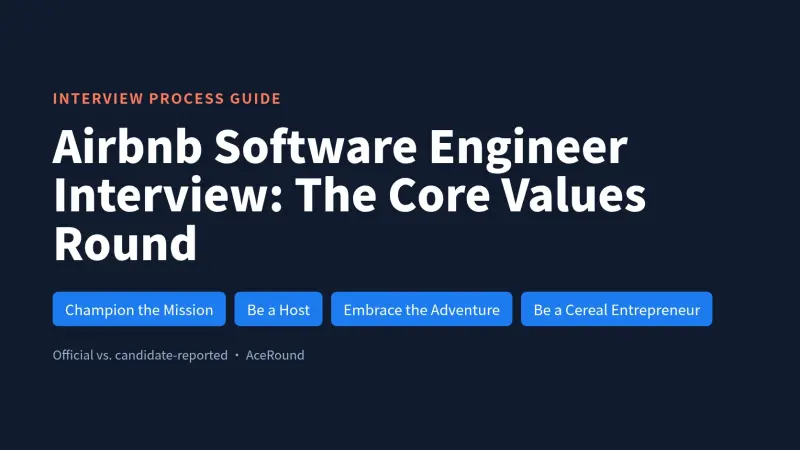
Airbnb Software Engineer Interview: The Core Values Round, Explained
Airbnb's four core values are public, but the interview round built on them isn't documented. Here's what's official, what candidates report, and how to prepare.
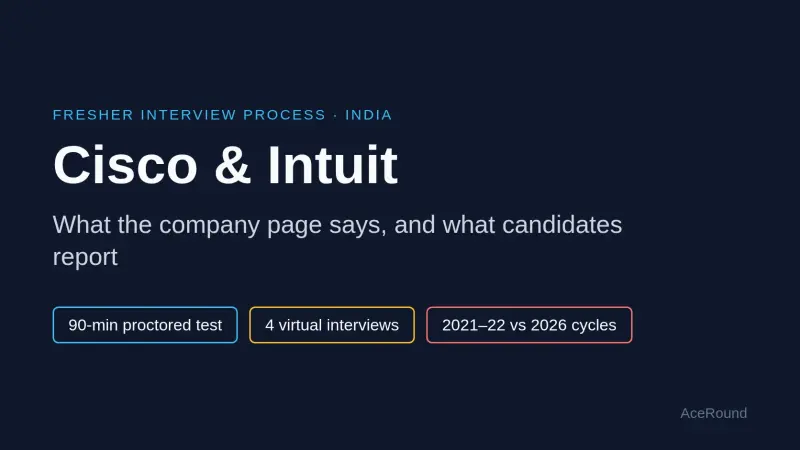
Cisco and Intuit Fresher Interview Process in India: Official vs Reported
Cisco's own Code with Cisco page, a third-party guide and one Intuit SDE-1 account differ on rounds and timing. What each says, and how to prep.
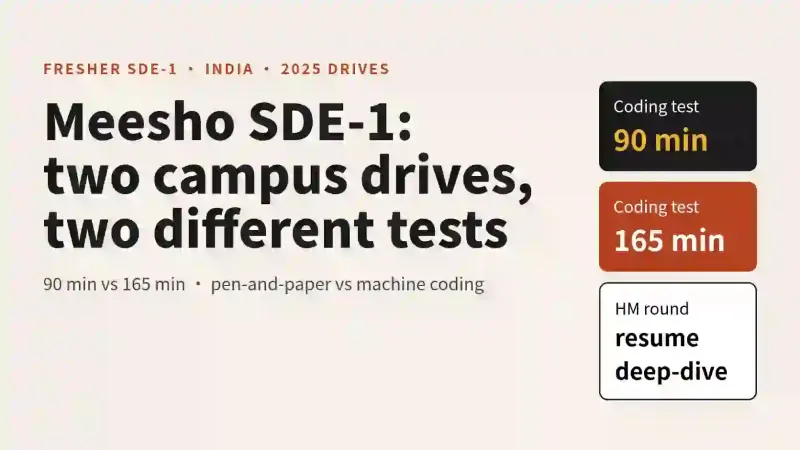
Meesho SDE-1 Interview Process for Freshers: Three 2025 Accounts Compared
Meesho SDE-1 campus accounts from 2025 disagree on test length, round order and design format. Here is what each reported and how to prep for any of them.