'Tell Me About a Time AI Made a Mistake' — Answered
A new 2026 interview question is catching people off guard: describe a time an AI tool got something wrong. Here's how to actually answer it well.
TL;DR: "Tell me about a time an AI tool made a mistake" is a fast-spreading 2026 interview question that tests verification habits, not AI knowledge. Interviewers assume you use AI, so what they're checking is whether you catch it when it's wrong. Answer with one specific, real story (a hallucinated stat, a subtle code bug, a misread file, a wrong customer answer), what you did once you spotted it, and what changed afterward. A candidate with no failure story is quietly telling the interviewer they don't check their own work.
A hiring manager on r/humanresources described the moment plainly in mid-2026: a candidate said, unprompted, "ChatGPT told me the wrong tax bracket for a client scenario, and I only caught it because the number looked off against last year's return." That was the whole interview, she said. Everything after it was just confirming the hire.
Nobody had asked a technical AI question. They'd asked a behavioral one, and the candidate happened to have the right story ready. Most people don't, and it shows.
Why this question exists now
The logic behind it is blunt. Knowledge about AI is nearly free now. Anyone can recite what a large language model does, what RAG stands for, or why hallucination happens. What's expensive, and what companies are actively hiring for, is judgment: the instinct to double-check a plausible-sounding AI answer before it goes into a client email, a codebase, or a customer's account.
Greenhouse's 2026 Candidate AI Interview Report found that 63% of job seekers have now faced some form of AI-related interview question, up sharply from six months earlier. Separately, only 26% of candidates trust AI to evaluate them fairly, which tells you skepticism toward AI cuts both ways in the room. PwC's 2026 Global AI Jobs Barometer documents the same shift from the employer side: as AI absorbs more execution work, the skills companies pay a premium for shift toward judgment and critical thinking. IMD's research on the emerging "judgment gap" frames that as exactly the muscle this kind of question is built to test.
Put those together and the interview logic is simple. If you've used AI tools for more than a couple of weeks, you have a story where one of them got something wrong. If you can't produce one, the interviewer isn't hearing "I'm great at AI." They're hearing "I don't check my own work," which is a worse answer than any actual mistake you could describe.
What a weak answer sounds like versus a strong one
Weak — no real story:
"AI tools are usually pretty accurate in my experience, I haven't really run into major issues."
This is the answer that costs you the role. It reads as either "I barely use AI" or "I never check it," and the interviewer knows both are true of almost nobody who actually uses these tools daily.
Better — a real mistake, thin on follow-through:
"ChatGPT once gave me a wrong statistic for a report. I caught it and fixed the number before sending it."
Honest and specific enough to be believable, but it stops right where the good part starts. Buried under "tell me about a mistake" is the interviewer's actual question: what does your verification process look like, and what did you change?
Strong — specific mistake, process, and a lasting change:
"I was using an AI research tool to pull comparison data for a client pitch. It cited a market-share figure that sounded exactly right for the narrative I was building, which is what made me suspicious enough to check the primary source instead of just trusting it. The actual number was almost double what the AI reported, likely from conflating two different reporting periods. I caught it the night before the pitch, not during it, which was close enough that I built a new habit. Any number the AI hands me that's doing real work in a deck gets traced to its source before it goes on a slide, no exceptions."
This works because it names a specific, plausible failure mode, shows the moment of doubt that triggered the check (not just a random audit), states the actual cost of getting it wrong, and ends with a concrete rule the candidate now follows. That's what "judgment," not just "carefulness," looks like in practice.
Sample failure modes, if you're stuck for material
If you're blanking on a story, most people's mistake falls into one of these. Pick the one closest to your actual work and rebuild the real details from there:
- Hallucinated statistic or citation. The AI invents a number or source that sounds authoritative (common in research, marketing, analyst roles).
- Subtle code bug that passed initial tests. A logic error in edge-case or null handling that only surfaced later (engineering).
- Misread or garbled input. A misheard term or mistranscribed word that changed the meaning of a document or note (support, ops, anything voice-to-text touches).
- Wrong method applied to the data. A statistical or analytical approach that doesn't fit the actual dataset (analyst, data roles).
- Generic or context-blind recommendation. Advice that ignores a constraint the AI wasn't told about, or wasn't paying attention to (PM, HR, recruiting).
- Confidently repeating the same wrong answer. The AI restates an error even after being corrected once, forcing you back to a primary source.
- Overconfident customer-facing answer. A support tool states a policy or fix that sounds right but isn't (customer support, service roles).
None of these are more or less impressive than the others. What separates a strong answer from a weak one isn't the mistake. It's whether you caught it before it mattered, and what you did differently afterward.
Common mistakes candidates make answering this
- Claiming a mistake you never actually caught. Interviewers who ask this regularly will follow up with "how did you know it was wrong?" A fabricated story falls apart fast under that question. A smaller, true story beats a bigger, invented one.
- Making it about the AI's flaws, not your process. A five-minute lecture on why hallucination happens skips the actual question. The interviewer wants your behavior, not your understanding of the underlying technology.
- Stopping at "I caught it." The weakest version of an otherwise decent answer just ends there. What did you do next (fix it, flag it, change your process)? That's the half of the answer that actually differentiates candidates.
- Being unable to name the stakes. "It was wrong, but it didn't really matter" is a fine thing to say once, but if every mistake you've ever caught was low-stakes, it suggests you've only ever used AI for low-stakes work, which undercuts the story.
The same instinct matters live, not just in the retelling
The verification habit this question is testing for isn't just an interview-prep exercise. It's the exact skill that separates people who use AI-assisted tools well from people who get burned by them, including during the interview itself. If you're using live interview help to work through a tough technical or behavioral question in real time, the instinct to sanity-check a suggestion before repeating it out loud, rather than parroting it word-for-word, is the same judgment this question is scoring you on. AceRound is built around that idea. It surfaces a structured starting point during a live interview, not a script to read verbatim, because an answer you haven't actually verified in your own head is exactly the kind of thing this question is designed to expose.
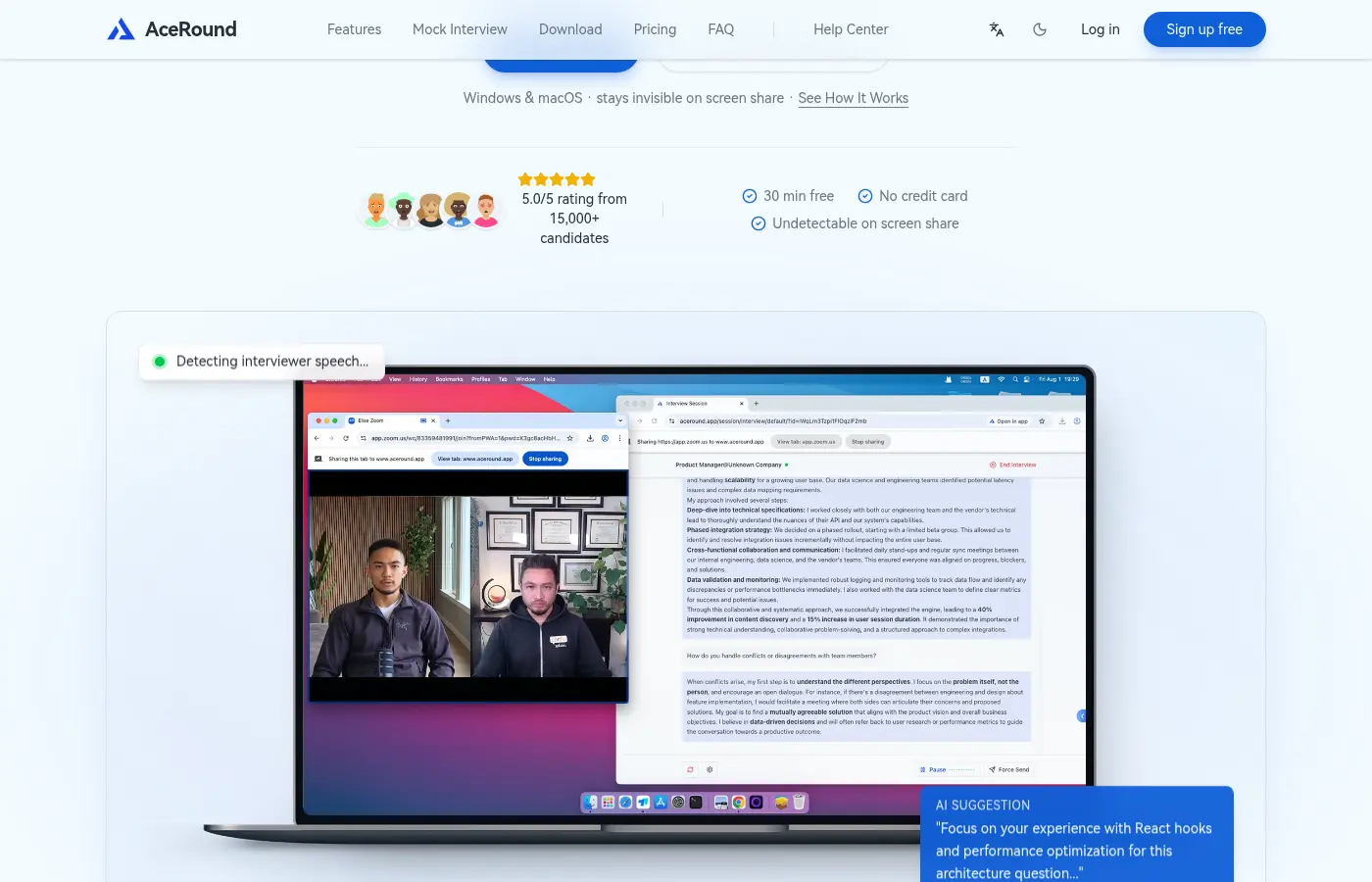
That's also worth saying plainly rather than glossing over: no AI tool, including the one helping you prep for this question, is infallible. Treating any AI output, ours or otherwise, as a draft to verify rather than an answer to trust is exactly the muscle this interview question is checking for. Bring that same instinct into the room and you're answering the question correctly before you've said a word.
This is a different test from "how do you use AI in your work?", which is really about fluency: can you get useful output out of a tool. It's also distinct from "how do you work with AI agents?", which tests delegation judgment for semi-autonomous tasks. This one is narrower and more personal. It wants a specific moment you were wrong to trust the output, and what you did about it.
FAQ
Is this really a standard interview question now, or just something a few interviewers ask? It is spreading fast, but it is not universal yet. It shows up most often at companies that have rolled out AI tools broadly and got burned at least once, and they are specifically screening for people who will not repeat that mistake. If you use any AI tool in your job at all, prepare an answer. If the role has zero AI exposure, it is less likely to come up.
What if I have genuinely never caught AI being wrong? That is worth pausing on before the interview, not during it. Every AI tool makes mistakes, so if you cannot recall one, it usually means you have not been checking output closely enough. That absence is its own answer the interviewer will hear. Go back through recent AI-assisted work and look for a moment you accepted output without verifying it, or catch a small one on purpose before your next interview.
Should I criticize the AI tool in my answer? No. Treat it like describing a junior colleague's mistake. You note it, you correct it, you adjust how you work with them next time. Trashing the tool reads as someone who resents having to check work, which is the opposite of what this question is testing for.
Does it hurt me to admit I lean on AI heavily at work? No, and the question exists partly because interviewers already assume you do. The signal they are scoring is not "do you use AI", since everyone does now. It is whether you have a verification habit attached to that usage. Heavy AI use paired with a real catch story is a stronger answer than light use with no story at all.
Can I use an example from interview prep itself, rather than a work project? It works in a pinch, but a real workplace example is stronger because it shows the mistake had actual stakes: a deadline, a client, a teammate. If prep is genuinely your only material, be upfront that it is a smaller-scale example and focus on the verification process rather than trying to inflate the stakes.
How is this different from "tell me about a time you made a mistake"? The mistake in this question belongs to the AI, not you, but your judgment is still what is being graded. The strongest answers make clear you were the one who caught it, not someone else, and that you changed something about how you work afterward. Confusing the two and centering your own error instead of the AI's is a common miss.
Author · Alex Chen. Career consultant and former tech recruiter. Spent 5 years on the hiring side before switching to help candidates instead. Writes about real interview dynamics, not textbook advice.
Related Articles
OpenAI's AI Interview Policy: Banned, Required, or Team-Dependent
OpenAI sells AI coding agents, then bans most candidates from using one. Here's the round-by-round policy, including the new agentic round that flips it.
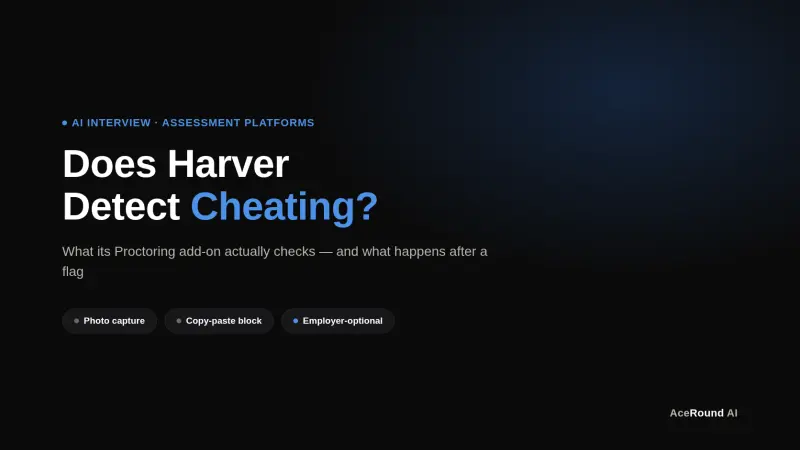
Does Harver Detect Cheating? What Its Proctoring Actually Checks
Does Harver detect cheating on its pre-employment assessments? A candidate look at Harver's Proctoring add-on, what gets logged after a flag, and what happens next.
Micro1's Zara AI Interview: What It Actually Tests (And Why Timing Gets Flagged)
Micro1's AI interviewer Zara has run 300,000+ interviews for remote roles. Here's why it flags response latency as a cheating signal, and what that means for AI prep.