Tell Me About a Time You Adapted to Change: STAR Guide
STAR examples for "tell me about a time you adapted to change," sorted by the type of change, plus the follow-up question that exposes a fake answer.

TL;DR: "Tell me about a time you adapted to change" isn't one question — a reorg, a new manager, a tool switch, and a merger each invite a different follow-up, so a generic "I'm flexible" story falls apart fast. Name the type of change, use STAR to show what you actually did differently (not just how you felt about it), and have an answer ready for "what did you do differently next time" — that's the follow-up that separates a real story from a rehearsed one.
Somewhere in the last two years, your team's structure changed, your manager changed, a tool you depended on got replaced, or your company got acquired — and if none of those happened to you personally, someone on your team can tell you exactly when it happened to them. Change at work stopped being a rare event a while ago; for most people it's closer to a recurring cost of having a job. Interviewers know this, which is why "tell me about a time you adapted to change" shows up constantly — and why a vague, upbeat non-answer ("I just roll with it!") gets a skeptical follow-up almost every time.
Why Interviewers Ask This
Nobody doubts that you can adjust to new circumstances eventually — everybody does, given enough time. What the interviewer is actually screening for is closer to what organizational psychologists call change adaptability: not whether you survive disruption, but whether you keep performing at a reasonable level while it's happening, and whether you come out of it having actually adjusted your behavior rather than just waiting for things to settle back down.
That distinction matters because "eventually adapted" and "adapted well" are different signals. A multidimensional, resource-based framework for workplace change adaptability treats it as an active process of drawing on specific resources — information-seeking, relationship-building, re-prioritizing — not a passive trait some people have and others don't. A broader literature review of career adaptability research backs this up: it's studied as a skill that shows up in concrete behaviors, which is exactly why a vague answer here reads as a red flag rather than a strength.
Six Different "Changes" — and the Story Each One Demands
Most prep advice treats "adapting to change" as one interchangeable story slot. It isn't. Interviewers probe different change types differently, and reusing the same story for all of them is how candidates get caught flat by a follow-up question — the same way a generic STAR method template without a specific angle falls apart under any pointed follow-up.
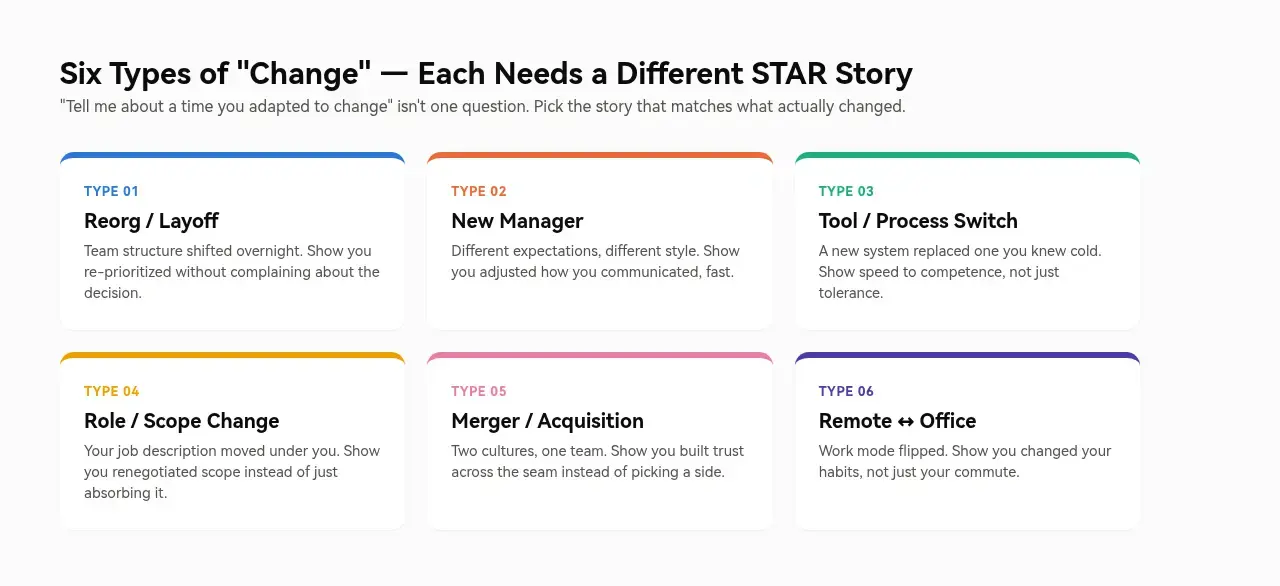
Reorg or layoff. The follow-up here is usually some version of "were you upset about it?" Your story needs to show you re-prioritized your actual work fast, without spending the answer relitigating whether the decision was fair.
New manager. Different manager, different expectations, sometimes overnight. A strong story shows you changed how you communicated — shorter updates, more written status, whatever the new person actually needed — not just that you "got along fine."
Tool or process switch. This is the most common version and the easiest to make boring. The gap most candidates miss: naming what you specifically did to get functional fast (a cheat sheet you built, a colleague you looped in) rather than "I read the documentation."
Role or scope change. Your job moved out from under you — new responsibilities added, old ones taken away. The strongest answers show you renegotiated the new scope with your manager instead of silently absorbing whatever landed on your desk.
Merger or acquisition. Two systems, two cultures, sometimes two bosses. Interviewers listen for whether you built trust across the seam — with the "other side's" team — instead of just picking a side and complaining about the other one internally.
Remote-to-office (or the reverse). This one is about habits, not location. A good answer names a specific routine you changed — how you structured your day, how you kept your team in sync — not just "I adjusted."
Pick the story that actually matches the change you were asked to handle. A tool-switch story answering a reorg question is a mismatch an experienced interviewer will notice.
Two Sample Answers, Sorted by Change Type
Tool switch (operations): "Six weeks into the role, my company replaced the CRM the whole sales team had used for four years, with two weeks' notice before the cutover. Instead of waiting for the vendor training, I spent the first afternoon rebuilding my five most common workflows in the new system as a personal test, then wrote a one-page mapping doc — 'old button does X, new button does Y' — and shared it with the team before the official rollout. We hit our pipeline-reporting deadline in week one with zero data loss, and three teammates told me the mapping doc saved them more time than the vendor's own training session."
Reorg (engineering manager): "When our department merged two teams into one under a new VP, my team of six got folded in with a team of eight I'd never worked with, and I went from managing my own roadmap to co-owning one with a peer manager I'd met twice. In the first week, I set up a standing 1:1 with the other manager specifically to align on priorities before either of us brought conflicting asks to our combined team, and I ran a short survey asking both teams what tooling and process differences were causing friction. We shipped our first joint milestone on the original timeline, and the survey surfaced two process conflicts I would never have caught by just waiting for them to blow up."
The Follow-Up Question That Breaks Weak Answers
Interviewers rarely stop at the story. The question to prepare for is some version of: "What did you do differently the next time change hit?"
This is the question that separates a one-off lucky break from an actual adjustment. If your honest answer is "nothing, I just handled that one the same way I handle everything," that's worth noticing before the interview, not during it. A specific answer — "I started asking a new manager how they like to receive updates in the first week instead of guessing" — shows the change actually taught you something you now do differently, which is the entire point of the question.
The Bad-Answer Trap: Sounding Like You're Blaming the Change
The fastest way to sink this answer has nothing to do with your STAR structure. It's tone. Interviewers listen for whether you're subtly relitigating the decision — "the reorg made no sense," "the new tool was worse than the old one," "the merger was handled badly by leadership." Even if every word of that is true, it reads as a preview of how you'll talk about the next change their company makes, six months after you're hired.
The fix isn't dishonesty — it's scope. Describe what you did, not your verdict on whether the change itself was a good call. "The new system took some getting used to, so I built X to get functional faster" works. "The new system was a downgrade and honestly still is" doesn't, even if it's your genuine opinion.
If You Don't Have a Dramatic Example
Not everyone has lived through a merger or a company-wide reorg, and that's fine — this question doesn't require a dramatic one. Scale it down: a new manager who ran meetings completely differently than the last one, a scheduling or ticketing tool that replaced something you'd used for years, a project reassigned to a different team mid-sprint. All of these count, as long as you can point to something specific you changed about how you worked — not just that you eventually got comfortable.
If you're rehearsing this with a real-time interview copilot like AceRound, this is a good moment to lean on it: when you're deciding which of two mediocre-feeling examples to use, a live prompt that nudges you toward naming the specific behavior you changed — rather than defaulting to "I just adjusted" — can be the difference between a forgettable answer and one that survives the follow-up.
Frequently Asked Questions
How do you answer "tell me about a time you adapted to change"? Name the specific type of change first — a reorg, a new manager, a tool switch, a role change, an M&A, or a shift between remote and office work — because each one invites a different follow-up question. Then use STAR: what changed and why it wasn't optional (Situation/Task), what you actually did differently because of it, not just how you felt about it (Action), and a concrete result plus what you'd do differently next time (Result).
What's the difference between this question and "tell me about a time you learned something quickly"? Learning-speed questions test how fast you absorb new information. This one tests something else: whether you can keep functioning, and functioning well, while the ground underneath your role is moving — a reorg, a new boss, a merger. You can be a fast learner and still handle organizational change badly, so reusing a learning-speed story here usually falls flat under a follow-up question.
What follow-up question should I expect after this answer? The most common one is some version of "what did you do differently the next time change hit?" It's checking whether your story is a one-off lucky break or an actual adjustment in how you operate. Have a real answer ready — a habit you built, a question you now ask earlier, a way you check in with a new manager faster.
What's the biggest mistake candidates make on this question? Sounding like they're relitigating the decision — complaining that the reorg was unfair, the new tool was worse, or the merger was mismanaged. Interviewers hear that as a preview of how you'll talk about the next change their company makes. Stick to what you did, not a verdict on whether the change was a good idea.
I don't have a dramatic example like a merger or layoff — what do I use? Scale it down. A new manager who ran meetings completely differently, a scheduling tool that replaced the one you'd used for years, a project that got reassigned to a different team mid-sprint — all of these count, as long as you can point to something you specifically changed about how you worked, not just that you "got used to it eventually."
Author · Alex Chen. Career consultant and former tech recruiter. Spent 5 years on the hiring side before switching to help candidates instead. Writes about real interview dynamics, not textbook advice.
Related Articles
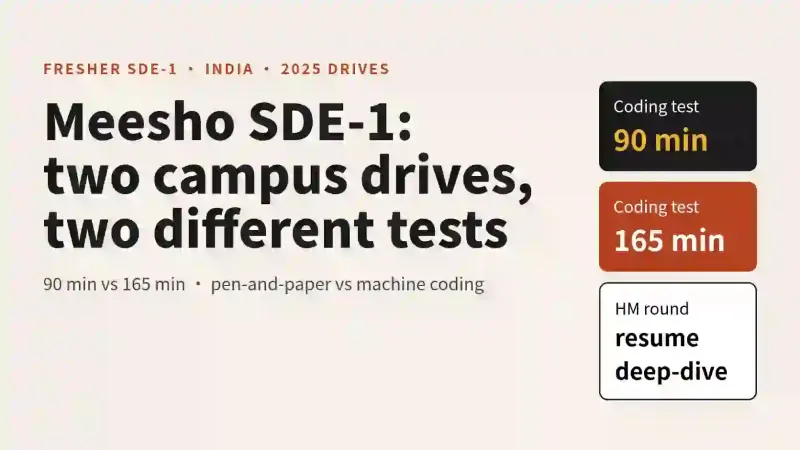
Meesho SDE-1 Interview Process for Freshers: Three 2025 Accounts Compared
Meesho SDE-1 campus accounts from 2025 disagree on test length, round order and design format. Here is what each reported and how to prep for any of them.
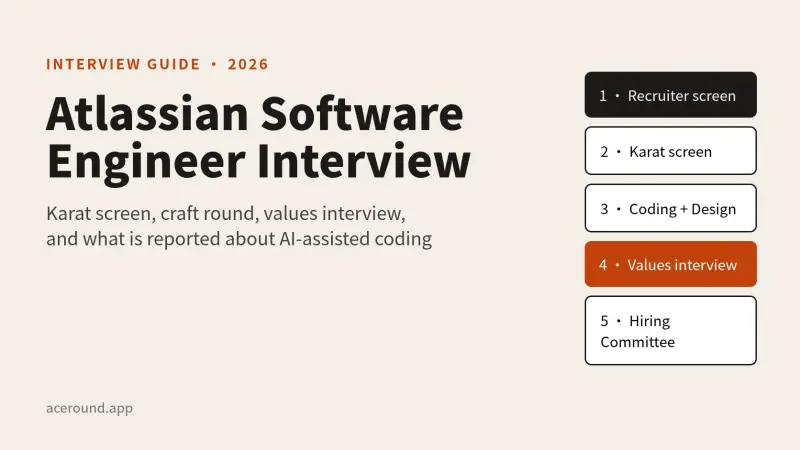
Atlassian Software Engineer Interview: Karat Screen, Craft Round and the Values Interview
How Atlassian's engineering loop works, from the Karat screen to the values round, what is official and what candidates report, including the AI-assisted rounds.
LinkedIn's AI-Enabled Coding Interview: What Candidates Report and How to Prepare
LinkedIn reportedly swaps one coding round for a CoderPad session with an AI panel. Here is the reported format, what gets scored, and what is unconfirmed.