Actuary Interview Questions: Where an AI Copilot Helps and Where Exams Still Decide
Real actuary interview questions — behavioral, technical, and brain teasers — plus an honest look at where live AI interview help applies and where SOA/CAS exams remain the real gatekeeper.

TL;DR — Actuarial interviews aren't one conversation; they sit inside a career-long exam pipeline. The interview tests three things: behavioral answers built from your SOA/CAS exam-study experience, technical questions pulled from early exam material (probability, financial math), and brain teasers that grade how you reason out loud. A live AI interview assistant can help with exactly that conversation — it has zero relevance to the proctored exams that are the profession's actual gatekeeper, before or after you're hired.
Search "actuary interview questions" and you'll get a list — usually the same handful of brain teasers and a generic "why do you want to be an actuary." What most lists skip is that the interview is one checkpoint inside a much longer credentialing process, and understanding that pipeline changes what's actually worth preparing for.
The Pipeline the Interview Sits Inside
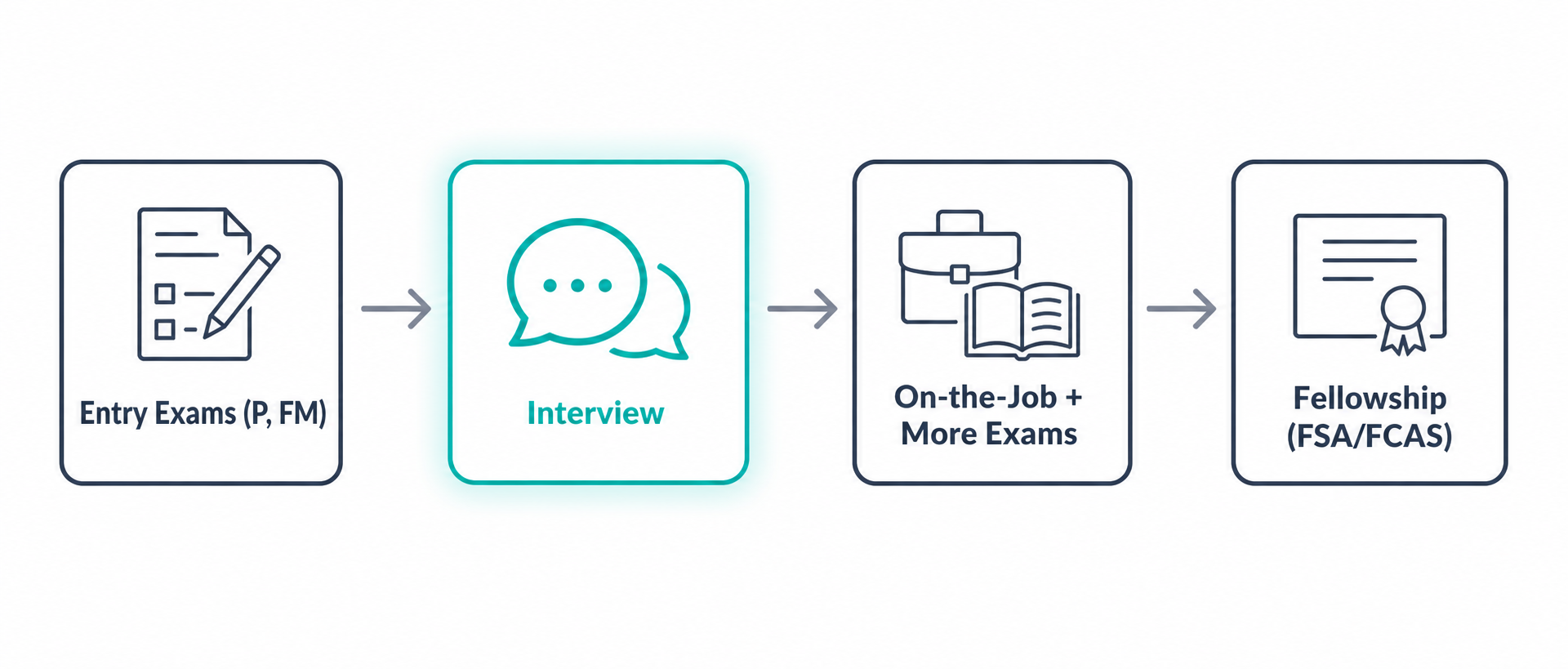
Becoming a credentialed actuary in the US/Canada system (SOA or CAS) doesn't end at hiring — it barely starts there:
- Entry exams — most candidates sit for Exam P (probability) and/or Exam FM (financial mathematics) before they're competitive for an entry-level role. Some employers will interview candidates who've registered for but not yet passed an exam, but having at least one pass is the norm.
- Interview — the one verbal, real-time stage in the whole process.
- On-the-job + continued exams — most companies expect you to keep sitting for exams while working, often with paid study days and salary bumps tied to each pass.
- Associateship and Fellowship — ASA/ACAS after a set of exams, FSA/FCAS (Fellow) after the full sequence, sometimes years later.
The interview is a real hurdle, but it's not the gatekeeper for the profession — the exams are, and they keep going long after you're hired. That's the honest frame before diving into what gets asked.
Behavioral Questions: Your Exam Experience Is the Material
Actuarial recruiters lean on the STAR format (Situation, Task, Action, Result) like most behavioral interviews, but the best source material for actuarial candidates specifically is exam prep itself — because studying for multiple rigorous, low-pass-rate exams while working is genuinely a time-management and stress-resilience story:
- "Tell me about a time you had to manage competing priorities" → your exam study schedule around a full-time job or coursework.
- "Describe a time you failed at something and what you did next" → a failed exam sitting and how you adjusted your study approach before the retake.
- "How do you handle a heavy workload?" → balancing study-day PTO, coursework, and deliverables during an exam cycle.
Interviewers who've been through the same exam system recognize a generic answer immediately — using your actual exam-cycle experience instead of a made-up scenario lands better and is easier to speak about specifically.
Technical Questions: Pulled From Early Exam Material
Technical questions cluster around what you'd have covered for Exam P and FM, and around core actuarial concepts interviewers expect any candidate to explain clearly:
- Explain a cumulative distribution function (CDF) to someone without a math background.
- Walk through how a mortality table is built and what it represents.
- Explain credibility theory — why you'd blend a policyholder's own experience with the broader pool's experience rather than trusting either alone.
- Basic tool questions: cleaning data in Excel, pulling a dataset with SQL, or which of Python/R/SAS you've used and for what.
The consistent thread across actuarial-career guides: interviewers are grading the explanation, not just whether you land the textbook definition. Reasoning through a partially-remembered formula out loud, stating your assumptions as you go, scores better than freezing when you can't recall it exactly.
Brain Teasers: Testing How You Think, Not Just the Answer
The one that shows up repeatedly: three baskets of fruit are all mislabeled — one says "apples," one "oranges," one "both" — and you can pick exactly one fruit from exactly one basket to correctly relabel all three. (The trick: pick from the "both" basket, since it's guaranteed to be wrong and can only actually contain one type.) Monty-Hall-style probability puzzles and Fermi-style estimation questions ("how many piano tuners are in Chicago") show up in a similar spirit.
None of these puzzles are really about the specific trick. They're a proxy for the actual job: reasoning out loud through incomplete information, stating assumptions explicitly, and correcting course mid-explanation when you spot an error — the same skill you'd use explaining a pricing assumption to an underwriter who isn't going to follow a silent derivation.
Case Studies: The Format That's Hardest to Fake
Some actuarial interviews include a case study — either a take-home exercise or a live scenario walked through in the room, mimicking a real pricing, reserving, or risk-assessment problem. These reward the same "narrate your reasoning" skill as the brain teasers, just at higher stakes and with more moving parts. If it's a take-home, you have time; if it's live, this is the stage where thinking out loud in real time under mild pressure matters most.
Where an AI Interview Assistant Actually Applies — and Where It Structurally Can't
Worth being precise here rather than implying a tool helps across the board. An AI interview assistant like AceRound listens during a live conversation and surfaces quick prompts — that's relevant to exactly one part of this process: the interview itself, when you're explaining a concept, narrating a brain teaser, or talking through a live case study. It has no relevance whatsoever to Exam P, Exam FM, or any later SOA/CAS exam — those are closed-book, proctored, computer-based tests with a completely different security model than a video call, and no live-assistance tool changes that.
If you're weighing whether real-time interview help even fits your situation, the same "one conversational stage inside a longer, exam-or-credential-driven pipeline" pattern shows up in other technical hiring processes — knowing which stage you're actually prepping for changes what "preparation" means. For the finance-adjacent side of this, our finance interview preparation guide covers overlapping technical-explanation skills for candidates moving between actuarial, quant, and analyst tracks.
FAQ
What questions are asked in an actuary interview?
Three clusters: behavioral questions built around your exam-study experience (time management, handling failure, working under pressure), technical questions pulled from early SOA/CAS exam material (probability, financial math, mortality tables), and brain-teaser or estimation puzzles that test how you reason out loud, not just whether you land the right number.
How many actuarial exams do you need before getting hired?
Most entry-level roles expect at least one or two passed exams, typically Exam P (probability) and/or Exam FM (financial mathematics), before you're competitive for an interview. Passing exams doesn't stop once you're hired — actuaries keep testing throughout their early career, often on company time and with study-day support, on the path to an ASA/ACAS and eventually FSA/FCAS designation.
Why do actuary interviews use brain teasers?
Puzzles like the mislabeled fruit-basket problem or Monty-Hall-style probability questions aren't really testing whether you know the trick. Interviewers are watching whether you reason out loud, state your assumptions, and correct course when you realize an approach is wrong — the same behavior they need when you're explaining a pricing or reserving assumption to a non-technical stakeholder later.
Can an AI interview assistant help with an actuarial interview?
It applies to exactly one part: the live conversation, where you're explaining a technical concept, walking through a brain-teaser's logic in real time, or discussing a case study out loud. It has no relevance to the SOA or CAS exams themselves — those are proctored, closed-book, and the actual credentialing gatekeeper for the profession, not something a live copilot could touch even if you wanted it to.
What's a good way to explain a technical concept like CDF or credibility theory in an interview?
Interviewers consistently say they're grading the explanation, not just the definition. Practice explaining core concepts — a cumulative distribution function, why credibility theory blends individual and pooled experience, how a mortality table is built — the way you'd explain them to a non-technical manager, in under a minute, before you walk in.
Author · Alex Chen. Career consultant and former tech recruiter. Spent 5 years on the hiring side before switching to help candidates instead. Writes about real interview dynamics, not textbook advice.
Related Articles
Correctional Officer Interview Questions: The Full Hiring Pipeline
Correctional officer interview questions and the real 9-stage hiring pipeline, with real oral board questions and an honest map of where interview prep actually helps.
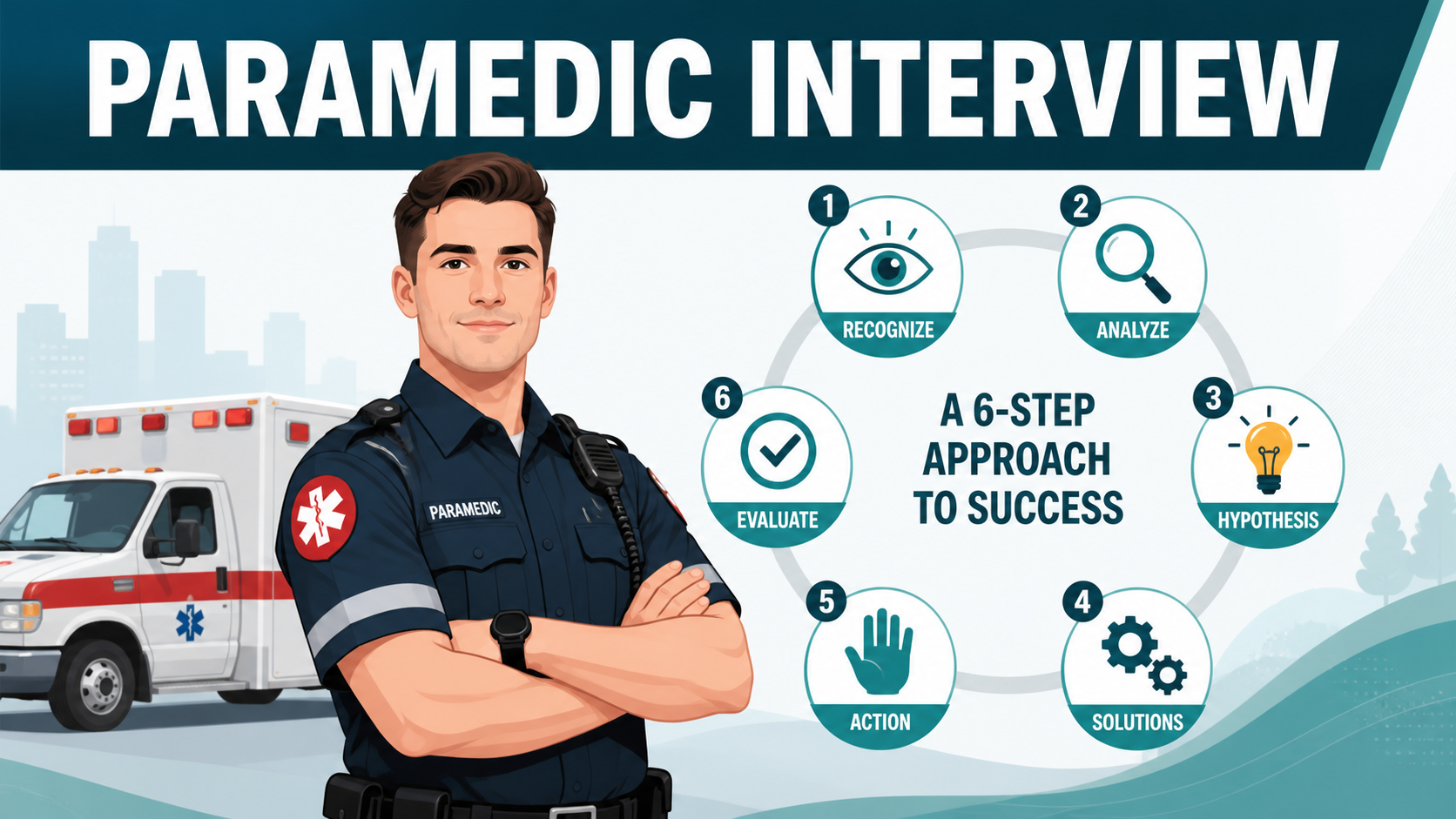
EMT & Paramedic Interview Questions Decoded
EMT and paramedic interview questions decoded: the clinical-judgment framework hiring panels are really scoring, with sample scenario answers.

US Remote Interview Tips for Candidates in India and the Philippines
US company remote interview tips for candidates in India and the Philippines: timezone math, connectivity backup plans, and what US interviewers actually score.