EMT & Paramedic Interview Questions Decoded
EMT and paramedic interview questions decoded: the clinical-judgment framework hiring panels are really scoring, with sample scenario answers.
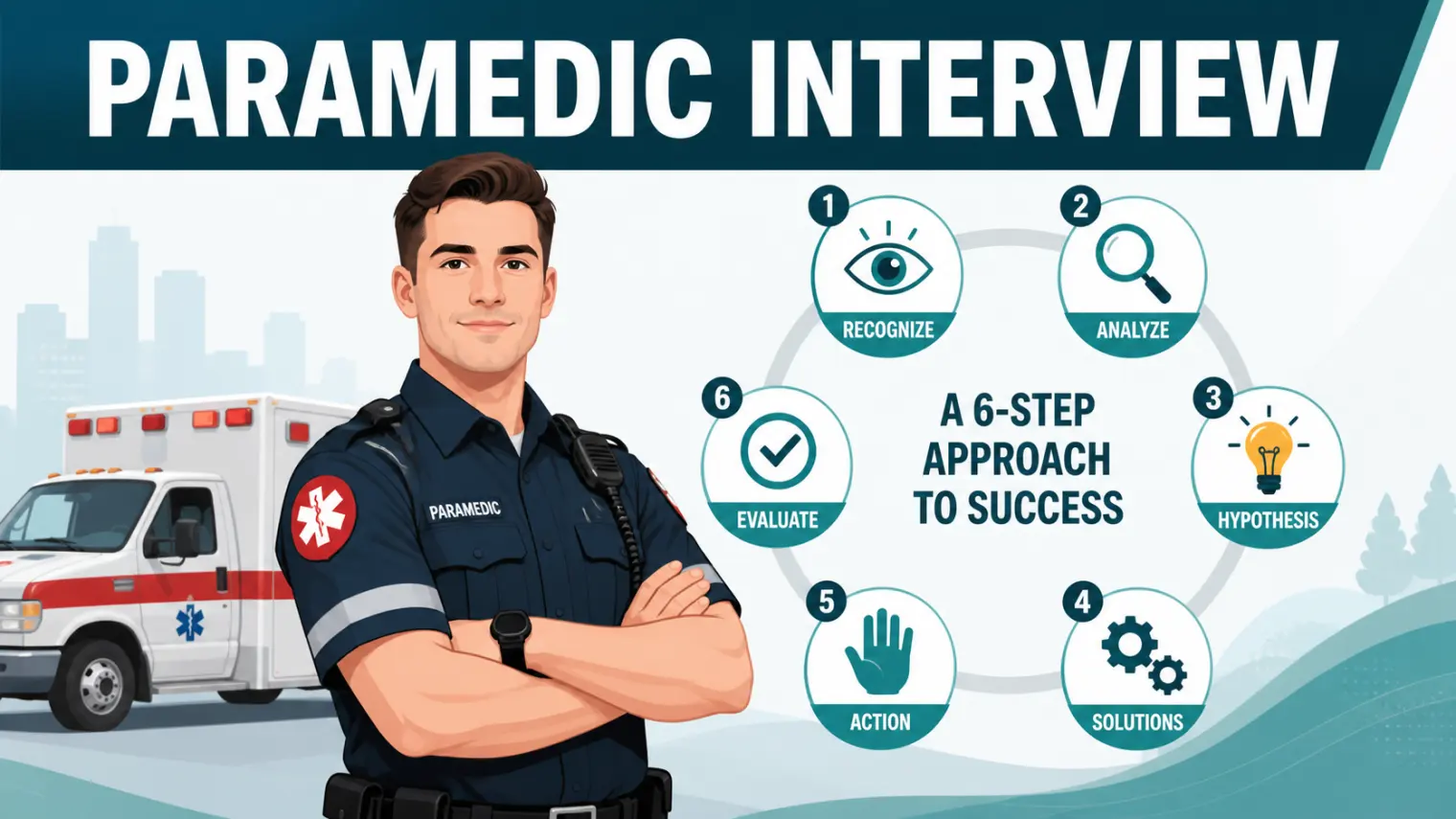
TL;DR — Most EMT and paramedic interview guides hand you a list of questions to memorize. The panel isn't scoring whether you know the "right" answer — it's scoring whether your reasoning follows the same clinical-judgment sequence NREMT now formally tests: recognize cues, analyze them, form a hypothesis, generate solutions, act, then evaluate. Learn the sequence and the scenario questions get much easier to answer, in any order they're asked.
You've studied protocols, you know your medications, and you can recite the difference between SALT and START triage without blinking. Then the panel asks: "Walk me through how you'd handle a three-patient MCI where one is unresponsive, one is screaming, and one is walking around."
If you freeze here, it's usually not a knowledge gap. It's that nobody explained what the panel is actually listening for — and it's not a memorized triage tag.
The three question types every EMS panel uses
Nearly every EMT and paramedic interview mixes three categories, and it helps to know which one you're in before you answer:
- Standard behavioral questions — "Tell me about yourself," "Why did you get into EMS," "What's your biggest weakness." Straightforward, but still worth preparing a specific, non-generic answer for.
- Conflict and teamwork scenarios — "What would you do if you had a disagreement with your partner," "Tell me about a time you received criticism." These test composure and self-awareness more than clinical skill.
- Clinical scenario questions — "A patient refuses transport, what do you do," "Walk me through a multi-patient triage." These are where most candidates underperform, because they answer with a conclusion instead of a process.
Generic interview guides treat all three the same way: memorize a strong-sounding answer for each. That works fine for category 1, partially for category 2, and badly for category 3 — because category 3 questions are testing how you think, not what you'd conclude.
What panels are actually scoring: the Clinical Judgment framework
In 2024, NREMT formally added Clinical Judgment as its own domain on the Paramedic cognitive exam, now weighted at 34-38% — on par with, or heavier than, traditional domains like Trauma or Cardiology. It's tested through scenario-based, multi-step item formats rather than standard single-answer multiple choice.
The domain is built around a six-step reasoning cycle, drawn from a 2022 EMS practice analysis:
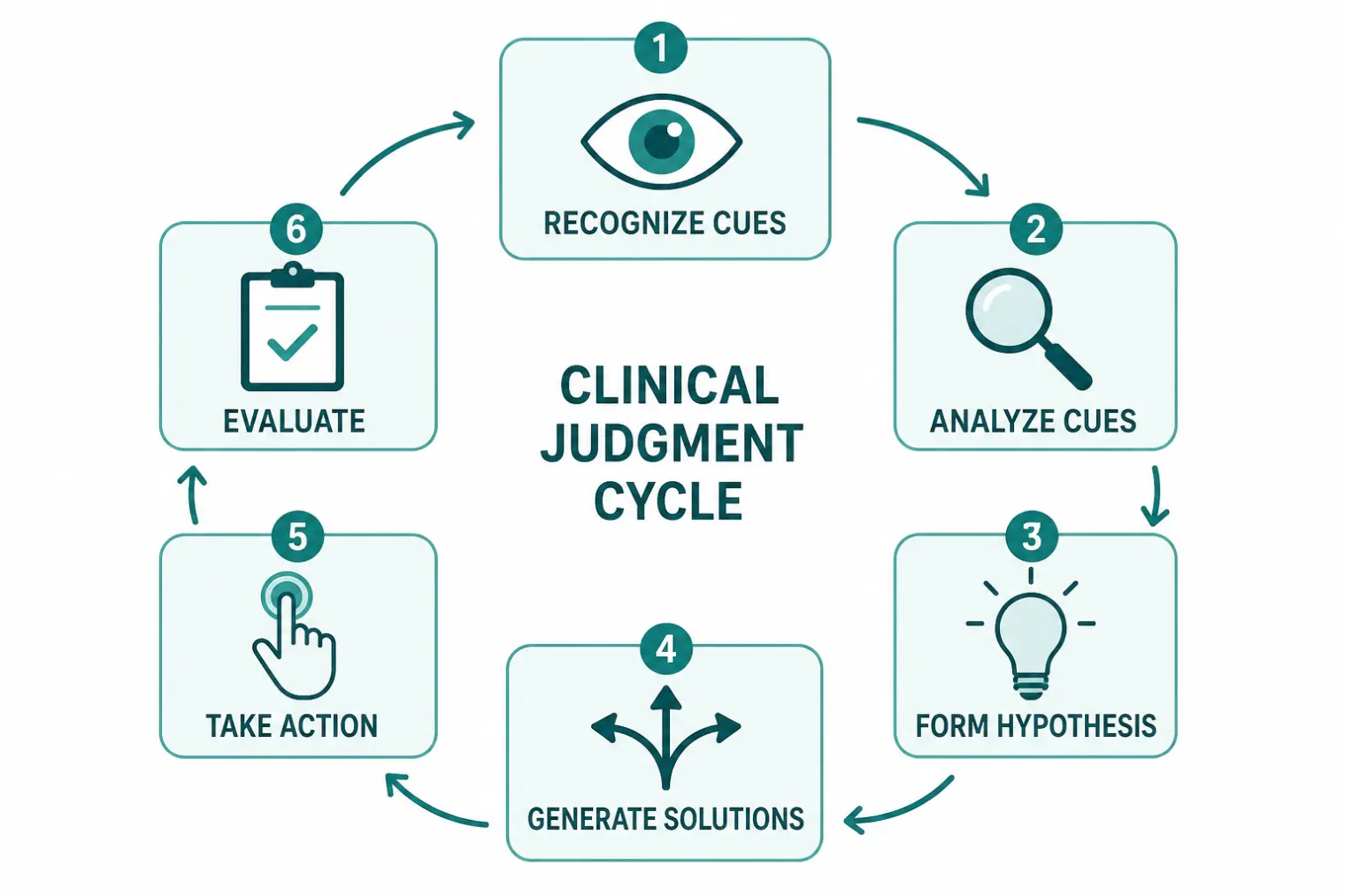
- Recognize cues — what do you notice first at the scene or with the patient
- Analyze cues — what do those findings actually mean, together
- Form a hypothesis — what's most likely going on
- Generate solutions — what are your options, given protocol and scope
- Take action — what you actually do, and in what order
- Evaluate — how you'd check whether it worked, and adjust if not
Here's the part most interview prep articles miss entirely: hiring panels are informally scoring this exact same cycle, whether or not they've ever heard the term "Clinical Judgment domain." EMS training publications like JEMS describe designing scenario questions around this identical recognize-analyze-hypothesize-act-evaluate loop specifically to test candidate reasoning, not just protocol recall.
So when a panel asks a scenario question, they're not looking for the fastest route to a conclusion. They're listening for whether you narrate the cycle out loud, in order.
Applying the framework to real scenario questions
"Walk me through a multi-patient MCI with a walking patient, a screaming patient, and an unresponsive patient."
A weak answer jumps straight to: "I'd tag the unresponsive one red and start there." That skips five of the six steps.
A strong answer narrates the cycle: "First, I'm recognizing cues from a distance before I approach anyone — mechanism of injury, number of patients, scene safety. Then I'm using SALT or START, per your agency's protocol, to analyze and categorize quickly: the walking patient can likely wait, the screaming patient is breathing and probably lower acuity than they sound, and the unresponsive patient needs immediate assessment. My hypothesis is the unresponsive patient is the highest priority pending airway and breathing checks. I generate my options — treat, transport order, request additional resources — take action starting with the highest-acuity patient, and continuously reevaluate as more units arrive or patient conditions change."
Same clinical conclusion, but the panel now sees the reasoning, not just the answer.
"A patient refuses transport. What do you do?"
Weak: "I'd document the refusal and move on." Technically not wrong, but it skips the reasoning.
Strong: walk through recognizing cues (is the patient oriented, competent to refuse), analyzing (any red flags suggesting impaired capacity), forming a hypothesis about the actual risk of refusal, generating solutions (involve family, contact medical control, re-explain the risk clearly), taking action, and evaluating (confirming understanding is documented and the refusal is genuinely informed).
What if you don't have much field experience yet
For entry-level EMT roles, panels don't expect war stories. What they're checking is whether you can apply the reasoning process even to a hypothetical or a clinical rotation experience. Narrating the six steps clearly on a smaller scenario often scores better than a vague, confidence-heavy answer from someone with more calls but less structured thinking.
Why candidates get rejected even with good qualifications
A recurring theme on r/ems threads from hiring-side EMS professionals: strong-on-paper candidates get passed over for jumping straight to an action without explaining the reasoning behind it, struggling to own past mistakes honestly, or giving answers so generic they could apply to any job. Clinical knowledge gets you in the room; how clearly you narrate your thinking is usually what separates candidates once you're in it.
Practicing scenario answers without freezing
The temptation is to script an answer for every likely scenario and memorize it. That backfires the moment a panel adds a twist mid-question — a scripted answer doesn't adapt, and it shows.
It's more durable to internalize the six-step framework itself and practice applying it live, out loud, to scenarios you haven't seen before — including behavioral follow-ups a panel throws in on the fly. If you're preparing for a panel-style interview more broadly, our behavioral interview questions guide covers the structure for the non-clinical half of the interview, and our STAR method guide is useful for framing "tell me about a time" questions using the same kind of structured narration.
For candidates who want a real-time structural nudge during the actual panel interview — a reminder of the framework, not a script to read off — a live AI interview copilot can help you stay anchored to the reasoning sequence when nerves make it easy to jump straight to a conclusion.
Author · Alex Chen. Career consultant and former tech recruiter. Spent 5 years on the hiring side before switching to help candidates instead. Writes about real interview dynamics, not textbook advice.
Related Articles

Snowflake's Official AI Interview Policy: What the 'Cheat Sheet' Says
Snowflake published its own AI cheat sheet for candidates: use AI to prep, not to perform. One coding round is even done in person. Here's the full breakdown.

Actuary Interview Questions: Where an AI Copilot Helps and Where Exams Still Decide
Real actuary interview questions — behavioral, technical, and brain teasers — plus an honest look at where live AI interview help applies and where SOA/CAS exams remain the real gatekeeper.
Correctional Officer Interview Questions: The Full Hiring Pipeline
Correctional officer interview questions and the real 9-stage hiring pipeline, with real oral board questions and an honest map of where interview prep actually helps.