Cloudflare Software Engineer Interview (2026): The AI-Assisted Coding Round
Cloudflare has no published interview process. Here's the loop candidates report, the 45-minute AI-assisted coding round, and how to prep for each round.
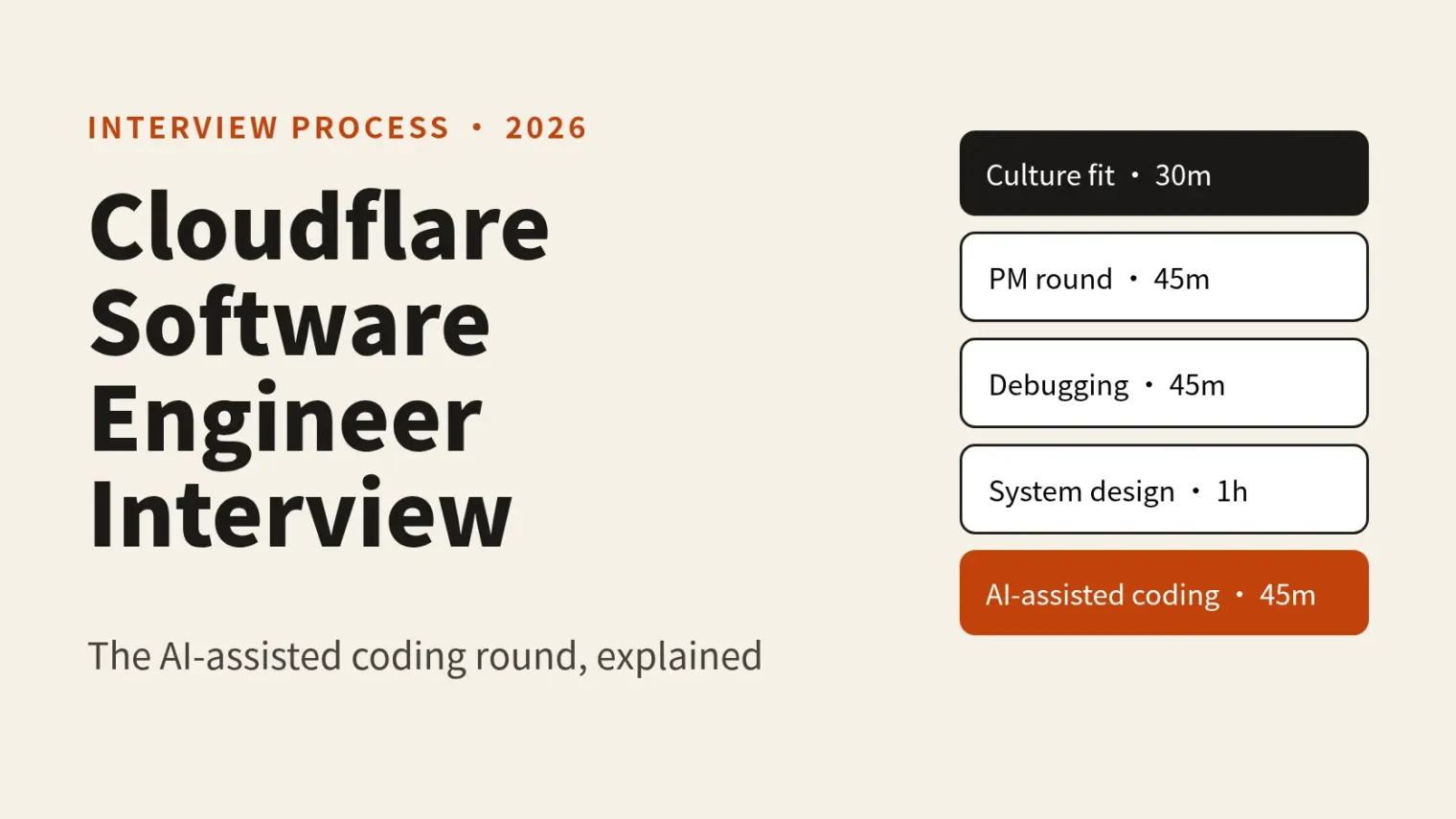
TL;DR: Cloudflare doesn't publish its interview process or any AI rules for candidates, so everything below is what candidates have reported in 2026. The loop people describe is a hiring manager chat, then culture fit, a PM round, a debugging round, system design and a 45-minute AI-assisted coding round where Google and AI were allowed. The AI round is the unusual one, and it's also the one nobody can confirm will be on your schedule.
Source note: I found no Cloudflare careers page describing the stages or an AI policy. Every round description here comes from candidate write-ups (mainly a TechPrep report from August 2026 and Glassdoor summaries) and prep sites, so it's all labeled reported.
If you search "does Cloudflare allow AI in interviews," you'll find a few confident answers. None of them link to anything Cloudflare wrote. What exists is a handful of candidate reports that happen to agree with each other, which is useful but not the same thing. So this guide separates what's reported from what's guessable, and tells you what to ask your recruiter.
The Loop Candidates Report
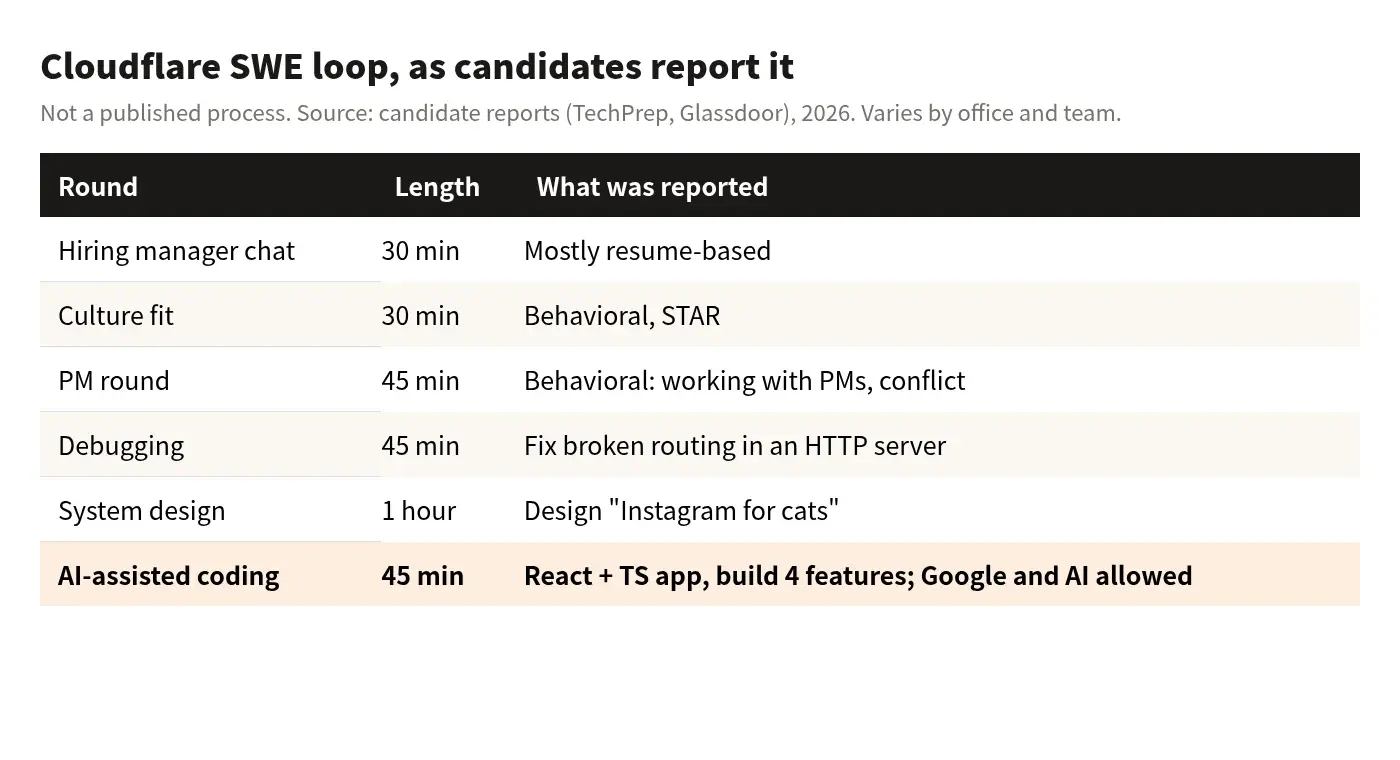
The most detailed recent account I found is a senior fullstack candidate in London (TechPrep, published September 2026, interviewing in August). They started with a 30-minute hiring manager conversation, mostly resume-based, then a five-round loop:
- Culture fit, 30 minutes. Behavioral questions. The candidate recommends reading Cloudflare's Life at Cloudflare page and the company blog beforehand.
- PM round, 45 minutes. Still behavioral: working with product managers, teamwork, conflict.
- Debugging, 45 minutes. You're handed a working system with something broken. Here it was an HTTP server with broken routing. The candidate called it fairly easy.
- System design, 1 hour. "Design an Instagram for cats."
- AI-assisted coding, 45 minutes. A React and TypeScript app with UI and API already built, and four extra features to add. "I was allowed to use Google and AI for whatever I wanted."
After that, per the same report, came an office visit and a 15-minute call with a C-level executive.
An Austin candidate described a similar five-round onsite in a Glassdoor-sourced summary: culture fit, a PM round, debugging, system design and a 45-minute AI-assisted coding round. So the shape repeats across two offices. What doesn't repeat is the coding content. One Austin account was asked to build a battleship game, another described a HackerRank-style question rather than typical LeetCode, and a third prep guide says interviewers are hands-on and often ask you to refactor, handle edge cases or tighten complexity. That variety is a sign the exercise depends on team and interviewer.
Two cautions. The sources disagree on whether the AI-assisted round is standard or only included for some teams. And one candidate said the recruiter hadn't mentioned the AI round in advance. Ask early, and don't assume yours is the same as anyone's write-up.
The AI-Assisted Coding Round, Practically
This is the part worth preparing for specifically, because it rewards a different skill than the usual live coding round. Based on the London description, you're not writing from a blank file. You're dropped into someone else's working app, with a UI and an API already there, and told to extend it in 45 minutes. One Glassdoor-sourced summary describes it as finding and fixing problems in an unfamiliar codebase by prompting, and the candidate said it felt closer to vibe coding than a normal live coding session. That's one person's impression.
What that implies, and this is my read rather than anything Cloudflare has stated:
- Reading speed matters more than typing speed. With four features and 45 minutes, the first five minutes should go to understanding how the existing app is wired: where routes live, how the UI calls the API, what the data shapes are. Prompting an assistant before you understand the structure tends to produce code that doesn't fit it.
- Order the four features. Pick the one you can finish with certainty first. A working feature one and two beats four half-built ones.
- Check what the tool gives you. Run the app after each change. Read the diff as if a teammate wrote it. An interviewer watching you will care more about whether you caught a wrong assumption than whether the first prompt was clever.
- Talk while you work. Say what you're asking the assistant for and why, and what you're rejecting. If the round is scored the way other AI-allowed rounds have been reported, judgment is what's visible.
We've written up how other companies structure similar rounds: Ramp's AI-assisted coding interview, LinkedIn's AI-enabled coding interview, DoorDash's AI-assisted working session and Datadog's published AI guidelines. Datadog is the useful contrast, because it says in writing which rounds are AI-allowed and which are not. Cloudflare hasn't, as far as I can find, so the safe reading is: use AI in the round you've been told is AI-assisted, and nowhere else unless a person tells you otherwise.
Debugging and System Design
Debugging. The one concrete example is fixing broken routing in a small HTTP server. Prep by practicing the loop of reproduce, narrow down, fix, then explain why it broke. Read error output before touching code, and say your hypothesis out loud before testing it.
System design. Reported prompts: an Instagram for cats, a global rate-limiting gateway, a distributed key-value store across about 100 edge databases, and a highly available HTTPS load balancer. One prep guide says the framing is almost always edge-flavored, with interviewers pushing on what happens when a point of presence fails. That's consistent with Cloudflare's business, so it's a reasonable bet, but it's a guide's characterization, not a published rubric. Practice designs where the failure case isn't an afterthought: where data lives, how requests get routed when a location goes down, what you give up for consistency.
Behavioral. Two of the five rounds are behavioral on the London report, so don't treat them as warm-ups. Have a handful of STAR stories ready, including one about a disagreement with a product partner.
A Prep Plan
- Week 1: Pick an unfamiliar open-source web app and add a feature to it in 45 minutes. Do it once with an assistant and once without, so you know how much slower unfamiliar code makes you.
- Week 2: Debugging reps. Break a small server on purpose, or use someone else's buggy project, and time the diagnosis. Then two system design sessions with a failure-handling focus.
- Week 3: Behavioral stories, especially product collaboration and conflict. Read the company blog posts the candidate suggested.
- Always: Ask your recruiter which rounds are AI-assisted and what tools you may use. It's a normal logistics question, and given one candidate said it wasn't mentioned up front, worth asking.
The skill that's hardest to build alone is narrating while you work. A mock interview session lets you rehearse the talk-while-you-build format before the real thing. Run the unassisted rounds the way they're meant to be run.
FAQ
Does Cloudflare allow AI in interviews?
I couldn't find a published policy. Candidate reports from 2026 describe one AI-assisted coding round where AI and Google were allowed, and a London candidate said for whatever they wanted. Ask your recruiter whether other rounds are AI-free.
How many rounds is the Cloudflare software engineer interview?
Candidates report a hiring manager chat, then five rounds: culture fit, PM, debugging, system design and AI-assisted coding. Some mention an office visit and a short call with an executive afterward. It varies by office and team.
What is the Cloudflare AI-assisted coding round?
Reportedly 45 minutes, on an existing app (React and TypeScript in one London report), adding several features while using AI and search freely.
What system design questions does Cloudflare ask?
Reported: an Instagram for cats, a global rate-limiting gateway, a distributed key-value store across many edge databases, and a highly available HTTPS load balancer, often with follow-ups on point-of-presence failure.
Is the Cloudflare interview hard?
Mixed. Senior applicants on Glassdoor rate difficulty around 2.6 out of 5, and one candidate called the debugging round fairly easy. Experiences differ by team.
Author · Alex Chen. Career consultant and former tech recruiter. Spent 5 years on the hiring side before switching to help candidates instead. Writes about real interview dynamics, not textbook advice.
Related Articles
Interview Cheat Tools in 2026: What They Actually Do, and What Catches Them
Most 'interview cheat tool' searches are looking for one of two very different products. What live answer-feeding tools do, what proctoring sees in 2026, and how to pick without gambling your offer.
Which Companies Allow AI in Coding Interviews? 2026 Policies Compared
Canva, DoorDash and Meta expect AI in some coding rounds. Snowflake and Palantir ban it. Here's every company's stance, what's official and what's only reported.
Zoho, Juspay and Groww Fresher Interview Process in India: Build-It-Live Rounds, Not Just an OA
Zoho cuts 1,500 to 3,000 applicants with aptitude and coding, then a live build round. Juspay runs hackathon rounds. What candidate posts report.