What Are You Looking For in Your Next Job? A Real Answer, Not a Script
Why interviewers ask what you're looking for in your next job, why generic growth answers fail, and how to give a specific response tied to the role.

TL;DR: "What are you looking for in your next job?" is a retention-risk question wearing a friendly disguise. The safe, generic answer — growth, culture fit, a new challenge — sounds fine and tells the interviewer nothing. The answer that actually works names one or two specific things and ties them to the role in front of you, not to jobs in general.
You're thirty minutes into the interview, feeling good, and then it comes: "So, what are you looking for in your next job?" It sounds like small talk. It isn't. It's one of the few questions in the entire interview where the interviewer is quietly checking whether hiring you is a good bet — or whether you'll be gone in eight months looking for the thing you didn't get here either.
Why Interviewers Ask What You're Looking For In Your Next Job
Turnover is expensive, and interviewers know it better than candidates do. LinkedIn's Economic Graph research, which surveyed more than 10,000 people who had recently changed jobs, found that career advancement — not money — is the number one reason people leave. Salary didn't even crack the top five reasons people started looking, though it became the second most influential factor once they were actually choosing between offers.
That gap matters. It means most people who quit weren't chasing a bigger paycheck — they were chasing something their previous job wasn't giving them: growth, autonomy, a different kind of work. Gallup's 2026 State of the Global Workplace report puts a number on how widespread that gap is: global employee engagement fell to 20% in 2025, the lowest since 2020, with the resulting productivity loss estimated at roughly $10 trillion a year. Interviewers who ask this question are trying to find out, in advance, whether their job actually closes your specific gap — because if it doesn't, you become part of next year's turnover statistic, and they're the ones who have to hire again.
The Answer Almost Everyone Gives — And Why It Falls Flat
Search this question and you'll find the same template everywhere: talk about growth, mention culture fit, say you're looking for a new challenge, and — this part shows up constantly — "do your research on the company first." It's not wrong advice. It's just advice so common that saying it back verbatim gives the interviewer zero new information about you.
Here's the part that template-style advice skips: this isn't a one-time script you write and memorize. It's a live match between what you actually want and the specific role, team, and company sitting across from you — which means the "right" answer changes depending on who's asking. An answer built for a fast-growing startup and an answer built for an established enterprise team should not sound the same, even if the underlying things you want (more ownership, a specific technical challenge, better mentorship) are consistent. If your answer would work identically at any company you might interview with this month, it's not really an answer — it's a placeholder.
A Better Framework for What You're Looking For In Your Next Position
Instead of a fixed script, build your answer from three ingredients you plug in fresh for each interview:
- One specific thing you want more of. Not "growth" in the abstract — something concrete: more ownership over a feature end-to-end, exposure to a part of the stack you haven't touched, direct customer contact, a chance to build a process rather than just follow one.
- Why your current or last role didn't fully deliver it — stated factually, not as a complaint. ("My current role is mostly maintenance work on a mature product; I'm looking for more greenfield ownership.")
- A concrete link to this specific role, drawn from the job posting or something the interviewer said earlier in the conversation. This is the step almost everyone skips, and it's the one that actually answers the culture fit interview question hiding inside this one — you're not just describing what you want, you're showing you understood what they're offering.
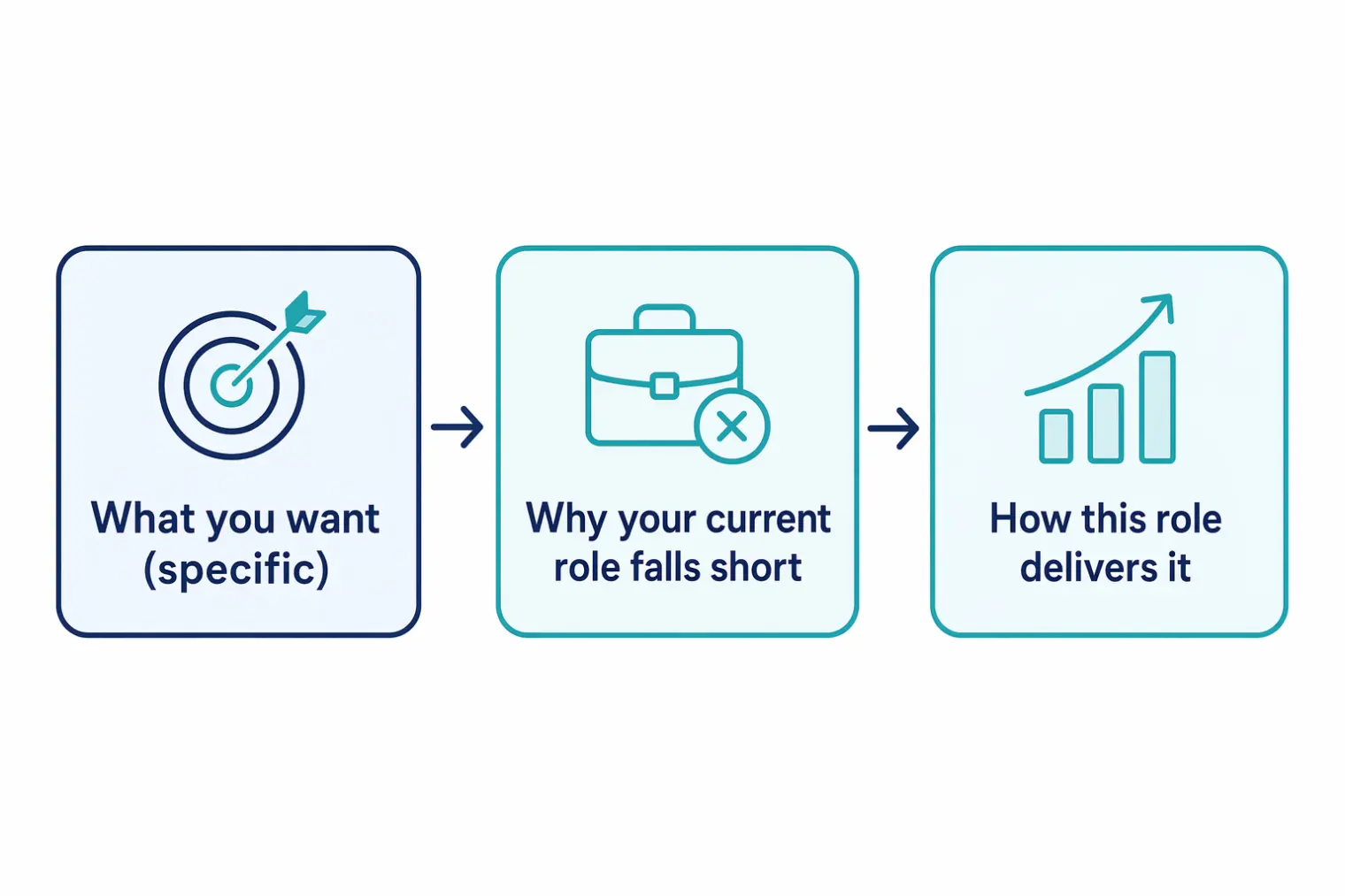
That third ingredient is why generic answers fail even when the content is technically true. Saying "I want more ownership" is fine. Saying "I want more ownership — on your team's job posting, the phrase 'owns a feature from spec to ship' is exactly what I've been trying to get more of" does the same job with ten times the credibility, because it proves you read the posting instead of running a template.
Example Answers by Career Stage
Early career, first real job search after a first job that didn't fit: "I want to go deeper on one thing instead of doing a bit of everything. My first role had me split across support, QA, and some scripting, which taught me a lot but never let me build real depth. This role's focus on [specific responsibility from the posting] is exactly the kind of depth I'm looking for."
Mid-career, changing companies for more scope: "I'm looking for a role where I own outcomes, not just tasks — right now I execute against a roadmap someone else owns. I noticed this role includes roadmap input, which is the piece I'm missing."
Career changer, pivoting into a new function: "I'm moving from [old field] into [new field], and what I'm looking for is a team willing to invest in that transition in exchange for what I bring from my old field — in my case, [specific transferable skill]. I'm not looking to start from zero; I'm looking for a place where that background is actually useful on day one."
Senior/leadership, moving for a different kind of challenge: "I've built and scaled a team once already. What I'm looking for now is a company at an earlier stage, where the problem is still being defined rather than just executed — I want to be in the room while the 'what' gets decided, not just the 'how.'"
What Not to Say
A few patterns reliably undercut an otherwise good answer:
- Leading with money. It's a legitimate factor — again, LinkedIn's data shows it's the second most influential thing once someone is actually choosing an offer — but opening with it signals "I'll take whatever pays enough," which is the opposite of the fit signal this question is fishing for.
- Trashing your current employer. Even accurate criticism ("my manager never gave me feedback," "the company was disorganized") reads as a risk flag about how you'll talk about this company later.
- An answer with no edges. "Somewhere I can grow, with good culture, doing meaningful work" could describe literally any job posting ever written. If it's that portable, it's not saying anything.
Rehearsing Out Loud Without Sounding Scripted
The framework above is easy to understand and surprisingly hard to say out loud for the first time without it sounding like you're reading from a template — especially the part where you tie your answer to details from the specific job posting in front of you. It tends to come out smoother the second or third time you say it than the first.
Running through it with a live AI mock interview — one that can actually respond to a follow-up like "what did you mean by more ownership?" — surfaces the parts that still sound generic faster than rehearsing alone in your head. If you're worried about freezing on a live follow-up mid-interview, that's also the exact moment a real-time AI interview assistant is built for: not to write the answer for you, but to keep the structure — specific want, honest gap, concrete link to the role — in front of you while you're speaking.
This question pairs closely with two others interviewers like to rotate through: "Why should we hire you?" asks what you bring; this one asks what you need. Prepare both together and neither catches you flat-footed.
FAQ
What are you looking for in your next job — what's a good answer? A good answer names one or two specific things you want (a type of ownership, a skill you want to build, a problem you want to work on) and ties each one directly to something in the job posting or the conversation so far — not a generic list of growth, culture, and challenge.
What are you looking for in your next position, if you're changing careers? Frame it around the overlap between what you're leaving and what you're moving toward — name the one or two transferable skills you're carrying over, and be direct about the gap you're closing, rather than pretending the pivot doesn't require an answer.
Why do interviewers ask what you're looking for in your next job? It's a retention-risk and fit question in disguise. Interviewers have seen enough hires leave within a year to know that a mismatch between what someone wants and what the role actually offers is one of the most common — and most avoidable — causes.
Is it bad to mention salary when asked what you're looking for in your next job? Not inherently, but it shouldn't be the whole answer or the first thing you say. Compensation is a real factor — LinkedIn's own research found it's the second most influential reason people accept an offer — but leading with it signals you'd take any job that pays enough, which is the opposite of what this question is testing for.
What should I avoid saying when asked about career growth in an interview? Avoid vague filler ("something challenging," "a good culture"), avoid criticizing your current or former employer, and avoid an answer so broad it could apply to literally any job at any company — all three read as either unprepared or evasive.
How specific should my answer be to what am I looking for in my next job? Specific enough that it couldn't be copy-pasted into an interview at a completely different company. If your answer works word-for-word for both a fintech startup and a healthcare nonprofit, it's too generic to do you any good.
Author · Alex Chen. Career consultant and former tech recruiter. Spent 5 years on the hiring side before switching to help candidates instead. Writes about real interview dynamics, not textbook advice.
Related Articles
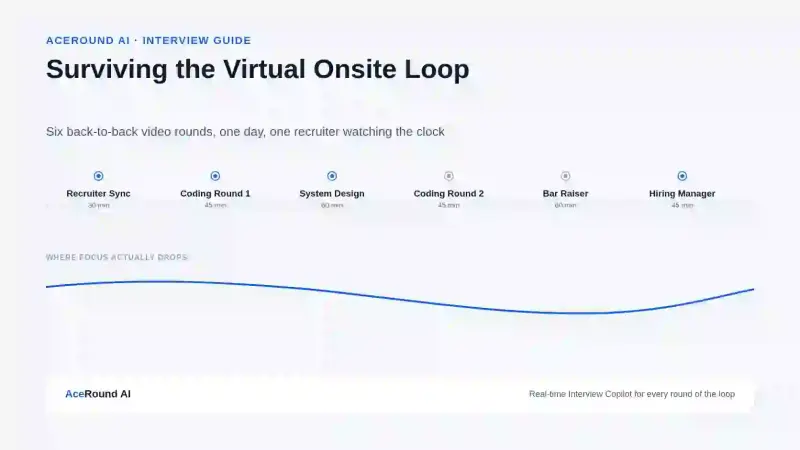
Virtual Onsite Interview Loop: How to Survive 4-6 Back-to-Back Rounds
What a virtual onsite interview loop is, why round 4 is where candidates fall apart, and how to prepare for 4-6 back-to-back video rounds in one day.
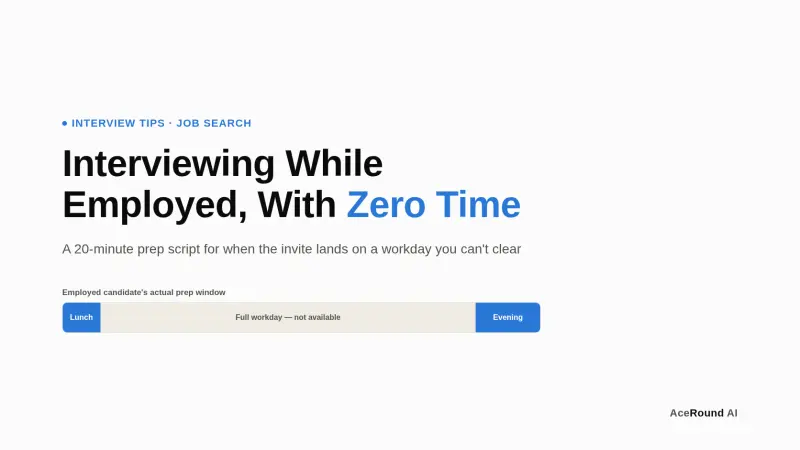
Interviewing While Employed: How to Actually Prepare With Zero Time
Job searching while employed means near-zero prep time, not just staying discreet. Here's a 20-minute prep script, plus what the counteroffer statistics actually show.
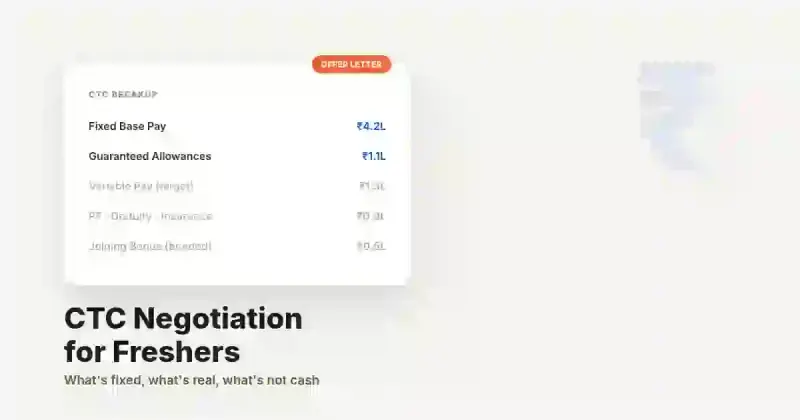
CTC Negotiation for Freshers in India: What's Actually Negotiable
Most fresher CTC negotiation advice ignores that TCS, Infosys, and Wipro set fixed pay bands. Here's what's really negotiable, and where lowball offers hide.