Virtual Onsite Interview Loop: How to Survive 4-6 Back-to-Back Rounds
What a virtual onsite interview loop is, why round 4 is where candidates fall apart, and how to prepare for 4-6 back-to-back video rounds in one day.
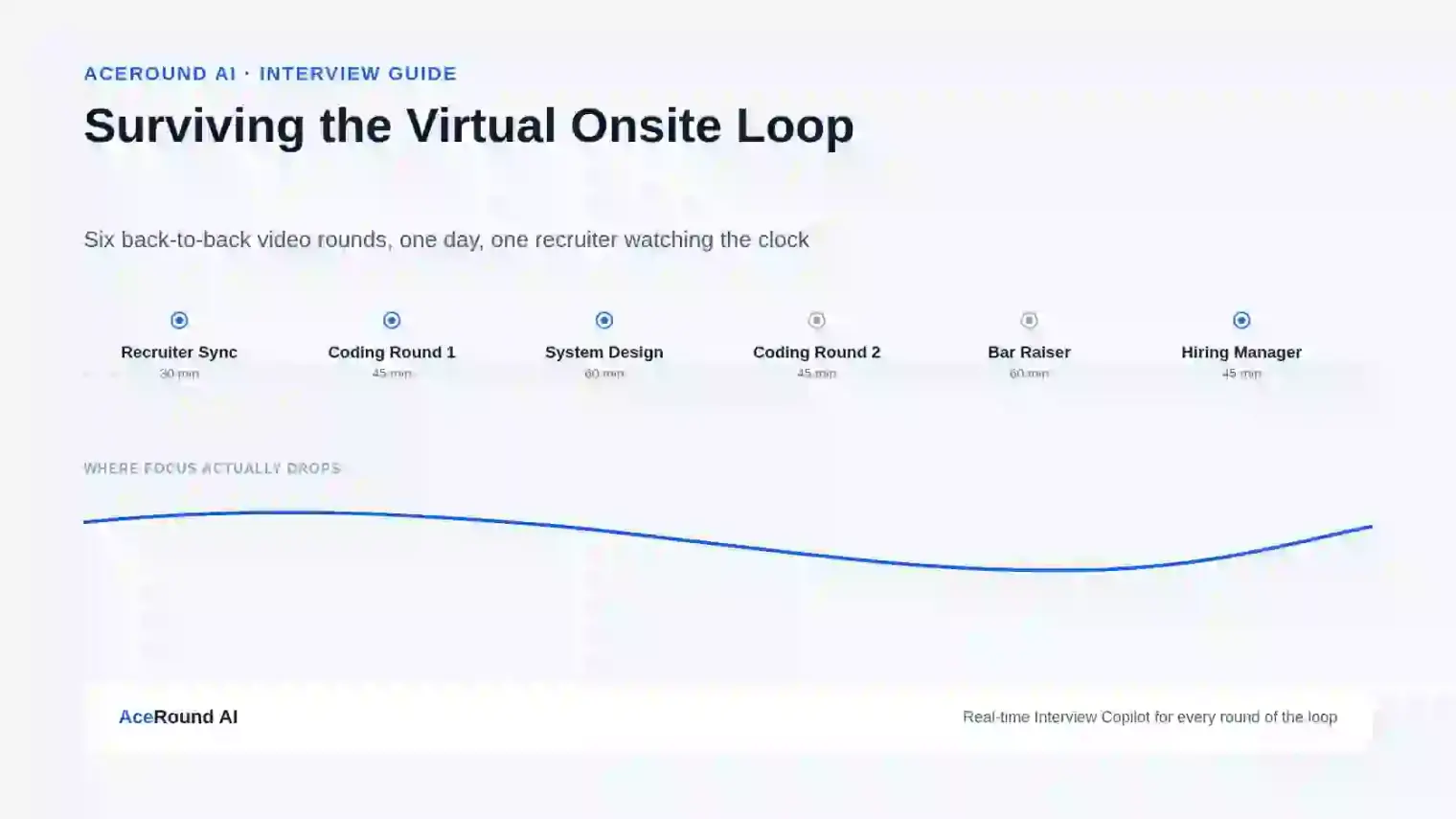
TL;DR: A "virtual onsite" isn't one interview — it's 4 to 6 of them, back-to-back, over video, in a single day. Most candidates prepare for the hardest question in the loop and get blindsided by round 5 fatigue instead. The fix isn't more technical prep. It's pacing, story consistency across rounds, and knowing you're allowed to ask for a different schedule.
Your recruiter sends the calendar invite and it's a single block: 9:00 AM to 3:30 PM, six separate Zoom links, thirty minutes between some of them and none between others. This is the "virtual onsite" — the video-era replacement for flying candidates to a campus for a day of in-person interviews, minus the free lunch and the change of scenery that used to break up the day.
Amazon, Google, Meta, and Microsoft all run some version of this for mid-to-senior roles: four to six 45-to-60-minute rounds, each with a different interviewer, each evaluating something different. Amazon's own hiring guide describes the loop as "four to six intensive interviews," and candidates at L6 and above should expect the high end of that range. Google's public research on interview panels found that four structured interviews predicted hiring quality about as well as the historically bloated loops that used to run 10+ rounds — which is why most of Big Tech has converged on a similar structure instead of shrinking further.
The problem candidates run into isn't any single round. It's round 5.
Why Round 5 Is Where People Fall Apart
By your third round, you've said your best story twice. By your fourth, you're recycling phrasing you used an hour ago and hoping the interviewer doesn't compare notes with the one before them (they do — most loops end in a debrief where interviewers literally compare what you said). By your fifth or sixth round, your energy for enthusiasm and eye contact is gone, even if your technical answers are still fine.
This is a real, measurable phenomenon, not just nerves. Decision fatigue and vigilance decline over sustained cognitive tasks — the same reason judges hand out harsher rulings later in the day and radiologists miss more anomalies on their last scan of a shift. A six-hour interview day is a sustained cognitive task with an audience.
Most interview prep — LeetCode reps, STAR story banks, company research — treats every round as an isolated event with a fixed level of difficulty. None of it accounts for the fact that round 6 is objectively harder than round 1, for reasons that have nothing to do with the question being asked.
What Actually Happens Between Rounds
A virtual onsite has almost no real breaks. Interviewers typically get 5-15 minutes to write up feedback before the next one joins — you often get less, because you're also expected to have your camera and headset ready, water refilled, and mentally reset before the next Zoom link populates. Amazon's "2 & 5 rule" (2 business days after a phone screen, 5 after the loop) tells you when you'll hear back — it tells you nothing about what those 15-minute gaps feel like when you're living them.
Three things worth knowing before the day, not during it:
You can ask to split the loop across two days. This isn't a secret hack, and it isn't a sign of weakness — it's a normal accommodation request. Recruiters field it regularly, especially for senior candidates or when the full loop runs past 5-6 rounds. The worst outcome of asking is "no." Ask when the calendar invite arrives, not the morning of.
Most loops still run fully virtual, even at companies enforcing in-office return-to-work policies for employees. Don't assume a "final round" implies an in-person superday just because the company has a strict RTO mandate for staff — confirm the format explicitly with your recruiter so you're not caught prepping for the wrong setting.
The order of your rounds is often deliberate. Companies frequently front-load the technical/coding rounds and put behavioral or "bar raiser"-style rounds later, on the theory that a tired candidate's true communication style is more visible when they're not performing at full energy. Knowing this changes how you pace yourself — the later rounds are not the ones to coast through.
Preparing With AI: Simulate the Fatigue, Not Just the Questions
Standard mock interview prep gets you ready for one round. It does nothing to prepare you for what your fourth answer to a similar question sounds like when you're tired and have already used your best phrasing twice.
Run a multi-round mock session back-to-back, not spaced out. Instead of practicing one behavioral question a day for a week, run three or four mock rounds in a single sitting, in the actual order your real loop will likely follow (technical rounds early, behavioral/bar-raiser-style rounds late). You're training for the fatigue curve, not just the content. An AI mock interview tool that lets you configure multiple rounds in sequence is the closest low-cost simulation of the real day.
Ask your AI prep tool to flag repeated phrasing across your practice answers. If you told the same story to three different mock interviewers using nearly identical sentences, that's exactly what will read as rehearsed to two real interviewers who compare notes afterward. Catching that in practice — not on interview day — is the whole point of doing it in advance.
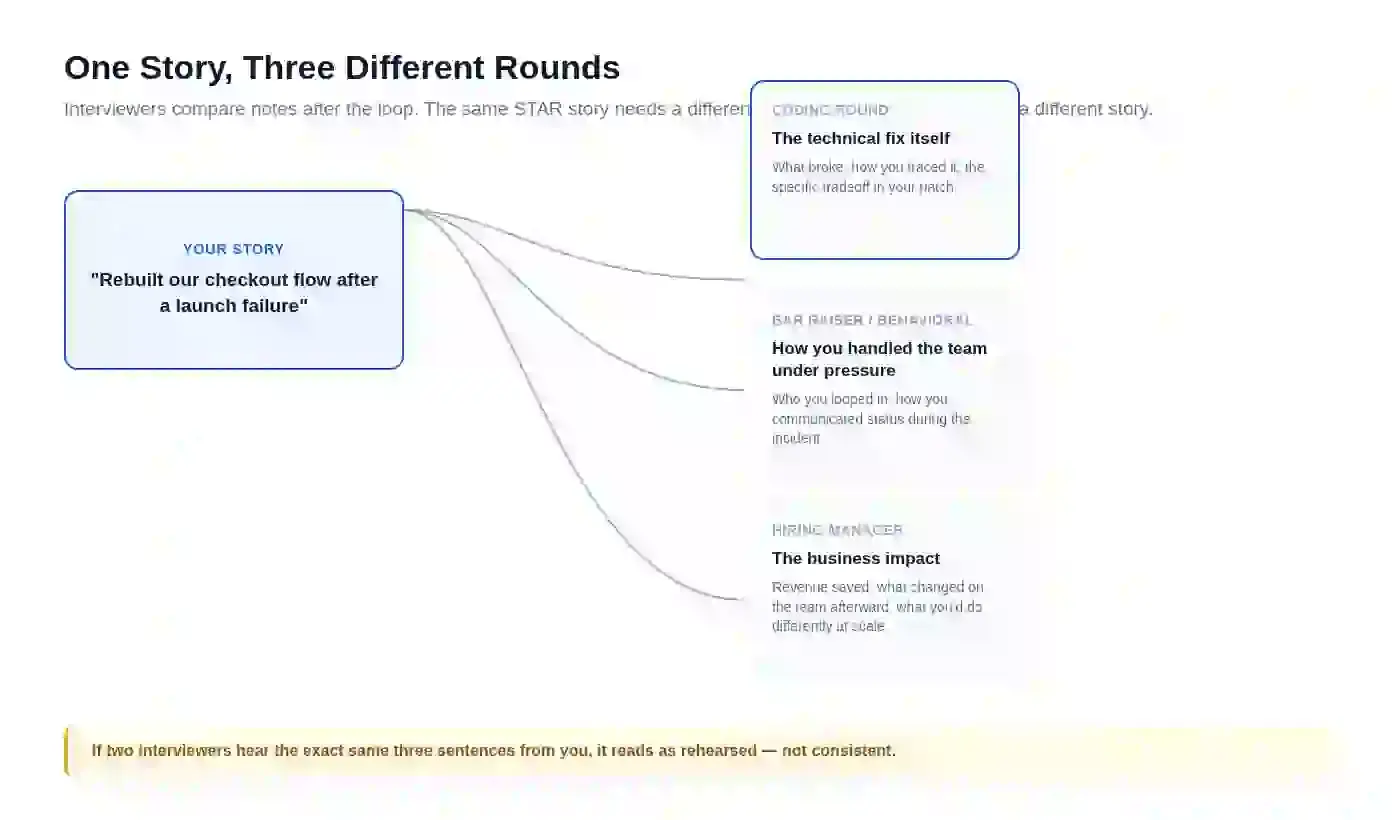
Build one story, three emphases, not three stories. The same incident should sound different depending on which round is asking about it: a coding round wants the technical decision, a bar-raiser-style round wants how you handled people under pressure, a hiring-manager round wants the business outcome. Feed one real story to an AI interview answer generator and ask it to draft three versions emphasizing different angles — then practice switching between them on demand, not just reciting one fixed script.
AceRound AI's Interview Copilot runs during live video calls and works across however many rounds your loop has in a day — it doesn't need a reset between Zoom links the way you do. See how it handles a multi-round interview day.
During the Loop: What Actually Helps in Round 5
Reset physically between rounds, even for 90 seconds. Stand up, drink water, look away from the screen. It sounds trivial against a technical system-design question, but the loop is testing sustained performance, and a body that's been rigid in one chair for four hours performs worse regardless of how well you know the material.
Write down what you told each interviewer. A one-line note after each round — "told the checkout-outage story, emphasized the technical fix" — takes ten seconds and prevents you from repeating yourself verbatim two rounds later. It's the single highest-leverage thing you can do between rounds and almost nobody does it.
Where live AI assistance genuinely helps here: structural prompts when your memory is running thin from fatigue, not full generated answers. A visible "STAR — you're on the technical-fix angle for this one, you already used the team-communication angle in round 2" cue solves exactly the problem that emerges by round 4: not that you don't know the material, but that you're too depleted to remember what you already said. Real-time AI interview assistance is most useful late in a loop, precisely when your own working memory is weakest.
Where it doesn't help: it can't restore the enthusiasm and warmth that naturally fade by hour five. Interviewers can tell the difference between someone who's tired and someone who's phoning it in, and no on-screen prompt fixes flat affect. The honest fix is pacing yourself across the whole day, not leaning harder on a tool in the last round.
FAQ
How many rounds are in a virtual onsite interview?
Most Big Tech loops run 4 to 6 rounds for mid-level roles, with senior and staff-level candidates often at the higher end. Amazon's own hiring documentation describes "four to six intensive interviews" of 45-60 minutes each; Google, Meta, and Microsoft run comparable structures for equivalent levels.
Is a virtual onsite interview the same as a final round?
Usually, yes — "virtual onsite" is the video-era term for what used to require flying to a physical campus, and it typically comes after one or more phone screens have already passed. Treat it as the decision-making stage, not an early filter.
Should I split my onsite interview loop across two days?
If your loop is 5+ rounds or you have a legitimate scheduling or accessibility need, it's reasonable to ask your recruiter whether the loop can be split. It's a routine accommodation request many recruiters can grant, not an unusual demand — but you have to ask when the invite arrives, not adjust silently on the day.
How do I stay sharp for the last round of a back-to-back interview loop?
Physically reset between rounds (stand, hydrate, look away from the screen), keep a one-line note of what you told each interviewer so you don't repeat yourself, and expect the later rounds to be harder purely due to fatigue — that's normal, not a sign you're underperforming.
What happens between rounds in a virtual onsite interview?
Very little from your side — most of the 5-15 minute gaps are the previous interviewer writing feedback before the next one joins. Use the gap to reset physically and jot a quick note on what you covered, rather than trying to cram more prep.
Do all interviewers see my answers from earlier rounds?
Not in real time, but almost every loop ends with interviewers comparing notes in a debrief or hiring-committee packet before a decision is made. Assume what you said in round 2 will be visible context for whoever reads the round 5 feedback.
Author · Alex Chen. Career consultant and former tech recruiter. Spent 5 years on the hiring side before switching to help candidates instead. Writes about real interview dynamics, not textbook advice.
Related Articles
Interviewing While Employed: How to Actually Prepare With Zero Time
Job searching while employed means near-zero prep time, not just staying discreet. Here's a 20-minute prep script, plus what the counteroffer statistics actually show.
CTC Negotiation for Freshers in India: What's Actually Negotiable
Most fresher CTC negotiation advice ignores that TCS, Infosys, and Wipro set fixed pay bands. Here's what's really negotiable, and where lowball offers hide.
Service-Based or Product-Based? Deciding When You Have Both Live at Once
TCS offer in hand, product company interview next week — here's the actual decision framework, not another generic service vs product comparison table.