Ramp's AI-Assisted Coding Interview: What Candidates Are Reporting
Candidates report Ramp added a round where using Cursor, Copilot, or Claude Code is expected, not banned. Here's what's confirmed, what's reported, and how to prepare.
TL;DR: Multiple candidates report that Ramp's interview loop — mainly for frontend and software engineering roles — includes a round where you're expected to work alongside an AI coding assistant, not avoid one. You're reportedly scored on judgment: how you prompt, how you verify, and whether you catch the tool being wrong.
Source note: this is built from one detailed Blind account, cross-referenced against four independent prep guides (GreatFrontend, InterviewQuery, Dataford, Techinterview.org) describing the same round, plus Ramp's own engineering blog for the internal-tooling context below. None of it is an official Ramp rubric.
If you're prepping for a Ramp interview and keep seeing scattered mentions of an "AI-assisted round" without much explanation, that's because nobody's written it up as its own thing — it shows up as a single bullet point buried in generic "Ramp interview process" guides. Here's what's actually being reported.
Where This Round Sits in the Loop
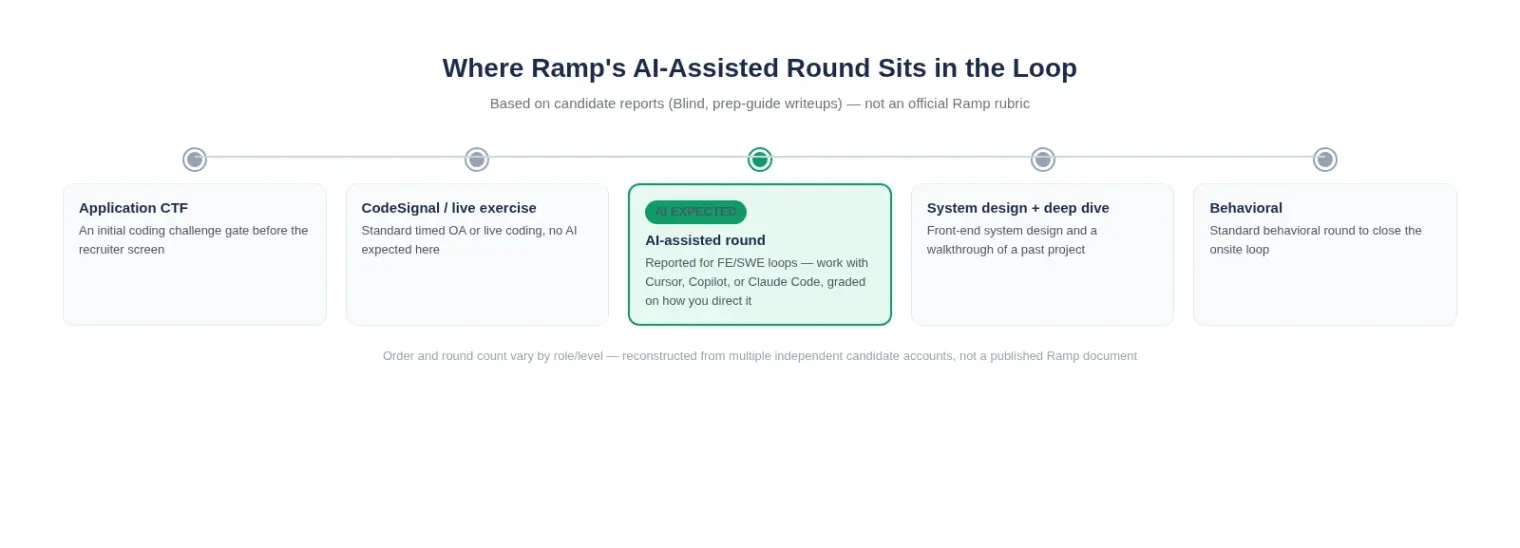
Candidate write-ups (a Blind thread from a frontend candidate, cross-referenced against prep guides on GreatFrontend, InterviewQuery, Dataford, and Techinterview.org, which describe a consistent picture rather than one lone report) describe a loop that includes an application-stage coding challenge, a CodeSignal or live coding exercise, a system-design and project deep-dive conversation, a behavioral round — and, more recently, an AI-assisted coding round.
That last one is the one nobody's fully explained. The Blind poster's own uncertainty is telling: they described expecting some mix of "plan mode, a few iterations, a verification phase" without a clear brief going in. That's consistent with a round still being figured out on both sides — new enough that even recent candidates aren't sure exactly what's being measured.
What Candidates Report Being Scored On
The recurring theme across accounts isn't "did you solve the problem" — it's how you worked with the tool to get there:
- Prompting and planning. Jumping straight to "write me a function that does X" reportedly reads worse than laying out an approach first and directing the tool through it.
- Iteration. Treating the first output as a draft, not a final answer — refining it based on what's actually wrong rather than accepting it wholesale.
- Verification. Catching when the assistant produces something subtly incorrect or over-confident, the same failure mode interviewers at other AI-forward companies are reportedly watching for too.
- Explaining your reasoning. Being able to walk through every line in the final output, including the parts the AI wrote, as if you'd written them yourself.
Take it as a strong signal about what to practice, not a confirmed scoring sheet — this is candidate pattern-matching, not a rubric Ramp has published.
Why This Tracks With How Ramp Says It Actually Builds Software
The round makes more sense once you know what Ramp has said publicly, in detail, about its own engineering process. On its engineering blog, Ramp describes building an internal background coding agent called Inspect, running in sandboxed VMs on Modal. For backend changes, Inspect runs the test suite, checks telemetry in Sentry and Datadog, and queries feature flags in LaunchDarkly before treating a change as done; for frontend changes, it verifies visually with screenshots and live previews. Every change still goes out as a normal pull request under the requesting engineer's own GitHub identity — Ramp built it that way specifically so the agent can't approve its own changes, which means human review stays in the loop even as the agent writes the diff. Ramp states that within a couple of months of building it, Inspect was authoring roughly 30% of merged pull requests across the company's frontend and backend repositories, and that the number is still climbing.
Ramp hasn't officially connected that blog post to its interview process. But a company running an AI agent through its own test suite, telemetry, and feature-flag system before a human ever reviews the diff has an obvious, practical reason to hire people who are good at directing one — and an interview round built around exactly that skill wouldn't be a stretch for that company to add.
How to Prepare, Given What's Actually Known
Treat the earlier rounds — the application CTF and the CodeSignal or live exercise — as standard unassisted coding rounds unless a recruiter tells you otherwise; nothing in the reports suggests AI is welcome there. Drill those the traditional way: timed, unaided practice until the fundamentals are automatic.
For the AI-assisted round itself, candidate accounts point to a workflow worth rehearsing end to end, not a set of prompts to memorize:
- State the problem back before prompting — write a one- or two-line plan of your approach first, the same way you'd talk through it with a teammate.
- Prompt for a first pass, not a finished answer — ask the tool to draft an approach you can inspect, not "solve this."
- Read the output like a diff you didn't write — check the logic against your plan line by line before you touch anything else.
- Deliberately break something in your head — pick the line most likely to be wrong (an edge case, an off-by-one, a mocked dependency) and verify it by hand or with a quick test.
- Narrate the fix out loud — explain why you changed what you changed, as if the interviewer can't see your screen.
That loop — plan, draft, inspect, verify, explain — is what candidate accounts describe interviewers actually watching for, and it's a habit built through repetition, not a script you recite once.
Comparing employers' AI stances or want to drill the unaided rounds: our piece on Snowflake's official AI cheat sheet covers a company that's taken the opposite approach in writing, and a mock interview session covers the timed, unaided practice the CTF and live-coding rounds still call for.
FAQ
Does Ramp allow AI tools in interviews?
Reportedly yes, in one specific round most often described for frontend and software engineering loops — candidates say using a tool like Cursor, Copilot, or Claude Code is expected there, not banned. This isn't an officially published Ramp policy.
What does Ramp's AI-assisted coding round actually test?
Based on candidate accounts, your workflow with the AI tool: how you plan, iterate, and verify — specifically whether you catch and fix wrong output rather than shipping it uncritically.
Is Ramp's AI-assisted round part of every interview loop?
Reports concentrate on frontend and SWE roles. Don't assume it applies to your loop without confirming — round composition varies by role and level.
What if my recruiter hasn't mentioned an AI-assisted round at all?
Ask what tools are available during the technical rounds as a logistics question, not a request for the scoring rubric — it reads better and gets you the same answer.
Author · Alex Chen. Career consultant and former tech recruiter. Spent 5 years on the hiring side before switching to help candidates instead. Writes about real interview dynamics, not textbook advice.
Related Articles
DoorDash's AI-Assisted Engineering Interview: 60 Minutes, Your IDE, AI Required
DoorDash replaced its coding rounds with a 60-minute AI-assisted working session. Here is what the official post confirms, how it's scored, and how to prepare.
Shopify Interview Process 2026: Life Story, Pair Programming and the AI Memo
Shopify's official hiring steps, what the Life Story round scores, and what Tobi Lütke's reflexive-AI memo does and doesn't tell you about using AI in the interview.
Nagarro, Persistent, Publicis Sapient, Thoughtworks: How Each Interviews Freshers in India
Nagarro's Mettl tests, Persistent's AMCAT-style objective round, Publicis Sapient's values round, Thoughtworks' pairing session: what candidates report for each, and where the reports disagree.