Predictive Index Test: How to Actually Prepare for the PI Cognitive and Behavioral Assessment
The Predictive Index test is really two assessments. Here's what the 12-minute Cognitive test and the untimed Behavioral checklist actually measure, score, and allow.
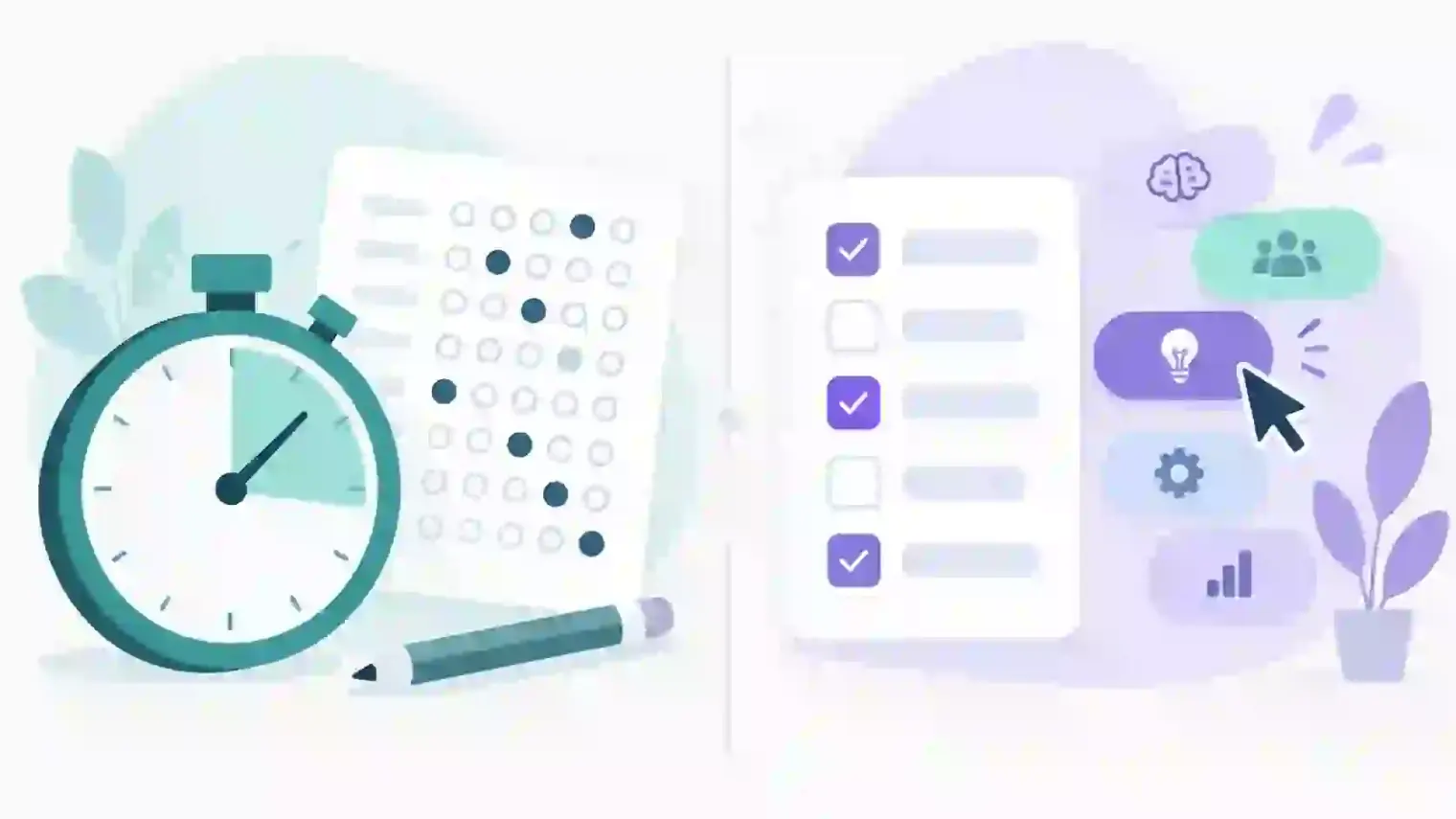
TL;DR: The Predictive Index test is actually two separate assessments usually sent together. The Cognitive Assessment is 50 questions in a hard 12-minute window, scored 100-450 (250 is average), and graded against whatever target score the employer set for that role — not a universal pass line. The Behavioral Assessment is an untimed, roughly 6-minute adjective checklist with no right or wrong answers, used for role fit rather than screening. Retakes are capped at three for the cognitive test and discouraged within a year for the behavioral one, and PI's own material warns that faking the behavioral checklist tends to backfire because it produces an internally inconsistent profile.
You get an email with a Predictive Index link, click through expecting one test, and end up looking at two: a fast-paced multiple-choice section that suddenly locks you out, followed by a screen full of adjectives you're supposed to pick from twice. Most prep sites treat "the PI test" as one thing and hand you a generic timed-quiz drill. It's actually two instruments that measure completely different things, get scored completely differently, and deserve different prep.
Two Tests, Not One
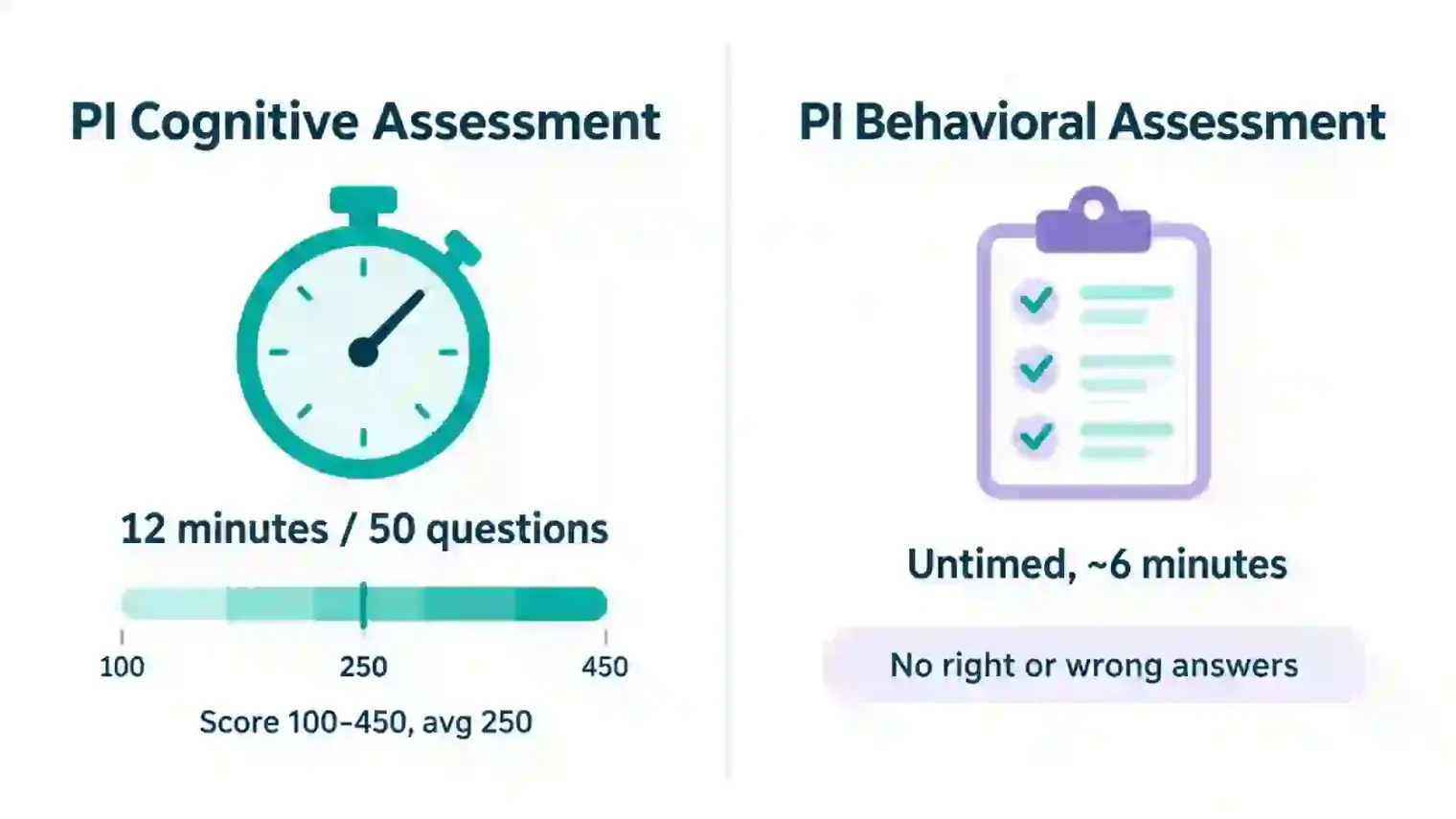
PI Cognitive Assessment: 50 multiple-choice questions covering verbal, numerical, and abstract reasoning, pulled from a larger item pool so two candidates rarely see an identical set. The clock is the whole game here — you get 12 minutes flat, roughly 14 seconds per question, and the test simply stops when time runs out regardless of how many questions you've reached. (Candidates with approved accommodations get 18 or 24 minutes instead.) PI is explicit that this measures general learning agility and problem-solving speed, not job knowledge or IQ.
PI Behavioral Assessment: A completely different format — you're shown a list of 86 descriptive words and asked to check off which ones describe how you're expected to behave at work, then asked again for how you actually behave. There's no time limit, it takes most people around 6 minutes, and there's no correct set of adjectives to pick. PI derives four factor scores from the pattern — Dominance, Extraversion, Patience, and Formality — used to assess role and team fit, not to screen candidates in or out the way the cognitive score does.
How the Cognitive Score Actually Works
Scores land on a 100-450 scale, with 250 set as the population average — roughly 20 correct answers out of 50. That's a lower "correct rate" than most candidates expect walking in, which is worth knowing before you sit down: this isn't a test built for most people to answer most questions correctly under the clock.
PI frames the assessment as criterion-based rather than pass/fail: the company that sent you the link picked a target score range for that specific role before your result ever showed up, and your score gets compared against that target, not against a universal company-wide bar. Functionally, landing well below whatever target they set behaves like failing — you're less likely to advance — but there's no single number PI publishes as "the passing score," because that number doesn't exist company-wide.
The Retake Policy Nobody Explains Clearly
This is the part most candidates can't find a straight answer to, and prep sites mostly skip it. Per PI's own support documentation:
- Cognitive Assessment: capped at three attempts total. An abandoned session or one that expires without finishing still counts as one of the three — so treat every attempt you start as one you're committed to.
- Behavioral Assessment: PI's guidance discourages retaking within a 6-12 month window, since the instrument is meant to capture a relatively stable behavioral pattern, not a moment-in-time result you can improve with practice.
In both cases, the actual decision to grant a retake belongs to the employer who administered the test, not to PI directly — if you're wondering whether you can try again, that question goes to the company, not to Predictive Index support.
Proctoring: What's Actually Watching
PI supports both proctored and unproctored delivery, and it's the employer's choice which one they use for a given role. In practice, the Cognitive Assessment is frequently sent as an unsupervised take-home link rather than a live-proctored session — but "unproctored" doesn't mean unmonitored. The platform runs client-side integrity controls during the 12-minute window: navigating away from the test tab or losing window focus can trigger a screen blur or lock, and copy-paste is blocked. That's a meaningful constraint to know about before test day rather than discovering it mid-attempt with the clock still running.
The Behavioral Assessment's Faking Trap
Because the Behavioral checklist has no objectively correct answers, it's tempting to pick whatever adjectives sound most impressive for the role rather than the ones that are actually true. PI's own guidance on this is direct: answering that way tends to produce a profile that's internally inconsistent — claiming a pattern of traits that don't statistically co-occur in real respondents — and that inconsistency is specifically what trained reviewers are taught to spot. A slightly less "perfect" but internally consistent answer set reads as more credible than a flattering one that doesn't hold together, which makes honest, quick, first-instinct answers the actually strategic choice here, not the cautious one.
Who Actually Sends This Test
Predictive Index markets its assessments as used by thousands of organizations, most commonly integrated into an applicant tracking system like Greenhouse rather than run as a standalone step. It shows up across a wide range of mid-size and large US employers rather than being concentrated in one industry — if you've gotten a PI link, you're very likely applying somewhere with a formal, ATS-driven hiring process rather than a small company doing ad hoc screening.
Where Practice Actually Helps — and Where It Can't
The honest limitation first: the Cognitive Assessment's 12-minute window and tab-lock behavior mean it isn't something you lean on outside help during — the format is built to be sat through in one uninterrupted pass, and that's genuinely the point of a timed cognitive-speed measure. What actually moves your score is rehearsing the pace beforehand: doing timed 12-minute practice sets until 14 seconds a question stops feeling like a sprint, which is a preparation problem, not a during-the-test one.
Where it gets more useful is everything PI doesn't test. A Predictive Index link is very often paired with a separate technical or role-specific assessment further into the same pipeline — if that next step is a coding OA, AceRound AI's OA Copilot is built for that stage specifically, running against a timed format rather than a generic problem bank. And once you clear the assessment stage entirely, the live interview rounds that follow are where real-time preparation earns its keep — our mock interview mode lets you rehearse under realistic pressure before you're doing it live with an actual interviewer.
If you're facing more than one screening platform in the same hiring process, our breakdowns of Criteria Corp's detection layers and CodeSignal's tips cover the other assessment vendors candidates most often run into alongside Predictive Index.
FAQ
How do you pass the Predictive Index test?
There's no universal passing score — employers set their own target score per role, so "passing" means clearing whatever bar that specific company decided on before they saw your result. The most useful thing you can do is practice the Cognitive Assessment's pace (about 14 seconds per question) so the clock doesn't cost you questions you'd otherwise get right, and answer the Behavioral checklist honestly and consistently rather than guessing what the employer wants to see.
What is a good score on the Predictive Index Cognitive Assessment?
Scores run on a 100-450 scale, with 250 set as the population average, roughly corresponding to 20 correct answers out of 50. "Good" is role-dependent — PI itself frames the assessment as measuring general learning speed and problem-solving rather than job knowledge, and employers set their own target range per role rather than using one fixed cutoff across the company.
Can you fail the Predictive Index test?
Not in the sense of a fixed pass/fail line built into the test itself. PI markets the Cognitive Assessment as criterion-based: your score gets compared against a target range the employer set for that specific role, not against a universal bar. In practice that still functions like failing if you land well below the employer's target, but the number itself doesn't carry a pass or fail label.
Is the Predictive Index test timed?
The Cognitive Assessment is strictly timed at 12 minutes for 50 questions — that clock is hard, and it stops the test when it hits zero regardless of how many questions you've answered. The Behavioral Assessment, a separate adjective-checklist instrument, is untimed and typically takes about 6 minutes.
Can you retake the Predictive Index assessment?
For the Cognitive Assessment, PI's own policy allows up to three attempts total, and an abandoned or expired session counts as one of those three. The Behavioral Assessment isn't designed to be retaken within a 6-12 month window by PI's guidance, though in both cases the actual decision to allow a retake sits with the employer who sent you the link, not with PI directly.
Does the Predictive Index Behavioral Assessment have right or wrong answers?
No — it's a free-choice checklist where you pick descriptive adjectives from the same list twice, once for how you're expected to act at work and once for how you actually act, and it derives four behavioral factor scores from the pattern. PI's own guidance warns that answering with whatever sounds most impressive, rather than accurately, tends to produce an internally inconsistent profile that trained reviewers are specifically trained to notice.
Author · Alex Chen. Career consultant and former tech recruiter. Spent 5 years on the hiring side before switching to help candidates instead. Writes about real interview dynamics, not textbook advice.
Related Articles
American Express's AI Interview Rules: What Amex Allows and Bans for Candidates
Amex published a candidate AI guide: research and practice are fine, live AI in any interview is not, unless the interviewer says so. Here's the full list.
Sonar's AI Interview Rules: Required in One Round, Banned in the Rest
Sonar published a candidate guide that splits AI use by stage: coding tests banned, the technical interview built around it. Here's what each round allows.
Dell and HPE Fresher Interview Process in India: HirePro Tests and Project-Heavy Rounds
Dell and HPE campus drives as candidates describe them: HirePro tests, CGPA cut-offs, funnel sizes, technical and HR rounds, and where posts disagree.