Does Criteria Corp Detect Cheating?
Does Criteria Corp detect cheating on its On Demand Assessment tests? A candidate look at photo checks, session logs, and answer-pattern flags.
TL;DR: Criteria Corp's On Demand Assessment platform runs baseline integrity checks (copy-paste blocking, session logging, randomized questions) on every test, plus an Anomaly Response Detection system that flags answer patterns as unusually polished or inconsistent. A separate, employer-optional AI Proctoring add-on layers in periodic photo re-capture (to confirm the same person is still there) and periodic screen/audio sampling — not continuous webcam streaming or a lockdown browser. Whether that add-on is active for your specific test link is not something you can see from the candidate side.
You get an email with a link to a Criteria Corp assessment — maybe the CCAT (cognitive aptitude), a personality inventory, or a role-specific skills test — and the instructions don't say much about what's being watched while you take it. Search "does Criteria Corp detect cheating" and most of what comes up is written for the HR teams buying the product, not for the person about to take it. So we read Criteria's own AI Proctoring product page and its blog post on preventing cheating to lay out exactly what's real.
Two Separate Layers, Not One System
Criteria Corp's anti-cheat approach splits into two genuinely different things, and mixing them up is where most confusion starts.
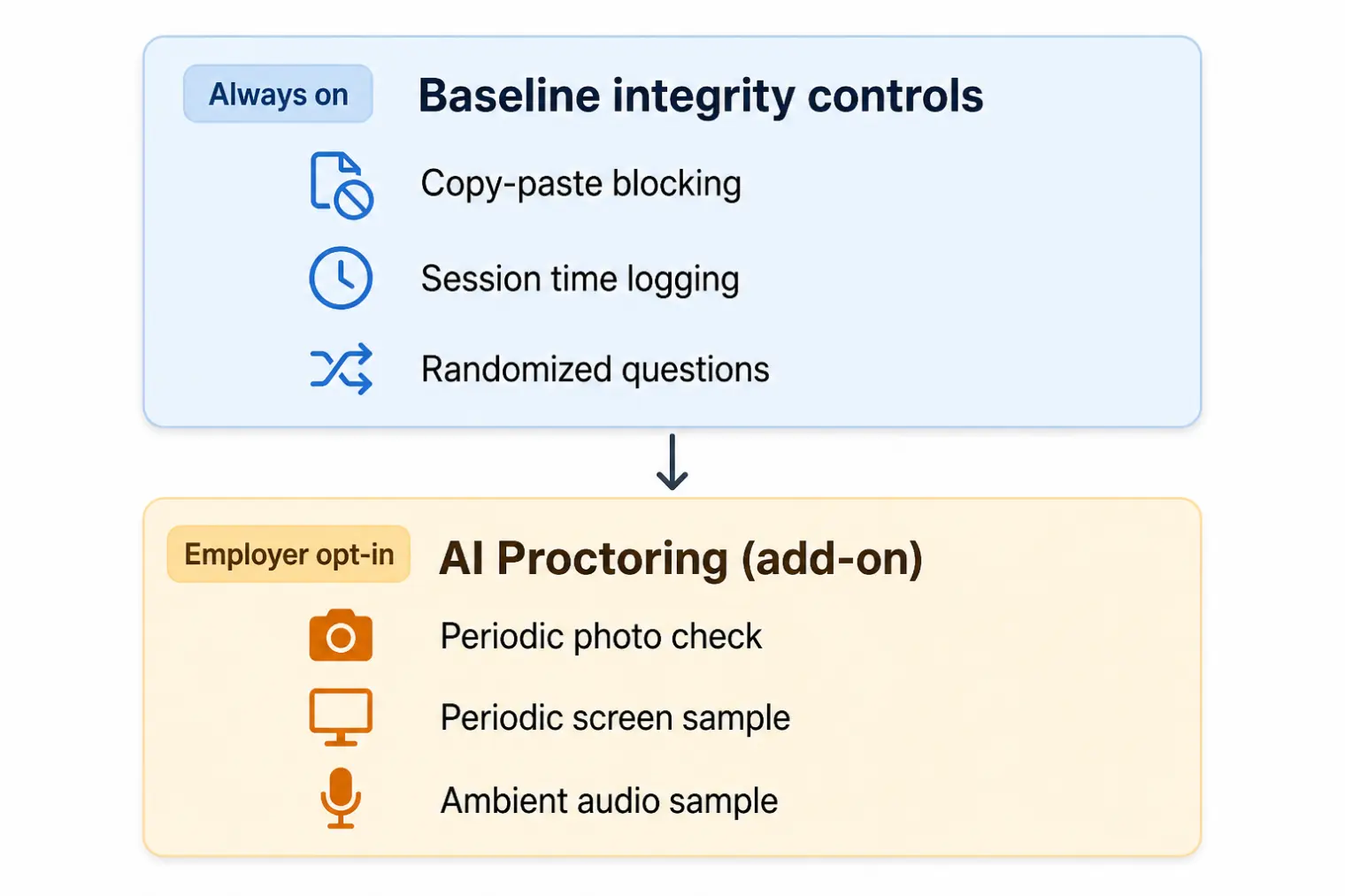
Baseline test-integrity controls run on every assessment automatically, with no employer opt-in required: copy-paste blocking, restrictions on navigating away from the test tab, logging of how long you spend per question, and item banking with randomized or adaptive question sets so that two candidates rarely see an identical test. None of this involves a camera or your screen — it's built into how the test itself is delivered.
AI Proctoring is a separate, add-on product that an individual employer chooses to enable for a specific role. It captures a reference photo before you start, then periodically re-captures your photo during the session and runs an AI comparison to confirm it's still the same person and that no second face has entered the frame. It also periodically samples your screen and ambient audio — not a continuous recording — to catch signals like a second device in view or another person's voice coaching you. Criteria is explicit in its own marketing that this is intentionally lighter-touch than a continuous webcam feed or a lockdown browser: no software installation, no scheduling a proctor, just periodic sampling reviewed afterward in a report.
The Detail Most Explainers Skip: Anomaly Response Detection
Separate from anything visual, Criteria Corp's platform includes what it calls Anomaly (or Aberrant) Response Detection — a statistical check on your answers to personality, risk, or integrity-style inventories. It flags patterns that look "overly positive, inconsistent, or coached," meaning answers that are suspiciously flattering across the board, or that contradict each other in ways a genuine respondent typically wouldn't. This has no camera or screen component at all; it's purely about whether your answer pattern looks internally consistent with how real people actually respond to that kind of inventory.
This is genuinely different from every other detection system in this category. HireVue scores your recorded video and voice for competency signals. HackerRank and similar coding platforms watch your IDE for plagiarism and paste patterns. SHL relies on an in-person re-sit to catch a score gap. Criteria's answer-pattern check works on text responses alone, with no visual or audio signal involved.
Can You Tell Whether It's Turned On For You?
No — and that's by design, not an oversight. AI Proctoring is enabled per role, at the hiring employer's discretion, and there's no candidate-visible indicator on the test screen showing whether it's active for the specific link you received. The practical takeaway is the same one that applies across this entire category of platform: behave as if it could be on, because guessing wrong in either direction doesn't actually help you.
The Proctored-Retake Pattern (And Why It's an Employer Policy, Not a Platform Feature)
A recurring worry among candidates researching Criteria Corp: taking an unmonitored CCAT first, advancing in the process, then being asked to retake it under live proctoring — and worrying that a lower second score reads as an accusation of cheating. This pattern is real and shows up across candidate discussions, but it's a policy individual employers layer on top of Criteria's product, not a rule Criteria enforces platform-wide. Some companies treat a large score gap between the unproctored and proctored attempts as a serious flag; others don't run a second proctored round at all. If you're told you'll retake the test proctored, that instruction is coming from the specific employer's hiring process, and outcomes for a score discrepancy vary by company — there's no single universal consequence baked into Criteria's software.
Who Actually Uses This Platform
Criteria states its assessments are used by more than 4,000 organizations, spanning financial services, government and public sector, healthcare, insurance, legal, manufacturing, retail, and transportation and logistics. That breadth matters for context: this isn't a developer-specific coding-test platform like HackerRank or CodeSignal, and it isn't limited to one industry. It's a general-purpose pre-employment screening layer, often paired with an applicant tracking system, used across a wide range of mid-size and large employers' hiring pipelines. Its security and compliance page lists SOC 2 Type II and ISO 42001:2023 (an AI-management-system standard) certifications, which is more formal AI-governance documentation than several other vendors in this space publish.
Preparing Honestly for a Criteria Corp Assessment
None of the mechanisms above are obstacles to work around — they're mostly just context for taking the test normally, without guessing about what's watching. A few things worth knowing going in: answer personality and risk-style questions consistently rather than picking whatever sounds most flattering on every item, since that's exactly the pattern Anomaly Response Detection is built to flag. Stay visible and alone in frame if you know AI Proctoring might be active for the role. And if your assessment is cognitive or skills-based under a time limit, practicing with realistic timed conditions beforehand — rather than planning to look things up mid-test — matters more than any detection mechanism, since the time pressure itself is usually the actual filter.
If you're preparing for the live interview rounds that typically follow an assessment like this, AceRound AI provides real-time answer support during the actual video interview, which is a different stage of the process than the proctored test itself. For the assessment stage specifically, our does TestGorilla detect cheating and does Codility detect cheating breakdowns are useful comparisons if you're facing more than one vendor's test in the same hiring pipeline.
FAQ
Does Criteria Corp always use a webcam or lock down my browser?
No. Criteria Corp's baseline test-integrity controls (copy-paste blocking, tab-navigation limits, session logging) run on every assessment, but continuous webcam streaming and browser lockdown are not part of the standard product. Full AI Proctoring, which adds periodic photo and screen sampling, is a separate add-on that individual employers choose to turn on for a specific role — you can't tell from the test itself whether it's active.
What is Criteria Corp's Anomaly Response Detection actually looking for?
It flags answer patterns on personality and risk-style assessments that look statistically inconsistent or unusually polished, described in Criteria's own material as answers that are overly positive, contradictory, or appear coached. It's a pattern-consistency check across your answers, not a webcam or screen-based signal.
Can Criteria Corp tell if someone else takes the test for me?
That's specifically what the AI Proctoring add-on's photo feature is built for. It captures a reference photo before the assessment starts, then re-captures periodically during the session and compares the images to confirm the same person is still there and that no additional face has entered frame. It's an identity-presence check, not a personality or competency judgment of your face.
I passed an unproctored CCAT, then scored much lower on a proctored retake. Does that mean I'm accused of cheating?
This is a real, recurring candidate concern, and it comes from a policy some employers layer on top of Criteria's product, not a feature Criteria requires. Some employers have candidates take an unmonitored CCAT first, then a live-proctored retake if they advance. A large score gap between the two is treated by that employer as a signal worth reviewing, and outcomes vary by company — it isn't an automatic, universal ban built into the platform itself.
Can I retake a Criteria Corp assessment if I think I did poorly?
Retake policy is set by the employer, not by Criteria Corp uniformly — some allow a retake after a waiting period, others don't allow one at all for that role. There's no single platform-wide answer, so check the instructions from the specific employer who sent you the test.
Which companies actually use Criteria Corp?
Criteria states more than 4,000 organizations use its assessments, spanning financial services, government and public sector, healthcare, insurance, legal, manufacturing, retail, and transportation/logistics. It's a horizontal pre-employment screening layer used broadly across mid-size and large employers, not a niche tool for one industry.
Author · Alex Chen. Career consultant and former tech recruiter. Spent 5 years on the hiring side before switching to help candidates instead. Writes about real interview dynamics, not textbook advice.
Related Articles
OpenAI's AI Interview Policy: Banned, Required, or Team-Dependent
OpenAI sells AI coding agents, then bans most candidates from using one. Here's the round-by-round policy, including the new agentic round that flips it.
Does Harver Detect Cheating? What Its Proctoring Actually Checks
Does Harver detect cheating on its pre-employment assessments? A candidate look at Harver's Proctoring add-on, what gets logged after a flag, and what happens next.
Micro1's Zara AI Interview: What It Actually Tests (And Why Timing Gets Flagged)
Micro1's AI interviewer Zara has run 300,000+ interviews for remote roles. Here's why it flags response latency as a cheating signal, and what that means for AI prep.