American Express's AI Interview Rules: What Amex Allows and Bans for Candidates
Amex published a candidate AI guide: research and practice are fine, live AI in any interview is not, unless the interviewer says so. Here's the full list.
Plenty of big employers have a vague line about AI in a recruiter email. American Express put a checklist on its careers site: eight topics, each with a green "allowed" and a red "not acceptable." It's one of the clearest candidate-facing AI rules from a large non-tech employer I've found.
Source note: everything below comes from Amex's own page, "Artificial Intelligence (AI) Usage Guidance for Candidates," on americanexpress.com/en-us/careers (read October 2026). It's general guidance, not a description of any specific loop. I'm not covering Amex interview questions or round structure because the page doesn't, and I won't guess.
The Eight Rules, Side by Side
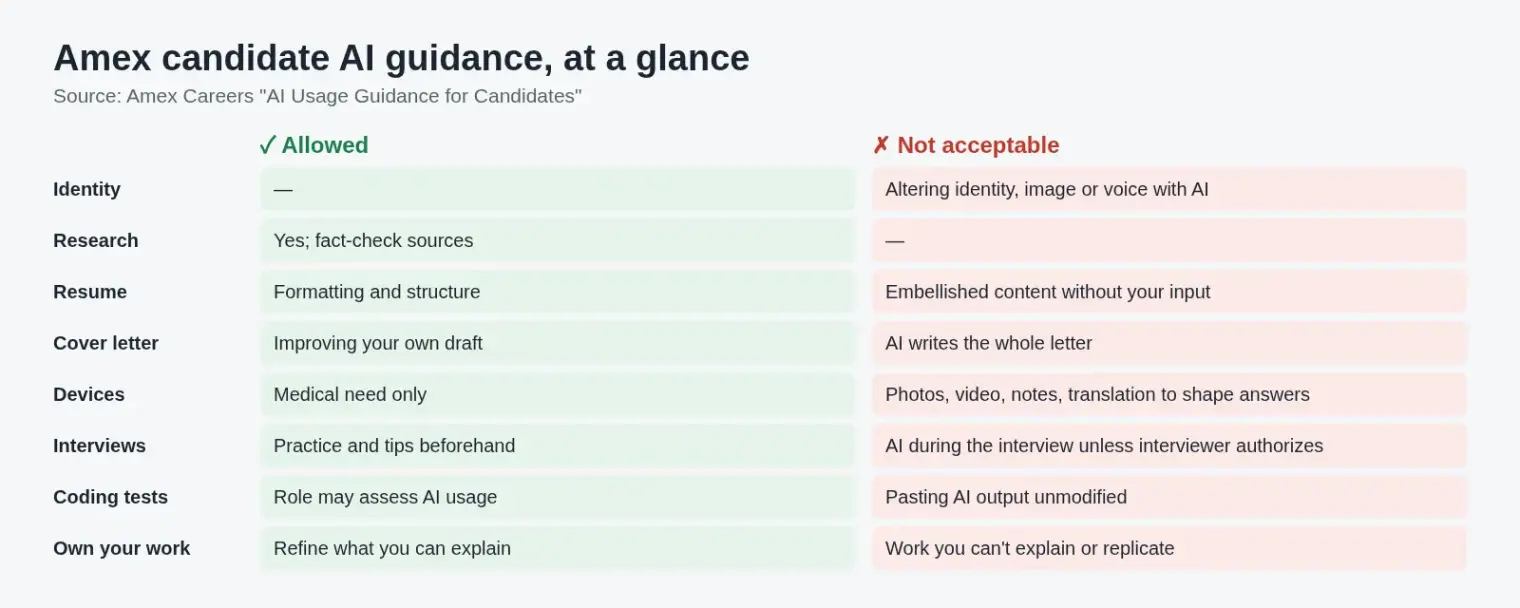
The page opens with a framing sentence worth reading closely: Amex wants "to get to know you and your skills with limited assistance from AI," and AI "should only be used in the limited ways outlined below." So the default is no, and the list is the exceptions.
- Candidate identity. Never acceptable to alter your identity, image or voice with AI. There's no green item here at all.
- Research. Allowed. The page adds: fact check all sources.
- Resume. Allowed for formatting and structure. Not allowed to generate content that embellishes your responsibilities and contributions without personal input.
- Cover letter. Allowed to improve an existing draft. Not allowed to have AI write the whole thing; it should reflect "your perspective and specific interest in Amex."
- Digital devices (smart glasses, headphones, hidden earpieces). Allowed when supporting a medical need. Not allowed to take photos, video or notes, or to translate information "to manipulate your interview answers."
- All interviews, video and in person. Allowed to practice common questions and read interview tips. Not allowed during the interview "unless explicitly authorized by the interviewer," and that covers commonly known AI tools.
- Coding assessments and technical interviews. Depending on the role, some assessments may test AI literacy and usage. Not allowed: submitting AI-generated solutions or copy-pasting prompts and submitting outputs without modification.
- Ownership of work. Allowed to refine work you "fully understand and can independently reproduce and explain." Not allowed: AI-generated work you can't explain, justify or replicate.
Three Things That Are Easy to Miss
1. "Unless explicitly authorized by the interviewer" is the whole door. The interview rule isn't "AI is banned." It's "AI is banned unless the interviewer says otherwise." That matters for the technical-assessment line, which openly says some roles may assess how you use AI. If your invitation or interviewer says AI is part of the exercise, you're covered. If nobody said it, assume it isn't. Ask in writing before the session rather than in the middle of it.
2. The device rule is about outputs, not just chatbots. Notes, photos and video are listed next to translation. An earpiece feeding you lines and a pair of glasses recording the screen sit in the same sentence. The one exception is a medical need, which is the only place the page makes room for a device at all.
3. The ownership test is the same one used everywhere else. "Can you explain, justify or replicate it" is Amex's version of the question Sonar asks in its own AI interview guide: if the interviewer asks you to go deeper, can you? If you can reproduce the work from scratch, AI-assisted prep is fine. If you can't, that's the gap they'll find.
What the Page Doesn't Say
Worth being honest about the gaps, because candidates fill them with guesses:
- It doesn't say how Amex detects AI use, or whether it does anything beyond watching the interview.
- It doesn't name specific tools, or specific assessment vendors.
- It doesn't describe the stages, the number of rounds, or what a technical assessment looks like.
- The only stated consequence is that inappropriate use "may result in disqualification from further consideration."
Anything you read elsewhere about an "Amex AI detection system" or a specific round format isn't on this page.
How to Prepare, Given Those Rules
The page is the source for the rules. The advice below is mine.
- Use the allowed lane fully. Research the company with AI and fact-check it, and practice the common questions out loud. The page explicitly allows both, and most of the preparation value is there.
- Draft your own resume bullets first. Let AI fix layout and wording, but start from your real contributions with real numbers. "Embellishes without personal input" is the phrase to stay away from.
- Write the cover letter yourself, then edit. One honest sentence about why Amex beats a generic paragraph; the page asks for "specific interest."
- Practice the answers without a screen. Since live AI is off by default, rehearse until you can deliver your stories unassisted. A mock interview session is a useful way to hear whether your explanations hold up when nothing is open next to the call.
- Check what each assessment allows before you start. For any coding or online test, read the instructions for that specific test. If the platform's own rules differ from your assumptions, the platform's rules win. Our HackerRank AI-assisted interview guide covers one common format.
For how other employers handle the same question, compare GitLab, Datadog and Zapier, or see all of them in which companies allow AI in coding interviews.
FAQ
Does American Express allow AI in interviews?
Not during the interview unless the interviewer explicitly authorizes it. Research and practice beforehand are fine.
Can I use AI to write my Amex resume or cover letter?
For formatting and for improving an existing draft, yes. Generating embellished content or an entire cover letter without your own input, no.
Are smart glasses or earpieces allowed?
Only for a medical need. Using them to capture or translate content to shape your answers isn't acceptable.
Can I use AI on an Amex coding assessment?
The page says some assessments may test AI literacy, depending on the role. Submitting AI output you copied without modification isn't acceptable.
What happens if Amex thinks I misused AI?
The page says it may result in disqualification from further consideration.
Author · Alex Chen. Career consultant and former tech recruiter. Spent 5 years on the hiring side before switching to help candidates instead. Writes about real interview dynamics, not textbook advice.
Related Articles
Sonar's AI Interview Rules: Required in One Round, Banned in the Rest
Sonar published a candidate guide that splits AI use by stage: coding tests banned, the technical interview built around it. Here's what each round allows.
Dell and HPE Fresher Interview Process in India: HirePro Tests and Project-Heavy Rounds
Dell and HPE campus drives as candidates describe them: HirePro tests, CGPA cut-offs, funnel sizes, technical and HR rounds, and where posts disagree.
Zapier's AI Interview Policy: Use AI to Prep, Not Live (and the AI Recruiter Screen)
Zapier publishes what AI use is OK at each hiring stage, bans it in live interviews, and may put you in a 15-20 minute screen run by an AI recruiter. Here's how both fit together.