Pharmacist Interview Questions: 3 Formats
Pharmacist interview questions differ by setting: retail, hospital panel, or PBM. See real questions for each, plus how to practice clinical cases with AI.
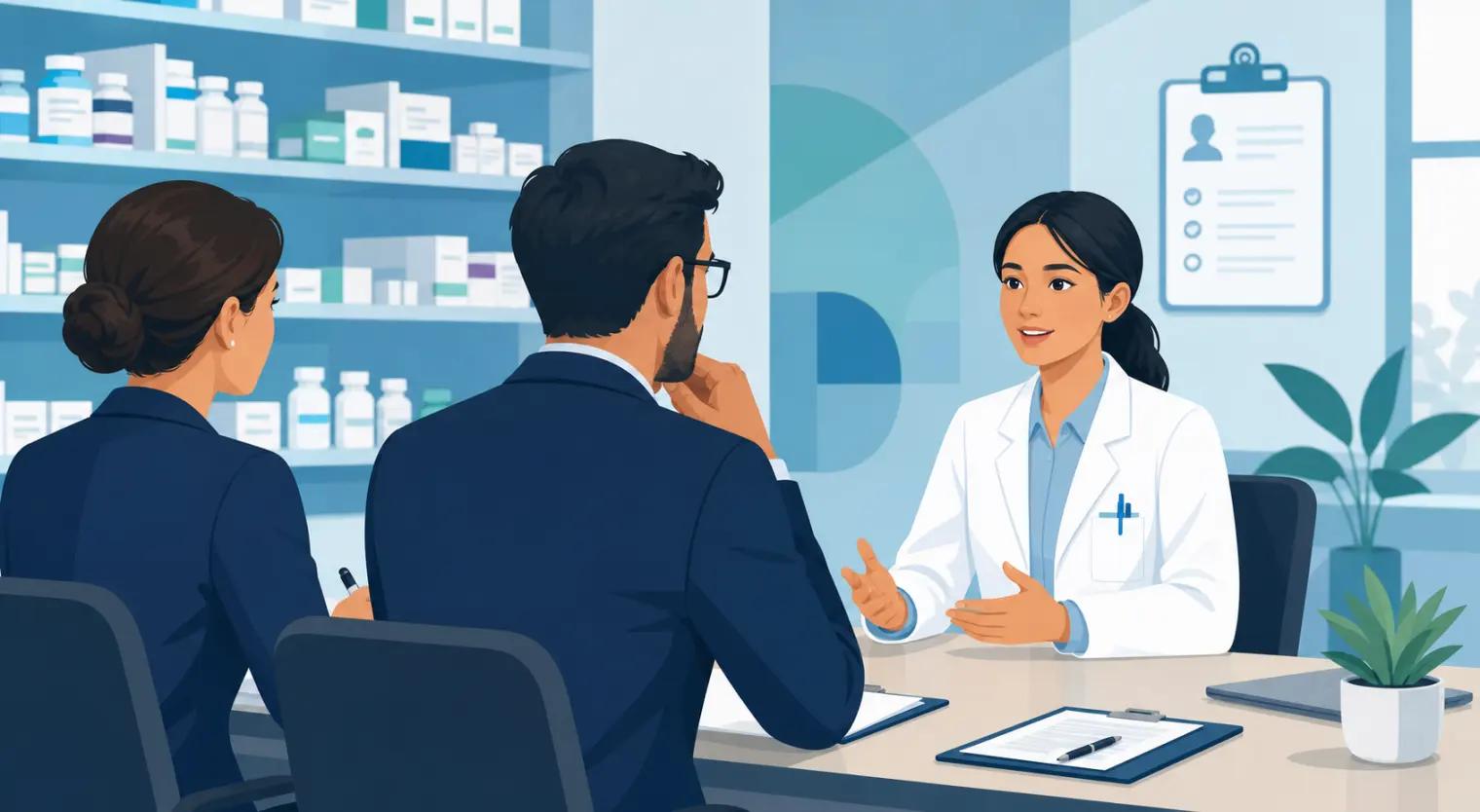
TL;DR: Pharmacist interview questions aren't one list — retail, hospital/clinical, and PBM roles each test something different. Retail leans on customer service and operations. Hospital and clinical interviews add a live, panel-format clinical case you solve out loud. PBM interviews test formulary and prior-authorization judgment. Below: the actual questions for each track, plus how a pharmacist interview AI copilot can help you rehearse the spoken clinical-case format instead of just reading sample answers.
You've spent eight years behind a retail counter — verifying scripts, catching interactions, calming down customers whose insurance just rejected a $400 copay. Then a hospital calls you in for an interview, and thirty minutes in, a pharmacy director slides a chart across the table and asks you to walk through vancomycin dosing for a patient with declining renal function — out loud, in front of five people, with a clock running.
That's not a hypothetical. It's a documented pattern from pharmacists posting on Student Doctor Network before hospital interviews, and it's the single biggest thing generic "pharmacist interview questions" lists get wrong: they hand you the same 20 behavioral questions regardless of whether you're interviewing at a CVS, a 400-bed hospital, or a pharmacy benefit manager. The three tracks share almost nothing beyond "you're a pharmacist."
Three Pharmacist Interviews, Three Different Tests
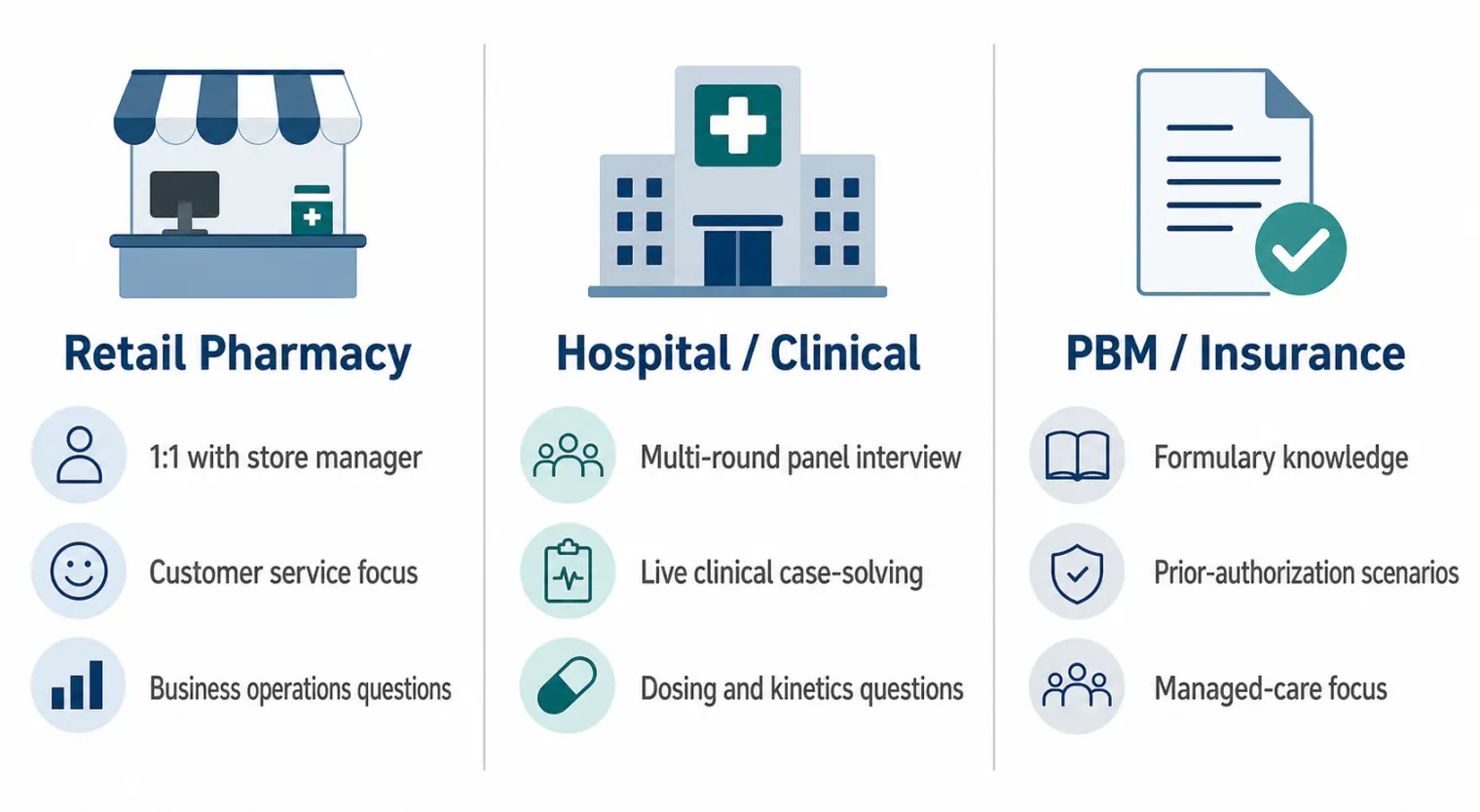
Before you prep a single answer, figure out which of these three you're actually walking into — the overlap is smaller than it looks.
| Retail | Hospital / Clinical | PBM / Insurance | |
|---|---|---|---|
| Format | One conversation, usually a store or district manager | Multi-round panel (3-6 people), 45-90 minutes | 1-2 rounds, often clinical + HR |
| Core test | Customer service, operations, throughput | Clinical judgment under pressure | Formulary/cost-outcomes reasoning |
| Signature question | Handling an angry customer or staffing shortfall | Live clinical case (dosing, monitoring, drug selection) | Prior-authorization or formulary scenario |
| Prep priority | Speed and composure stories | Rehearsing clinical reasoning out loud | Managed-care vocabulary |
If you're moving between tracks — retail to hospital is the most common jump — the clinical-case format is the part your current experience doesn't cover, and it's the part almost no generic interview guide addresses in any depth. That's the gap this guide fills.
Retail Pharmacist Interview Questions
Retail interviews (CVS, Walgreens, independent pharmacies, grocery-chain pharmacies) are the most standardized and the least clinically intense. You're usually talking to one person — a store manager, district manager, or pharmacy supervisor — and they're evaluating whether you can run a high-volume counter without burning out or burning bridges with customers.
"Tell me about a time you handled an angry or upset customer." They want a de-escalation story, not a policy recitation. Name the actual friction (insurance rejection, wait time, an out-of-stock medication), what you said, and the resolution — even if the resolution was "I got them a 3-day emergency supply while we sorted out the prior auth."
"How do you handle a busy shift when you're short-staffed?" This is a triage question. Good answers name a real prioritization system: life-critical scripts first, clear communication with the team and customers about wait times, and knowing when to escalate to a manager rather than silently absorbing the overload.
"Walk me through how you'd handle a suspected drug-seeking patient." Retail-specific and common. The answer isn't "refuse to fill it" — it's checking the state PDMP (prescription drug monitoring program), verifying with the prescriber if something looks off, and treating the patient respectfully throughout, since a legitimate pain patient and a drug-seeking one can look identical at the counter.
"Why retail, and why this company specifically?" Chains ask this because retail turnover is high. A generic "I like helping people" answer reads as a placeholder. Reference something specific — the company's clinical services (immunizations, MTM programs), the store's community role, or a scheduling/growth reason that's actually true for you.
Hospital and Clinical Pharmacist Interviews: The Panel Format
This is where most retail-to-hospital candidates get caught off guard, and it's the format ASHP's own interview-prep resources are built around.
What actually happens in the room. Expect a panel of 3-6 people — a pharmacy director, a clinical coordinator, one or two staff pharmacists, sometimes a physician or nurse manager — for 45 to 90 minutes. You'll get standard behavioral questions, but the part that catches people off guard is the live clinical case: a scenario read aloud, and you reason through it verbally while the panel listens and sometimes interjects with follow-up complications.
Typical clinical-case prompts:
- A patient on vancomycin with declining renal function — walk through your dosing adjustment and monitoring plan.
- A patient starting TPN (total parenteral nutrition) — what do you check before verifying the order?
- A choice between two antibiotics for a resistant infection — justify the selection using kinetics and site of infection.
The panel isn't grading you against a textbook answer typed out somewhere — they're listening to how you think: do you ask about renal function before dosing, do you mention drug interactions unprompted, do you say "I'd verify with the ID pharmacist" when a case is outside your comfort zone instead of guessing. A clinical pharmacist who moderates the SDN interview forums put it bluntly: some interviewers will throw in an odd question — "what animal would you be and why," or "what's something you're ashamed of" — specifically to see how you handle being knocked off a rehearsed script.
Standard behavioral questions layered on top:
- "Tell me about a time a new system or process was introduced and how you adapted." (A 2026-specific favorite, given how fast EHR and verification workflows are changing.)
- "Describe a medication error you were involved in and what changed afterward."
- "How do you stay current with new drugs and guideline updates?"
Why rehearsing out loud matters more here than anywhere else. You can read every sample answer online and still freeze the first time you have to reason through a kinetics problem verbally, live, with people watching. This is one of the few interview formats where practicing the spoken reasoning — not memorizing a script — is the actual skill being tested. Some candidates use AceRound AI during mock runs specifically for this: it listens in real time and can nudge you toward a piece of clinical logic you're skipping (like checking renal function before finalizing a dose), the way a preceptor would during rounds, so you build the habit of verbalizing your reasoning before the real panel.
PBM and Insurance Pharmacist Interviews
Pharmacy benefit manager (PBM) and health-plan pharmacist roles — formulary management, prior authorization review, drug utilization review — get almost no coverage in standard interview guides, despite being a distinct and fast-growing track as more pharmacists move into managed care (BLS projects continued growth in non-dispensing clinical and administrative pharmacist roles through 2034).
"Walk me through how you'd evaluate a prior-authorization request for a non-formulary drug." They want you to weigh clinical necessity against formulary alternatives and cost, and to explain the criteria transparently — not just "I'd approve it if the doctor asked."
"How do you balance cost containment with patient outcomes?" This is the PBM version of "tell me about yourself" — everyone gets asked some form of it. There's no single right answer, but a good one shows you understand formulary decisions aren't purely cost-driven; step therapy and tiering exist to manage risk and spend without blocking necessary care.
"Describe your experience with drug utilization review or clinical criteria development." If you don't have direct experience, talk about adjacent work: catching interactions at the counter, working with prior-auth denials from the pharmacy side, or clinical guideline research from a hospital rotation.
Common Pharmacist Behavioral Questions (Any Setting)
A few questions show up regardless of track — worth having tight answers ready for all three:
- "Why did you choose pharmacy?" — Keep it specific to your path (a rotation, a mentor, a personal experience), not a generic "I like science and helping people."
- "What's your biggest weakness?" — A real one, with a concrete fix. "I used to double-check everything to the point of slowing down the line — I now set a structured checkpoint instead of re-verifying every step."
- "How do you handle an unfamiliar medication?" — Be honest: check with a colleague or reference source, tell the patient you're confirming, and follow up. Interviewers penalize false confidence far more than admitted uncertainty.
- "Tell me about a conflict with a colleague or provider." — Use the STAR method (Situation, Task, Action, Result); see our STAR method guide for a full framework if this format is new to you.
How to Practice the Format You're Actually Facing
Reading sample answers gets you maybe 40% of the way there for retail and PBM interviews, and noticeably less for hospital panels — because the hospital format specifically tests live verbal reasoning, not recall.
A practical way to close the gap:
- Identify your track first (retail / hospital-clinical / PBM) and prioritize prep time accordingly — don't spread evenly across all three question types if you know which room you're walking into.
- For hospital and clinical interviews, rehearse clinical cases out loud, not silently. Say the dosing adjustment, the monitoring plan, the differential — the panel is listening to your reasoning process, not just your conclusion.
- Practice with real-time feedback if you can. AceRound AI works as a discreet real-time interview copilot for both mock practice and live calls — useful if you want a second set of "ears" catching gaps in your clinical logic before the actual panel does. If you're new to AI-assisted interview prep in general, our AI mock interview guide covers the basics.
- Have two or three real examples ready, not composites — a real medication-error story, a real difficult-customer or difficult-colleague story, and a real "I didn't know, here's what I did" story. Panels notice when answers feel rehearsed versus lived.
A Few Regional Notes
Interview format is broadly similar worldwide, but licensing sits in front of it in some markets: in Japan, foreign pharmacy credentials go through a multi-month equivalency review before the national exam, so licensing timing matters more than interview polish early on. In South Korea, international graduates' preliminary licensing review bundles a written exam, a language assessment, and an interview component — meaning "the interview" partly overlaps with the licensing process itself, not just an employer screen. In Brazil, interviewers commonly probe familiarity with ANVISA (Brazil's drug regulatory agency) alongside the standard clinical questions.
Frequently Asked Questions
What are the most common pharmacist interview questions? Across every setting, expect: why you chose pharmacy, how you handle a medication error, how you stay current with new drugs and guidelines, how you'd handle a suspected drug-seeking patient, and a strengths/weaknesses question. Hospital and clinical interviews add live clinical case questions — a specific drug-dosing or monitoring scenario you solve out loud in front of the panel.
What is a hospital pharmacist panel interview like? It's usually 3-6 people at once — a pharmacy director, clinical coordinator, a staff pharmacist, sometimes a physician or nurse manager — and it runs 45-90 minutes. Expect at least one live clinical case (e.g. vancomycin dosing, a TPN calculation, an antibiotic selection) that you talk through step by step, not just a list of behavioral questions.
What questions does a retail pharmacist interview focus on? Retail interviews are almost always a single conversation with a store or district manager, and they weight customer service and operations far more than clinical depth: handling an angry customer, managing a busy shift with limited staff, insurance rejections at the counter, and why you want retail specifically.
What do PBM and insurance pharmacist interviews ask about? PBM (pharmacy benefit manager) and health-plan pharmacist interviews focus on formulary management, prior-authorization criteria, drug utilization review, and managed-care cost/outcomes tradeoffs — a different vocabulary from patient-facing retail or hospital interviews, closer to a policy or clinical-review conversation.
What qualities does a pharmacist need to succeed? Interviewers across all three tracks look for clinical attention to detail, honesty about the limits of your knowledge, calm communication under pressure, and adaptability to changing systems and guidelines. Retail weighs customer-facing composure more heavily; hospital and PBM weigh clinical and analytical judgment more heavily.
Can AI help you practice for a pharmacist interview? Yes, particularly for the clinical-case portion of hospital and health-system interviews, where you need to reason out loud under time pressure rather than recite a memorized answer. Tools like AceRound AI listen in real time and can prompt you toward the clinical logic you're missing, similar to how a preceptor would nudge you during rounds.
Author · Alex Chen. Career consultant and former tech recruiter. Spent 5 years on the hiring side before switching to help candidates instead. Writes about real interview dynamics, not textbook advice.
Related Articles
OpenAI's AI Interview Policy: Banned, Required, or Team-Dependent
OpenAI sells AI coding agents, then bans most candidates from using one. Here's the round-by-round policy, including the new agentic round that flips it.
Does Harver Detect Cheating? What Its Proctoring Actually Checks
Does Harver detect cheating on its pre-employment assessments? A candidate look at Harver's Proctoring add-on, what gets logged after a flag, and what happens next.

Micro1's Zara AI Interview: What It Actually Tests (And Why Timing Gets Flagged)
Micro1's AI interviewer Zara has run 300,000+ interviews for remote roles. Here's why it flags response latency as a cheating signal, and what that means for AI prep.