Mu Sigma, Fractal, ZS Associates: Cracking the Guesstimate Round
Mu Sigma, Fractal Analytics, and ZS Associates don't run a TCS-style aptitude gate or an Amazon-style DSA marathon — they run guesstimates and case studies. Here's the round structure and how to actually structure an answer.

For anyone with a Trainee Decision Scientist, Analyst, or Business Technology Analyst interview coming up at Mu Sigma, Fractal Analytics, or ZS Associates — on-campus or off-campus. If you're comparing this against other tracks, AMCAT and eLitmus covers the aptitude-gated off-campus channel these firms sometimes hire through, and Razorpay, PhonePe, Swiggy, and CRED covers product-company machine-coding rounds if you're weighing analytics against an SDE track.
TL;DR: For anyone with an analytics, decision-science, or business-case interview coming up at one of these three — Mu Sigma, Fractal Analytics, and ZS Associates hire through a format that looks nothing like a TCS aptitude gate or an Amazon DSA marathon: an OA (aptitude, sometimes Python/SQL) followed by guesstimate and case-study rounds — live business-reasoning problems with no clean right answer, graded on how you structure the estimate, not whether you hit an exact number. Mu Sigma leans on a live technical panel, Fractal splits the OA and the case round cleanly in two, and ZS's case comes with a written component instead of pure conversation. Genpact and EXL run adjacent analytics hiring tracks with a similar shape, though public candidate accounts for those two are thinner.
Every India-hiring post so far on this blog has been about employer structure — IT services versus product companies versus GCCs. This one is about a format that cuts across employer type: the guesstimate-and-case round, which Mu Sigma effectively popularized in India's analytics-hiring market and which Fractal and ZS both run in their own versions. If your pipeline includes an analytics, decision-science, or business-consulting-adjacent role, this round is very likely on your calendar regardless of which of these three names is on your offer letter — and it rewards a different kind of preparation than another 50 LeetCode mediums.
Mu Sigma: Aptitude Does the Filtering, the Panel Does the Grading
Mu Sigma's fresher role is titled Trainee Decision Scientist, and the reported funnel runs an aptitude test, into a video-response or bot-screening round, into a technical panel that leans heavily on guesstimates, sometimes with a group case study folded in before the final HR conversation. One widely-shared candidate account described roughly 800 applicants narrowing to 96 after the aptitude stage alone — which tells you the volume filtering happens early, and by the time you're in front of a live panel, the field has already thinned considerably.
A commonly cited example of the genre: "estimate the number of coffee shops in a city like Pune." The specific prompt changes every intake — the structure being graded doesn't. Some postings for this role route through AMCAT.
On comp: candidate reports describe a stepped structure over the first four years, rising from the low single-digit lakhs toward roughly ₹10 LPA with bonuses — don't anchor a specific number into your own negotiation.
Fractal Analytics: OA First, Then Two Named Interview Stages
Fractal's reported process starts with an online assessment — commonly four Python questions and four SQL questions — before moving into two labeled interview rounds: "Problem Solving," a market-entry or profitability-style case, and "Business Understanding," which leans on guesstimates and basic probability. An HR round closes the loop.
A market-sizing guesstimate around estimating the number of cars in a market is a commonly cited example — again, generic-consulting-style rather than confirmed Fractal-original. Entry titles vary across postings ("Analyst," "Associate," "Analytics Consultant"), and reported comp figures are inconsistent enough across sources that quoting a single number here would overstate what's actually known — ask your recruiter for the band tied to your specific offer. On difficulty: the Python/SQL OA is reported as closer to fundamentals (joins, aggregations, basic scripting) than the DSA-heavy off-campus OAs at product companies — it's a filter for competence, not a LeetCode-medium gate.
ZS Associates: The Best-Documented of the Three, and the Most Written Component
ZS's process is the one with the most consistent candidate documentation: a roughly 50-minute cognitive/aptitude test that includes guesstimate-style items, a case-study round delivered as a written case with around five questions split between quantitative and qualitative reasoning rather than a purely spoken back-and-forth, and an HR/fit conversation to close. Some hiring channels report a broader five-stage loop — "roughly three to five stages" is the honest range across accounts.
The case content reported here skews pharma and healthcare-themed — consistent with ZS's actual client base as a life-sciences-focused consultancy, which is a more specific signal than the generic-case pattern at the other two firms, though still not a single confirmed leaked question. Fresher titles include "Business Technology Analyst" and "Decision Analytics Associate."
Where the Three Actually Line Up
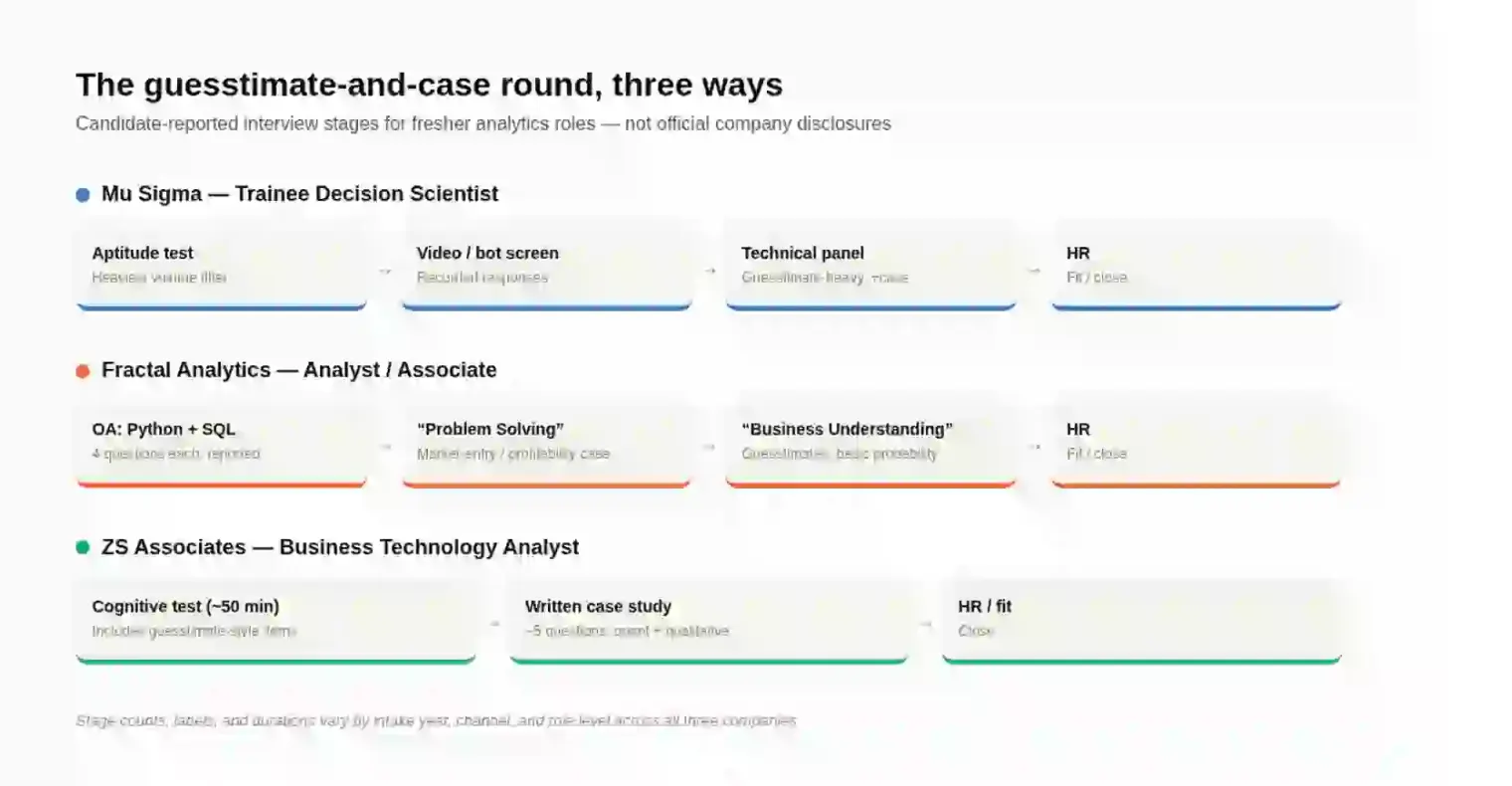
| OA / screening stage | Distinctive round | What it tests | Fresher title | |
|---|---|---|---|---|
| Mu Sigma | Aptitude test, video/bot screen | Guesstimate-heavy technical panel | Structuring under a live panel | Trainee Decision Scientist |
| Fractal Analytics | Python + SQL OA | "Problem Solving" case, then "Business Understanding" guesstimates | Case logic, then estimation | Analyst / Associate |
| ZS Associates | ~50-min cognitive test | Written case, ~5 quant + qualitative questions | Structuring an answer on paper | Business Technology Analyst |
Round counts, labels, and durations are candidate-reported and vary by intake year, channel, and role level — not official company disclosures. Confirm your specific loop with your recruiter once scheduled.
Why This Is a Different Test Than an Aptitude Gate or a DSA Round
Against the AMCAT/eLitmus off-campus channel — that gate is largely quantitative aptitude and verbal ability, scored against a fixed answer key. None of these three companies stop at that; the guesstimate and case rounds have no fixed answer key at all, and a candidate who aces the aptitude cutoff can still lose the case round entirely on structure. Against a DSA-heavy off-campus OA — the kind product companies run — a guesstimate round doesn't care whether your code compiles; it cares whether you can state an assumption, defend it when the interviewer pushes back, and land on a number that's the right order of magnitude, out loud, in real time.
That live, unscripted, verbal-reasoning-under-time-pressure shape is also what separates this round from most other prep content. A LeetCode streak doesn't transfer to it, and neither does a memorized "consulting case framework" — interviewers in these rounds are specifically trained to notice when someone is reciting a rehearsed structure instead of reasoning about the actual number in front of them.
Genpact and EXL: A Similar Shape, Thinner Documentation
Genpact and EXL both post analytics-titled roles — separate from their much larger BPM/operations hiring pipelines — and some candidate accounts for these analytics tracks describe case-study rounds with a similar flavor to the three above. But the public documentation here is noticeably thinner: most accounts come from career-coaching guides rather than first-person candidate write-ups, and nobody's published a clear before-and-after comparing the analytics track's interview format against general BPM hiring at the same company. If either of these two is in your pipeline, the safest assumption is "similar format to Mu Sigma/Fractal/ZS, confirm specifics with your own recruiter" rather than treating any single reported comp figure as settled.
A Structure That Actually Works for Guesstimates
The framework that holds up across all three companies' reported rounds is the same one management consulting has used for decades, and it's worth internalizing rather than memorizing:
- State the question back and clarify scope out loud — "coffee shops in Pune" could mean the metro area or just the city limits; saying which one you're estimating, before you start, is itself a signal of structured thinking.
- Pick a decomposition method and commit to it — population-based ("Pune's population, divided by average people-per-coffee-shop-catchment") or supply-based ("known chains, times average outlets per chain, plus an estimate for independents") both work; picking one and reasoning through it beats hedging between two.
- State every assumption as a round number and keep moving — "I'll assume 6 million people, 30% urban core" is a defensible assumption stated out loud; second-guessing yourself mid-calculation is what actually costs candidates time, not the arithmetic itself.
- Sanity-check the final order of magnitude before you say it — does "40,000 coffee shops in Pune" feel plausible for a city that size, or does it imply one shop per 150 people, which is obviously too dense? Catching your own implausible answer before the interviewer does is worth more than getting the arithmetic exactly right.
Walking Through One, Start to Finish
Here's what those four steps sound like said out loud, on the "coffee shops in Pune" prompt:
"I'll estimate this for Pune city limits, not the wider metro area, since that's the more common reading. I'll go population-based: Pune's roughly 6-7 million people — I'll round to 6 million for the city. Say 60% live in areas dense enough to support a coffee shop within easy reach, so that's 3.6 million people in the addressable zone. Now, how many people does one coffee shop typically serve? In a market like this, I'd estimate one shop per 1,500-2,000 people once you count both chains and independents — I'll use 1,800. That gives 3,600,000 divided by 1,800, which is 2,000 coffee shops."
At this point the interviewer might push: "Why 1,800 and not, say, 1,000?" The answer isn't to second-guess the number — it's to defend the reasoning behind it: "1,000 per shop would imply a coffee shop roughly every few blocks in every neighborhood, which feels closer to a market like South Mumbai than a mid-size city; 1,800 accounts for denser IT-corridor areas averaging out against quieter residential ones." Then the sanity check out loud: "2,000 shops across a 6-million-person city works out to about one shop per 3,000 residents overall once you include the 40% outside the dense zone — that feels like the right order of magnitude for a market this size, not off by a factor of 10 either way."
Next time you practice one on your own, record it and play it back listening for exactly three things: did every number get a stated reason, did a follow-up get defended instead of revised, and did the final check compare against something plausible instead of just restating the arithmetic. Miss one of those three and that's the specific thing to redo, not the whole rep.
Practicing This Round for Real
The hard part about a guesstimate round isn't the math — it's holding your reasoning together when someone interrupts mid-estimate with "why 1,800, not 1,000?" A few ways to build that specific reflex, in rough order of realism:
- Self-interrupt on purpose. Mid-estimate, stop and ask yourself the pushback question before anyone else does — "why this number and not double it?" — and answer it out loud before moving on. This is the cheapest version and works solo.
- Recruit someone to only ask "why." They don't need domain knowledge — the job is just to interrupt at an assumption and demand a reason, which is closer to what actually derails candidates than the arithmetic itself.
- Time-box the whole thing to 90 seconds for the first number. Panels expect a first estimate fast, then refinement — spending three minutes before saying any number out loud is a more common failure than an inaccurate first guess.
If lining up a person for the second option is the bottleneck, a mock interview run does the interrupting for you on your own schedule.
FAQ
What actually happens if I freeze or go blank mid-guesstimate?
The recovery move isn't to guess a random number to fill the silence — it's to say the part you do know out loud: "I know Pune's population is in the low single-digit millions, let me work from there" restarts the reasoning chain in front of the interviewer instead of leaving dead air. Candidate accounts suggest panels weigh how you recover more than whether you froze at all in the first place.
Is Fractal Analytics' Python/SQL OA hard, or is it closer to fundamentals?
Candidate reports describe it as closer to joins, aggregations, and basic scripting than a DSA-heavy off-campus OA — a competence filter rather than a LeetCode-medium gate. The harder stage for most candidates is the case and guesstimate rounds that follow, not the OA itself.
Is ZS Associates' case round spoken or written?
Reports describe it as a written case with roughly five questions split between quantitative and qualitative reasoning, rather than a purely spoken back-and-forth like a McKinsey-style case interview. That rewards being able to organize a clear answer on paper under a clock — a different rehearsal than practicing to talk fluently.
Does the process look different for experienced or lateral hires versus freshers?
Almost certainly, but the candidate accounts this piece draws on are overwhelmingly fresher/campus-hire postings, so a specific lateral-hire loop for these three companies isn't something this research turned up — the honest answer is to ask your recruiter directly whether the aptitude stage is shortened or skipped for your track, rather than assuming either way. What's less likely to change with experience is the case round's actual reasoning bar: a sharper follow-up question is more likely than a lighter one.
If you want that live back-and-forth without lining up a friend's schedule, a mock interview run does it on your own time, and OA Copilot covers the Python/SQL OA stage on the actual platforms it runs on.
Author · Alex Chen. Career consultant and former tech recruiter. Spent 5 years on the hiring side before switching to help candidates instead. Writes about real interview dynamics, not textbook advice.
Related Articles
Sonar's AI Interview Rules: Required in One Round, Banned in the Rest
Sonar published a candidate guide that splits AI use by stage: coding tests banned, the technical interview built around it. Here's what each round allows.
Dell and HPE Fresher Interview Process in India: HirePro Tests and Project-Heavy Rounds
Dell and HPE campus drives as candidates describe them: HirePro tests, CGPA cut-offs, funnel sizes, technical and HR rounds, and where posts disagree.
Zapier's AI Interview Policy: Use AI to Prep, Not Live (and the AI Recruiter Screen)
Zapier publishes what AI use is OK at each hiring stage, bans it in live interviews, and may put you in a 15-20 minute screen run by an AI recruiter. Here's how both fit together.