Zapier's AI Interview Policy: Use AI to Prep, Not Live (and the AI Recruiter Screen)
Zapier publishes what AI use is OK at each hiring stage, bans it in live interviews, and may put you in a 15-20 minute screen run by an AI recruiter. Here's how both fit together.
Zapier is an AI-first company, so you'd expect an open door for AI in its interviews. The reality is more specific: encouraged while you prepare, banned while a person is talking to you, and in some cases the first voice you hear is an AI agent's.
Source note: everything below comes from two Zapier-published pages, the "How to collaborate with AI during Zapier's hiring process" page on zapier.com and the company blog post "Applying to Zapier? Here's why you might meet an AI recruiter" (both read October 2026). Neither describes your specific loop, and the AI screen is described as a pilot, so confirm with your recruiter what applies to your role.
The Rules, Stage by Stage
Zapier's guidance is built as a table of "thoughtful use" against what it bluntly labels "AI slop". Here is the same thing condensed.
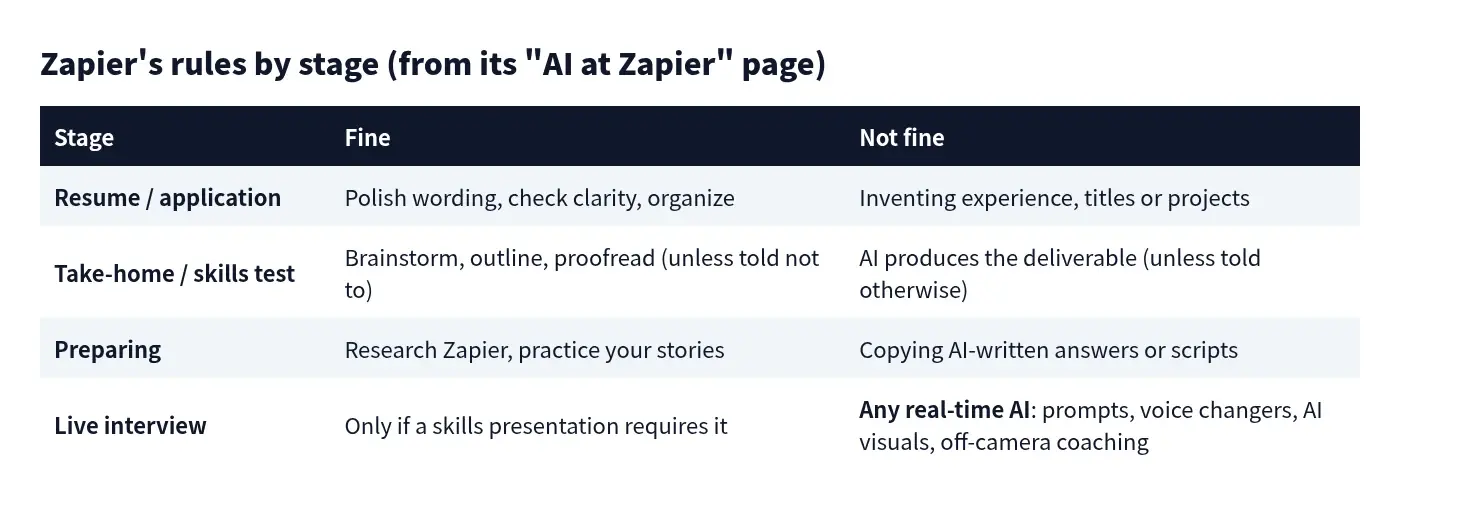
A few lines worth quoting rather than paraphrasing:
- Applying. AI can "polish how you describe your work, check clarity, or organize your resume." What it can't do is create "fake experience, titles, or achievements."
- Take-homes. Use AI "to brainstorm, outline ideas, or proofread, unless otherwise noted to not use it." The "AI slop" column is "having AI complete the task or generate your deliverables (unless we say otherwise)."
- Preparing. Researching Zapier and practicing your stories with AI is fine. "Copying AI-written answers or using AI scripts during interviews" is not.
- Live interviews. "No use of AI is permitted during live interviews, unless it is a required part of a skills presentation." The examples given are prompts, voice changers, AI-generated visuals and off-camera coaching.
Underneath the table are three expectations: use AI "as your collaborator, not your creator", be transparent ("be prepared to share what AI contributed, what you kept, what you changed, and why"), and stay authentic. The sentence that explains the whole policy is this one: "We want to see how you use AI thoughtfully, not how well you can hide it."
One more promise: if a step has an exception to these rules, Zapier says it will be clear about expectations at that step.
The Part That Surprises People: You May Be Interviewed by an AI
The second page is a Zapier recruiting post about "agentic recruiters". If you apply, you may be invited to a recruiter screen with an AI agent. Here is what Zapier says about it.
Why it exists. A recent software engineering posting drew "several thousand applications in just 48 hours". Zapier commits to responding to every candidate within seven days, and says doing initial interviews by hand at that scale would take hundreds of recruiter hours. It also says up to 30% of applications are fraudulent, with fake identities, unverifiable credentials, and "some deepfakes on live interviews".
What the call is.
- After a person reviews your application, you may be invited to a 15-20 minute AI-led screening call.
- The AI asks the same structured questions a human recruiter would, with follow-ups tailored to Zapier's criteria.
- You can do it at your convenience, in your own time zone.
- AI summarizes your responses against a rubric. A human recruiter reads the notes, transcript and recording alongside your application and makes the call on whether you move forward.
What's optional. Participation is "completely optional". Opting out has "no impact on your candidacy" and your application is reviewed as usual. Zapier says it will pilot this with a small number of roles, primarily software engineering, where application volume is highest.
Who decides. "AI does not make hiring decisions at Zapier." The company also says it built safeguards so the AI focuses on the content of answers rather than accents or speech patterns.
The policy page adds a list of other places AI sits in Zapier's hiring: drafting job descriptions, helping screen resumes alongside human review, summarizing interview transcripts through BrightHire, and drafting candidate communications through Ashby.
Two Things That Look Like a Contradiction
You'll read "we encourage AI" and "no AI in live interviews" on the same page, and then discover an AI conducts part of the process. They fit together if you split the process by who is being evaluated:
- Before a conversation (resume, take-home, prep), Zapier evaluates your work product and wants you to use the tools it uses itself.
- During a conversation (live interviews), it evaluates how you think and communicate in the moment. AI in your ear defeats that, which is why the live-interview ban is the one unconditional line.
The AI-led screen is Zapier's side of the process, not yours. The policy page doesn't say whether a candidate may use AI help during that call, and its examples of banned live use (prompts, off-camera coaching) point toward no. The screen exists so Zapier can hear your own story, so plan to answer unassisted, and ask your recruiter if you're unsure.
How to Prepare
What follows is drawn from those two pages plus our own suggestions, which are marked.
For the AI-led screen
- Treat it like a recruiter call: structured questions about your background, with follow-ups. Have two or three real stories ready, each with the situation, what you did and what changed.
- Answer out loud and concisely. A recording and transcript are reviewed by a person afterward, and the AI is following a rubric, so clear, specific answers are easy to score.
- Our suggestion: rehearse speaking to a voice that follows up instead of to a friend who nods. A mock interview with spoken follow-ups is a decent way to get used to the rhythm.
For take-homes
- Use AI the way Zapier lists: brainstorm, outline, proofread. Keep your own reasoning in the deliverable.
- Keep a short note of what AI contributed, what you kept and what you changed. Zapier says to be prepared to share exactly that.
For live interviews
- No second screen, no prompts, no coaching. The policy is unambiguous and the consequence it implies is a lost candidacy over a small edge.
- If a skills presentation involves AI, the assignment should say so. Zapier says it will be clear about exceptions.
For your resume
- AI can tighten bullets. It can't add experience. With roughly three in ten applications described as fraudulent, anything that reads as inflated gets a closer look.
How Zapier compares: GitLab spells out a similar stage-by-stage policy, Datadog publishes its AI guidelines, and Canva and OpenAI go further and build AI into some rounds. The full side-by-side lives in which companies allow AI in coding interviews.
FAQ
Does Zapier allow AI in interviews?
Not live ones. Its guidance says no AI during live interviews unless a skills presentation requires it. It encourages AI for resumes, take-home brainstorming and proofreading, and interview prep, with transparency.
Is Zapier's AI recruiter screen mandatory?
No. Participation is optional, and opting out doesn't affect your candidacy. Zapier describes it as a pilot with a small number of roles, mostly software engineering.
What happens in the AI-led screening call?
A 15-20 minute call where an AI agent asks the same structured questions as a human recruiter, with follow-ups. A human recruiter then reviews the summary, transcript and recording.
Does AI decide whether I get hired at Zapier?
Zapier says no. AI never decides who is hired, rejected or advanced; recruiters and hiring managers decide.
Can I use AI on a Zapier take-home?
To brainstorm, outline or proofread, yes, unless told not to. Having AI produce the deliverable is not OK unless the assignment says so. Be ready to explain what AI contributed.
Why does Zapier use an AI recruiter?
By its account, volume and fraud: thousands of applications in 48 hours for one engineering role, and up to 30% of applications described as fraudulent.
Author · Alex Chen. Career consultant and former tech recruiter. Spent 5 years on the hiring side before switching to help candidates instead. Writes about real interview dynamics, not textbook advice.
Related Articles
Dell and HPE Fresher Interview Process in India: HirePro Tests and Project-Heavy Rounds
Dell and HPE campus drives as candidates describe them: HirePro tests, CGPA cut-offs, funnel sizes, technical and HR rounds, and where posts disagree.
GitLab's AI Interview Policy: What's Allowed at Each Stage
GitLab publishes its AI rules for candidates: welcome in assessments and take-homes, not as a script in live interviews. Here's the stage-by-stage breakdown.
KPIT, Tata Elxsi and LTTS Fresher Interview Process: Engineering R&D Hiring Tests by Year
KPIT, Tata Elxsi and L&T Technology Services campus rounds as candidates describe them: Superset, AON, HirePro and CoCubes tests, C/C++ coding limits, and where posts disagree.