Medical Assistant Interview: How to Prepare for the Questions Nobody Warns You About
A medical assistant interview mixes clinical, admin, and behavioral questions — plus, sometimes, illegal personal ones. Here's how to prepare for all of it.
TL;DR: A medical assistant interview mixes clinical questions (vitals, EHR software, phlebotomy), admin questions, and behavioral scenarios like handling a difficult patient — and occasionally, illegal personal questions about marital status or childcare that small practices ask anyway. Prepare for all three categories, know how to redirect the inappropriate ones professionally, and lean on your certification and clinical-rotation hours even if you have zero paid experience.
You've been to three interviews this month. One asked if you're married. Another wanted to know who watches your kids while you work. A third just wants to see your resume again because you clearly don't have "enough experience" — for a role the posting called entry-level. If this sounds familiar, you're not imagining it, and you're not doing something wrong. Medical assistant hiring is high-volume, often informal, and — especially at small private practices — sometimes runs on questions that shouldn't be asked at all. Here's how to prepare for the interview you'll actually get, not the sanitized version in most prep guides.
What a Medical Assistant Interview Actually Covers
Most medical assistant interviews blend three distinct question types, and the mix depends heavily on the employer:
- Clinical knowledge questions — taking vitals, basic phlebotomy, EHR software experience, ICD-10 basics, sterilization procedures. Some employers add a practical component: a hands-on skills demonstration (drawing blood on a training arm, documenting a mock chart) rather than just talking about it.
- Administrative questions — scheduling, insurance verification, patient intake, multitasking under a full waiting room.
- Behavioral questions — how you handle a difficult or upset patient, how you protect patient confidentiality, what you do when you don't know an answer.
Employer type changes the emphasis. Private practices (family medicine, OB/GYN, dermatology, chiropractic) tend to run more informal, conversational interviews — which is also where candidates report the most boundary-crossing personal questions. Urgent care and hospital systems run more structured, HR-supervised processes with less variance.
The Clinical and Admin Questions You'll Almost Certainly Get
- "How do you take and document vital signs?"
- "What EHR systems have you used?" — naming a specific system (Epic, athenahealth, eClinicalWorks) from your training or rotation is a stronger answer than "I'm familiar with electronic records in general."
- "Walk me through how you'd handle a full waiting room and a physician running behind."
- "How do you ensure patient confidentiality?" — this is really a HIPAA question in disguise; naming HIPAA directly signals you understand the framework, not just the vibe of "keeping things private."
- "What would you do if you didn't know how to answer a patient's question?" — the strong answer is escalation, not guessing: "I'd tell them I'll get the right person to answer that accurately" beats improvising a clinical answer you're not certified to give.
The Questions Nobody Warns You About
Here's the part most interview guides skip entirely. On community forums, medical assistant candidates describe being asked directly by interviewers — including at an OB/GYN and a chiropractic office in one candidate's account — "Are you married?", "Do you have kids?", and "Who watches the kids while you work?" These questions are not legal to ask in a US job interview under EEOC guidance, but that doesn't mean they won't come up, especially in smaller, less HR-structured practices.
You have options, and none of them require confrontation:
- Redirect to the underlying, legitimate concern. The real question behind "who watches your kids" is usually "can you reliably work this schedule." Answer that directly: "I have reliable care arrangements in place and I'm fully available for the hours we discussed."
- Keep it brief and move forward. You don't owe a detailed answer, and over-explaining can invite more follow-up. A short, confident response closes the topic.
- Decide your own threshold in advance. Some candidates choose to answer plainly rather than deflect, and that's a legitimate choice too — there's no single "correct" response, only the one that keeps you comfortable and the conversation moving toward whether you can do the job.
If You Have Little to No Clinical Experience
Entry-level medical assistants are often career-changers or fresh certificate-program graduates, and phone screens with zero paid clinical experience are common. The candidates who struggle most tend to undersell what they actually have: clinical-rotation hours, skills-lab practice, and certification study all count as relevant preparation, even unpaid. Say "During my clinical rotation at [site], I drew blood and roomed patients under supervision for [X] hours" instead of leading with "I don't have much experience yet." One is a credential; the other is an apology.
If you're feeling "under-qualified" for a phone screen despite an interview being scheduled — that's a signal the employer already saw enough on your resume to want to talk to you. The interview exists because they think you might be a fit; treat it that way instead of pre-rejecting yourself.
CMA, RMA, or CCMA — Does the Certification You Hold Matter?
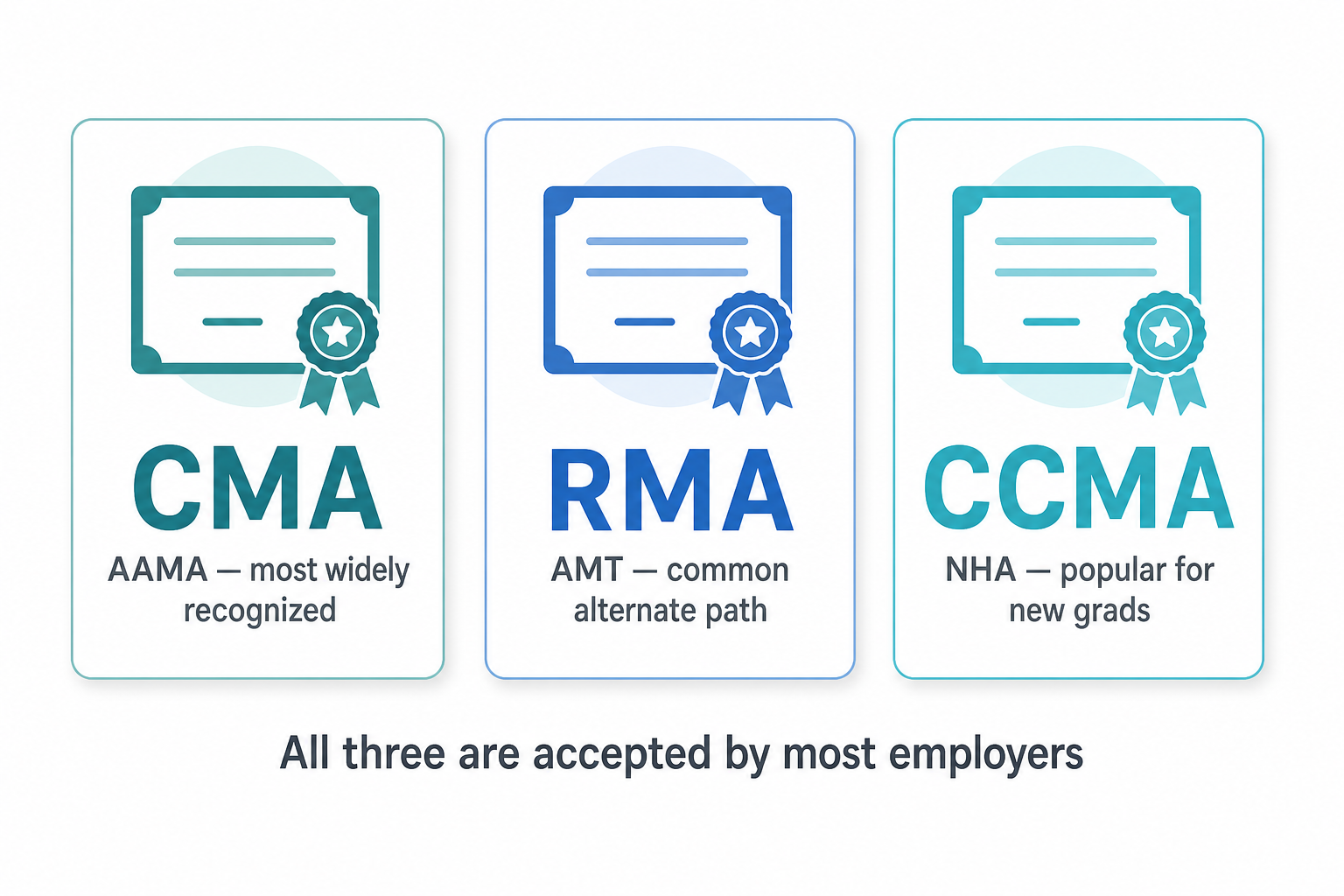
Short answer: not much, for most employers. CMA (through AAMA) is often called the most widely recognized credential, RMA (through AMT) is a common alternate path, and CCMA (through NHA) is popular among newer graduates of shorter certificate programs. According to the Bureau of Labor Statistics, medical assistant employment is projected to grow 12% from 2024 to 2034 — much faster than average, with roughly 112,300 openings projected per year — which means most employers are motivated to accept any recognized certification rather than gatekeeping on which one. If an interviewer asks which you hold, they're usually confirming you're certified at all, not ranking credentials.
How to Actually Practice for This Interview
The generic advice — "use the STAR method," "research the practice," "bring extra resumes" — appears on every medical assistant interview listicle, and none of it is wrong. It's also not enough on its own, because the format that actually trips candidates up is live, back-and-forth conversation under mild pressure: a follow-up question you didn't expect, a scenario question that needs a specific clinical example, or one of the boundary-crossing personal questions above landing when you're not braced for it.
That's the gap real-time practice closes. Running through scenario-based questions out loud — "tell me about a time a patient was upset with you," "walk me through taking vitals on a pediatric patient," "how would you respond if someone asked about your family situation" — and getting immediate feedback on whether your answer actually lands, is a different skill than reading a question bank. AceRound AI runs structured mock interviews for exactly this kind of role-specific practice, so the first time you face an unexpected follow-up isn't during the real interview. If you're preparing for the behavioral side specifically, the behavioral interview questions guide covers the STAR framework in more depth, and the nurse interview preparation guide is a useful adjacent reference if your role overlaps with clinical care duties.
FAQ
Are interviewers allowed to ask if you're married or who watches your kids?
No, not legally in the US — questions about marital status, children, or childcare arrangements are considered discriminatory under EEOC guidance and are not supposed to be asked in a job interview. In practice, candidates report getting these questions anyway, especially from small private practices. You're not obligated to answer directly; a professional redirect like "I have reliable childcare in place and I'm fully available for the schedule we discussed" answers the underlying concern without engaging the inappropriate part.
How do you pass a medical assistant interview with no experience?
Lead with your training program specifics (skills lab hours, clinical rotation site, certification status) instead of apologizing for lack of paid experience. Employers hiring entry-level medical assistants expect to train on their specific EHR and workflow — what they're screening for is reliability, coachability, and basic clinical vocabulary, not years on the job.
What should I wear to a medical assistant interview?
Business casual, not scrubs, unless the employer specifically asks you to come in scrubs for a working interview or skills demonstration. Closed-toe shoes and minimal jewelry signal you already understand clinical safety norms, which registers even before you answer a question.
Why do I keep getting rejected after a lot of interviews?
This is a common, frustrating pattern for entry-level medical assistants, and it's rarely about a single bad answer. The usual culprits are: applying to postings that actually want 1-2 years of experience despite listing "entry-level," underselling clinical-rotation hours as if they don't count as experience, or not naming a specific EHR system when asked (say "I trained on Epic during my rotation" instead of "I'm familiar with electronic records").
Does it matter if I have CMA, RMA, or CCMA instead of one specific certification?
Not in any way that should cost you the interview. CMA (AAMA), RMA (AMT), and CCMA (NHA) are all recognized, active certification paths, and most employers accept any of the three. If an interviewer asks about it, they're usually confirming you're certified at all, not ranking which credential you hold.
Author · Alex Chen. Career consultant and former tech recruiter. Spent 5 years on the hiring side before switching to help candidates instead. Writes about real interview dynamics, not textbook advice.
Related Articles
Does CodeSignal Detect Cheating? What Actually Gets Flagged
Does CodeSignal detect cheating? Yes, via Suspicion Score, LeakSweep, and ID/webcam verification. Here's exactly what triggers a flag and what doesn't.

Why Are You the Best Candidate for This Job?
How to answer 'why are you the best candidate for this job' without sounding cocky, even with less experience than other applicants.

Does CoderPad Detect AI Cheating? What Actually Gets Flagged (2026)
Does CoderPad detect AI cheating? A factual breakdown of paste and IDE-exit alerts, session playback, Screen's plagiarism checks, and what it can't see.