How Do You Stay Organized? Interview Answer + Examples
The best answer to "how do you stay organized" names a real system and tells a STAR story, not just "I make lists." Here is how to build yours.

TL;DR: The strongest answer to "how do you stay organized" names one real system — not a list of habits — and proves it with a short STAR story where the system held up under real pressure. Vague answers ("I make to-do lists," "I'm just a organized person") score lower than specific ones, even when the underlying discipline is identical.
Here's what actually happens in the room: the interviewer asks "how do you stay organized," and most candidates answer with something true but forgettable — "I keep a to-do list," "I use my calendar a lot," "I'm just naturally organized." All three are honest. All three also sound like every other answer the interviewer heard that week.
The question isn't really about tidiness. It's a proxy for something the interviewer can't observe directly in an hour: will this person's work fall apart the moment three deadlines land in the same afternoon? A specific answer — a named system, a real moment it was tested — is the only way to actually answer that in 90 seconds.
Why Interviewers Ask This (What They're Actually Scoring)
"How do you stay organized" rarely appears alone. It shows up as a check on three things at once:
Repeatability. Interviewers aren't asking if you're organized this week. They're asking whether you have a system that survives a bad week — a system, not a mood.
Behavior under load. The honest sub-question is "what happens to your work when priorities collide?" A candidate who describes a system that only holds up in calm conditions hasn't really answered it.
Specificity as a proxy for honesty. Vague answers ("I'm detail-oriented," "I stay on top of things") pattern-match to interview cliché. Concrete answers — a named method, a named tool, a dated example — read as more credible even when the underlying discipline is comparable, because specificity is harder to fake convincingly on the spot.
None of this is about whether your desk is tidy. It's a compressed proxy for reliability.
Two Answers That Actually Work
Most advice assumes you already have a system to describe. In practice, candidates split into two honest starting points — and both can produce a strong answer.
If you're naturally systematic
Don't just name the system — show it surviving contact with real chaos.
"I run a weekly Eisenhower-style priority sort every Monday morning, and I time-block two 90-minute deep-work sessions a day in Google Calendar so meetings can't quietly eat the whole week. Last quarter I was running three client launches at once. I built a shared tracker with color-coded deadlines and a daily 10-minute triage instead of trying to hold it all in my head. All three launched on time, and my manager adopted the tracker template for the rest of the team."
Notice what's doing the work: a named method (Eisenhower-style sort), a concrete habit (time-blocking, specific duration), and a result that outlasted the story (the team adopted it).
If you built a system after struggling (the honest reframe)
This is the answer most competitor advice skips, and it's often the stronger one when told directly.
"I'll be candid — I'm not naturally organized. Early in my career I missed a deadline because I was tracking everything in my head, and that taught me I needed an external system rather than willpower. I adopted GTD: every task gets captured the moment it lands, then sorted into next-actions versus someday-maybe, reviewed weekly. Two years later I haven't missed a deadline, and my team lead now has me help onboard new hires on the same process."
This works because it frames disorganization as a solved past problem, not a live risk. Self-awareness plus a fix is a stronger signal than an unverifiable claim of natural tidiness. If you're not sure whether your real story lands this way, running it past a live interview coach before the real conversation — AceRound AI can play interviewer and probe the follow-ups below — tends to surface the gaps faster than practicing alone.
Structure Your Answer With STAR (Even Though It Doesn't Feel Like a "Story" Question)
Most candidates treat "how do you stay organized" as a values question and answer in the abstract. Interviewers remember stories, not adjectives. Use the same STAR structure you'd use for any behavioral question:
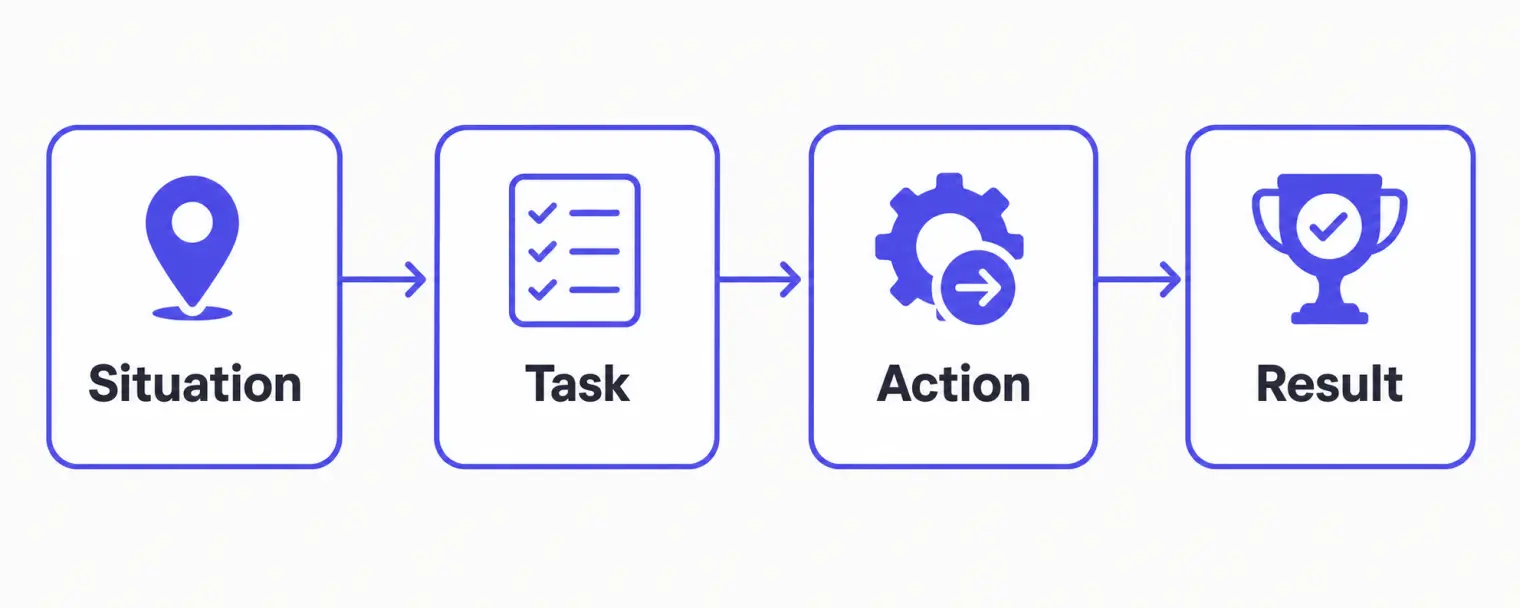
Situation — one sentence of context: what made organization suddenly matter (a busy season, a cross-team project, a period with no manager oversight).
Task — what you were responsible for holding together, and why the stakes were real (a missed handoff, a client deadline, competing priorities from two managers).
Action — the actual mechanics of your system: what you capture, where, how often you review it. This is where the named method or tool belongs.
Result — what happened because the system held: on-time delivery, a mistake that didn't happen, a process your team later adopted.
The failure mode to avoid: skipping straight from "I use Notion" to "it works great," with no situation where it was actually tested. That's a description of a habit, not evidence of a skill.
Name Real Systems, Not Vague Claims
The single biggest gap between a forgettable answer and a memorable one is specificity. Compare:
| Vague (skip this) | Specific (use this) |
|---|---|
| "I make to-do lists" | "I use GTD — capture everything the moment it lands, sort into next-actions vs. someday-maybe, review weekly" |
| "I stay on top of my calendar" | "I time-block two 90-minute focus sessions daily so meetings can't eat deep work" |
| "I prioritize well" | "I run an Eisenhower urgent/important sort every Monday before planning the week" |
| "I'm just organized" | "I built a shared Notion tracker with color-coded deadlines after a missed handoff taught me I needed one" |
You don't need to invent a system for the interview. Pick the one you actually use — Getting Things Done, the Eisenhower Matrix, simple time-blocking, or a tool like Notion, Todoist, or Asana — and describe it in one clear sentence before moving to the story. Naming an actual method signals you use it daily rather than reciting an interview script.
Remote and Hybrid Work: Show Async Organization, Not Just Tools
If you're interviewing for a remote or hybrid role, calendar management alone under-answers the question. Remote teams care more about whether your organization system keeps other people unblocked when you're not online.
Strong remote-specific framing:
"My team spans three time zones, so my system is async-first: task ownership lives in Asana so nothing depends on someone being online to hand it off, status updates go through short recorded updates instead of live meetings, and I close every day with a written summary of blockers in our team channel. That cut our average task turnaround by a third because nobody was waiting on a live sync to get unblocked."
The signal here isn't the tool — it's that your organization system accounts for people who aren't in the room, which is precisely what a remote hiring manager is trying to screen for.
Follow-Up Questions to Prepare For
A confident first answer often triggers a follow-up that tests whether the system is real or rehearsed. Prepare for:
- "Tell me about a time you dropped the ball anyway." — Tests honesty. Claiming a system with zero failures reads as evasive, not impressive.
- "How do you handle competing deadlines from two different managers?" — Tests prioritization under conflicting authority, not just personal task management.
- "How do you organize a team, not just yourself?" — Tests whether your system scales past personal habits into shared process.
- "How would your coworkers describe your organizational style?" — Tests self-awareness against external perception. See our full breakdown of this exact question if it comes up on its own.
- "How do you physically or digitally organize your workspace?" — A concrete, lower-stakes probe that still expects specifics, not "it's pretty tidy."
Have a short, honest answer ready for the "dropped the ball" question specifically. A single believable miss, with what you changed afterward, makes the rest of your answer more credible — not less.
Common Mistakes That Undercut a Strong Answer
Listing three habits instead of naming one system. "I use a planner, I set reminders, and I check my email first thing" is a list of behaviors, not a system. Interviewers can't tell if it holds together under pressure.
No story, just a description. "I stay organized by prioritizing tasks" tells the interviewer nothing they couldn't guess. Show it being tested.
Overclaiming perfection. "I never miss anything" invites a skeptical follow-up and, if pushed, an answer that contradicts itself.
Generic tool-dropping with no method behind it. Naming Notion or Asana without explaining how you use it is close to naming no tool at all — the tool is the artifact, not the substance.
Answering as if this is a personality question. "I'm just a very organized person" is unfalsifiable and easy to forget five minutes later. A named method plus a dated example is not.
How to Practice This With AI
The gap between "I have an organization system" and delivering it as a tight, specific 90-second answer usually only shows up out loud. A simple workflow:
- Draft your raw story with no structure — just the facts, chronologically.
- Run a mock interview in AceRound AI focused on this question, followed by the five follow-up probes above.
- Record and listen back. Most candidates discover they spend too long on the situation and rush the result — the part that actually lands.
- Iterate until you can tell the same story slightly differently each time while keeping the method, the moment, and the result intact.
Two or three rounds over a couple of days is usually enough for the answer to sound like something you know, not something you memorized. For how this fits into broader behavioral prep, see our behavioral interview questions guide.
FAQ
What is a good answer for how do you stay organized?
Name one real system, not three vague habits. Pick a framework you actually use (GTD, time-blocking, the Eisenhower Matrix, or a specific tool like Notion or Todoist), describe how it works in one sentence, then back it with a short STAR story showing it under real pressure. "I make to-do lists" is not a system; naming the method and showing the moment it mattered is.
How do you answer if you are not naturally organized?
Reframe it honestly instead of pretending. Say you are not naturally organized, describe the specific moment that taught you why an external system beats willpower, then explain the system you adopted and the result since. Interviewers read this as self-awareness and problem-solving, which scores higher than a generic claim of being tidy by nature.
What do interviewers actually want to hear when they ask this question?
Three things: that you have a repeatable system rather than relying on memory, that your system holds up under competing deadlines (not just a quiet week), and that you can name specifics — a tool, a method, a real example — instead of describing organization in the abstract.
Should I mention specific tools like Notion or Google Calendar?
Yes. Naming a specific, current tool (Notion, Todoist, Asana, Google Calendar with time-blocking) signals you actually use a system daily rather than reciting an interview cliché. Pair the tool with the method behind it — the tool is the artifact, the method is the substance.
What follow-up questions come after "how do you stay organized"?
Expect "tell me about a time you dropped the ball," "how do you handle competing deadlines from two managers," "how do you organize a team, not just yourself," and "how would your coworkers describe your organizational style." Prepare a second, shorter story for the failure question — claiming you have never missed anything reads as evasive.
How do I show organizational skills for a remote or hybrid job?
Emphasize async-first habits over calendar management alone: how you document decisions so people in other time zones are not blocked, how you communicate status without a live meeting, and how you personally track commitments that span days without a manager checking in.
Author · Alex Chen. Career consultant and former tech recruiter. Spent 5 years on the hiring side before switching to help candidates instead. Writes about real interview dynamics, not textbook advice.
Related Articles

Does Cursor Allow AI in Interviews? Anysphere's Two-Sided Policy
Cursor's maker bans AI in round one to test raw skill, then hands you an 8-hour paid project where using AI well is the entire grade. Here's how the two rounds actually differ.

The Internal Transfer Interview: What Actually Changes at Google and Amazon
Fewer rounds doesn't mean lower stakes. How Google and Amazon's internal transfer mechanics — tenure rules, manager notification, bar raisers — actually differ from an external hire.

Databricks Interview: The Concurrency Round Nobody Warns You About
Databricks runs a full hour on multithreading alone, and reportedly grades system design in a Google Doc, not a whiteboard tool. Here's what candidates say.