How Would Your Coworkers Describe You? The Answer That Isn't a Cliché
Learn why interviewers ask how your coworkers would describe you, why 'hardworking team player' backfires, and how to build a self-aware, credible answer.

TL;DR: "How would your coworkers describe you?" isn't a request for three nice adjectives — it's a test of whether your self-image matches your actual reputation. The safest-sounding answer ("hardworking team player") is the one trained interviewers trust least, because it gives them zero real signal and sounds rehearsed.
You've prepped for "tell me about yourself." You've got a failure story ready. Then the interviewer asks, almost casually: "How would your coworkers describe you?" — and you freeze for half a second, because you've never actually asked them.
That half-second of hesitation is the point. This question isn't really about vocabulary. It's about whether you know something true about your own reputation, or whether you're about to improvise something that sounds nice.
Why This Question Actually Gets Asked
Harvard Business Review researcher Tasha Eurich ran a series of studies — roughly 5,000 participants across 10 investigations — and found that only 10 to 15% of people are genuinely self-aware, meaning most people's internal self-view and how others actually perceive them diverge more than they'd guess. Interviewers ask this question precisely because it's hard to fake convincingly — either your answer matches what a reference check will reveal, or it doesn't, and experienced interviewers can often tell the difference from how specific (or vague) your answer is.
This is a fundamentally different test than "what are your strengths?" That question asks what you believe about yourself. This one asks whether you understand how you land with the people who actually work next to you every day — which is a much harder thing to fabricate on the spot.
The Cliché Trap
Here's what almost every generic interview-prep article gets wrong: they tell you to "pick 2-3 positive traits and back them with an example," without warning you which traits actively hurt you.
"Hardworking." "Team player." "Dedicated." "Detail-oriented." These aren't wrong, exactly — they're just identical to what every other candidate says, which means they carry no information. Worse, research on impression-management tactics in interviews shows that trained interviewers are specifically calibrated to notice when an answer sounds like a performance rather than a description — and generic virtue-words are the single most common tell.
A 2024 study in the Journal of Business and Psychology found that authenticity cues in interview answers correlate with both interviewer ratings and actual job performance — in other words, sounding genuine isn't just a "soft" preference, it predicts real outcomes. The fix isn't a better adjective. It's a more specific, harder-to-fake description.
The Triangulation Framework
The strongest answers don't offer one flat list of traits — they show you're aware you're perceived differently by different people, and that this variation itself is a form of self-knowledge. This maps roughly to the Johari Window concept from organizational psychology: there's a version of you visible to peers, a version visible to your manager, and a version visible to people outside your immediate team, and they're not identical.
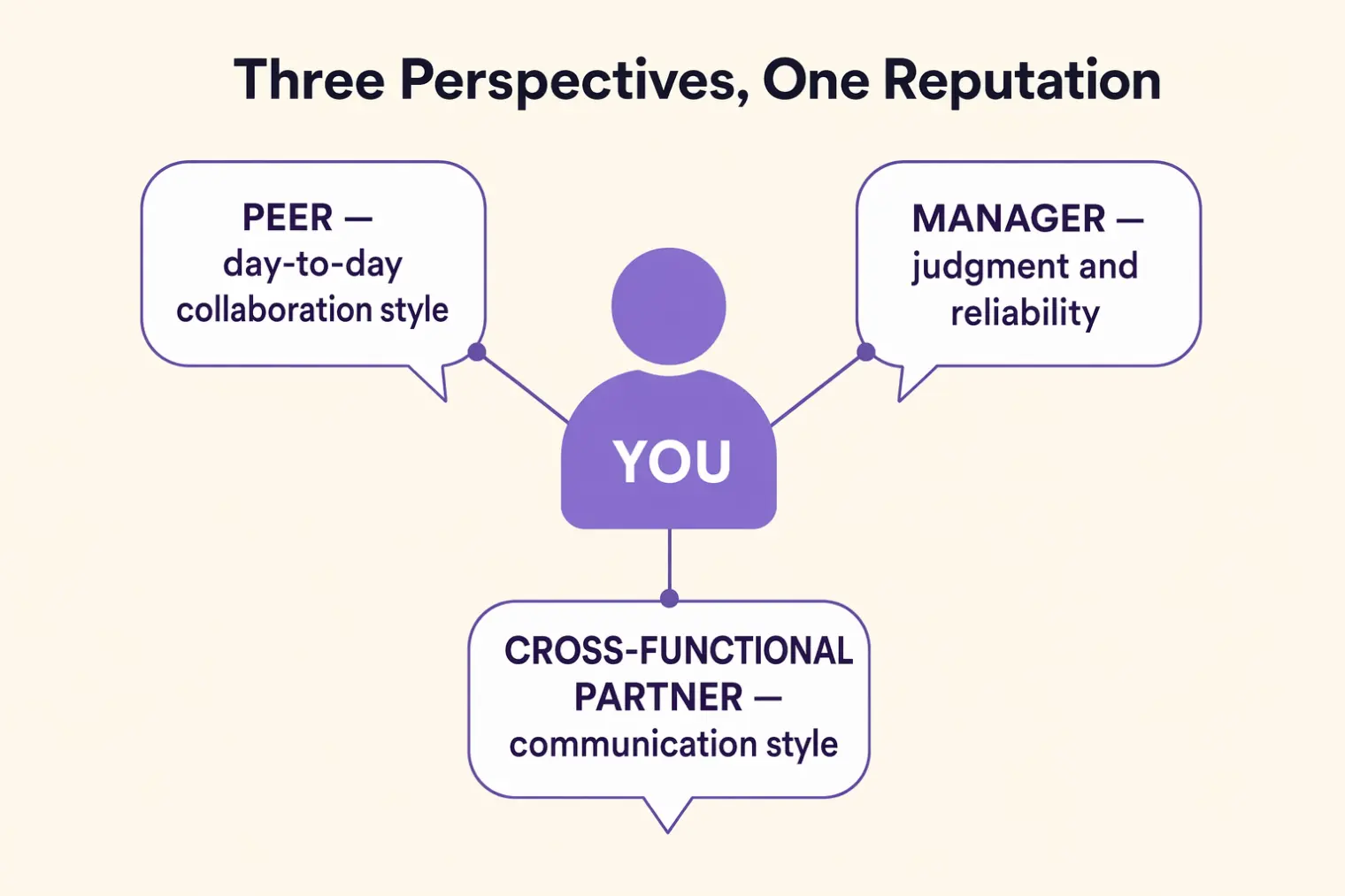
Try structuring your answer in three parts:
- How a peer would describe you — usually about day-to-day collaboration style. ("A peer on my last team would probably say I'm the person who asks the annoying clarifying question in planning meetings — the one that saves us from building the wrong thing.")
- How your manager would describe you — usually about judgment and reliability. ("My last manager described me, almost word for word, as someone she didn't have to double-check.")
- How a cross-functional partner would describe you — usually about communication style. ("Someone in sales I worked with regularly once said I was the only person in engineering who'd actually explain a delay in plain language instead of jargon.")
You don't need all three in every answer — even naming two, with the awareness that they're not identical, does more work than a single tidy adjective list. It signals you've actually thought about your reputation from multiple angles, not just rehearsed a script in the mirror.
What If You Genuinely Don't Know?
If you're staring at this question with no idea what your coworkers would actually say, don't invent something plausible-sounding. Ask.
Message two or three people from meaningfully different working relationships — a peer, someone you've mentored or managed, someone from an adjacent team — and ask directly what one or two words they'd use to describe working with you. Cross-reference that against your last two performance reviews, which usually contain language you can borrow almost verbatim (and which is, conveniently, defensible if a reference check ever happens).
The pattern that shows up across multiple sources — not the nicest-sounding word, the one that actually repeats — is your real answer.
Related Variants You'll Also Hear
Interviewers rotate through close variants of this same underlying question, and preparing one framework covers all of them:
- "How would your boss describe you?" — treat this as evaluating judgment and reliability under deadline pressure specifically, distinct from the peer-collaboration angle.
- "Describe yourself in three words." — same trap, same fix: specific over generic, one example ready per word.
- "Tell me about yourself" and "what are your strengths?" — related but distinct; those ask what you claim about yourself, this one asks what's actually observable from the outside.
Practicing the Answer Out Loud
The hard part of this question isn't knowing the framework — it's saying it out loud without sounding like you're reciting a Johari Window diagram. Answers that work in your head often come out stiff the first time you say them to another person.
Running through it with a real conversational partner, or a live AI mock interview that can ask a natural follow-up ("what would your manager say instead?"), tends to expose the parts that still sound rehearsed faster than silent rehearsal does.
FAQ
How would your coworkers describe you — what's a good answer? A good answer names 2-3 traits that are specific to how you work with others (not generic virtues), backs each with a short concrete example, and — ideally — shows you know you're seen slightly differently by different people, which signals real self-awareness rather than a rehearsed line.
How would your boss describe you? Treat this as a distinct question from the coworker version — a boss usually evaluates your judgment, reliability under deadline pressure, and how much oversight you need, while coworkers evaluate collaboration and day-to-day working style. Prepare a separate, boss-specific example.
Why do interviewers ask how your coworkers would describe you? Interviewers are testing the gap between your self-image and your actual reputation. Research on self-awareness (Tasha Eurich, Harvard Business Review) finds only 10-15% of people are genuinely self-aware — meaning most candidates' self-description doesn't match how others actually experience them, which is exactly what this question is designed to surface.
Is "hardworking team player" a bad answer? Yes — not because it's false, but because it's the same three words every other candidate says, and trained interviewers read generic virtue-words as a sign you haven't thought carefully about your actual reputation, or worse, that you're managing their impression of you rather than answering honestly.
What if I genuinely don't know how my coworkers see me? Don't guess — ask. Message two or three colleagues from different working relationships (a peer, someone you managed or mentored, someone from another team) and ask directly what one or two words they'd use. Cross-reference with your last two performance reviews. The pattern that repeats across sources is your real answer.
Describe yourself in three words for an interview This is a close variant of the same question, usually asked without the coworker framing. The same rule applies: avoid generic virtue-adjectives, pick words specific enough that a stranger couldn't guess them from your job title alone, and have one example ready per word.
Author · Alex Chen. Career consultant and former tech recruiter. Spent 5 years on the hiring side before switching to help candidates instead. Writes about real interview dynamics, not textbook advice.
Related Articles
Datadog Interview Process (2026): What's Allowed With AI, Round by Round
Datadog publishes its AI rules for candidates. Here's what they allow, what they ban, the reported loop, and how to prep for the project deep dive.
Figma Software Engineer Interview Process (2026): What's Reported
Figma publishes no interview rubric. Here's the loop candidates report, the product-flavored coding and design rounds, and what's known about an AI round.

Oracle and PayPal Fresher Interview Process in India: What Candidates Reported, Year by Year
Oracle India's test moved from aptitude plus core CS to HackerRank with a REST API task. PayPal's cut-offs and platform also differ. Posts compared.