Freshworks and Postman Interview Process in India: HackerRank and LLD vs Take-Home and Pairing
Freshworks runs a HackerRank test and design round; Postman describes a take-home, a pairing review and system design, with AI tools allowed. What campus and candidate posts say, and where they disagree.
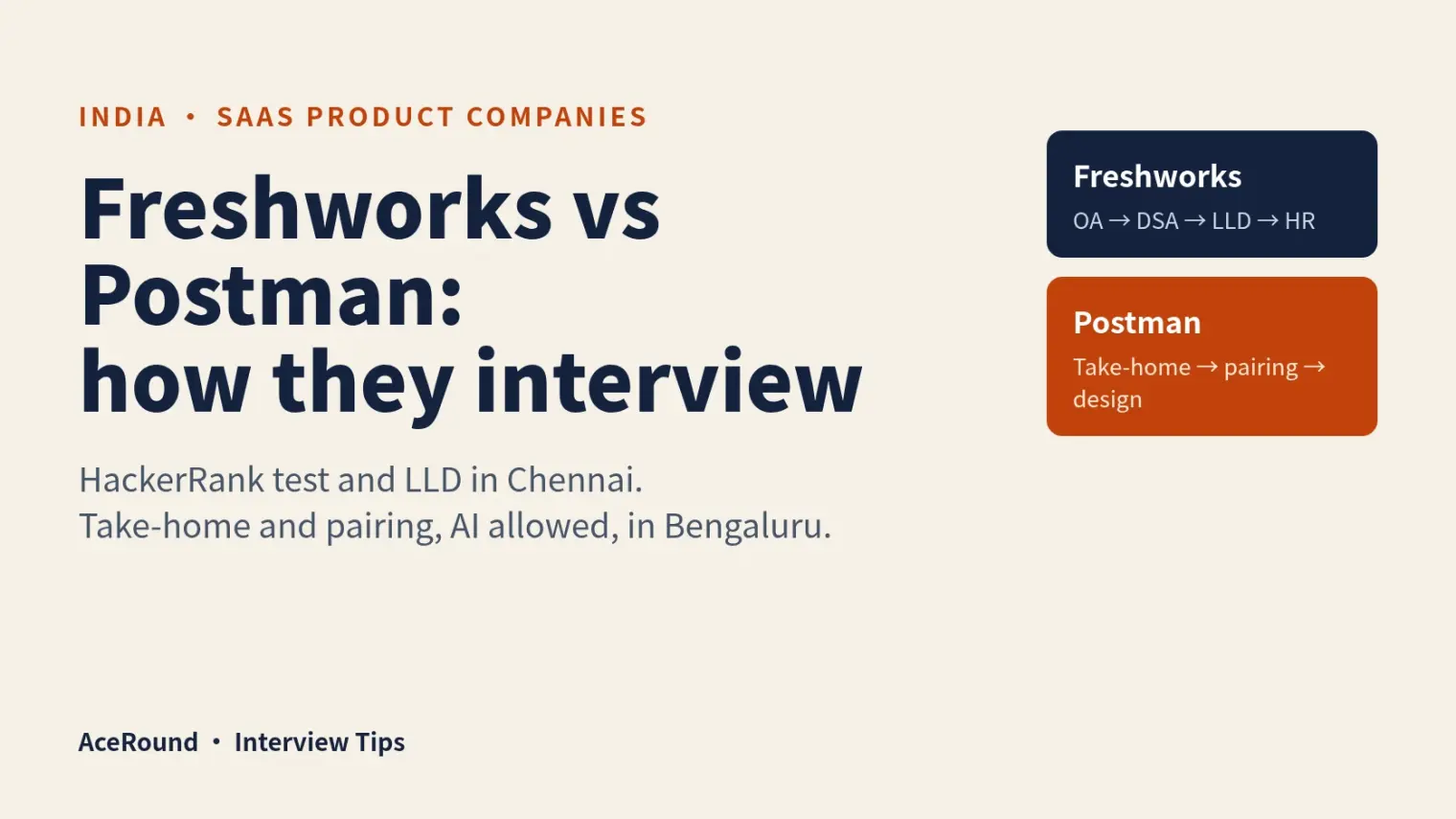
For anyone holding a Freshworks or Postman link. They're the two Indian SaaS product companies where the interview doesn't look like the service-firm pipeline or the fintech unicorn rounds, and the two have almost nothing in common with each other.
TL;DR: Freshworks, from the posts I found, is a funnel: a timed HackerRank test, an assignment, then face-to-face rounds that thin the batch from hundreds to a handful. Postman, from its own engineering lead, is the opposite: a take-home you do with any tools you like, then a conversation where you explain your choices. Evidence for both is thinner than for the big IT firms, and I say where.
I read the pages I could open: three GeeksforGeeks campus posts, two prep guides for Freshworks, and one official Postman blog post plus an older Postman candidate account. I left BrowserStack and Chargebee out. The accounts I found for them were SDE-1 or SDE-2 posts I couldn't open, and a half-read post is worse than none.
Freshworks: A Funnel That Narrows Fast
Freshworks is Chennai-headquartered, and the fresher posts I found are campus drives, one of them from Sastra University in Thanjavur.
Round 1, the online test. Two posts describe a 75-minute test with 4 questions, and one names HackerRank. The Sastra University candidate says out of 350 students 87 moved on. Another says 3 of 4 solved, and about 40 of 300 qualified. Those pass rates are one drive each, so read them as "most people don't clear this", not as a rate.
Round 2, the build or written round. This is where the posts diverge. The Sastra post gave a front-end or back-end problem statement with 12 to 15 hours, and 47 of 87 went through. A 2020-era post (the author applied in November 2020) had a take-home too: build a file-based key-value store with create, read and delete, as a library with a class interface. The third post instead had a 40-minute written test with two problems on OOP and linked lists. The third one is a different shape from the other two, so whichever year you're in, ask.
Rounds 3 and 4, face to face. The Sastra candidate had 15 interview panels, one per candidate, and got arrays, kth-largest, lowest common ancestor, tree traversals and a sudoku data-structure question, with live code. The next round moved to OOP (upcasting, abstract classes, static and final), ACID, and two puzzles, bridge crossing and egg dropping. The 2020-era post split rounds into a front-end interviewer and a back-end one, with string clean-up and linked-list deletion problems, plus the "move one numeral to fix 101 − 102 = 1" puzzle. Another candidate was asked puzzles of this kind in a round where 5 of 14 moved on, and wasn't one of them. I can't say the puzzles were the reason, but expect them.
HR. Short and friendly in both selected accounts: why Freshworks, were you rejected elsewhere, and whether you're ready for a six-month internship. Both selected authors were asked whether they're ready for a six-month internship, and one reports the verdict as intern plus full-time offer.
What the newer guides add. Two 2026 prep sites describe five or six stages over three to six weeks, a low-level design round for SDE-1 (parking lot, library system, vending machine, a fault-tolerant scraper), and a bar-raiser round with a senior engineer from another team. One of them says readable, modular code is weighted over passing every case. I couldn't find a first-hand fresher post confirming the LLD round, so I'd call it likely rather than certain. The two guides also disagree on the test: one says about 3 medium-to-hard problems on HackerRank or Mercer | Mettl, the other says 2 problems plus MCQs on OS, DBMS and OOP.
On pay: I found no sourced figure for Freshworks, so I'm leaving it out.
Postman: One Engineer Published the Whole Process
In April 2026 a Postman engineer who leads the Codegen team published the process he designed for his team. It runs in four steps:
- Take-home task. No timer, your own environment, whatever tools you like. He says the goal "is not to submit a correct answer" but to make deliberate choices and be ready to talk about them.
- Pairing code review. An engineer walks through your submission and asks questions. He says it isn't a defence and isn't graded for correctness: it's whether you can explain the tradeoffs.
- System design. There's no fully defined spec on purpose. He says the more senior the candidate, the more they should lead, and that asking clarifying questions before designing is what impresses most.
- Culture and motivation conversation. He says they don't want rehearsed answers.
The AI policy is explicit in his words: candidates can Google, use Claude Code, and bring their own laptop and IDE. His example is that "if Claude Code wrote half your solution, that's totally fine", and what isn't fine is being unable to explain how it works or why you accepted its suggestions.
Two cautions. This describes his team, and the post doesn't say which roles or locations it covers. And it doesn't match the older account I found: a 2021 Staff Engineer post on Taro has a 30-minute hiring manager screen, a 45-minute screen-shared coding round on a caching module and a 45-minute design round. So the process has changed, or it varies by team. A search aggregator also lists a File Directory manager in React as a coding task and a 3 to 4 week timeline, which I couldn't open to check.
On pay: Levels.fyi shows self-reported total compensation for Postman India from about $31K at IC1 to about $119K at IC4, with 99 submissions as of 1 October 2026. I found no verified fresher figure, and I'd read that table as a rough ceiling guide.
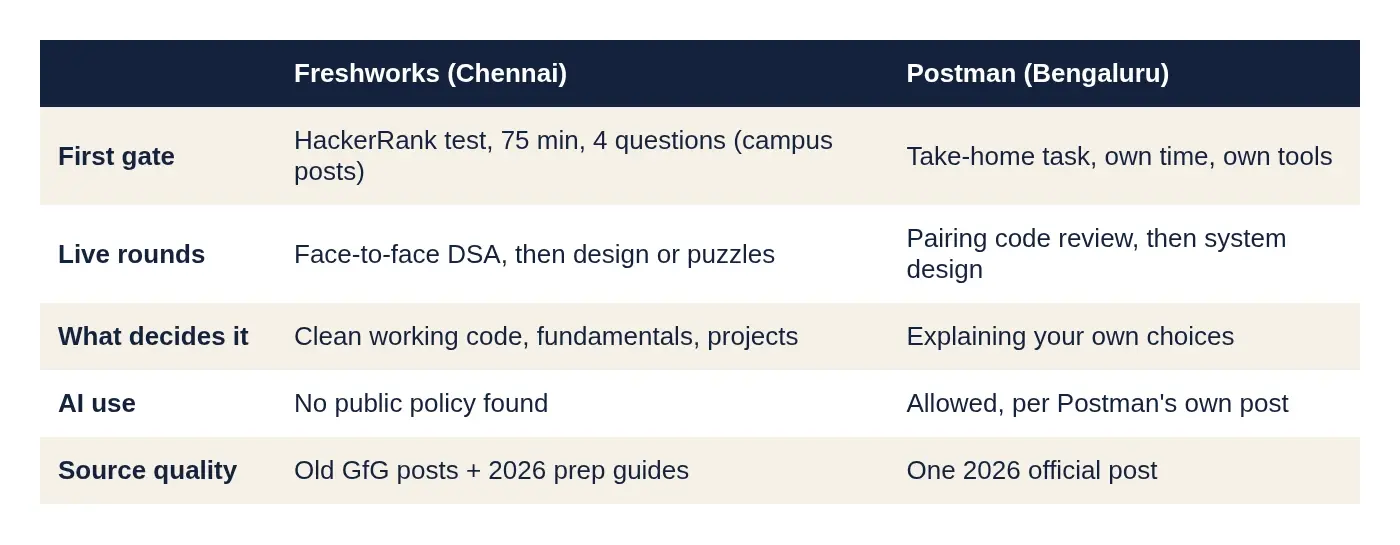
Side by Side
How to Prep for Each
Freshworks: drill the timed test first, because that's where hundreds become tens. Four questions in 75 minutes means getting the easy ones out cleanly and submitting a brute force before optimising. Then rehearse a small design problem from scratch (a parking lot with three vehicle types is enough), writing classes you could run. Revise OOP basics and ACID, and have a few puzzles ready.
For the HackerRank stage, OA Copilot (for online assessments on HackerRank, CodeSignal, Codility and similar) is built around that kind of timed round. The campus posts describe candidates using Google and friends, but your own invite and the proctoring terms shown before the test are what govern your drive, so read them first.
Postman: practising LeetCode won't rehearse this. Build the take-home properly, then keep a short note of three decisions you made and one thing you'd change with more time. When the pairing session comes, you'll be explaining out loud, and a mock interview where you walk someone through your own code is closer to that than another coding drill. If you used AI in the build, be able to say what you accepted, what you rewrote and why.
For both: the Postman post and a 2021 Postman account both involve screen-shared work, and the Freshworks test is taken from home in the Sastra account, so check your setup the day before.
If you're running several drives at once, the multiple placement drives guide covers how to split your time, and the product-based OA guide covers the platforms that turn up here too.
FAQ
How many rounds does the Freshworks interview have for freshers?
Campus posts describe a coding test, an assignment or written round, two face-to-face technical interviews and HR. Newer guides list five to six stages. The posts are mostly older, so treat that as a shape and read your own invite.
What platform does the Freshworks coding test use?
Two campus posts describe 4 questions in 75 minutes, one naming HackerRank. A prep site says HackerRank or Mercer | Mettl, and another says 2 problems plus MCQs. They disagree, so trust your invite.
What is the Freshworks LLD round?
A design interview where you turn a small system, like a parking lot or vending machine, into classes and methods. Guides say it mainly applies to SDE-1 and that readable, modular code counts for more than passing every case. I found no first-hand fresher post confirming it.
What is the Postman interview process?
A Postman engineering lead published it in April 2026: a take-home, a pairing review of your code, system design, then a fit conversation. It describes his team and may differ elsewhere.
Can I use AI in the Postman interview?
His post says yes, including Claude Code, as long as you can explain how the solution works and why you accepted what the AI suggested. That's Postman's statement, not a norm.
What is the salary at Postman in India?
Levels.fyi self-reports run from about $31K at IC1 to about $119K at IC4, with 99 submissions as of 1 October 2026. There's no official table and I found no verified fresher figure.
Author · Alex Chen. Career consultant and former tech recruiter. Spent 5 years on the hiring side before switching to help candidates instead. Writes about real interview dynamics, not textbook advice.
Related Articles
Airbnb Software Engineer Interview: The Core Values Round, Explained
Airbnb's four core values are public, but the interview round built on them isn't documented. Here's what's official, what candidates report, and how to prepare.
Cisco and Intuit Fresher Interview Process in India: Official vs Reported
Cisco's own Code with Cisco page, a third-party guide and one Intuit SDE-1 account differ on rounds and timing. What each says, and how to prep.
Meesho SDE-1 Interview Process for Freshers: Three 2025 Accounts Compared
Meesho SDE-1 campus accounts from 2025 disagree on test length, round order and design format. Here is what each reported and how to prep for any of them.