Firefighter Interview Questions: How to Pass the Oral Board
What a firefighter oral board panel actually scores, real interview questions candidates have faced, and how AI mock practice preps you before you walk in.
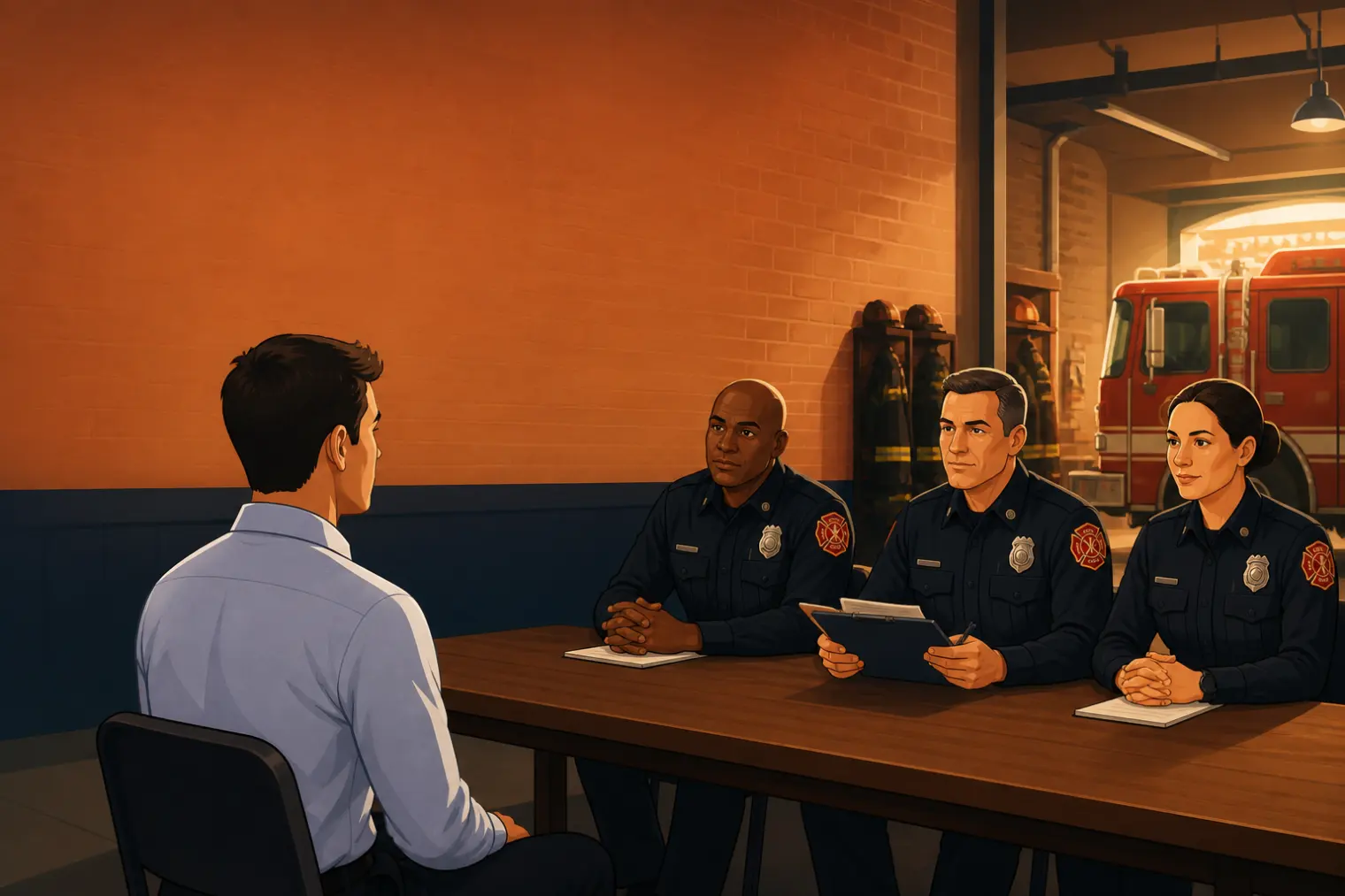
TL;DR: A firefighter oral board is a scored panel exam, not a conversation — typically 3 to 5 evaluators, 45 to 90 minutes, each scoring your answers independently on background, teamwork, stress, and judgment scenarios. Firefighter interview AI prep works best as pre-board drilling, not live assistance — you can't glance at a screen while a panel watches you across a table. This guide covers the real questions candidates have faced, how scoring actually works, and how to use AI mock practice to stop freezing when the board puts you on the spot.
One department's hiring round drew roughly 3,000 applicants for 12 open positions. By the time you're sitting in front of the oral board, you've already survived the written test, the physical ability test, and a stack of paperwork — and you're now competing against hundreds of people who know the same sample questions you do. The oral board is where departments separate candidates who memorized answers from candidates who can actually think out loud under a panel's eyes.
Here's what the board really looks like, the questions candidates have actually faced, and where AI-assisted practice fills the gap that static question lists leave open.
What a Firefighter Oral Board Actually Looks Like
Most candidates picture a friendly conversation with a few firefighters. It's closer to a timed exam with a human interface.
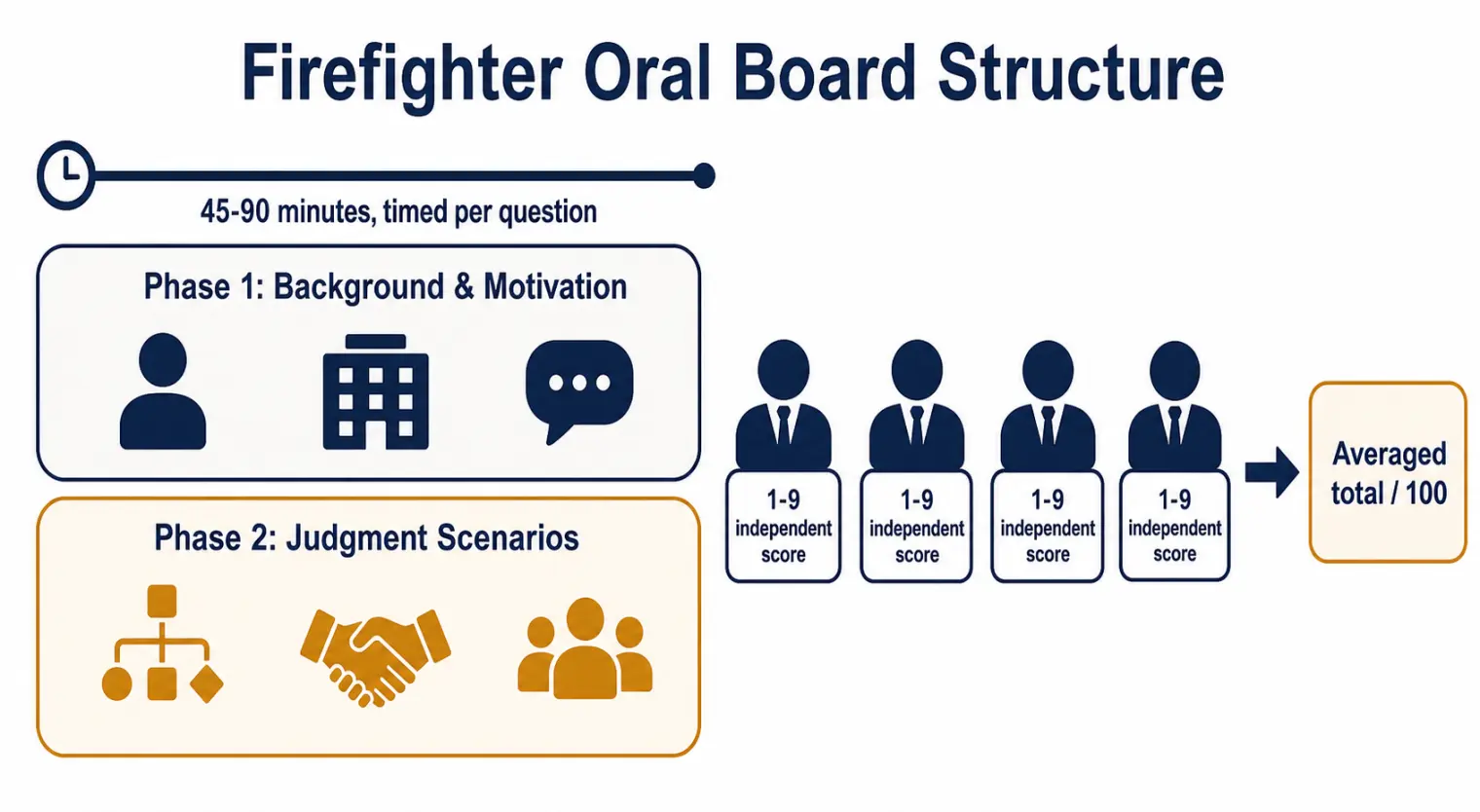
The panel: typically 3 to 5 evaluators — a captain, a battalion chief, sometimes a union representative or a civilian HR member. Each one scores you independently, without conferring with the others during your answers.
The duration: 45 to 90 minutes, with specific time limits per question in many departments. A promotional or leadership-track oral board can run 90 to 120 minutes and adds budget, political, and supervisory scenario questions on top of the standard set.
The structure: almost every department runs a two-part format:
- Background and motivation — who you are, why firefighting, why this department specifically.
- Situational and values-based scenarios — hypothetical crew or public situations that test how you'd actually reason and act, not what you can recite.
The scoring: each panelist rates your answers independently, and the scores are averaged into a final total. There's no partial credit for a nervous, rambling version of the right answer — the board is grading how clearly and calmly you communicate under time pressure, not just whether the content was correct.
Real Firefighter Oral Board Interview Questions (and What They're Testing)
These firefighter interview questions and answers recur across departments and hiring cycles, organized by what they're actually measuring.
Background and motivation
- "Tell us about yourself." A short self-pitch. Panels have heard hundreds of these and can spot a memorized paragraph immediately — specificity beats polish.
- "Why do you want to be a firefighter?" Generic answers ("I've always wanted to help people") score low. A specific moment — a ride-along, a mentor, an experience that shaped the decision — scores higher.
- "Why this department, specifically?" This is a research question disguised as a motivation question. Panels can tell within a sentence whether you looked into the department or copy-pasted a generic answer.
Situational and values scenarios
- "What are three attributes every firefighter should have?" A real oral board question one candidate recounted after failing the board — deceptively simple, and panels are listening for whether your answer connects to lived evidence, not a list of adjectives.
- Teamwork and trust: describe a time you had to earn a team's trust quickly, or resolve friction with a coworker. Panels are scoring whether you take ownership of your part in the friction, not just how the story ends.
- Handling stress and feedback: how you've responded to criticism or a high-pressure moment. The panel is watching for defensiveness — one wrong reaction here can outweigh a strong answer everywhere else.
- The no-easy-answer judgment question: scenarios with no single correct response, such as being asked to make a call typically reserved for a supervisor with no one to consult. Multiple candidates describe this as the hardest moment of the board — not because the topic is obscure, but because it's delivered live with no time to prepare, in front of 5 or more evaluators.
The part almost nobody warns you about: live follow-up probing. Panels routinely push back on your first answer — "what if that didn't work?" or "why that response and not another?" — and it's rarely covered in prep content, even though it's exactly where memorized answers fall apart.
Why Knowing the Answers Isn't Enough
Reddit threads from firefighter candidates share a consistent pattern. One candidate described the board's questions as "actually very straightforward," then added: "I just go blank when put on the spot." Another, recapping a set of questions they failed, asked strangers online how they would have answered — not because they didn't know the content going in, but because the moment of live delivery scrambled it.
This is the gap static prep content can't close. A 50-question PDF teaches you what might be asked. It does nothing to prepare you for the actual experience of a stranger with a clipboard asking a harder version of your answer 10 seconds after you finish talking.
How AI-Assisted Practice Actually Helps Here
One honest caveat first: a firefighter oral board is in-person and unscripted by design, so real-time screen assistance isn't the right tool for the room — you can't check a screen while 3 to 5 evaluators are watching you across a table. Where AI-assisted prep genuinely helps is before you walk in, not during.
1. Rehearse the follow-up, not just the opening answer.
Load your background stories and scenario answers into an AI mock interview tool and have it fire an unscripted "why would/wouldn't you do that?" probe right after — the exact skill the board tests and the one thing static question lists can't simulate. AceRound AI can run this kind of back-and-forth practice loop and flag answers that sound rehearsed instead of reasoned.
2. Pressure-test your scenario judgment.
Describe a teamwork or values scenario, give your answer, then have an AI tool push back the way a panelist would — "you said you'd talk to them privately first, what if that already failed?" This surfaces gaps in your reasoning before a real panel does.
3. Time your answers.
Background answers should land in roughly 60 to 90 seconds; scenario answers can run longer. Practicing against a timer — human or AI — prevents the ten-second non-answer and the three-minute ramble that loses a panel halfway through.
4. Get honest feedback on delivery, not just content.
It's hard to hear your own filler words, pacing, or hedging in the moment. An AI practice partner reviewing a recorded answer can flag "you said 'you know' eight times" in a way a mirror never will.
A Practical Two-Week Prep Plan
If you're wondering how to pass a firefighter interview on a deadline, here's the compressed version:
- Days 1-3: Write one specific, evidence-backed story for each category — motivation, teamwork, stress/feedback, and a values judgment call. Research the department specifically so "why here" has real substance behind it.
- Days 4-7: Say every answer out loud, timed. Record one attempt and listen back for filler words and pacing.
- Days 8-11: Practice the follow-up loop — have someone, or an AI tool, push back on each answer with an unscripted "why" or "what if," and answer without pausing to reset.
- Days 12-13: Run a full mock board — every question, back to back, at real interview length (45-90 minutes), no breaks between questions.
- Day 14: Rest. Skim your notes once, lightly. Cramming new material the night before produces memorization, not readiness — and a board can tell the difference.
Frequently Asked Questions
What is the hardest question in a firefighter oral board interview?
Candidates most often cite the no-easy-answer scenario questions — things like listing three attributes every firefighter should have, or being pushed on a judgment call with no clean textbook answer. The difficulty usually isn't the topic itself, it's that a panelist follows up in real time with a harder version of your own answer, and there's no script for that. Practicing the follow-up, not just the opening line, is what actually prepares you.
My firefighter oral board interview is tomorrow. What should I do right now?
Don't cram new material. Re-read your own notes on why this department specifically, pick one clean story each for teamwork, handling stress, and a time you were held accountable, and say them out loud once, timed. Boards can tell when someone recites a paragraph versus recalls a real memory — a calm run-through beats last-minute new content every time.
What questions are asked in a firefighter interview?
Expect a mix across categories: motivation and background (why firefighting, why this department), teamwork and trust, handling stress or criticism, and situational judgment scenarios where you're asked how you'd react to a hypothetical crew or public situation. Almost every board also asks at least one values question with no single correct answer, designed to see how you reason out loud.
How is a firefighter oral board interview scored?
A panel of 3 to 5 evaluators — often a captain, a battalion chief, sometimes a union rep or civilian HR member — each score your answers independently, usually on a numeric scale, and the scores are averaged into your final result. The board is timed, typically 45 to 90 minutes total with time limits per question, and it's run as a structured exam, not a conversation.
Why do candidates who know the material still freeze in a firefighter oral board?
Because knowing what to say and delivering it out loud, on the clock, in front of 3 to 5 strangers scoring every word, are two different skills. Reddit threads from candidates who bombed oral boards almost never say they didn't know the answer — they say they went blank the moment the panel actually asked it. The fix is rehearsing under the same time pressure and panel dynamic, not reading more sample answers.
Related reading: panel interview tips, the STAR method for interview answers, and situational interview questions go deeper on structuring the stories you'll use across every phase of the board.
For an official framework many departments model their process on, see the IAFC Career Center's firefighter interview questions guide and FireRescue1's tips for passing the firefighter oral board.
Author · Alex Chen. Career consultant and former tech recruiter. Spent 5 years on the hiring side before switching to help candidates instead. Writes about real interview dynamics, not textbook advice.
Related Articles
Meesho SDE-1 Interview Process for Freshers: Three 2025 Accounts Compared
Meesho SDE-1 campus accounts from 2025 disagree on test length, round order and design format. Here is what each reported and how to prep for any of them.
Atlassian Software Engineer Interview: Karat Screen, Craft Round and the Values Interview
How Atlassian's engineering loop works, from the Karat screen to the values round, what is official and what candidates report, including the AI-assisted rounds.
LinkedIn's AI-Enabled Coding Interview: What Candidates Report and How to Prepare
LinkedIn reportedly swaps one coding round for a CoderPad session with an AI panel. Here is the reported format, what gets scored, and what is unconfirmed.