Does Vervoe Detect Cheating? What Gets Flagged
Vervoe's anti-cheat checks plagiarism, location and tab-switching — but most are opt-in, not default. Here's exactly what triggers a human review.
TL;DR: Vervoe can flag suspicious activity — but most of its anti-cheat features are opt-in per assessment, not switched on by default. Plagiarism matching only compares your text against other candidates' answers (ChatGPT/web-source matching is a separate paid add-on most employers don't buy). Geolocation flags trigger on a location change within roughly 30 minutes. Proctoring is randomized still screenshots, not continuous video. None of it auto-rejects you — every flag lands with a human reviewer first.
You're staring at a Vervoe assessment invite, and the question in your head isn't "what will they ask me" — it's "what exactly is this thing watching, and will it flag something I didn't even do on purpose."
That anxiety is reasonable. Vervoe is used by thousands of companies for skills-based hiring, and its own marketing leans into the anti-cheat angle. But a lot of what circulates online about it is either written for employers (so it skips the parts candidates actually care about) or written by "how to cheat" content that overstates how invisible AI shortcuts really are. Here's what Vervoe's anti-cheat system actually checks, based on Vervoe's own documentation, not guesswork.
What Vervoe Actually Checks — and What's Off by Default
Vervoe's anti-cheat stack is a set of features an employer configures per assessment, not one universal setting applied to every candidate everywhere. That distinction matters more than most articles admit.
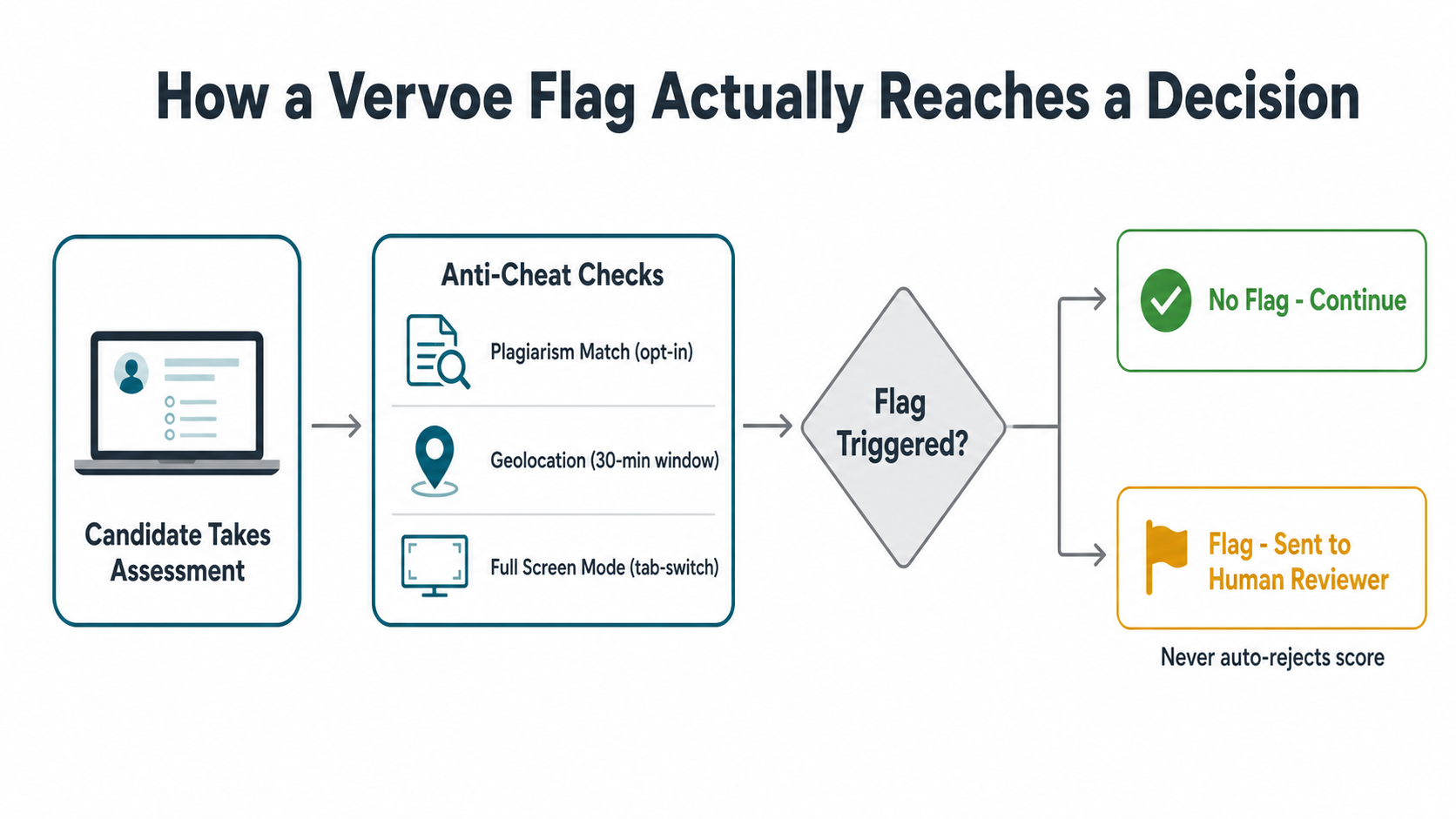
Plagiarism detection is off by default. An employer has to manually enable it, per question, in their assessment settings. A meaningful share of Vervoe assessments never turn it on at all. When it is on, it works by comparing the first 500 words of your written answer against every other candidate's answer to that same question — it's a similarity check between candidates, not a lie-detector for your own honesty.
ChatGPT and web-source matching is a separate, paid add-on. Base plagiarism detection only checks candidate-vs-candidate similarity. Catching text that matches ChatGPT output or public web sources requires an extra feature most employers haven't purchased. If you're worried specifically about "will it know I used AI to draft this," the honest answer is: usually not, unless this employer paid for that specific add-on.
Geolocation flags are about location jumps, not devices. If two logins for the same candidate happen from noticeably different cities inside a roughly 30-minute window (based on IP address), it gets flagged. Switching from your laptop to your phone in the same room doesn't trigger this. A VPN, a hotel Wi-Fi network, or a spotty mobile connection sometimes does — which is a source of real false positives, not just cheating.
Full Screen Mode blocks tab-switching — when it's turned on. This is the feature that catches someone alt-tabbing to Google an answer or open a chat window. It's a per-assessment toggle, and Vervoe auto-disables it for question types that require candidates to open external files or links, since forcing full-screen would break the task itself.
Proctoring means randomized still screenshots, not video. Vervoe periodically captures still images during an assessment rather than recording continuous webcam or screen video. There is no facial recognition and no voice-pattern analysis in the standard product — a meaningfully lighter footprint than platforms like HireVue.
What Actually Triggers a Flag vs. What Doesn't
| Behavior | Likely to flag? | Why |
|---|---|---|
| Switching tabs to check notes | Only if Full Screen Mode is on for that question | It's an opt-in toggle, disabled for some question types |
| Submitting an answer nearly identical to another candidate's | Yes, if plagiarism detection is enabled | Compares the first 500 words across candidates on the same question |
| Pasting AI-generated text word-for-word | Only if the employer bought the AI/web-matching add-on | Base plagiarism only checks candidate-vs-candidate |
| Logging in from a different city 20 minutes later | Yes, if geolocation is enabled | Flags location jumps inside a short window |
| Using a VPN or unstable connection | Sometimes, as a false positive | Geolocation infers from IP, not intent |
| Looking away from the camera occasionally | No | No continuous video or facial analysis exists to catch this |
The pattern: Vervoe's system is built to catch coordinated or obvious behavior — shared scripts across candidates, sudden location swaps, disabling full-screen to search externally. It is not built as a moment-by-moment surveillance layer on your face or your screen.
What Happens When You're Flagged
This is the part most "does X detect cheating" content skips entirely: a flag is not a verdict. Vervoe's own product design routes every flag to the employer's hiring team as an annotation on your submission — not an automatic score deduction and not an auto-reject.
A human then decides what it means. A geolocation flag from a VPN gets waved off constantly. A plagiarism match between two candidates who clearly copied the same online answer key gets taken seriously. If your assessment window resets — because you asked for an extension or the employer restarted it — the flag resets with it.
The uncomfortable part isn't the automated check. It's that a human reviewer, once they're looking at your submission because of a flag, is now reading everything else more skeptically too.
Is There Really an "Undetectable" AI Tool for Vervoe?
Search this topic and you'll find content that promises exactly that — a tool that lets you "breeze through completely undetected." Treat that claim the way you'd treat any absolute guarantee in hiring tech: skeptically.
Vervoe's checks are configured differently by every employer, which is precisely why no product can honestly claim to beat all of them consistently. A tool that works around a bank's locked-down Full Screen Mode configuration might do nothing useful against a startup that never turned plagiarism detection on in the first place — and vice versa. "Undetectable" is a marketing word, not an engineering fact, when the target system itself is inconsistently configured by design.
The more durable move is preparing well enough that there's nothing to hide. If a scenario question asks you to walk through how you'd debug a production incident or handle a difficult stakeholder, an answer built from your own real experience reads as specific and confident on a first take — no assistance required, no flag risk, no gap to expose in the next round.
How to Actually Prepare for a Vervoe Assessment
Vervoe leans heavily on scenario and simulation-style questions — building a spreadsheet model, writing a real email response, walking through a technical judgment call — rather than pure multiple-choice. That format rewards rehearsal more than raw knowledge, because you're being scored on how cleanly you execute under a timer, not just whether you know the theory.
AceRound AI runs structured mock interviews so you can drill the scenario-style prompts out loud before the real assessment — the same skill Vervoe is actually testing — instead of hoping a shortcut gets you through a system that's watching for exactly that kind of shortcut. If you're prepping for a coding-heavy assessment specifically, the does Codility detect cheating and does TestGorilla detect cheating guides cover how the two most common alternatives handle detection, and is using AI in interviews cheating breaks down where the honest line actually sits.
Frequently Asked Questions
Does Vervoe detect cheating?
It can, for the checks a given employer has actually enabled. Plagiarism matching, geolocation flags, and Full Screen Mode tab-switch detection are real, but plagiarism detection is off by default and Full Screen Mode is disabled for some question types. Nothing auto-rejects you — flags go to a human reviewer.
Does Vervoe record your webcam or screen continuously?
No. Proctoring is randomized still screenshots, not continuous video or audio. There's no facial recognition or voice-pattern analysis in the standard product.
What happens if Vervoe flags your assessment?
The flag is a note added to your submission for the employer's hiring team to review — not an automatic score penalty. A human decides what it means, and the flag resets if your assessment window is reset.
Can Vervoe detect ChatGPT-written answers?
Only with an optional paid add-on most employers haven't purchased. The base plagiarism check compares your answer against other candidates' answers to the same question, not against AI or public web content.
Does Vervoe use geolocation tracking?
Yes, when enabled. It flags a candidate completing an assessment from a noticeably different city within roughly a 30-minute window based on IP address. VPNs and unstable connections can cause false positives.
Is there really an undetectable AI tool for Vervoe assessments?
Be skeptical of any product claiming this outright. Vervoe's checks vary by employer configuration, so no tool can honestly guarantee it beats all of them — that claim is marketing, not an engineering fact.
Author · Alex Chen. Career consultant and former tech recruiter. Spent 5 years on the hiring side before switching to help candidates instead. Writes about real interview dynamics, not textbook advice.
Related Articles

'Tell Me About a Time AI Made a Mistake' — Answered
A new 2026 interview question is catching people off guard: describe a time an AI tool got something wrong. Here's how to actually answer it well.
How Do You Work With AI Agents? (Answered)
A new 2026 interview question is catching candidates off guard: how do you decide what to delegate to an AI agent? Here's how to actually answer it.

Physical Therapist Interview AI Prep Guide
Physical therapist interview questions: clinical-reasoning scenarios, productivity and caseload questions, and how to rehearse both with AI.