Does CodeSignal Detect Cheating? What Actually Gets Flagged
Does CodeSignal detect cheating? Yes, via Suspicion Score, LeakSweep, and ID/webcam verification. Here's exactly what triggers a flag and what doesn't.
TL;DR: Yes — does CodeSignal detect cheating has a concrete answer: it runs a Suspicion Score (solution similarity, paste events, typing telemetry), LeakSweep (scans public sites for leaked questions), and, on proctored sessions, ID verification plus webcam/screen recording. A flag isn't an automatic rejection — it's a signal the hiring team reviews. None of this is the same system as a live human interview, which is the round a real-time copilot like AceRound actually helps with.
You just finished a CodeSignal General Coding Assessment. You pasted your final solution, hit submit, and now you're refreshing your inbox wondering if that "Verified" badge is actually going to show up — or if something you did three minutes ago just got logged somewhere you can't see.
That anxiety has spawned a whole genre of blog posts promising to help you "beat" CodeSignal's detection, most of them written by companies selling a stealth overlay tool for the assessment itself. They're long on scare tactics and short on citations. Here's what CodeSignal's own documentation actually says it monitors, what a flag really means, and where the honest limits of that monitoring are.
What CodeSignal Actually Monitors
CodeSignal names its anti-cheating system directly on its own cheating-and-fraud page: five layers working together, not one black-box detector.
- Suspicion Score. This is the core signal. It aggregates solution similarity (how close your answer is to other submissions or known solutions), copy-paste events, and typing/telemetry patterns — the rhythm of how you actually typed the code, not just what ended up in the box. CodeSignal's support documentation explains this is a composite score, not a single yes/no cheating flag.
- LeakSweep. CodeSignal actively scans public sites — Stack Overflow, LeetCode, GitHub — for its own assessment questions and solutions that have leaked. If your submission matches a leaked answer verbatim, that's a different, stronger signal than ordinary solution similarity.
- ID verification and proctored recording. On sessions the employer sets to proctored mode, you'll need a government ID plus webcam, microphone, and full-screen recording. This is opt-in per assessment, configured by the hiring company — it is not on by default for every test.
- AI proctoring. CodeSignal names this as one of its five safeguards, alongside dynamic (rotating) question sets designed to make static answer banks less useful.
The company has been public about why this matters: in a 2026 press release, CodeSignal reported that fraud attempts on entry-level assessments more than doubled year over year in 2025 — split across copy-paste plagiarism, proxy test-taking, unauthorized AI use, and identity fraud. That's the pressure driving all five layers above.
Does CodeSignal Use AI to Detect Cheating?
Sort of, and it's worth being precise about what that means. CodeSignal lists "AI proctoring" as one of its five safeguards, but there's no publicly documented feature that scans your submitted code and stamps it "AI-generated" the way a text-plagiarism checker flags an essay. Candidates on tech-career forums ask this exact question — "can non-proctored CodeSignal tell that code is AI-generated?" — and the honest answer is that the signal isn't content analysis, it's behavior: a full solution appearing as a paste event, with typing telemetry showing no iteration beforehand, is what feeds the Suspicion Score. The system is inferring how the code arrived, not reading the code and diagnosing its origin.
What Actually Gets You Flagged
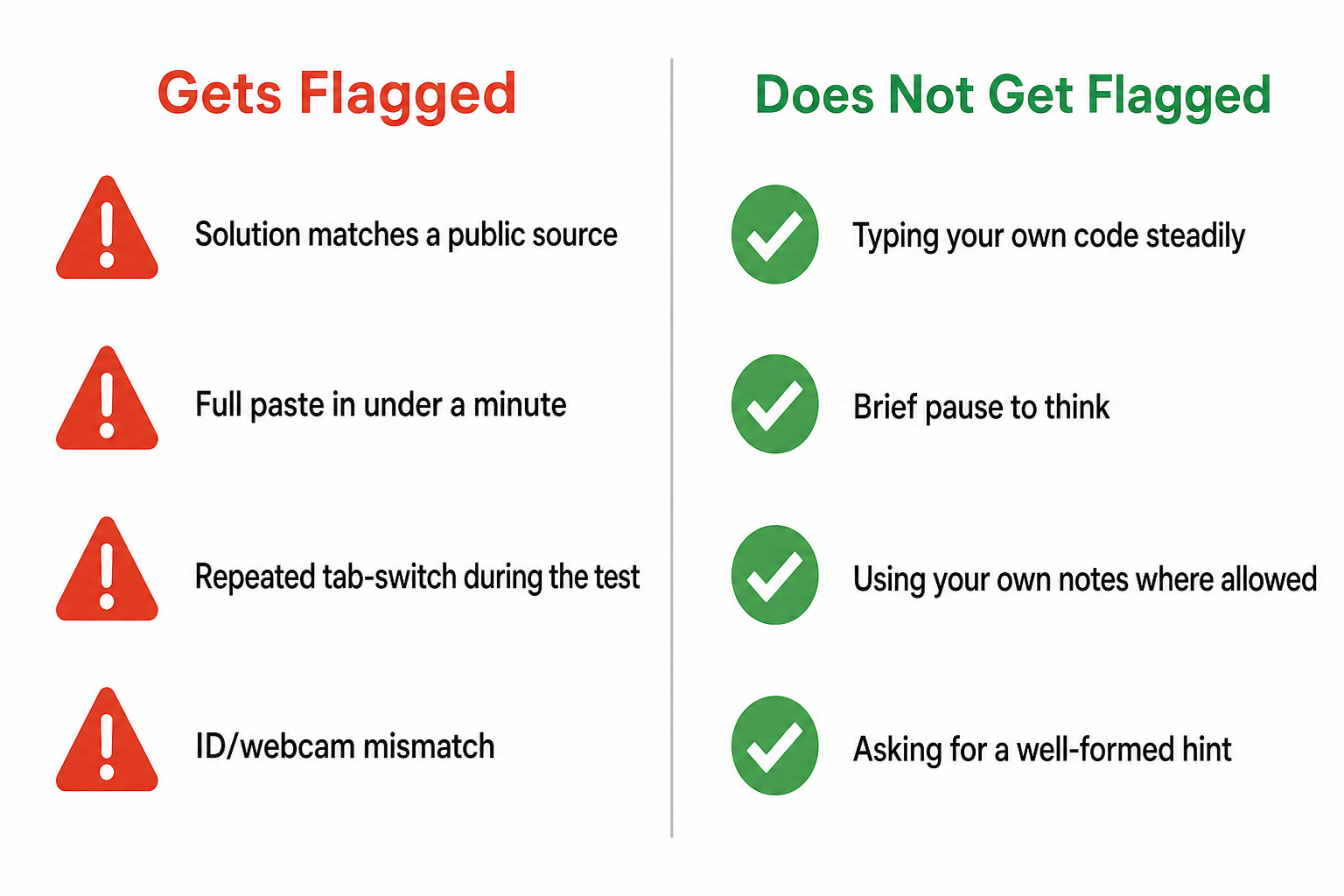
Based on what CodeSignal documents about Suspicion Score inputs, the patterns that draw real scrutiny share one trait: they cluster.
- A full, working solution pasted in under a minute, with a typing pattern that shows no drafting or backspacing beforehand.
- A submission matching a solution LeakSweep has already indexed from a public site.
- Repeated tab-switching or window-blur events logged in tight correlation with a paste event, over multiple problems in the same session.
- An ID or webcam mismatch on a proctored session — a different person's face than the one verified at sign-in.
A single one of these, on its own, is a data point. What triggers a serious review is several of them lining up on the same problem.
What Doesn't Get You Flagged
The overcorrected version of this fear treats every normal behavior as risky. It shouldn't:
- Typing your own code at a normal, uneven pace — pauses, backspacing, and false starts are exactly what authentic problem-solving looks like, and they're the opposite of a flat, instant-paste signature.
- A brief pause to think. Suspicion Score is built around patterns, not the mere existence of a gap in activity.
- Referencing your own permitted notes, where the assessment's stated rules allow outside resources — check the specific assessment's instructions, since policies vary by test type and employer.
- Asking a well-scoped question of an AI tool during an assessment that explicitly allows AI assistance (CodeSignal's newer AI-enabled formats exist specifically for this) — the detection layers described here are aimed at unauthorized use on tests that don't permit it, not at every interaction with AI everywhere.
CodeSignal's OA vs. the Live Interview That Follows
This distinction matters more than most of the "beat the detector" content admits: CodeSignal's General Coding Assessment is an asynchronous, proctored screening step — a filter before you ever talk to a human. It is not the same system, and not the same stakes, as the live video interview that typically comes after you pass it.
That's also where the practical prep advice diverges. Trying to find a way around OA proctoring is a bad trade even if it worked, because the actual bottleneck for most candidates isn't the OA — it's the live round afterward, where a recruiter or engineer is watching you think in real time. AceRound AI is built for that round specifically: real-time coaching during a live conversation, not a way to route around an automated screening step. If you're deciding what kind of prep actually matters here, the best AI for technical interview guide breaks down live-support tools versus prep-only tools so you pick the one that matches what you're actually facing next.
For the OA rounds at other companies, HackerRank's detection system works differently and is worth knowing if your pipeline uses both. And if you want the full landscape across platforms, this breakdown of how online interviews detect cheating compares HireVue, Zoom, and OA tools side by side.
How to Prepare So You Never Have to Think About Any of This
- Do the assessment the way you'd solve it on a whiteboard: draft, iterate, fix your own mistakes. That's what an authentic typing pattern looks like, and it's also just how you get better at the underlying skill.
- If you draft in your own editor first, retype rather than paste the final version — it costs you two extra minutes and removes a whole category of ambiguity.
- Read the specific assessment's rules before you start. Some CodeSignal formats explicitly allow outside resources or AI assistance; others don't. The rules aren't universal across every test.
- Treat the OA as the low-stakes filter it is, and put your prep energy into the live round that follows — that's the interview where practiced, real-time reasoning under pressure actually pays off. If you want structured practice with CodeSignal's specific format and question types, that's a separate, useful step before the OA itself.
FAQ
Has anyone actually been caught cheating on CodeSignal?
Yes — CodeSignal itself reported that fraud attempts on entry-level assessments more than doubled year over year in 2025, across four categories: copy-paste plagiarism, proxy test-taking, unauthorized AI use, and identity fraud. A flag doesn't mean instant rejection, but the company is actively tracking and publishing these numbers.
Can CodeSignal tell if my code is AI-generated?
There's no publicly documented AI-content detector that scans code the way plagiarism checkers scan text. What CodeSignal can see is behavioral: a large block of code appearing without matching keystroke telemetry, combined with a paste event, feeds into the Suspicion Score. The signal is the paste-and-typing pattern, not a stamp that says "written by AI."
Can I write my solution in my own IDE and paste it into CodeSignal?
Technically yes, but doing this on a proctored assessment logs as a paste event and contributes to your Suspicion Score, especially if the whole solution lands at once with no subsequent edits. If you want to think in your own editor, retype the final version rather than pasting it.
Does failing a CodeSignal assessment affect other companies I apply to?
Only if you retake the same standardized assessment (like the General Coding Assessment) that another employer also uses — CodeSignal's model reuses scores across companies for shared assessment types, not company-specific custom tests. A flagged, unverified attempt on a shared assessment can follow you to a different application using that same test.
Can CodeSignal see my screen or webcam during a non-proctored assessment?
No. Screen recording, webcam capture, and ID verification only apply to sessions the employer has explicitly set to proctored mode. An unproctored assessment relies on Suspicion Score signals (paste events, typing telemetry, solution similarity) alone, with no video or screen capture involved.
Author · Alex Chen. Career consultant and former tech recruiter. Spent 5 years on the hiring side before switching to help candidates instead. Writes about real interview dynamics, not textbook advice.
Related Articles
Medical Assistant Interview: How to Prepare for the Questions Nobody Warns You About
A medical assistant interview mixes clinical, admin, and behavioral questions — plus, sometimes, illegal personal ones. Here's how to prepare for all of it.
Why Are You the Best Candidate for This Job?
How to answer 'why are you the best candidate for this job' without sounding cocky, even with less experience than other applicants.
Does CoderPad Detect AI Cheating? What Actually Gets Flagged (2026)
Does CoderPad detect AI cheating? A factual breakdown of paste and IDE-exit alerts, session playback, Screen's plagiarism checks, and what it can't see.