Capital One Virtual Job Tryout 2026: What Each Module Scores
Capital One's FAQ confirms four VJT modules and a 20–45 minute average. What each module measures, the navigation rules, and a worked business-case method.
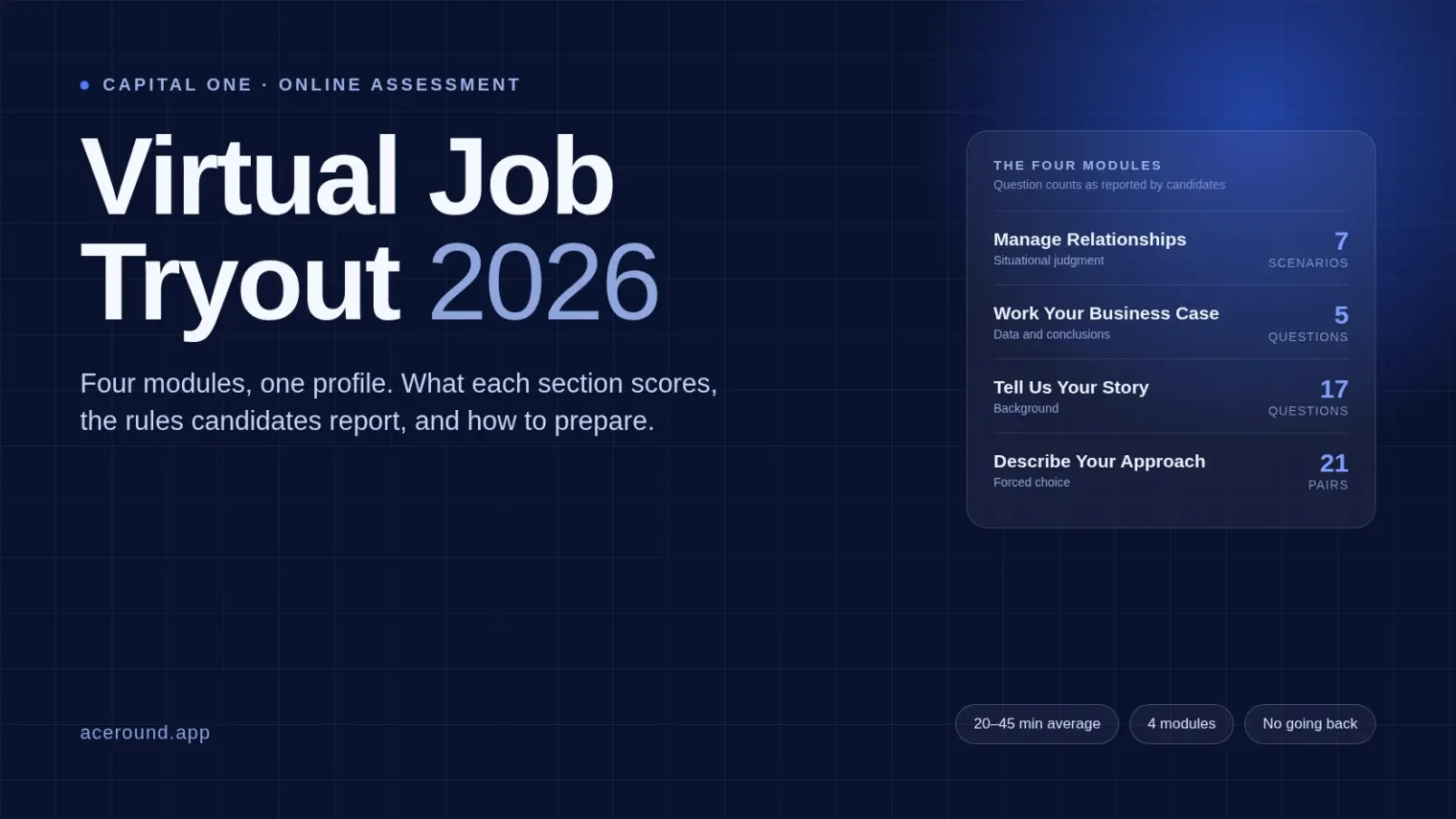
TL;DR: The Capital One Virtual Job Tryout is a written work-sample assessment in four modules — Manage Relationships, Work Your Business Case, Tell Us Your Story and Describe Your Approach — that Capital One says takes 20–45 minutes on average and adapts to the role you applied for. It is not a coding test, not a recorded video interview and not the same thing as the hour-long "virtual test" or Power Day.
Candidates report roughly 50 questions, a sitting closer to 30–60 minutes, and no way back once you submit an answer in the first two sections. The two sections most people rush — background and forced-choice personality — account for about 38 of those 50 questions, which is why those two sections deserve as much care as the scenarios everyone rehearses.
This guide separates Capital One's published statements from candidate-reported detail, then gives a worked method for the business case, a one-evening preparation plan, and what happens after you submit.
Search "Capital One Virtual Job Tryout" and you find two kinds of page. Some describe it as a personality quiz and leave it at that. Others sell question banks and imply there is a hidden answer key. Neither explains the thing that actually determines your result: the VJT is a profile-matching assessment, scored against a model of what the target role looks like, not against a single passing grade.
That distinction changes how you prepare. You are not trying to get every question "right". You are trying to produce one coherent, role-aligned profile across four sections that measure different things — and to do it in an interface that will not let you go back.
What the Virtual Job Tryout actually is
Capital One's candidate FAQ describes the VJT as an individualized assessment sent by email after you apply. The company's own wording is that it "will help you demonstrate the skills and knowledge you would bring to the role, while also helping you learn more about the way we work at Capital One." At the end, Capital One says it has "a better idea about your experiences, strengths and how you approach work."
Three details in that description matter more than they look:
- Individualized. The FAQ says the modules depend on "the role you applied for and modules you may already have completed." Two candidates applying to different programs can sit different versions of the same assessment. A friend's experience is a data point, not a template.
- Sent by email, with a Workday task. Capital One says the invitation arrives by email from Workday, and a task in your candidate profile contains a PDF with the assessment link. If the email is missing, the Workday task is the second place to look.
- 20–45 minutes on average. That is Capital One's published figure. It is an average planning range, not a timer, and the FAQ does not publish a question count, a pass score or a retake rule.
The name is also a source of confusion. "Virtual Job Tryout" is a HireVue assessment product name, and HireVue sells a product under it. Capital One's version carries Capital One's own module names and its own configuration, so a generic HireVue video-interview guide will not describe what you are about to open. Prepare from the invitation.
Which Capital One assessment did you actually get?
Capital One runs several assessments that candidates describe interchangeably, and the differences decide what you should do this week. The invitation names the one you have; this table is how to read it.
| What the invitation says | What it is | Format | Where it appears |
|---|---|---|---|
| Virtual Job Tryout (VJT) | Work-sample and profile assessment | Four written modules; 20–45 minutes on average; no visible timer, per candidates | Analyst, strategy, finance, product and operations candidates, by report |
| Virtual test | Role-knowledge exam listed separately in Capital One's student interview guide | About one hour | Between the recruiter screen and the hiring manager pre-screen, for some positions |
| CodeSignal / coding assessment | Proctored coding test | Four tasks in 70 minutes on the General Coding Assessment | Technology, cyber and machine learning candidates, by report |
| Power Day | Final round of live interviews | Job fit, behavioral and case interviews over video | Candidates who clear the earlier stages |
| On-demand interview | Recorded video answers | A fixed set of questions, recorded without an interviewer | Customer Care roles |
Two official pages explain the split. Capital One's student FAQ says the programs that require an online assessment are the Analyst Development Program and the Technology Development Program; other programs begin with a first-round interview, according to the same page. Its interview guide then describes an automated assessment that evaluates "communication, customer focus, leadership and problem solving", and separately lists the hour-long virtual test and Power Day.
Candidates fill in the rest: analyst-side applicants report the four-module VJT, technology applicants report CodeSignal, and some report both a role-fit assessment and a coding test. If your email says "Virtual Job Tryout", the rest of this guide applies. If it names CodeSignal, our Capital One CodeSignal and Power Day guide covers that route, including how the 70 minutes break down.
The four modules, and what each one scores
Capital One names four possible modules. The descriptions below separate the company's published description from what candidates report about the format.
Manage Relationships
Capital One's description: "Make decisions and respond to scenarios you'll commonly encounter in the role."
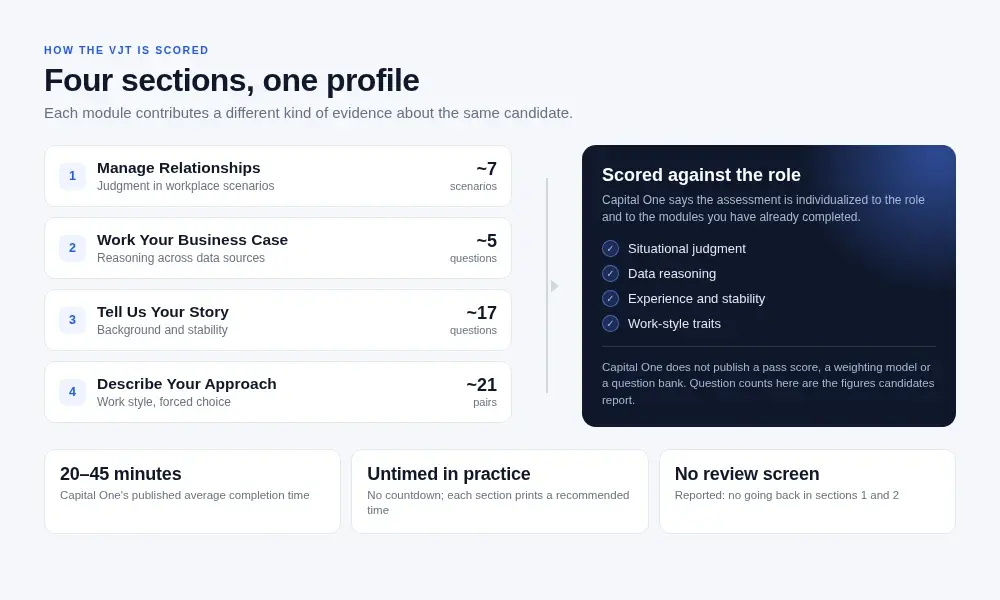
What candidates report: Around seven workplace scenarios, each with four possible responses. You choose the most appropriate and the least appropriate response, and the section is the first thing you see. The recommended time is roughly eight minutes.
What it scores: Communication, ownership and judgment about when to escalate. The scenarios usually involve a competing priority, a colleague who has dropped something, or a customer whose problem collides with another urgent issue.
How to answer: Run two questions on every option. Does it solve the immediate problem? Does it preserve the working relationship? The best response usually does both: it establishes the facts, communicates with the right person, and proposes a concrete next step. The worst response is rarely subtle — blaming someone, forwarding without context, ignoring the issue, or promising a fix before checking — so trust the obvious read on the "least" side instead of hunting for a trick. The middle two options are the real decision; one of them usually looks conscientious but hands off ownership.
Work Your Business Case
Capital One's description: "Review and integrate information from multiple sources about a fictitious business and offer solutions to help it succeed."
What candidates report: About five questions built on tables, charts and a short narrative about a fictional company. Some questions ask you to judge whether a conclusion is supported; others ask you to rank or choose among recommendations. Most candidates spend 10–15 minutes here, the largest block of the sitting.
What it scores: Whether you can hold several sources at once and separate what the data supports from what sounds plausible. The arithmetic is deliberately simple; the difficulty is choosing the right calculation and checking every option instead of stopping at the first believable one.
How to answer: Restate the question in your own words before touching the numbers, name the metric it asks for, compute exactly, then test each option against the result. Most wrong answers are built from a real number used the wrong way — an average of averages, a count read as a rate, a total that ignores group size. The business-case method below works through the four patterns that account for most of these questions.
Tell Us Your Story
Capital One's description: "Tell us about your work experiences and background that have helped shape who you are."
What candidates report: Around 17 quick background questions about tenure, past performance and self-assessment, answered on a five-point scale or a set of ranges.
What it scores: Stability, self-awareness and consistency with the personality section that follows. Biodata sections are built to compare a candidate's pattern of answers with patterns associated with success in the role. This is also the section candidates finish in a hurry, which is a mistake, because the answers are read alongside the next section.
How to answer: Do not max every rating. A profile that claims to be in the top percentile on every dimension reads as careless, and a profile that rates itself average everywhere reads as low confidence. Answer from evidence you could defend in an interview — a manager's feedback, a review, a specific project — and keep the story you tell here consistent with the choices you make in Describe Your Approach.
Describe Your Approach
Capital One's description: "Tell us about your preferred style and approach to work."
What candidates report: Around 21 forced-choice pairs. Each presents two statements that both sound positive, and you pick the one that describes you better. There is no neutral option, no "both" and no "neither".
What it scores: A trait profile against the role. Forced choice exists to make gaming harder: when both options are desirable, your pattern of choices across 21 pairs says more than any single answer. Prep services that track the section report paired items designed to check whether similar questions produce aligned answers.
How to answer: Before you start, read the job description and write down the four or five traits it repeats — data-driven, customer-focused, comfortable with ambiguity, detail-oriented, collaborative. Decide where you genuinely sit on each, then hold that stance for all 21 pairs. The failure mode is not picking the "wrong" trait; it is drifting between stances as the wording changes, which produces a profile that looks inconsistent rather than balanced.
How the sitting actually runs
Capital One does not publish the interface rules, so this part is candidate-reported and should be treated as a planning estimate rather than a guarantee.
| Section | Reported questions | Reported time | Navigation |
|---|---|---|---|
| Manage Relationships | ~7 | ~8 minutes | No going back |
| Work Your Business Case | ~5 | 10–15 minutes | No going back |
| Tell Us Your Story | ~17 | A few minutes | One question back |
| Describe Your Approach | ~21 | A few minutes | One question back |
Candidates describe the assessment as untimed — no countdown on screen — with a recommended completion time printed in each section's instructions. That combination is why the reported sitting (30–60 minutes) runs longer than Capital One's 20–45 minute average: without a clock, the business case expands to fill the attention you give it.
A workable allocation for a 45-minute sitting:
- 5 minutes reading the instructions and the section guidance, before answering anything.
- 8–10 minutes on Manage Relationships, reading each scenario twice.
- 15 minutes on Work Your Business Case, with the arithmetic written down.
- 5 minutes on Tell Us Your Story.
- 5 minutes on Describe Your Approach.
- The rest as buffer, not as extra time to second-guess the last two sections.
Two rules follow from the navigation limits. In the first two sections, commit only when you can explain why the option you chose is better than the one next to it. In the last two, answer at the pace of recognition rather than deliberation; a forced-choice answer that takes 90 seconds is usually a sign you are trying to reverse-engineer the scoring key.
The business case: four calculations that decide the section
The business-case section rewards a small number of habits. These four patterns cover most of what candidates describe, with worked examples in the style of the section rather than reproductions of live questions.
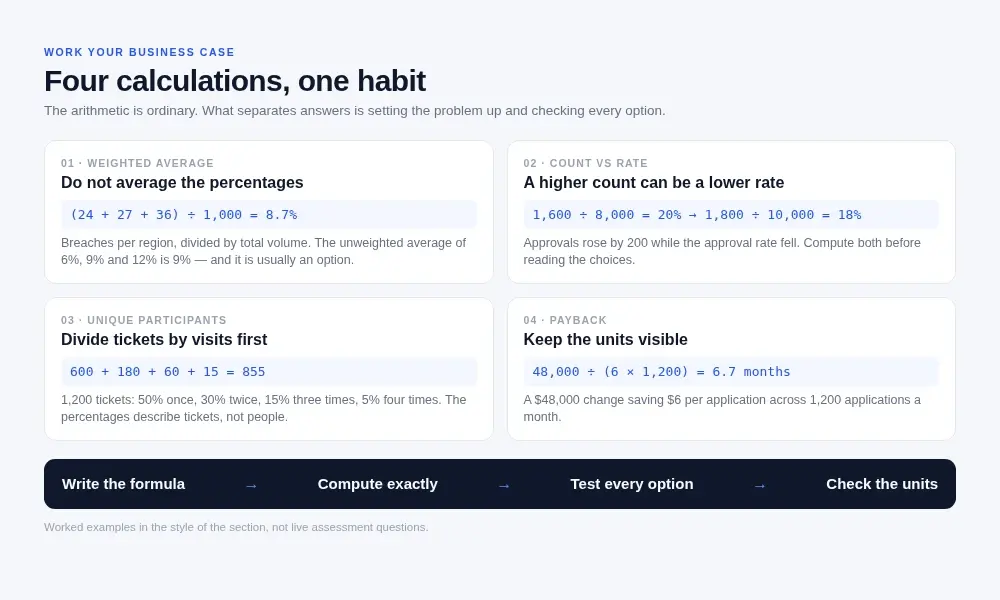
1. Weighted averages. A support organization handles tickets in three regions. Region A closes 400 tickets with a 6% breach rate, Region B closes 300 at 9%, and Region C closes 300 at 12%. What is the overall breach rate?
Do not average 6, 9 and 12. Compute breaches: 24 + 27 + 36 = 87. Total tickets: 1,000. Overall rate: 8.7%. The unweighted average (9%) is the trap answer, and it is usually one of the options.
2. Count versus rate. A program received 8,000 applications last year and approved 1,600. This year it received 10,000 and approved 1,800. Which statement is correct?
Approvals rose (1,600 → 1,800), but the approval rate fell (20% → 18%). The correct conclusion is "the count increased and the rate decreased." Questions in this section frequently offer a true count and a false rate in the same option, so compute both before reading the choices.
3. Unique participants. A venue sold 1,200 tickets across a four-night run. Of those tickets, 50% went to people who attended once, 30% to people who attended twice, 15% to people who attended three times, and 5% to people who attended four times. How many unique people attended?
The percentages describe tickets, not people, which is the whole question. Once-only: 600 tickets = 600 people. Twice: 360 tickets = 180 people. Three times: 180 tickets = 60 people. Four times: 60 tickets = 15 people. Unique attendees: 600 + 180 + 60 + 15 = 855. Divide the ticket count for each group by the number of visits before adding.
4. Break-even and payback. Capital One's own business-analyst recruiters describe break-even questions as typical of the case interviews: "how many units a company needs to sell to break even." The same logic shows up in the business case. If a process change costs $48,000 to build and saves $6 per application across 1,200 applications a month, payback takes 48,000 ÷ (6 × 1,200) = 6.7 months.
The discipline matters more than the arithmetic:
- Write the formula before you calculate.
- Keep units visible — people versus tickets, months versus years, percentage points versus percent.
- Compute exactly; do not estimate and then look for the closest option.
- Test every option, including the ones that look obviously wrong. One of them is usually right.
If you are applying to the Analyst Development Program
The Analyst Development Program is one of the two programs Capital One lists as requiring an online assessment, and analyst candidates report an additional quantitative module on top of the four standard sections.
According to candidate reports, that module is delivered separately — often through the Listen Platform — with roughly 7 to 11 problems and no time limit. The data usually arrives as an Excel file attached to the invitation, and the questions ask for a defensible answer rather than a fast one: payback periods, break-even volumes, capacity and throughput, rate comparisons across segments. The arithmetic is deliberately ordinary. What is being tested is whether you can set the problem up, state your assumptions, and show work that stays defensible if someone asks you to explain it.
The setup matters more than the arithmetic. Capital One's business-analyst recruiters describe messy arithmetic as the common failure: "If you lose track of your numbers early, you might get stuck later when you need them." Write the setup down, label the intermediate results, and keep one consistent sheet.
The same interview page describes what follows for analysts: a mini case interview, then a virtual Power Day with two to three additional case interviews and a product strategy conversation. That is a different skill from the written assessment — talking through a problem while someone watches — and it is covered in our Power Day guide.
What Capital One says about AI, notes and monitoring
Capital One's Candidate Terms and Conditions, linked from the careers FAQ, are explicit about outside help. The relevant section states that candidates "must complete all interviews and assessments independently" and that "the use of external resources and third-party assistance, programs, or AI tools (e.g. Gemini, ChatGPT, etc.) is strictly prohibited during interviews and assessments, unless permission is specifically indicated." The same document says candidates may take notes during an interview but cannot bring existing materials into one.
Three practical consequences:
- The invitation is the only place an exception would appear. Capital One's public pages do not carve out an AI-permitted version of the VJT the way CodeSignal does with its Cosmo-enabled assessments. If your invitation does not grant permission, the terms apply as written.
- Notes are treated differently in interviews and assessments. The terms allow note-taking during an interview; they do not extend that permission to assessments.
- Monitoring is set per assessment, not published per module. Capital One's FAQ does not say whether a given VJT is recorded or proctored; the invitation is the document that would state it. Read it before you open the link rather than after.
None of that changes what the assessment measures. The VJT is scored on the profile your answers produce, and a profile assembled from someone else's judgment tends to fail the consistency checks the format runs: between sections, between paired forced-choice items, and between the biodata answers and the personality choices.
A preparation plan that fits in one evening
The VJT rewards calibration, not memorization. Ninety minutes is enough to move from "what is this" to "I know what I am doing in each section."
First 20 minutes: read the role, not the test. Open the job description and write down the four or five traits it repeats. Then read Capital One's FAQ page for the modules. Keep the trait list next to you for the rest of the evening; it is the reference point for both Tell Us Your Story and Describe Your Approach.
Next 25 minutes: situational judgment. Work through five or six scenarios from any situational-judgment set, and for each one write the most and least appropriate response plus one sentence of reasoning. The reasoning is the point: it forces you to name whether an option solves the problem, preserves the relationship, or merely sounds diligent. Our situational interview questions guide covers the same judgment in spoken form.
Next 25 minutes: the four calculations. Do one weighted average, one count-versus-rate comparison, one unique-participant problem and one payback calculation, by hand, with the formula written first. If you are applying to the Analyst Development Program, add a spreadsheet problem: filter a table, compute a rate by segment, and write down the assumption you made.
Next 15 minutes: decide your stance. Choose your position on the traits you listed — planner or adapter, team-first or individual driver, detail-first or big-picture — and write two sentences of evidence for each. Then answer ten forced-choice pairs without changing stance. Consistency is the score.
Last 5 minutes: environment. Use a laptop rather than a phone, close everything you do not need, and check the deadline on the invitation. The assessment is long enough that a flat battery or a dropped connection is a real risk.
On the day, in 30 minutes: reread the trait list, do two situational-judgment scenarios, do one weighted average, and open the invitation ten minutes early. Do not start the business case tired; it is the section where a careless setup costs the most.
What not to do is equally specific. Do not memorize leaked questions — the modules change by role, and a memorized answer to a question you were not asked is worse than a considered answer to one you were. Do not invent a personality profile; the paired items are designed to catch it. And do not sprint through the last two sections to "get to the end", because they account for most of the questions you will answer.
After the VJT: what comes next
Capital One's published sequence, after the assessment, runs through a recruiter screen, a possible hour-long virtual test, a 30-minute hiring manager pre-screen, and Power Day. Data science candidates add a take-home challenge before Power Day. Power Day itself is virtual, on Zoom, with video required for the whole session, and mixes job fit, behavioral and case interviews depending on the role.
The student FAQ adds a useful expectation: most candidates hear a decision from their recruiter within about two weeks. Capital One does not publish a turnaround for the VJT itself, so the practical move after submitting is to check the Workday task and your email rather than refreshing the assessment link.
If the next stage is a case or behavioral interview, the preparation shifts from written judgment to spoken reasoning. That is a different exercise: you have to narrate the setup, take a hint without losing the thread, and land a recommendation out loud.
Practicing the part that follows: the VJT is silent and written; the recruiter screen, virtual test and Power Day are spoken. A mock interview with follow-up questions is a reasonable way to rehearse the case and behavioral rounds, because the hard part is not knowing the framework — it is keeping it intact while someone else talks. If your route runs through a coding assessment instead, OA Copilot is built for that stage, and the assessment's own rules decide how any tool may be used.
FAQ
What is the Capital One Virtual Job Tryout?
It is Capital One's online work-sample assessment, sent by email to candidates for certain roles. Capital One's candidate FAQ says it may combine four modules — Manage Relationships, Work Your Business Case, Tell Us Your Story and Describe Your Approach — and takes 20–45 minutes on average. It is not a coding test and not a recorded video interview.
How long does the Capital One Virtual Job Tryout take?
Capital One publishes an average of 20–45 minutes. Candidates report sittings closer to 30–60 minutes because the assessment is not visibly timed and the business-case section rewards care over speed. Your invitation may state its own window.
How many questions are on the VJT?
Candidates report about 50 questions across the four modules: roughly 7 situational-judgment scenarios, 5 business-case questions, 17 background questions and 21 forced-choice personality pairs. Capital One does not publish a question count, and the module mix changes by role, so treat the numbers as a planning estimate.
Can you go back and change an answer?
Candidates report that you cannot return to a previous question in Manage Relationships or Work Your Business Case, and that you can step back only one question in Tell Us Your Story and Describe Your Approach. Read each scenario before you commit, because there is no review screen.
Is the Virtual Job Tryout the same as CodeSignal or the virtual test?
No. Capital One's student interview guide lists a separate hour-long virtual test that checks role knowledge, and technology candidates usually report a CodeSignal coding assessment rather than the standard VJT. The invitation names the assessment you were sent; prepare for that one.
Can you use ChatGPT or another AI tool during the VJT?
Capital One's candidate terms require all interviews and assessments to be completed independently and prohibit external resources, third-party assistance, programs and AI tools unless permission is specifically indicated. The terms also say candidates may take notes during an interview but cannot bring existing materials into one. The invitation is where any exception would appear.
How long do you have to complete the VJT?
Candidates report a 14-day window from the invitation email, with the link also delivered as a task and PDF in the Workday candidate profile. Capital One does not publish a universal deadline, so use the date on your own invitation.
Do software engineers take the Virtual Job Tryout?
Reports point the other way: the VJT is most common for analyst, strategy, finance, product and operations roles, while software engineering, cyber and machine learning candidates are usually routed to a CodeSignal coding assessment. Capital One's student FAQ names the Analyst Development Program and the Technology Development Program as the two with an online assessment, and the invitation decides which assessment that is.
Author · Alex Chen. Career consultant and former tech recruiter. Spent 5 years on the hiring side before switching to help candidates instead. Writes about real interview dynamics, not textbook advice.
Related Articles
Capital One Tech Interview: CodeSignal, Virtual Job Tryout, and Power Day
Capital One's official pages confirm a multi-step process and Power Day cases, but not CodeSignal or an AI rule. Here's what's confirmed vs. candidate-reported.

Unstop Assessment Proctoring: Full-Screen, Tab Switches, and SmartHire
How Unstop online assessments proctor campus and off-campus drives: Basic, Standard, and Advanced tiers, full-screen violations, SmartHire virtual camera errors, and the Tab-key focus bug.
HirePro Assessment: Tenant Alias, System Check, and Every Error
What a HirePro assessment checks before the paper: the tenant alias screen, the compatibility check, each error message, and the Secure Exam Browser route.