Recruiter Interview Preparation with AI: How to Pass When You Know Every Trick
Preparing for a recruiter job interview is uniquely hard — you know hiring better than anyone but still freeze on talent acquisition behavioral questions. Here's how AI changes your prep.

TL;DR: Recruiter interview preparation is deceptively hard — you know every interview technique, but talent acquisition roles get evaluated on recruiter-specific behavioral questions about stakeholder conflict, candidate ethics, and hiring philosophy that generic AI tools don't simulate. This guide covers the role reversal psychology, the questions you'll actually face, and how AI-powered practice finally helps you answer them fluently.
After screening 1,400 candidate applications last year, Sarah could spot a weak STAR answer in the first two sentences. She had coached candidates through behavioral questions, spotted overselling from 10 resumes away, and knew exactly what hiring managers were looking for. Then she interviewed for a Senior Talent Acquisition Specialist role at a Series B startup. When they asked "tell us about a time you had a hiring manager who rejected every diverse candidate," she went completely blank.
She had never prepared an answer to that question from the other side of the table.
Why Recruiters Struggle to Prepare for Their Own Interviews
This sounds counterintuitive. You spend your working life on the right side of the table. You've coached hundreds of candidates through STAR methods, awkward silences, and salary negotiations. You understand how interviewers think — because you are one.
So why do talent acquisition professionals consistently report higher interview anxiety than candidates from other roles?
Because knowing how the game works is not the same as being ready to play it. When you interview candidates, you control the structure. You ask questions calibrated to reveal what you need. You manage the pace, the silence, the follow-up probes. You're the authority in the room.
When you sit on the other side for a recruiter role, all of that disappears. And you face something worse than generic behavioral questions: recruiter-specific scenarios that require you to explain your sourcing philosophy, justify past calls on candidate ethics, and demonstrate metrics-oriented thinking — all under time pressure, in front of interviewers who have heard every polished answer a thousand times.
The HR manager interview has a similar dynamic. People ops professionals who understand organizational design better than most still freeze when defending their own decisions under live questioning. Deep process knowledge doesn't transfer automatically into interview fluency.
The Questions Talent Acquisition Specialists Actually Face
Generic interview prep lists miss the mark here. These are the real questions used in recruiter and talent acquisition specialist interviews:
On candidate experience and ethics:
- "How do you treat candidates who don't get the job?"
- "What do you do when a qualified candidate's salary expectations don't match what you can offer?"
On stakeholder management:
- "Tell us about a difficult hiring manager you've worked with and how you overcame it."
- "Describe a time when you disagreed with a hiring decision and what you did about it."
On process and philosophy:
- "What is your process for preparing for interviews with candidates?" (Yes — you will be asked this. The irony is deliberate.)
- "How do you assess a candidate's fit for a role?"
- "How do you balance the use of technology with the personal touch needed in recruitment?"
Notice what's different about these questions. They aren't asking you to recall a project success. They're probing your values around people, power, and process — and the interviewers know exactly what a scripted answer sounds like.
This is where talent acquisition specialist interview preparation diverges completely from standard behavioral interview coaching. The STAR method is foundational, but recruiters need to go further.
Why Generic STAR Answers Fall Short for Recruiter Roles
The STAR framework works for most roles because hiring managers are listening for structure and specificity. But in a recruiter interview, the person across the table is evaluating something more specific: do you think about recruitment the way we do?
When a hiring manager asks "how do you balance technology with personal touch in recruitment?", they're really asking:
- Are you someone who hides behind ATS data to avoid hard judgment calls?
- Do you understand that algorithms can't replace relationship intelligence?
- Where does your philosophy actually sit on the efficiency-empathy spectrum?
A textbook STAR answer — "In my last role, I noticed automated screening was filtering out qualified candidates. I audited the rejection data. The result was we recovered 12% more viable candidates per quarter." — sounds impressive but answers a different question. It demonstrates analytical competence, not philosophy.
What the interviewer actually wants: "I build hybrid processes because I've seen what happens at both extremes. Pure automation misses the edge cases humans catch — the candidate who looked junior on paper but turned out to be the strongest cultural fit we'd seen in a year. Pure relationship-building doesn't scale past 30 open roles. My process uses AI for first-pass filtering on hard skills, then I personally review every borderline candidate. The close pile is where the best hires hide."
That's not a STAR answer. That's a practitioner's philosophy statement. You need to prepare both — and the gap between knowing the right answer intellectually and saying it fluently under pressure is exactly what AI interview practice closes.
Practice the role reversal with AceRound AI. Real-time answer suggestions during live recruiter interview simulations — run the scenarios until the answers flow. Start free →
How AI Interview Preparation Helps Recruiter Candidates Specifically
The difference between reading about recruiter interview questions and being ready to answer them is the same gap that exists for every other candidate: repetition under realistic pressure.
Here's what happens without practice: you have a solid answer prepared for "how do you handle a difficult hiring manager," you've thought it through, you know your story. Then the interview starts, the stakes feel real, and your answer comes out fragmented — you skip the most compelling part, rush the resolution, and end on a metric instead of the human insight.
AI-powered recruiter interview preparation fixes this not by scripting your answers, but by letting you run the scenario until the answer flows naturally. AceRound's real-time AI copilot surfaces suggestions during practice sessions — not to dictate what you say, but to surface the angle you forgot to take, the specific outcome you undersold, or the philosophy statement you buried midway through a long story.
For recruiter and people operations interview preparation, this matters most for:
The ethics questions. "How do you treat candidates who don't get the job?" sounds simple. In practice, candidates either give a generic "I send timely communication" answer or over-philosophize for 90 seconds. The right answer lands in a narrow range that demonstrates both operational discipline and genuine care for candidate dignity. You need 4–5 practice reps to reliably hit that range.
The stakeholder conflict scenarios. These require calibrated honesty in your storytelling. You need to be clear that the hiring manager was wrong without sounding like you're criticizing a former employer. That tonal balance is something you practice into, not think your way into.
The meta-questions. "What's your process for preparing to interview candidates?" requires you to speak as a practitioner describing your craft — not as a candidate reciting a framework. The shift in voice is subtle and hard to nail without rehearsal.
Recruiter Interview Preparation Across Global Markets
Hiring manager interview preparation has a global dimension most guides ignore entirely. Recruiter roles exist in every market, but what interviewers evaluate varies significantly by region.
US-based TA roles: Heavy emphasis on metrics — time-to-fill, cost-per-hire, offer acceptance rate. Your answers to philosophy questions should connect to measurable outcomes. Per SHRM research, 51% of organizations now use AI in recruitment — interviewers will ask how you work alongside AI tools, not whether you use them.
APAC markets (Japan, Korea, Singapore): Relationship-building and stakeholder harmony are weighted more heavily than efficiency metrics. A conflict with a hiring manager isn't primarily a problem-solving story — it's a relationship navigation story. The framing changes significantly.
European markets (Germany, Netherlands, UK): Compliance awareness has become a core recruiter competency since the EU AI Act. Interviewers may test your understanding of algorithmic bias in screening. "How do you balance technology with personal touch" carries regulatory weight in these markets.
LatAm tech markets (Brazil, Colombia): Remote-first roles have created demand for recruiters who can hire across borders. Recruiter candidates in these markets increasingly need to demonstrate competency in English-language interviews for global companies while knowing local hiring customs and compensation benchmarks.
According to AIHR's research on talent acquisition specialist competencies, the highest-performing TA professionals are evaluated not just on process execution but on strategic influence — the ability to shape hiring manager thinking. If you can't tell a compelling story about doing that, you won't clear the final rounds.
Understanding which market you're interviewing into — and how to adapt your recruiter interview preparation accordingly — is something AI coaching with multilingual support can address across all these contexts.
FAQ
What do you do when a qualified candidate's salary expectations don't match what you can offer?
Don't obscure the range, and don't withdraw immediately. The strongest answers demonstrate transparency, creativity, and candidate respect: acknowledge the gap directly, explore whether total compensation or equity or growth trajectory changes the math, and if it genuinely doesn't work, part ways professionally and keep the relationship warm. Candidates remember how you handled a no. Many eventually accept a different role you bring them — often years later.
How do you handle a difficult hiring manager who kept rejecting qualified candidates?
This is a values question more than a process question. The interviewer wants to see: did you push back? Did you understand the real objection beneath the surface rejection, or did you just accept it? Did you find a way to get them what they actually needed — even when they couldn't articulate it? The answer requires a specific friction point, a specific conversation, and a specific outcome. Generic "I escalated to HR" stories fall flat every time.
How do you treat candidates who don't get the job?
Timely communication is the baseline — interviewers aren't impressed by "I send rejections within 48 hours." The question is about your philosophy on candidate experience as a long-term competitive advantage. Companies that treat rejected candidates with dignity get referrals, boomerang hires, and employer brand benefits that compound over years. Build that case into your answer.
How do you assess a candidate's fit for a role?
Avoid generic frameworks. Be specific about how you distinguish technical competence from role fit, and what you do when a candidate has one but not the other. Name the signals you use beyond structured interview scores: how candidates respond to challenging follow-up questions, what reference check patterns reveal, how they handle ambiguity. The best answers demonstrate a practiced, systematic approach with honest acknowledgment of where judgment calls are unavoidable.
What is your process for preparing for interviews with candidates?
The irony of being asked this as a recruiter candidate is deliberate. The interviewers want to see self-awareness and methodical preparation — the same things you look for in candidates you assess. Be specific: how you research the role before screening calls, how you design your question set, how you calibrate against hiring manager criteria before you start. If your actual prep process differs from what you coach candidates to do, acknowledge that honestly.
How do you balance the use of technology with the personal touch in recruitment?
This question has no right answer, only a thoughtful one. Avoid positioning yourself as either a pure-process automator or a relationships-only traditionalist — both signal blind spots. Strong answers acknowledge what technology does well (consistency at scale, removing some forms of bias, handling high-volume first-pass screening) and where it falls short (assessing motivation, reading nuance, building the relationships that convert competitive offers). Place yourself on that spectrum with a specific example of where you've drawn a deliberate line.
Author · Alex Chen. Career consultant and former tech recruiter. Spent 5 years on the hiring side before switching to help candidates instead. Writes about real interview dynamics, not textbook advice.
Related Articles
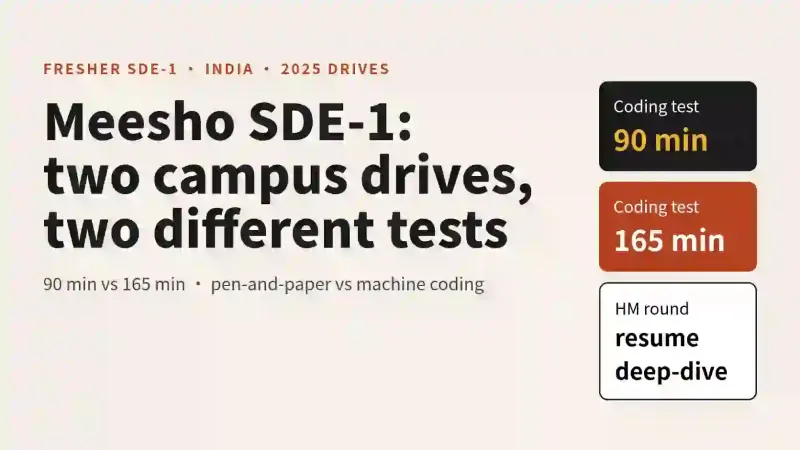
Meesho SDE-1 Interview Process for Freshers: Three 2025 Accounts Compared
Meesho SDE-1 campus accounts from 2025 disagree on test length, round order and design format. Here is what each reported and how to prep for any of them.
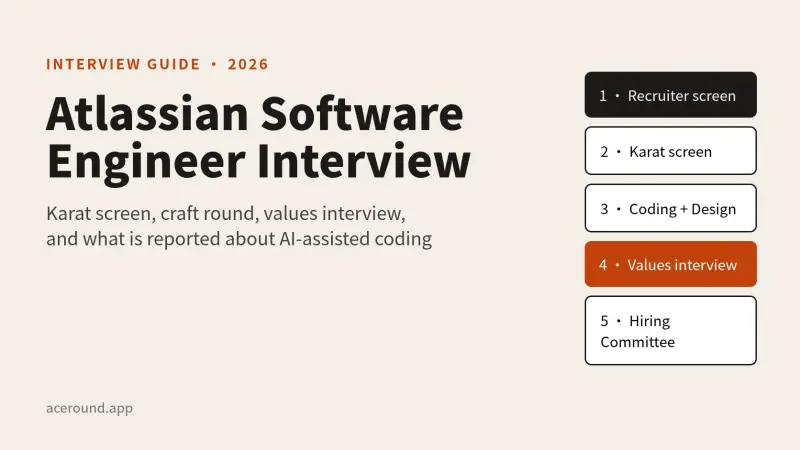
Atlassian Software Engineer Interview: Karat Screen, Craft Round and the Values Interview
How Atlassian's engineering loop works, from the Karat screen to the values round, what is official and what candidates report, including the AI-assisted rounds.
LinkedIn's AI-Enabled Coding Interview: What Candidates Report and How to Prepare
LinkedIn reportedly swaps one coding round for a CoderPad session with an AI panel. Here is the reported format, what gets scored, and what is unconfirmed.