How Do You Handle Criticism? The Interview Answer Interviewers Actually Want
Master 'how do you handle criticism' with the CARE framework — 3 sample answers, the unfair criticism variant, and tips for global job seekers interviewing across cultures.

TL;DR: When asked how do you handle criticism in an interview, interviewers want proof you can receive feedback without getting defensive and use it to improve performance. Use the CARE framework — Context, Accept, Respond, Effect — with one concrete example. Candidates who practice this out loud perform measurably better than those who rehearse it in their heads.
Most candidates answer this question the same way: "I welcome feedback — it helps me grow."
The interviewer nods politely. Then mentally moves on.
It's not that the answer is wrong. It's that it's invisible. Thousands of candidates give that exact sentence every day, and it signals nothing about how you actually behave when a manager pulls you aside and says your work missed the mark.
This question is one of the more revealing behavioral questions in any interview. Not because the answer is complicated, but because most people have never thought carefully about what the interviewer is trying to learn — or practiced their response under realistic pressure.
Let's fix both of those.
What the Interviewer Is Actually Measuring
Before building your answer, understand what's being evaluated. "How do you handle criticism?" tests three distinct things:
1. Coachability. Can you actually get better based on input from others? Interviewers have seen plenty of talented people plateau because they resist feedback. They'd rather hire someone with 80% of the skills who improves fast than someone with 100% who doesn't.
2. Emotional regulation. Do you go quiet, get defensive, or take it personally? Your answer reveals whether criticism triggers a threat response or a learning response. Research from NeuroLeadership Institute found that performance conversations can spike heart rates by up to 50% — how you manage that matters in real collaboration.
3. Self-awareness. Do you actually know where your blind spots are? Candidates who can name a genuine weakness, explain what feedback surfaced it, and describe how they changed are far more credible than those whose only example of criticism was "they said I work too hard."
The good news: you can signal all three in one well-structured answer.
The CARE Framework: How to Answer "How Do You Handle Criticism?"
Most candidates give a generic answer because they try to build a response in the moment. The CARE framework gives you a structure that's specific, memorable, and credible:
- C — Context: Set up the situation in one sentence. What were you working on, and who gave the feedback?
- A — Accept: Show how you received the feedback. Not passive acceptance — active engagement. Did you ask a clarifying question? Did you take notes?
- R — Respond: What specific action did you take because of the feedback?
- E — Effect: What changed? What result followed?
This is a tighter, criticism-specific version of the STAR method, tuned for questions where your internal reaction matters as much as the outcome.
The key is Respond — this is where most answers fall apart. People move from "I received the feedback" straight to "and things got better" without ever explaining what they actually did differently. That middle step is what makes the answer real.
Quick tip: If you're preparing for a round of behavioral interview questions, this question almost always appears. Prepare two examples — one from work, one from a learning or team project — so you're never stuck.
3 Sample Answers Using the CARE Framework
Software Engineer
"During a code review at my last job, a senior engineer flagged that my authentication module was leaking session data in edge cases I hadn't tested for. My first instinct was to explain my reasoning — but I caught myself, asked her to walk me through the specific failure scenario first, and took notes. After the meeting, I spent two days adding 14 edge-case tests that covered the patterns she'd pointed out, then refactored the module. At the next review, she said it was the cleanest version she'd seen. More importantly, I now write edge-case tests before flagging any security-adjacent code as done."
What makes this work: specific failure (session data, edge cases), a moment of self-awareness (catching the defensive impulse), a concrete action (14 new tests), and a durable change (altered workflow).
Marketing Manager
"My VP told me that a campaign deck I'd put three weeks into wasn't 'thinking big enough' — the targeting was solid but the creative brief was too safe. That stung a bit. I asked for 30 minutes with her the next morning to understand what 'bigger' looked like in her view, went back through our top three performing campaigns to find the creative pattern I'd missed, and rebuilt the brief around that. The relaunch hit 40% higher CTR than our Q1 benchmark. But the more useful outcome was that I now do a 'boldness check' before presenting any creative work — I'll ask one person outside the project to tell me if anything feels like we're playing it safe."
This answer handles the emotional component honestly ("that stung") without dwelling on it — then shows the candidate turned feeling into action.
Recent Graduate (Entry-Level)
"During my final-year project, my supervisor told me that my data analysis was technically correct but presented in a way that was hard for a non-specialist to follow. I asked him to point to a specific chart that confused him, and once I understood the gap, I completely redesigned the visuals and added a one-page executive summary. When I presented to the review panel, two professors specifically mentioned that the clarity of the presentation was a strength. It changed how I think about any work that goes to a mixed audience — I always ask myself, 'would someone outside my field understand this in three minutes?'"
For candidates without extensive work experience: academic, internship, and team project examples all count. What matters is that the example is real and the self-correction is specific.
The Trickiest Variant: "Tell Me About a Time You Were Criticized Unfairly"
This question exists, and almost no interview prep resource addresses it properly.
The challenge: if you say you handled it perfectly by just accepting it anyway, you look like a pushover. If you describe how you pushed back hard, you might come across as defensive. The actual right move is narrower than both.
What interviewers want here is professional judgment — the ability to distinguish between feedback worth acting on and feedback that's factually wrong, without escalating unnecessarily.
A strong answer for unfair criticism follows a slightly modified structure: Acknowledge the relationship, disagree with evidence (not emotion), show you sought resolution, and demonstrate the outcome was professional.
Example:
"A client once sent an escalation email saying our team had missed a deadline — but the date in the email was wrong. Rather than firing back a correction, I gathered the original scope document and the client's own sign-off email, then called them directly to walk through the timeline together. Once they saw the documentation, they acknowledged the miscommunication and retracted the escalation. I followed up with a written summary so there was a shared record going forward. The relationship actually got stronger because we'd resolved it cleanly rather than letting it fester."
Key structure: respectful disagreement + evidence + resolution + no lingering resentment.
What to avoid: "I didn't say anything because I didn't want to cause conflict." That answer, while culturally common, signals that you'll absorb unfair criticism indefinitely rather than raising legitimate concerns.
A Note for Global Job Seekers: The Cultural Dimension
If you're interviewing at a Western company and grew up in a high-context culture — where showing deference to seniors is normal and openly addressing criticism upward can feel disrespectful — this question can feel like a trap.
Here's the honest reality: in most Western tech or corporate interviews, the answer "I listened carefully and improved my work" without any element of agency or self-advocacy reads as passive. Interviewers often interpret it as low self-awareness rather than professional respect.
This doesn't mean you have to perform a personality transplant. It means you need to show that you can advocate for clarity ("I asked a follow-up question to understand the feedback better") while still demonstrating that you acted on legitimate input.
The cultural instinct to avoid conflict and accept feedback silently is not inherently wrong — it actually reflects exactly the kind of emotional regulation interviewers value. The adjustment is showing that you converted that instinct into a specific, visible action.
If you're coming from an East Asian, South Asian, or MENA background and interviewing for your first US or European role, this framing difference is worth understanding explicitly. The question isn't testing whether you push back loudly — it's testing whether you're intentional in how you respond.
How to Practice This Answer Before Your Interview
Reading a good example is not the same as being able to deliver it clearly under pressure.
The specific skill you need to build is the ability to recount a past experience in a structured, confident way when someone is watching you and asking follow-up questions. That requires repetition — ideally with feedback.
A few options that actually help:
1. Record yourself on video. Watch for: pace (too fast = nervous), body language during the "Accept" phase (defensive posture undermines the words), and whether you actually land on a concrete outcome or trail off.
2. Use an AI mock interview tool. Tools like AceRound AI let you practice behavioral questions with real-time feedback on structure and specificity. The immediate feedback loop is more useful than self-review because you notice gaps you can't hear in your own head.
3. Practice with follow-ups. After your answer, have a partner ask: "Can you tell me more about how you felt in that moment?" and "What would you have done differently?" Strong answers survive follow-up questions; weak ones fall apart.
Preparation for this question is one of those cases where 30 minutes of deliberate practice beats three hours of reading about it.
Frequently Asked Questions
How do you handle criticism at work interview answer?
Give a specific example using the CARE framework: briefly describe the situation, show how you received the feedback with openness (ask a clarifying question, take notes), explain what action you took, and state the outcome. Avoid generic claims like "I always welcome feedback" — specificity is what makes the answer credible.
How do you respond to criticism example answer?
See the sample answers above for role-specific examples. The key pattern across all of them: acknowledge the feedback without minimizing it, take a visible action (not just a mental note), and show a lasting change in behavior or process. One well-chosen example beats three vague ones.
How do you handle constructive feedback in the workplace?
In an interview context, distinguish between receiving feedback (stay calm, ask clarifying questions) and acting on it (make a specific change, then follow up with the person who gave the feedback to close the loop). The second part is often omitted — and it's usually what separates strong candidates from average ones.
Tell me about a time when you were criticized unfairly?
Show professional judgment: if the criticism was factually wrong, disagree with evidence not emotion, seek a resolution, and keep the relationship intact. If there's genuine ambiguity about whether it was unfair, acknowledge that — "I wasn't sure at the time whether the feedback was accurate" — then explain how you worked through it.
What to say when asked how do you handle negative feedback?
Same structure as constructive feedback: specific example, genuine emotion (briefly), concrete action, result. The word "negative" in the question is a cue that the interviewer wants to see your emotional baseline, not just your process. Acknowledging the difficulty briefly ("that was hard to hear") is actually a strength, as long as you then describe what you did with it.
How do you handle criticism if you disagree with it?
The clearest answer: "I start by assuming I might be missing something — so I ask a question to understand the feedback better before responding." If after understanding it you still disagree, be direct but evidence-based: "My read of the data was X — can we look at that together?" Never escalate emotionally. That instinct is always counterproductive.
Author · Alex Chen. Career consultant and former tech recruiter. Spent 5 years on the hiring side before switching to help candidates instead. Writes about real interview dynamics, not textbook advice.
Related Articles
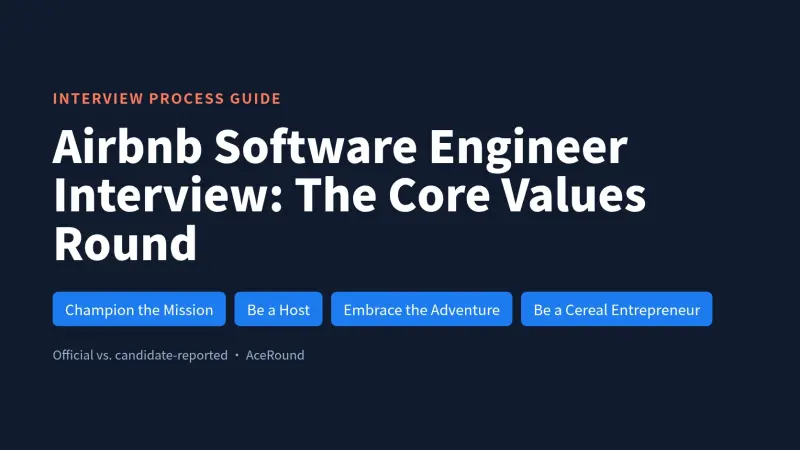
Airbnb Software Engineer Interview: The Core Values Round, Explained
Airbnb's four core values are public, but the interview round built on them isn't documented. Here's what's official, what candidates report, and how to prepare.
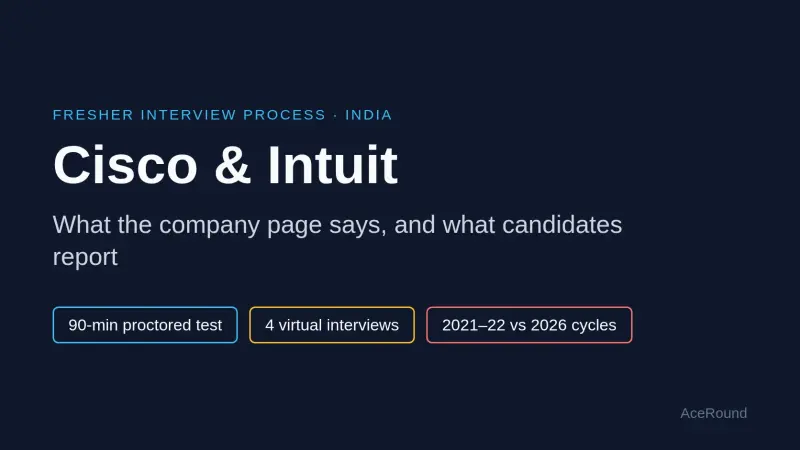
Cisco and Intuit Fresher Interview Process in India: Official vs Reported
Cisco's own Code with Cisco page, a third-party guide and one Intuit SDE-1 account differ on rounds and timing. What each says, and how to prep.
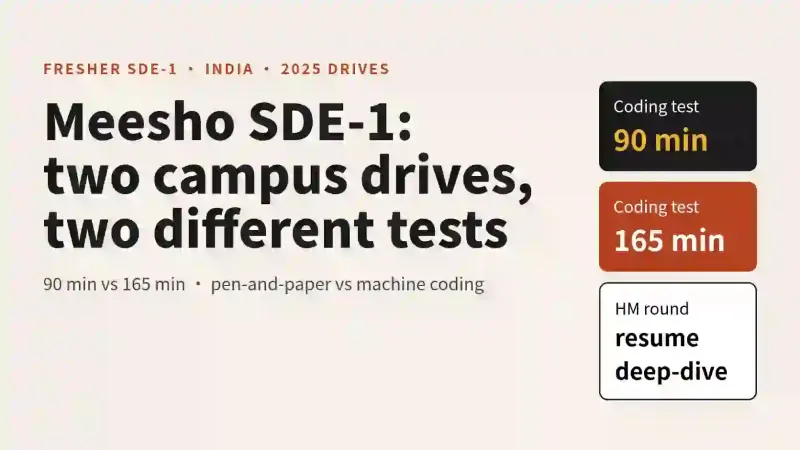
Meesho SDE-1 Interview Process for Freshers: Three 2025 Accounts Compared
Meesho SDE-1 campus accounts from 2025 disagree on test length, round order and design format. Here is what each reported and how to prep for any of them.