Bank Teller Interview Questions: How AI Interview Prep Actually Helps
Bank teller interview AI prep for the cash-drawer, compliance, and angry-customer questions generic listicles skip — plus what to expect in a group interview.

TL;DR: Bank teller interview AI prep works best on the three questions that actually decide the offer — the cash-drawer discrepancy scenario, the compliance/suspicious-transaction judgment call, and the angry-customer roleplay. The U.S. Bureau of Labor Statistics counts about 347,400 teller jobs with roughly 29,800 openings a year despite a shrinking total headcount — high volume hiring of candidates who mostly have never sat through a formal interview before.
Here's the thing nobody tells you before your first bank teller interview: almost everyone in the room with you has never done this before either. It's usually a first job, a return to work, or a career change into retail banking — not a room full of polished professionals. That changes what the interview is actually testing. It's testing whether you can follow a process under pressure and communicate clearly, not whether you already sound like a banker.
The Questions You Will Almost Certainly Get
Across Indeed, JobTestPrep, and the hiring guides candidates actually read before a teller interview, the same core set repeats:
- "Tell me about the extent to which you've handled large amounts of cash." The gateway question — banks need to know you're comfortable with the core mechanic of the job before anything else.
- "Walk me through your process for balancing your cash drawer, and how you address discrepancies when they occur." Notice the phrasing: when they occur, not if. Admitting a drawer can come up short without panicking is part of the correct answer.
- "What would you do if you saw a coworker take money from the drawer?" Tests integrity under an uncomfortable social situation, not just honesty in the abstract.
- "How do you stay motivated doing repetitive work?" Screens for whether you understand the day-to-day reality of the role before you're three weeks in and bored.
- "What would you do if a customer became upset with you?" Almost always asked, sometimes as a live roleplay instead of a story.
If you can only prepare two answers, prepare #2 and #5 — they're the ones interviewers say separate a real candidate from a memorized script.
The Cash-Drawer Discrepancy Question, Answered Properly
Most prep guides tell you to just "explain your process," which is true but incomplete. The actual structure interviewers are listening for has three parts:
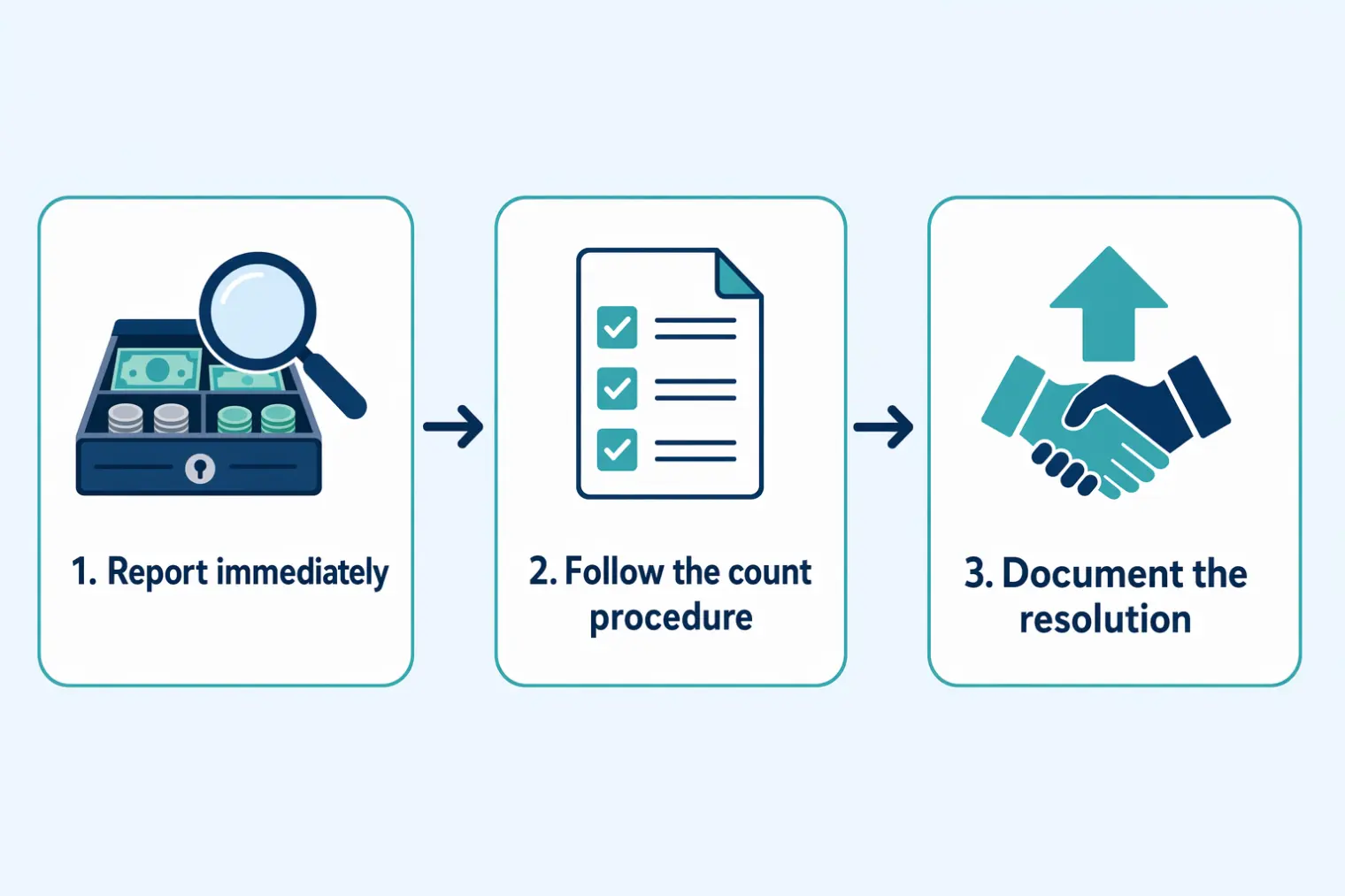
- Report it immediately, don't try to fix it quietly. Saying "I'd flag it to my supervisor right away" beats any story about personally recounting three times before telling anyone — banks care more about surfacing the discrepancy fast than about you solving it solo.
- Follow the count-verification procedure, not improvisation. Reference recounting against the register tape or till log, checking for a transposed transaction, and involving a second teller if your branch requires dual verification for shortages over a threshold.
- Document the resolution. Whether the discrepancy was found or written off per policy, state that you'd log it per procedure. This is the detail most candidates skip and the one that signals real cash-handling experience, or at least an understanding of why it matters.
The Compliance Question Most Guides Skip Entirely
This is the gap in almost every teller-interview article online: nobody prepares candidates for a Bank Secrecy Act (BSA) or anti-money-laundering (AML) scenario question, even though larger retail banks increasingly ask one. Something like: "A customer wants to deposit $15,000 in cash in small bills and gets vague when you ask about the source — what do you do?"
The Federal Reserve Bank of Minneapolis's overview of BSA training requirements makes the expectation clear: front-line staff aren't expected to personally adjudicate whether a transaction is suspicious. The correct interview answer is procedural — you'd complete any required reporting threshold documentation (Currency Transaction Reports apply above $10,000), note anything that felt evasive, and escalate to a supervisor or the bank's BSA officer rather than deciding on your own whether to refuse the transaction. Saying "I'd just tell them no" is actually a wrong answer; saying "I'd follow the reporting procedure and flag anything unusual to my supervisor" is the one that shows you understand your actual role in the compliance chain.
Handling the Angry-Customer Scenario Live
This one overlaps with almost every customer-facing entry-level role, and the structure holds here too: acknowledge the frustration before you problem-solve, name the specific action you took, then close the loop with the outcome. Our guide on customer service interview questions breaks down the full three-beat version if you want the detailed walkthrough — the only teller-specific addition is that your "fix" often involves a specific banking action (waiving a fee, escalating to a manager for an override, or explaining a hold on funds) rather than a generic apology.
Group Interviews and the Math/Attention Test
Retail banks hiring tellers at volume — think large branch networks rather than a single community bank — often run group interview formats or pair the interview with a timed assessment testing basic math accuracy and attention to detail (spotting numeric errors quickly, matching totals). If you're told to expect an assessment component, don't over-study math you already know; the test is measuring speed and consistency under a clock, which is closer to the actual job than it looks. Treat it like a warm-up, not a hurdle.
Practicing the Delivery, Not Just the Script
This is where a live AI interview assistant like AceRound is genuinely useful, and where we'll be honest about the limits. AceRound gives real-time answer suggestions while you're speaking — so if an interviewer's cash-drawer question gets a follow-up you didn't rehearse ("what if the discrepancy happens again the next week with the same teller?"), you get a live prompt for extending your answer instead of freezing on an unscripted twist.
What it won't do: replace understanding your actual bank's specific procedures, or simulate a human interviewer's read of your body language during a live roleplay. Use it to stress-test how your compliance and cash-handling answers hold up under an unexpected follow-up, not as your only rehearsal. For the format where an AI does the interviewing rather than assisting you, our guide on how to answer AI interview questions covers what changes when a structured rubric is scoring you instead of a person.
If you're coming into this with zero formal interview experience, that's genuinely fine — the hiring volume behind these 29,800 annual openings depends on it. Run through your cash-drawer and angry-customer answers once, then have a mock AI interview or a friend add a complication you didn't plan for. If your answer holds up, you're ready.
FAQ
What is the most common bank teller interview question? "Tell me about the extent to which you've handled large amounts of cash" and "walk me through how you'd balance your cash drawer" are the two questions that show up across nearly every bank teller interview guide. If you only prepare two answers, prepare these.
What should I say if asked about a cash drawer discrepancy? Walk through the process, not a promise that it never happens: report the shortage or overage immediately rather than trying to fix it quietly, follow your branch's count-verification procedure, and document the resolution. Interviewers are testing whether you handle the process correctly under pressure, not whether you're a robot who never makes mistakes.
Do bank tellers get asked compliance questions in interviews? Increasingly yes, especially at larger retail banks. You may get a scenario like "a customer wants to deposit $15,000 in cash and seems evasive about where it's from — what do you do?" The correct answer references following your bank's BSA/AML procedures and escalating to a supervisor, not personally deciding whether the transaction is suspicious.
How do I answer the angry customer question as a bank teller? Acknowledge the frustration before offering a fix, state the specific action you'd take, and close with the outcome. A story where the conflict resolves too smoothly usually reads as invented — a small amount of friction in your example makes it more believable.
Do bank tellers have group interviews? Yes, this is common at large retail banks hiring in batches. You may be evaluated alongside other candidates on a group exercise or asked to complete a timed math and attention-to-detail assessment before or alongside the interview itself.
I've never had a formal job interview before — will that hurt me for a teller role? No. Bank teller hiring pulls heavily from candidates with little or no interview experience, and interviewers know this. What matters is whether you can follow a process calmly, communicate clearly, and handle a customer scenario without freezing — not polish.
Author · Alex Chen. Career consultant and former tech recruiter. Spent 5 years on the hiring side before switching to help candidates instead. Writes about real interview dynamics, not textbook advice.
Related Articles

Two Sigma Software Engineer Interview: The Hidden Test Case Problem
Two Sigma's HackerRank OA fails candidates who pass every sample case they can see. Here's how the hidden-test-case gate actually works, round by round.

Deloitte USI, EY GDS, KPMG GDC, and PwC AC: India Hiring Process Explained
Deloitte USI, EY GDS, KPMG GDC, and PwC AC run four separate hiring processes — HireVue, group exercises, and Eduthrill included — and none of them match a TCS-style aptitude test.
Virtual Onsite Interview Loop: How to Survive 4-6 Back-to-Back Rounds
What a virtual onsite interview loop is, why round 4 is where candidates fall apart, and how to prepare for 4-6 back-to-back video rounds in one day.