Warehouse Associate Interview: Real Guide
Warehouse associate interview questions, physical-demands screening, and the video-screening format many candidates don't expect.
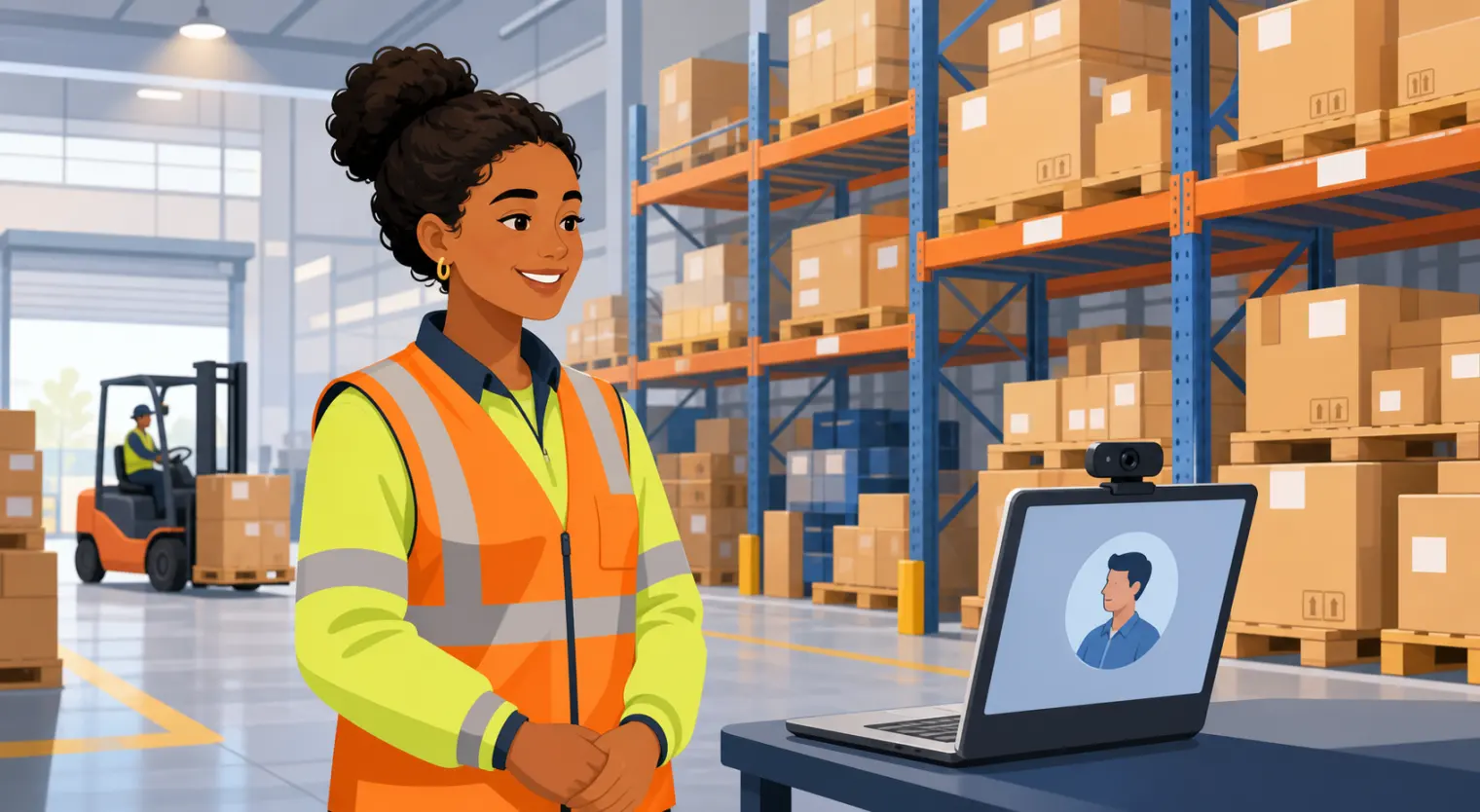
TL;DR: Warehouse associate interviews rarely hinge on trick questions — they hinge on shift availability, whether you can meet the physical lifting requirement, and one teamwork or reliability scenario. A growing share of employers now screen through an unscheduled async video recording instead of a live conversation, or skip the interview entirely and go straight from application to a hiring appointment. Know which format you're in, prep the physical-demands answer honestly, and practice your on-camera delivery out loud — that's what actually decides these hires.
The U.S. Bureau of Labor Statistics projects steady growth for material-moving and warehouse occupations through 2034, and large-scale e-commerce fulfillment has made "warehouse associate" one of the highest-volume hourly job categories in the country. Yet most interview-prep content online still treats it like a generic office interview — a flat list of ten questions with no mention of the fact that the "interview" itself might be a background check and an appointment booking, or a video recording you do alone with no one watching live. If you're prepping for an Amazon, FedEx, UPS, Walmart, or Target-style warehouse role, the format is often the part that catches people off guard, not the questions.
The Questions That Actually Decide the Interview
Three things get asked in almost every warehouse hiring process, in roughly this order of importance:
- "What's your shift availability?" Warehouses run overnight, weekend, and holiday shifts that are chronically understaffed, so this is usually asked before your work history. A hard "no" to a shift they need filled can end the conversation faster than a weak answer to anything else — but a specific, honest constraint (a second job, a class schedule) is far better than agreeing to hours you'll later no-show.
- Physical demands interview questions almost always follow, like "Can you lift [25-75] pounds repeatedly through a shift?" This isn't a formality — it's a disclosed physical requirement tied to the actual role, and standing 8-10 hours is usually part of the same question. If you have a limitation, raise it before you're scheduled, not after; some employers can place you in a lighter-duty role instead of rejecting you outright.
- A teamwork or reliability scenario. Something like "tell me about a time you had to keep pace with a team" or "what would you do if you were falling behind on a task." Warehouses run on throughput targets, so the interviewer is listening for whether you flag a problem early and ask for help, versus quietly falling further behind.
If the role is closer to a retail sales floor or customer-facing counter than a fulfillment center, the questions shift toward people-management — the retail manager interview guide covers that version in depth.
Two Sample Answers That Actually Show the Pattern
Shift availability: "I'm fully open to any shift Monday through Saturday, including early mornings or overnights. Sunday mornings I have a standing commitment until 10am, but I'm available for a Sunday afternoon or evening shift starting that week if needed." — Specific and negotiable beats a flat "I'm flexible," which employers hear as vague, or a flat "no Sundays ever," which reads as a hard block.
Teamwork/reliability scenario: "At my last job doing seasonal retail stocking, we had a truck delivery that came in two hours late and needed to be shelved before the store opened. I noticed about halfway through that our pace wouldn't finish in time, so I told my shift lead right away instead of waiting until the deadline, and we pulled one more person from the floor to help. We finished eight minutes before opening. I'd rather flag it early than have my lead find out at the last minute." — A specific moment, a specific action (spoke up early), and a specific outcome (a number, not just "it worked out").
The Formats Unique to This Industry
Warehouse hiring increasingly skips the format most people prepare for.
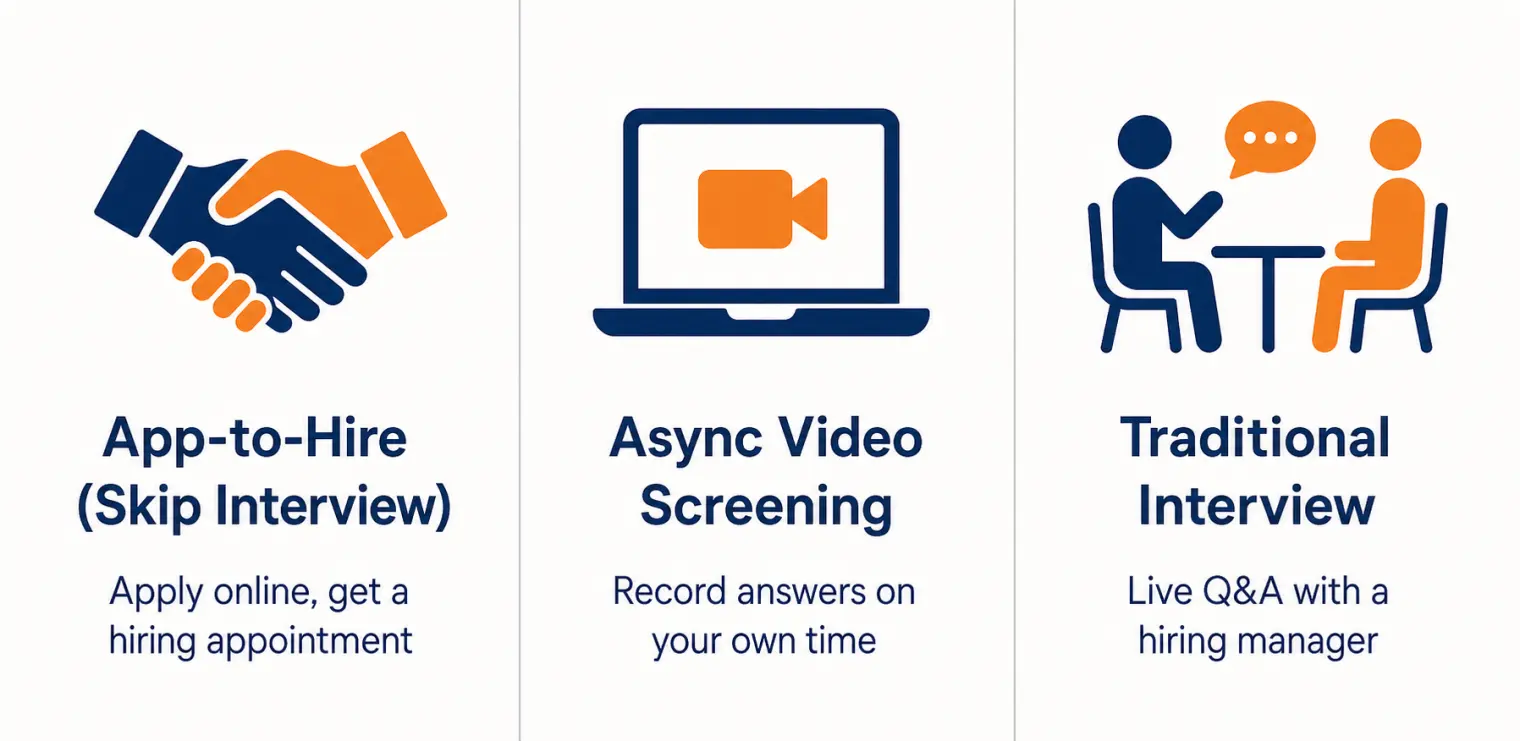
App-to-hire, no traditional interview. For many large fulfillment-center roles, Amazon's hiring process is: apply online, pass a background check, then book a hiring appointment — closer to onboarding paperwork than a Q&A. If you're expecting a formal interview and instead get a scheduling link, that's normal, not a red flag.
A video interview for a warehouse job is now common, not rare. Some large retailers now send a link where you record your own answers to 2-4 prompts within a time limit, with no live interviewer on the other end. This format rewards rehearsal specifically — pacing your delivery, not trailing off, and not needing more than one retake — because you usually only get one or two attempts per question and no one is there to put you at ease. The one-way video interview guide covers the on-camera mechanics of this format in more detail, since it now shows up well beyond warehouse hiring.
Traditional in-person or phone interview. Still common at smaller warehouses, staffing agencies, and some regional distribution centers — closer to the shift-availability and physical-demands conversation described above, sometimes with a brief facility tour.
If English Isn't Your First Language
Warehouse and fulfillment work is one of the largest entry points into the U.S. job market for non-native English speakers, and larger employers explicitly build hiring processes around it — Amazon runs a dedicated hiring track for non-English speakers, including translated safety materials and interpreters during onboarding. What actually matters in the interview or video screen is being clearly understood on three things: your shift availability, that you understood the safety instructions, and one short teamwork example — not polished grammar. The AI interview help for non-native English speakers guide has phrasing patterns that apply directly to these shorter, more literal warehouse-interview questions.
Practicing Before the Real Thing
The hard part of warehouse interview prep isn't knowing the questions — every job board lists the same three or four. It's rehearsing your shift-availability and teamwork answers out loud until they come out specific and fast, especially if you're prepping for a one-take async video recording where there's no room to restart mid-sentence. If you're using a real-time interview copilot like AceRound to prep, it's built for exactly this — a live prompt if a follow-up question catches you off guard on a phone screen, or a quick rehearsal pass before you hit record on a video screening, is more useful here than memorizing another static answer list.
Frequently Asked Questions
Do Amazon warehouse jobs really have an interview, or does it go straight to hiring? Often, no traditional interview at all. For many fulfillment-center roles, Amazon's process is apply online, pass a background check, then book a hiring appointment — closer to a paperwork and orientation step than a Q&A. Other warehouse employers still run a short in-person or phone screen, so confirm which process you're in rather than assuming either way; some staffing agencies that place warehouse workers also skip straight to a same-day offer.
What if I can't lift 50 pounds — will they still hire me? Most warehouse job postings list a specific lifting requirement (commonly 25-75 lbs) because it is a genuine, legally disclosed physical requirement of the role, not a throwaway line. If you have a condition that limits this, say so before you're scheduled for a physical shift rather than after — employers can sometimes accommodate or place you in a lighter-duty role (returns processing, quality checks) instead of turning you down outright, but only if you raise it early.
Will they ask about shift availability, and what if I can't work the shift they want? Yes — availability is usually asked before anything about your work history, because warehouses run around the clock and overnight, weekend, and holiday coverage is the hardest to staff. Being upfront about a hard limit (a second job, childcare, school) rather than saying yes and then no-showing protects your reputation with the employer and with any staffing agency involved; many warehouses have multiple shift patterns and will try to fit you into one that works before ruling you out.
Is a warehouse interview really done over video — what do they ask you to record? Increasingly, yes. Some large retailers now use an async, on-demand video format: you get a link, read 2-4 prompts, and record your answer within a set time limit (often under two minutes each), with no live person on the other end. Typical prompts ask about teamwork, handling a mistake, or staying reliable under a repetitive, fast-paced routine. Practice saying your answer out loud at a normal pace before you hit record — most people's first take runs long or trails off, and you usually only get one or two attempts per question.
Is it a problem if English isn't my first language for a warehouse interview? No — this is one of the most common entry points into warehouse work, and larger employers explicitly hire for it; some post safety materials and onboarding in multiple languages and note that interpreters or bilingual staff are available for the hiring process. What matters most is being able to clearly confirm your availability, safety instructions, and a simple example of teamwork — you don't need polished English, just to be understood on those specific points.
What happens after the interview — background check, drug test, physical assessment? Most warehouse offers are conditional on a background check, and many are conditional on a drug test as well, depending on the employer and location. Some also run a brief physical or functional assessment (a lifting or mobility check) before your first shift. None of this replaces the interview or video screen — it happens after, so don't assume a background-check email means you didn't get the job; it usually means the opposite.
Author · Alex Chen. Career consultant and former tech recruiter. Spent 5 years on the hiring side before switching to help candidates instead. Writes about real interview dynamics, not textbook advice.
Related Articles
DoorDash's AI-Assisted Engineering Interview: 60 Minutes, Your IDE, AI Required
DoorDash replaced its coding rounds with a 60-minute AI-assisted working session. Here is what the official post confirms, how it's scored, and how to prepare.
Shopify Interview Process 2026: Life Story, Pair Programming and the AI Memo
Shopify's official hiring steps, what the Life Story round scores, and what Tobi Lütke's reflexive-AI memo does and doesn't tell you about using AI in the interview.
Nagarro, Persistent, Publicis Sapient, Thoughtworks: How Each Interviews Freshers in India
Nagarro's Mettl tests, Persistent's AMCAT-style objective round, Publicis Sapient's values round, Thoughtworks' pairing session: what candidates report for each, and where the reports disagree.