AceRound vs Parakeet AI: 2026 Comparison
AceRound vs Parakeet AI compared on features, pricing math, and the detection risk behind Parakeet's process-naming trick — before you buy credits.
TL;DR: AceRound vs Parakeet AI comes down to how you pay and what you're actually protected from. Parakeet is a live-only overlay sold in credit packs — you can run out mid-interview, and its "invisible" process shows up under a generic name in Task Manager rather than not showing up at all. AceRound AI starts free, adds prep and mock-interview modes Parakeet doesn't have, and charges a flat $39.90/month or $69.90 for a 90-day Season Pass instead of per-credit guessing. If you're specifically comparing the two for a Taiwan or mainland Chinese job search, native Mandarin/English code-switching is the gap Parakeet's language list doesn't close.
Parakeet AI has real traction — the company claims over 1.5 million users and shows up constantly in "best AI interview copilot" roundups next to Cluely and Final Round AI. It's also one of the few tools with enough Taiwan and mainland Chinese search interest that GSC data shows real demand from that audience, even though almost none of the write-ups about it exist in Chinese. Before you buy a credit pack, here's what actually differs between Parakeet and AceRound once you get past the marketing page.
What Parakeet AI Actually Does
Parakeet is a lightweight desktop overlay for Mac and Windows that sits over Zoom, Google Meet, Teams, Webex, and Amazon Chime, listens to the interviewer's question, and generates a live answer — including screenshot-to-solution support for coding platforms like HackerRank and LeetCode. You can pick between GPT-5, GPT-4.1, or Claude 4.0 Sonnet per session, which is a genuinely useful option most competitors don't offer.
What it doesn't do: there's no practice or mock-interview mode, no post-interview review, no resume parsing, and no question bank. It's built for one moment — the live call — and nothing before or after it.
Feature by Feature
| AceRound AI | Parakeet AI | |
|---|---|---|
| Live interview support | Yes, behavioral + technical + case/PM | Yes, general chat + coding screenshot mode |
| Mock interview / prep mode | Yes | No |
| Model choice | Managed automatically | GPT-5, GPT-4.1, or Claude 4.0 Sonnet, user-selected |
| Platform coverage | Zoom, Meet, Teams, and OA-adjacent prep | Zoom, Meet, Teams, Webex, Amazon Chime |
| Pricing model | Free tier + flat monthly/season pass | Credit packs, pay-per-session |
| Chinese-English code-switching | Built for it | Advertised broadly, little verified Chinese-market feedback |
| Post-interview feedback | Yes | No |
| Free option | Yes, ongoing | ~10-minute trial sessions only |
The practical gap is scope. Parakeet is well-built for the specific moment of a live call, but a modern hiring process usually includes at least one round — a recruiter screen, a behavioral loop, a case round — that isn't a coding platform, and Parakeet has nothing designed for preparing beforehand or reviewing afterward.
The "Invisible" Claim, and What's Actually Documented
Parakeet markets itself as invisible to screen capture. The part that's real: in a standard screen share, the interviewer doesn't see the overlay window. The part that's more contested: multiple independent write-ups, including a detection-methods breakdown from Shadecoder, document that Parakeet's background process appears in Task Manager or Activity Monitor under a generic renamed label rather than not appearing at all — which is a meaningfully different claim than true invisibility. Talview, an enterprise proctoring vendor, runs a page specifically about detecting Parakeet AI, which by itself is evidence the "can't be caught" framing isn't settled the way the marketing implies. A dedicated third-party site (parakeetdetector.com) exists for the sole purpose of flagging it.
None of this means the tool doesn't function as designed — the window-hiding works. It means "hidden from screen share" and "undetectable" are two different claims, and treating them as the same thing is where the real exposure sits. Response lag is the other tell: user reports describe generic answers and multi-second delays on live coding problems, which a trained interviewer can notice independently of anything visual.
Pricing: Credits vs. a Flat Rate
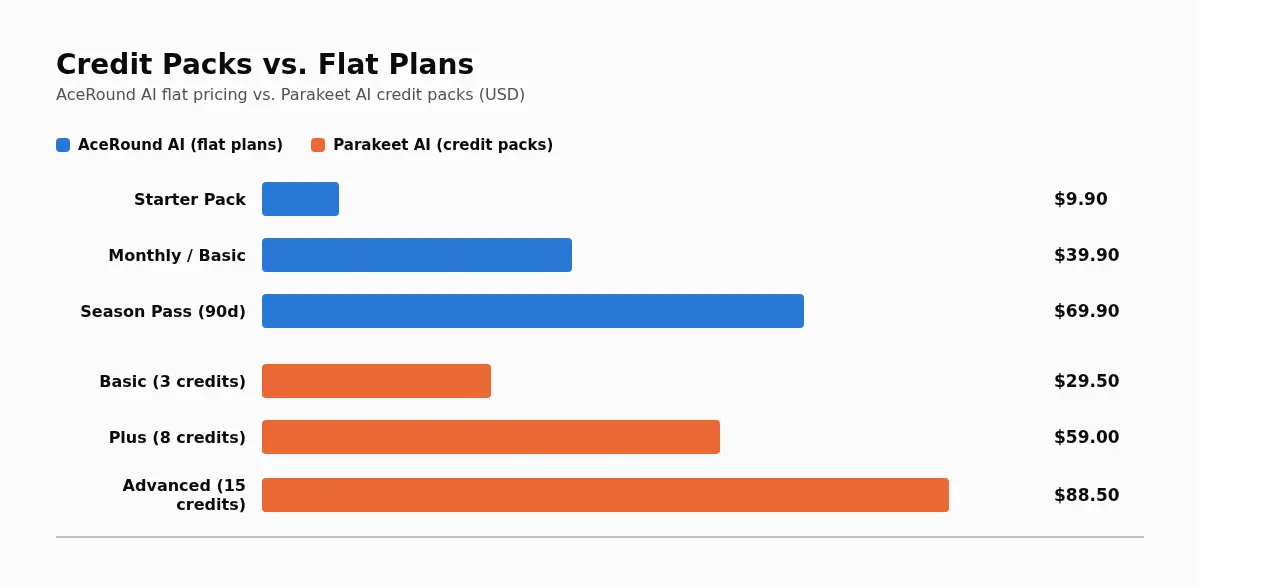
Parakeet sells in packs: roughly $29.50 for a 3-credit Basic tier, $59 for Plus (8 credits with bonus credits included), and $88.50 for Advanced (15 credits) — cheaper per credit as you buy more, but you're still estimating how many credits a real interview process will burn before you buy. Run out mid-interview, and the failure mode reported by users is the assistant simply stopping.
AceRound's current pricing removes that guesswork: a $9.90 Starter Pack covers a single high-stakes round if that's all you need, a free tier lets you test the product first, and unlimited access runs $39.90/month or $69.90 for a 90-day Season Pass if your search is going to take a few months — which most job searches do. Try the free tier before deciding anything.
Why This Matters More for Taiwan and Mainland Chinese Candidates
GSC data shows real search interest in Parakeet AI from Taiwan and mainland Chinese users, but there's almost no Chinese-language commentary about it anywhere — no PTT threads, no 一亩三分地 discussion, nothing beyond a single aggregator site that just republishes Parakeet's English feature list. That's unusual for a tool with over a million claimed users, and it suggests the demand is coming from candidates preparing for English-language interviews with global companies (TSMC's overseas hiring loop and general offshore tech interviews both fit this pattern) who have almost no local reviews to check the tool against.
AceRound's native Mandarin/English code-switching support is the concrete difference that matters here — Parakeet lists broad language coverage, but a live interview where you're thinking in Mandarin and answering in English is a different problem than static translation, and it's one Parakeet has no documented track record on.
Who Should Actually Use Which
Parakeet makes sense if: your only remaining round is a live technical call on a platform it explicitly supports, you're comfortable estimating credit usage in advance, and you've weighed the process-naming detection risk against your specific interview's monitoring setup.
AceRound makes sense if: your process includes a behavioral, case, or non-technical round anywhere in the loop, you'd rather not budget credits mid-search, you want to practice beforehand rather than rely entirely on live generation, or you're interviewing across Mandarin and English and need that handled natively rather than as an afterthought.
For a wider field of competitors, AceRound vs Cluely and AceRound vs Interview Coder cover the other two most-searched comparisons, and the existing Parakeet AI pricing and alternatives roundup covers a wider set of options if Parakeet itself isn't your final choice.
FAQ
Is Parakeet AI safe and legit? The company is real and the product works as a live overlay, but 'safe' depends on what you mean. Enterprise proctoring vendors like Talview run pages specifically about detecting Parakeet, and Parakeet's own process shows up in Task Manager or Activity Monitor under a generic name rather than being invisible outright. That's a documented gap between the marketing claim and what's actually verifiable.
Is Parakeet AI undetectable? Not fully. Independent write-ups on Parakeet's detectability, plus a dedicated third-party detector site built to catch it, both point to the same issue: naming a background process something generic doesn't make it invisible to anyone who checks. Response lag and flat answer delivery are separate behavioral tells that no amount of window-hiding fixes.
Can Parakeet AI be detected during a coding interview? Detection risk is documented at two levels — the renamed background process itself, and behavioral tells like multi-second response lag on live coding platforms. Neither requires the interviewer to see your screen; both have been written about by third parties independent of Parakeet's own marketing.
How much does AceRound cost compared to Parakeet AI? Parakeet sells credit packs starting around $29.50 for 3 credits, scaling down to roughly $5.90 per credit on its largest tier — you pay per session, and running out of credits mid-interview is a reported failure mode. AceRound starts with a free tier, a $9.90 Starter Pack for a single high-stakes round, and unlimited monthly ($39.90) or 90-day Season Pass ($69.90) access for a full job search, so cost doesn't depend on guessing how many credits an interview will use.
Does AceRound support Chinese-English interviews the way Parakeet does? AceRound is built for native Mandarin/English code-switching in real time, which matters for Taiwan and mainland Chinese candidates interviewing with English-speaking companies. Parakeet advertises broad language support but has close to no Chinese-language user reviews or community discussion to verify how that holds up in a live, mixed-language interview.
Author · Alex Chen. Career consultant and former tech recruiter. Spent 5 years on the hiring side before switching to help candidates instead. Writes about real interview dynamics, not textbook advice.
Related Articles
Does Harver Detect Cheating? What Its Proctoring Actually Checks
Does Harver detect cheating on its pre-employment assessments? A candidate look at Harver's Proctoring add-on, what gets logged after a flag, and what happens next.
Micro1's Zara AI Interview: What It Actually Tests (And Why Timing Gets Flagged)
Micro1's AI interviewer Zara has run 300,000+ interviews for remote roles. Here's why it flags response latency as a cheating signal, and what that means for AI prep.

Does CoCubes Detect Cheating During the Online Assessment?
CoCubes (an Aon platform) proctors off-campus drives with real AI monitoring — what it actually watches, what candidates report, and where prep helps.