Accountant Interview AI Tips: Your Role-by-Role Prep Guide
Role-tiered accountant interview AI tips for staff accountants, CPA candidates, and Big 4 applicants — with concrete answer frameworks for technical, behavioral, and ethics questions.
TL;DR: Most accountant interview prep is too generic. This guide covers role-specific accountant interview AI tips for three levels — staff accountant, public accounting/CPA candidates, and senior/management roles — with frameworks for the technical questions, ethical traps, and "AI fluency" questions that modern interviewers now ask.
Picture this: a mid-size regional CPA firm posts one staff accountant opening, gets 340 applications, and schedules 18 first-round interviews. Three of those candidates will get a second round. The interviewer has 45 minutes per candidate, and accounting technical questions only take 15. The other 30 minutes? Pure behavioral territory — and that's where most candidates fall apart, not because they lack accounting skills, but because they've only drilled technical questions.
Here's what the prep guides most candidates read get wrong: they treat every accountant interview the same. A staff accountant interview at a local firm looks almost nothing like a Big 4 first-round, which looks nothing like a controller interview at a tech company. Treating them identically is why technically competent candidates walk out without offers.
The Three Tiers of Accountant Interviews
Before picking a prep strategy, identify which tier you're interviewing for.
Tier 1: Staff Accountant (entry-level to 3 years) Primary focus: Can you do the work accurately, handle volume, and not create problems? Interviewers test: reconciliation process, journal entries, accruals, error-catching instincts, and whether you'll survive a month-end close. Behavioral questions center on accuracy under pressure and learning from mistakes.
Tier 2: Public Accounting / CPA Track (firm associate or senior) Primary focus: Can you represent the firm to clients, manage your own time across multiple engagements, and make judgment calls when the rules are unclear? Technical depth goes deeper (revenue recognition, lease accounting under IFRS 16/ASC 842), and ethical judgment questions appear here that almost never appear in Tier 1.
Tier 3: Senior / Management Accountant (5+ years, industry or corporate) Primary focus: Process improvement, stakeholder communication, and whether you can develop junior staff. Questions shift toward "tell me about a time you redesigned a process" and "how do you translate financial data for a non-finance audience." AI fluency questions hit hardest at this tier.
Most online prep resources blend all three together. That's their problem. Once you know your tier, your prep time drops by roughly a third because you can cut irrelevant territory.
Accountant Job Interview Questions You'll Actually Face
These questions appeared verbatim in accountant interview guides from Robert Half, Intuit, and ICAEW — and they map cleanly to what candidates report being asked on Reddit's r/Accounting.
Technical questions (all tiers):
- "Walk me through your reconciliation process."
- "What is the difference between accrual and cash accounting?"
- "How do you ensure accuracy in your financial reports?"
- "Describe a time you identified a financial discrepancy."
Technical questions (Tier 2–3 only):
- "How do you stay updated on accounting standards?"
- "What's your experience with ASC 842 / IFRS 16?"
- "How would you handle a situation where a client's books don't reconcile and the deadline is tomorrow?"
Behavioral questions (all tiers):
- "Tell me about a time you made an accounting error and what changes you made as a result."
- "Describe a situation where you had to meet multiple tight deadlines simultaneously."
Ethical judgment questions (Tier 2–3):
- "What would you do if your manager asked you to misclassify an expense?"
- "How would you handle discovering a material misstatement in a client's financials?"
For the ethical questions: the answer structure that works is Clarify → Escalate → Document. You'd first confirm you understood correctly (maybe there's a legitimate interpretation you're missing), then escalate through proper channels, then document the decision trail regardless of outcome. Never say you'd "just refuse and report them" in the first round — it sounds naive. The realistic answer acknowledges organizational complexity without compromising on ethical outcome.
Staff Accountant Interview Tips for the Behavioral Round
The behavioral round is where most entry-level candidates underperform — not because they can't answer the questions, but because they haven't thought through their stories in advance.
Three specific patterns that interviewers at public and regional firms actually care about:
The "busy season" pattern. If you're interviewing for any role that involves month-end close or tax season (which is most of them), you will get some version of "how do you handle working under deadline pressure?" The weak answer describes feelings: "I stay calm and prioritize." The strong answer describes a system: "During a particularly compressed Q4 close, I had to reconcile five accounts simultaneously in 48 hours. I broke it down by materiality — highest-balance accounts first — set two-hour blocks with a review checkpoint, and flagged one anomaly early enough to get a senior review before the deadline. We closed on time."
The "error-handling" pattern. "Tell me about a time you made an accounting error" is almost universal in staff accountant interviews. Candidates who haven't prepared this story in advance get nervous and give vague answers. The winning structure: state the error clearly (no minimizing), explain how you caught it or how it was caught, describe the immediate correction, and end with the system you implemented to prevent recurrence. The interviewer is not testing whether you make errors. They're testing whether you have self-awareness and process-improvement instincts.
The "learning from feedback" pattern. This shows up as "tell me about a time you received critical feedback" or "describe a situation where you disagreed with your manager." Prepare a story where you received feedback that was uncomfortable, initially disagreed internally, but ultimately changed your behavior because the feedback was correct.
An AI mock interview tool like AceRound AI is particularly useful for this preparation because it can drill these specific question types on repeat — something human mock interview partners rarely have patience for. The ability to run 15 variations of "describe a time you made an error" until your story comes out naturally in 90 seconds is exactly the kind of repetition that actually builds interview fluency.
For more on structuring behavioral stories, the STAR method guide covers the framework in depth.
CPA Interview Questions AI Can Now Help You Practice
Here's a category that almost no prep resource covers yet: AI fluency questions in accounting interviews.
As firms adopt AI-powered tools (Intuit's AI, Bill.com's automation, generative AI in audit planning), senior interviewers now ask questions like:
- "Describe a time you used AI or automation to improve a financial process."
- "How do you see AI changing the accounting profession over the next five years?"
- "What tasks do you currently automate, and what's your thought process for deciding when automation is appropriate?"
If you haven't been in a role where you've actively used AI tools, you still need a credible answer. The honest approach: describe your awareness of specific tools (mention Intuit Assist, Copilot for Finance in Microsoft 365, or AI features in your ERP of choice), your judgment on where AI introduces risk versus efficiency, and your commitment to maintaining oversight. Interviewers aren't looking for enthusiasm — they're looking for evidence that you understand the tradeoffs.
For your own prep, using AI to practice interview answers creates a useful feedback loop: you're simultaneously developing your fluency with AI tools while preparing answers about AI fluency. That's not a trick — it's genuine experience you can reference.
The AICPA's This Way to CPA career launchpad includes an AI-powered mock interview tool specifically designed for accounting candidates. For CPA exam candidates, it's a natural starting point before adding more general-purpose tools to your prep stack.
Accounting Behavioral Interview: The Scenarios That Trip People Up
Beyond the standard STAR method question types, accounting interviews have a handful of scenario categories that trip candidates up specifically because they involve judgment calls, not just facts.
The ethical trap scenario. These are usually framed neutrally: "What would you do if you discovered a discrepancy that your manager seemed aware of but wasn't correcting?" Candidates stumble here because they either (a) immediately go nuclear ("I'd report them to the SEC") or (b) collapse entirely ("I'd probably ask them about it"). Neither is the right answer in round one of an interview. The correct approach involves: clarifying assumptions, seeking context, using internal channels first, escalating incrementally, and documenting throughout. This mirrors the AICPA Code of Professional Conduct's guidance on ethical conflicts.
The "client is wrong" scenario. In public accounting, you'll face versions of: "A client insists on a treatment you believe violates GAAP. How do you handle it?" The right answer isn't about winning the argument — it's about: documenting your professional judgment, getting the conversation in writing, consulting your engagement manager, and ultimately being clear that you cannot sign off on an incorrect treatment. Practice saying "I would document my disagreement formally and escalate" without it sounding like corporate cover.
The deadline conflict scenario. "Two senior managers both give you urgent work due at the same time. What do you do?" The answer interviewers want isn't "I'd work late to do both." It's: you transparently surface the conflict, get explicit prioritization guidance from both managers or their shared superior, set accurate expectations on delivery, and deliver on whatever commitment you made. Promising both and delivering neither is the worst outcome — in interviews and in accounting careers.
For more on behavioral interview questions, there's a full breakdown of common patterns and how to structure answers.
Public Accounting Interview Preparation: The Big 4 Format
Big 4 interviews (Deloitte, PwC, EY, KPMG) and their equivalent at large regional firms follow a structured format that's quite different from industry accounting.
Typical format:
- Round 1: HR screen (30 min) — fit, background, why accounting, why this firm
- Round 2: Behavioral panel (60–90 min) — 3–4 interviewers, STAR questions, ethics scenarios
- Round 3: Technical assessment or partner/manager round — depends on the service line
- Office visit / final round: Sometimes a full-day format with multiple 30-minute conversations
The Big 4 have moved significantly toward structured behavioral interviews, scored against competency rubrics. This means the interviewer isn't improvising — they have a scorecard, and they need quotable evidence for each competency. Generic answers that describe how you'd approach a hypothetical score much lower than specific past experiences with clear outcomes.
Differentiation between firms:
- Deloitte emphasizes cultural alignment and leadership potential more aggressively than technical mastery in early rounds.
- PwC's "digital upskilling" initiative means technology/AI fluency questions appear more in their interviews than at other firms.
- EY focuses heavily on client service mindset and teamwork examples.
- KPMG tends to probe ethical judgment more thoroughly in early rounds.
These are generalizations — your specific service line (audit, tax, advisory) will dominate the interview more than firm culture at the question level. But the firm-specific culture signals matter when you're formulating "why this firm" answers.
Using AI tools for Big 4 prep: The volume of behavioral practice required for Big 4 interviews makes AI mock interview tools genuinely useful — not as a shortcut, but as a way to get repetitions in without scheduling human practice sessions. Run 20 behavioral questions, identify which story types you're over-relying on (most candidates lean too hard on 1–2 stories), and build out a broader story bank before your actual interview.
Robert Half publishes detailed accounting interview question guides that are worth scanning for the employer perspective — what they're actually evaluating with each question.
FAQ
What are the most common accountant interview questions?
The questions that appear most consistently across accounting interviews: "Walk me through your reconciliation process," "What is the difference between accrual and cash accounting," "How do you ensure accuracy in your financial reports," "Describe a time you identified a financial discrepancy," and "Tell me about a time you made an accounting error and what changes you made." Technical questions vary by role level; these behavioral and process questions appear almost universally.
How should I answer "tell me about a time you made an accounting error"?
State the error clearly without minimizing it, explain how it was caught (ideally by you before anyone else noticed, but be honest if that's not the case), describe the immediate correction, and end with the preventive measure you implemented. The interviewer is evaluating your self-awareness and process-improvement instincts, not your error rate. Everyone in accounting has made errors.
What AI tools actually help with accountant interview preparation?
For real-time interview practice, AceRound AI provides answer suggestions during live or practice interviews, which is useful for drilling behavioral question responses until they feel natural. AICPA's mock interview tool (via thiswaytocpa.com) is CPA-specific. ChatGPT or Claude can help you generate custom practice questions for a specific role if you paste in the job description. The most useful application across all of them is repeating the same behavioral question type 10–15 times until your answer comes out cleanly within 90 seconds.
How do I answer AI fluency questions in an accounting interview?
Describe specific tools you've used or evaluated (Intuit Assist, Copilot for Finance, your ERP's automation features), articulate your judgment on where AI creates risk versus efficiency in accounting contexts, and demonstrate that you maintain professional oversight rather than blindly trusting AI outputs. If you haven't used AI professionally yet, say that honestly — but show awareness of the tools and thoughtful perspective on adoption tradeoffs.
What's the difference between Big 4 and industry accounting interviews?
Big 4 interviews are more structured and behavioral-heavy, scored against competency rubrics across multiple rounds. Industry accounting (corporate, government, nonprofit) tends to be less structured, often with more direct technical testing in areas specific to that industry. The ethical judgment scenarios and client-handling questions in Big 4 interviews don't typically appear in corporate accounting interviews, which lean more toward process, systems, and cross-functional communication.
How do accounting interview questions differ globally?
The technical framework shifts by jurisdiction: US candidates need GAAP and FASB fluency; UK and Commonwealth candidates should know IFRS 15 and 16, and interviewers expect awareness of ICAEW/ACCA credentials. Canadian interviews often explicitly ask about AI tool adoption and perspective. Candidates with international credentials (e.g., ACCA in a US interview) should proactively address their qualification equivalency — don't leave the interviewer to figure it out. ICAEW's interview guide covers the UK/global perspective in detail.
Author · Alex Chen. Career consultant and former tech recruiter. Spent 5 years on the hiring side before switching to help candidates instead. Writes about real interview dynamics, not textbook advice.
Related Articles
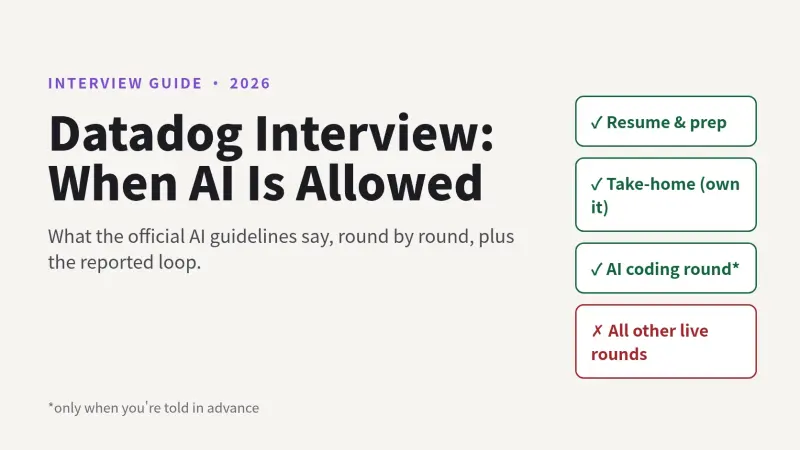
Datadog Interview Process (2026): What's Allowed With AI, Round by Round
Datadog publishes its AI rules for candidates. Here's what they allow, what they ban, the reported loop, and how to prep for the project deep dive.
Figma Software Engineer Interview Process (2026): What's Reported
Figma publishes no interview rubric. Here's the loop candidates report, the product-flavored coding and design rounds, and what's known about an AI round.
Oracle and PayPal Fresher Interview Process in India: What Candidates Reported, Year by Year
Oracle India's test moved from aptitude plus core CS to HackerRank with a REST API task. PayPal's cut-offs and platform also differ. Posts compared.