Wonderlic Test in 2026: Is It Proctored, and Where Does AI Help Fit?
The Wonderlic comes in two formats: a proctored test and an unproctored take-home QuickTest. Here's what separates them and where outside help is possible.
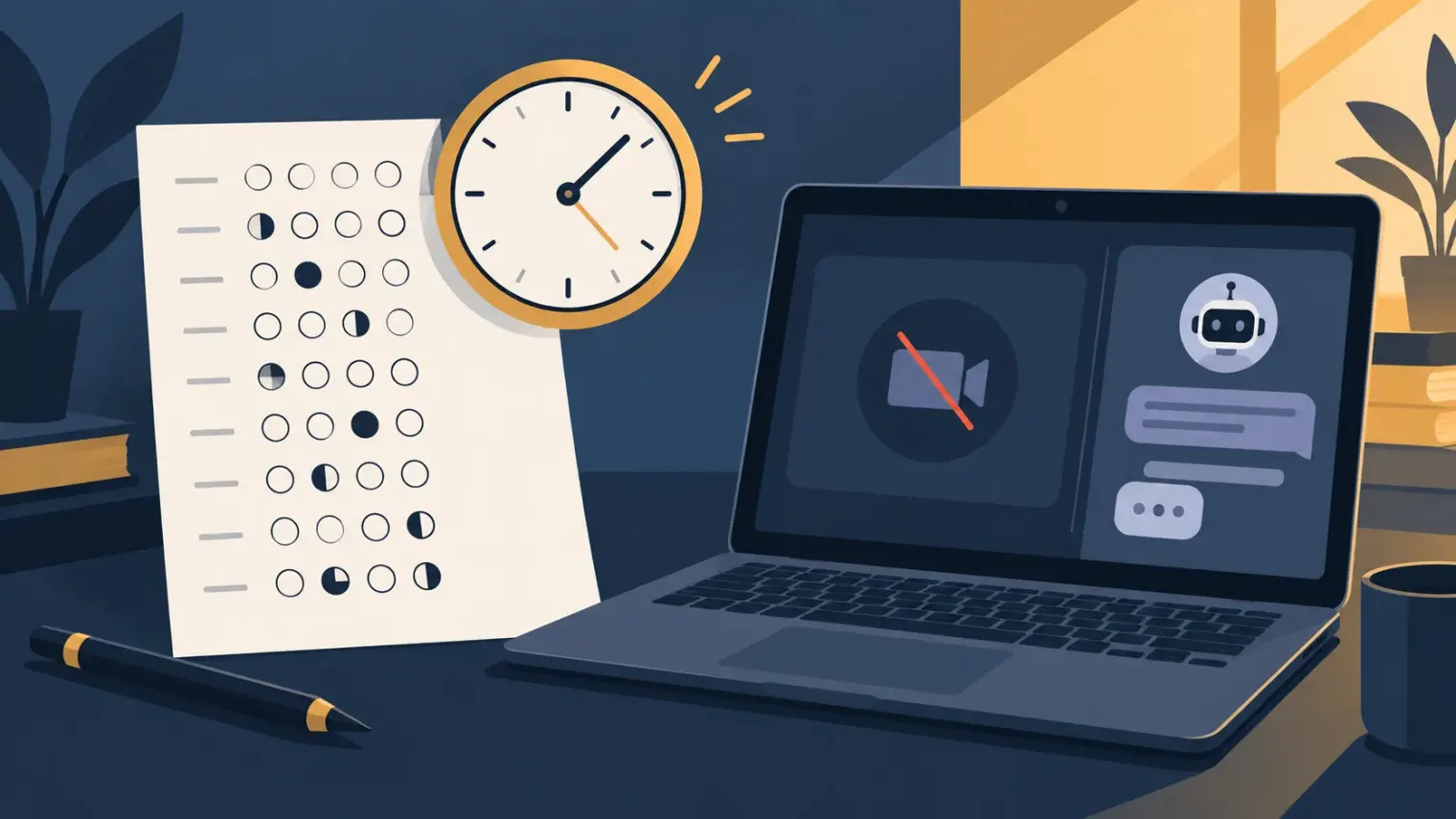
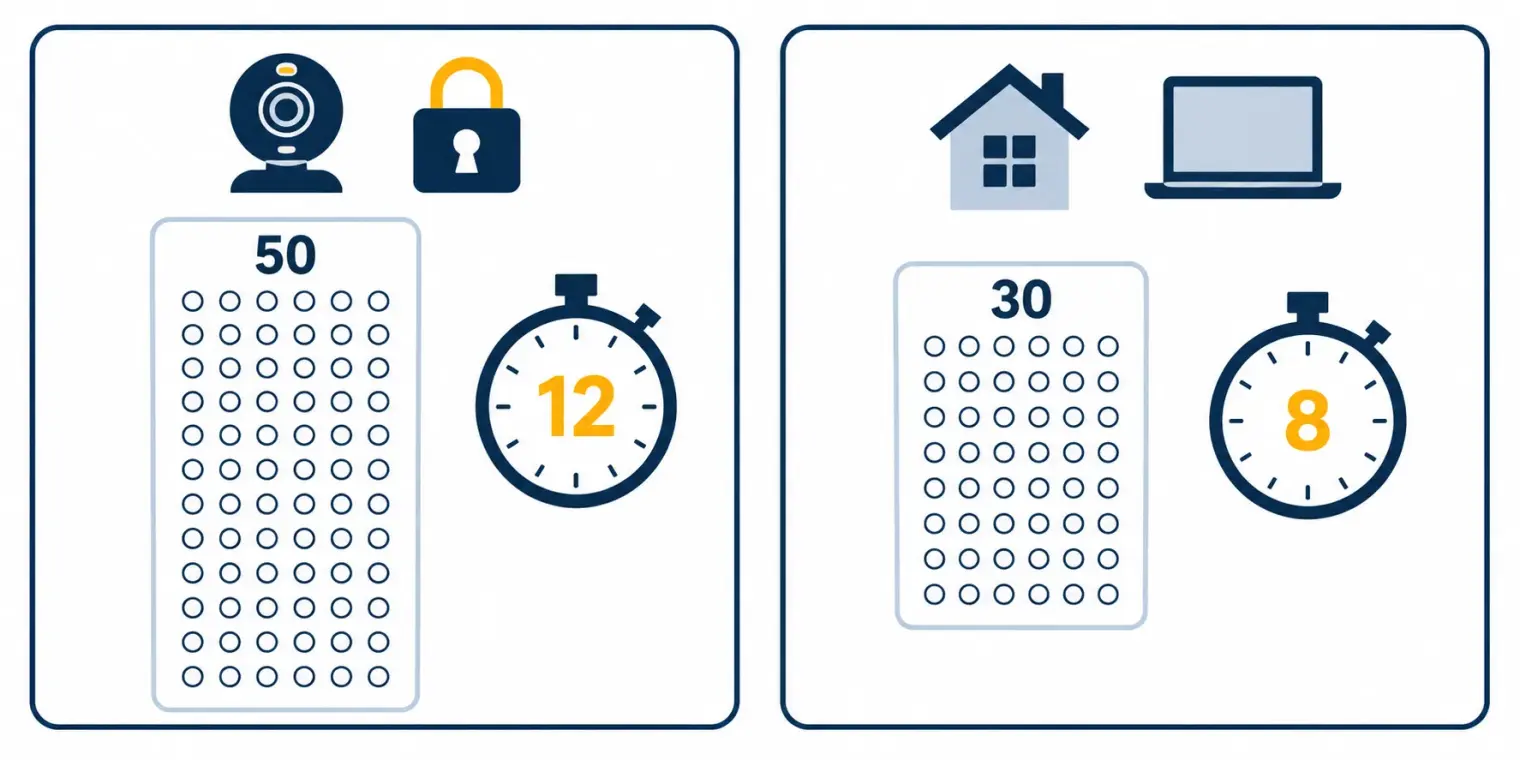
TL;DR: "The Wonderlic test" is actually two different experiences depending on which one an employer sends you. The full Wonderlic Personnel Test — 50 questions, 12 minutes, often proctored — is frequently a later-stage or final screen. The shorter QuickTest — 30 questions, 8 minutes, usually unproctored and taken at home — is often the first filter before you ever talk to a recruiter. The average score is around 20 out of 50, "good" depends entirely on the role, and outside help is only physically possible on the unproctored version. Wonderlic's June 2026 rebrand to Wonderlic Select layers a personality and motivation module on top of the classic cognitive test, but the cognitive scoring itself hasn't publicly changed.
You get a link in an email, click it expecting a quiz, and 12 minutes later you're staring at a screen that just locked you out mid-question. Or — just as commonly now — you get a link, take a shorter version at your kitchen table with nobody watching, and never think about it again until three weeks later when a recruiter mentions your "cognitive score" on a call. Most Wonderlic explainers online treat it as one fixed thing. It isn't, and the difference between the two versions changes almost everything about how you should approach it.
Two Very Different Tests, Same Brand Name
The classic Wonderlic Personnel Test: 50 multiple-choice questions across verbal, numerical, and abstract reasoning, given in a hard 12-minute window. This is the version most people picture — an intense, high-pressure sprint where the test simply cuts off when time expires, whether you've answered 30 questions or all 50.
The Wonderlic QuickTest: a shorter 30-question, 8-minute version that functions as an early-funnel filter. Employers increasingly send this one as an unproctored, take-it-whenever-you-want link before a candidate has done anything else in the pipeline — it's cheap to administer at scale and doesn't require scheduling a proctored session for every applicant who applies.
Same underlying item bank and scoring logic, completely different context: one is a supervised checkpoint late in the process, the other is an unsupervised gate at the very start.
Proctoring: The Question That Actually Matters
This is the detail that determines whether anything in this article about outside help is even relevant to your situation. Wonderlic doesn't mandate proctoring — each employer chooses. In practice:
- The full 50-question test is more often proctored, either in person or via webcam through a monitoring platform, especially when it's used as a later-stage or final decision point.
- The QuickTest is frequently sent as an unproctored remote link, taken on your own device, in your own environment, on your own schedule.
Wonderlic's own published research is worth knowing here: comparing tens of thousands of proctored and unproctored administrations, they found only a small difference in outcomes (a correlation around 0.86 between the two conditions) — which is essentially their argument that the hard time limit itself, not a human watching, is the real integrity mechanism. Whether you find that reassuring or not, it explains why so many employers are comfortable sending the unproctored version: the company's own data says the clock does most of the work.
How the Score Actually Works
Scores run on a straightforward 0-50 raw scale (the QuickTest scales proportionally), with the population average landing around 20 correct answers out of 50. That's lower than most candidates expect walking in — this isn't a test most people finish with most answers right.
There's no single passing score because Wonderlic doesn't set one; the employer does, per role. Wonderlic's own historical job-group guidance suggests rough target bands — high teens for entry-level and semi-skilled work, low-to-mid 20s for skilled and clerical roles, upper-20s and into the 30s for managerial, professional, and engineering positions — but the actual bar for your specific application is whatever number the hiring team decided before your result existed.
Note on the 2026 rebrand: Wonderlic's June 2026 redesign, branded Wonderlic Select, bundles a personality and motivational-fit module alongside the classic cognitive test. That's a real change to what employers see in the full report, but the cognitive-scoring convention itself — the part candidates fixate on — hasn't publicly changed.
Where Outside Help Is Actually Possible (and Where It Isn't)
The honest split, since this determines what's realistic to even attempt:
Proctored, 12-minute full test: not something you lean on outside assistance for during the attempt. It's a webcam-or-in-person session with a hard clock and a controlled environment — the entire design intent is one uninterrupted, supervised pass.
Unproctored QuickTest: physically, you're alone with a laptop and no one watching. What that changes in practice is less than candidates hope — it's still an 8-minute, 30-question sprint, and reading a question, deciding whether to search for help, and acting on it inside a ~16-second-per-question pace usually costs you more time than it saves. The realistic lever here isn't real-time assistance mid-test; it's rehearsing the pace beforehand until the format stops feeling like a sprint. Timed practice sets, done repeatedly, are what actually move this specific score.
Where a tool like AceRound AI genuinely fits is downstream of the Wonderlic, not during it: cognitive screens like this frequently sit in the same pipeline as a technical coding assessment or a live interview round. If your next step is an actual coding OA, AceRound's Coding Test Copilot is built for that stage specifically — it doesn't do anything for a multiple-choice cognitive test, and we're not going to pretend otherwise. If your next step is a live interview, a mock interview run beforehand is where real preparation time is well spent, because unlike a 12-minute locked cognitive sprint, an interview conversation is exactly the kind of format that benefits from rehearsal.
Who Actually Sends This Test
The Wonderlic shows up across a genuinely wide range of employers rather than concentrating in one industry — documented users include HSBC, Morgan Stanley, Citadel, IBM, PepsiCo, Mercedes-Benz, Medline Industries, Zurich Insurance, Subway, and Canadian National Railway, giving it real reach into both the US and Canadian job markets. It's also the cognitive test the NFL Scouting Combine has used on draft prospects for decades — the reason most non-jobseekers have heard the Wonderlic name at all, and a reminder that a 12-minute score has been treated as a meaningful signal by some very different industries for a very long time.
If your hiring process pairs the Wonderlic with a second assessment platform, our breakdowns of Predictive Index and Criteria Corp's detection layers cover the other pre-employment tests candidates most often run into in the same pipeline.
FAQ
Is the Wonderlic test proctored?
It depends which version an employer sends you. The full 50-question, 12-minute Wonderlic Personnel Test is often proctored — either on-site or over webcam through a platform like Crossover — because it's frequently used as a later-stage or final screening step. But many employers run an earlier, unproctored 30-question, 8-minute QuickTest as a remote take-home filter before ever inviting you anywhere. Wonderlic itself doesn't require proctoring; each employer decides.
What is a good Wonderlic score?
The population average sits around 20 correct out of 50, and Wonderlic's own historical job-group guidance suggests different target ranges by role — roughly the high teens for entry-level and semi-skilled positions, the low-to-mid 20s for skilled and clerical roles, and upper-20s to low-30s for managerial, professional, and engineering roles. There's no universal passing score; the company that sent you the test set its own bar for that specific job before your result ever existed.
Can you use a calculator on the Wonderlic test?
No. The classic Wonderlic Personnel Test is built to measure speed and accuracy together, and calculators aren't part of the intended format — the math questions are designed to be solvable through mental arithmetic within the time limit. Bringing one out during a proctored session is the kind of thing that gets flagged.
How long is the Wonderlic test?
The classic full test is 50 questions in a hard 12-minute window — the clock stops the test regardless of how many questions you've reached. The shorter QuickTest variant that many employers use as an early filter is 30 questions in 8 minutes. Both work out to roughly the same pace: about 14-16 seconds per question.
Can you retake the Wonderlic test?
Wonderlic doesn't publish one fixed retake rule that applies everywhere — that decision sits with the employer who sent you the test, and policies vary by company. Some allow a retake after a waiting period (commonly cited around six months), others don't offer one at all for a given hiring cycle. If you're wondering whether you can try again, the honest answer is to ask the recruiter, not to search for a universal Wonderlic policy that doesn't exist.
What companies use the Wonderlic test?
It shows up across a wide range of industries rather than being concentrated in tech. Employers and their hiring pipelines have been documented using it include HSBC, Morgan Stanley, Citadel, IBM, PepsiCo, Mercedes-Benz, Medline Industries, Zurich Insurance, Subway, and Canadian National Railway. It's also the cognitive test the NFL Scouting Combine has used for decades to screen draft prospects, which is where most people outside the hiring world first hear the name.
Author · Alex Chen. Career consultant and former tech recruiter. Spent 5 years on the hiring side before switching to help candidates instead. Writes about real interview dynamics, not textbook advice.
Related Articles
Micro1's Zara AI Interview: What It Actually Tests (And Why Timing Gets Flagged)
Micro1's AI interviewer Zara has run 300,000+ interviews for remote roles. Here's why it flags response latency as a cheating signal, and what that means for AI prep.
Does CoCubes Detect Cheating During the Online Assessment?
CoCubes (an Aon platform) proctors off-campus drives with real AI monitoring — what it actually watches, what candidates report, and where prep helps.
Anthropic's AI Interview Policy Explained: Where Claude Is Banned, Where It's Required
Anthropic makes Claude, then bans it from most of its own interview. Here's the stage-by-stage AI policy, and why the take-home test keeps changing.