AI Interview Assistant for Non-Native English Speakers: What Actually Helps
Non-native English speakers face accent bias and mid-answer freezes in interviews. See what research shows and what helps in the moment.
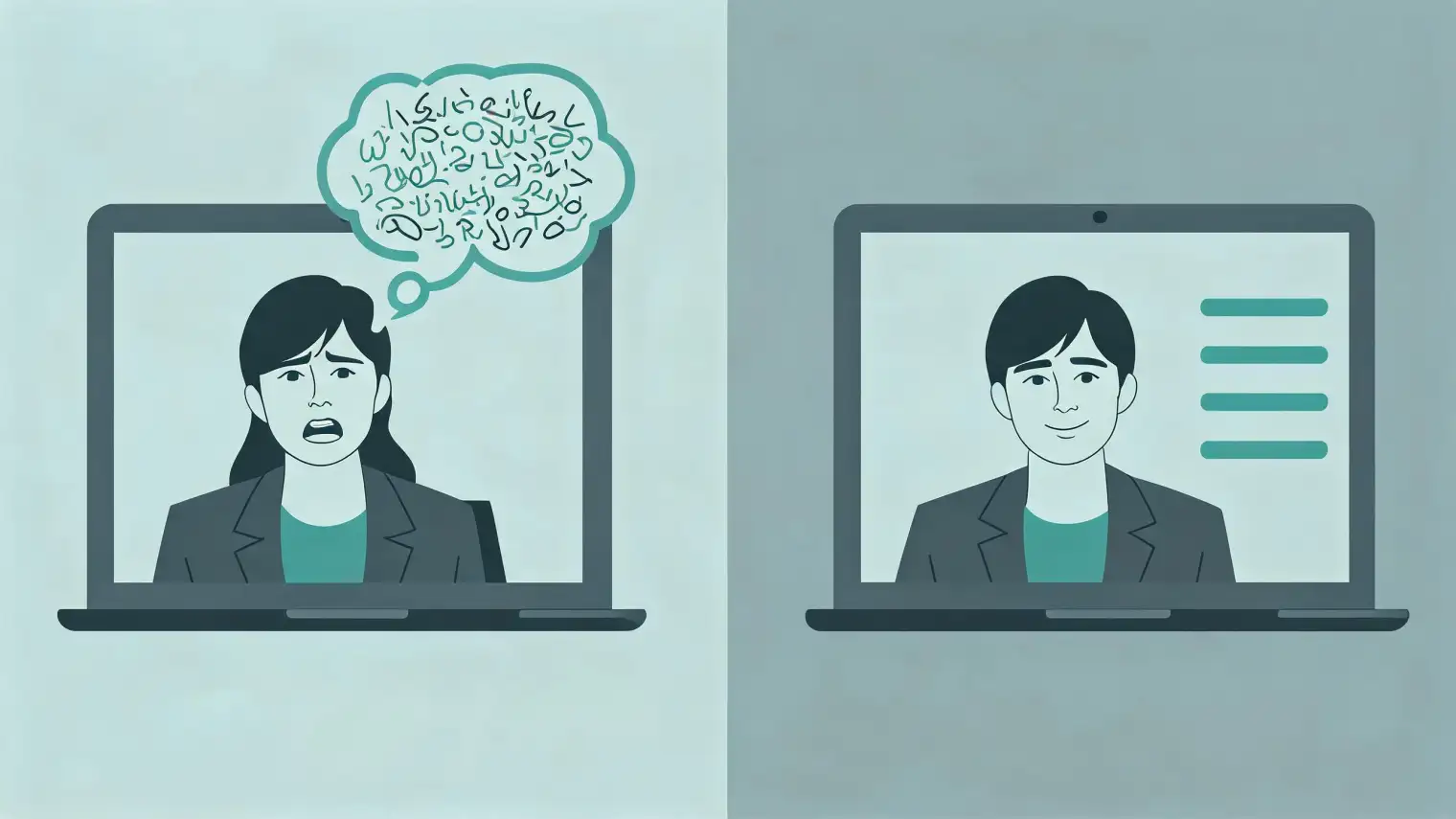
TL;DR: An AI interview assistant for non-native English speakers works best when it helps during the live interview, not just before it — because the actual problem (freezing mid-answer while your brain translates and searches for words at the same time) happens in real time. Practice and memorized scripts help, but research on non-standard accents shows they can roughly halve interview success odds at equal competence, and no amount of pre-interview rehearsal fixes a blank-out that happens live. Real-time structure and phrasing support closes that specific gap.
You're mid-answer. The interviewer just asked a follow-up you didn't fully prepare for. In your head, the sentence is already there — in your first language. By the time you've translated it, restructured the grammar, and picked the right word for "分寸" or "空気を読む" or whatever concept doesn't map cleanly onto English, three seconds of silence have passed and you've lost the thread of what you were even trying to say.
That gap — not vocabulary, not grammar, but the extra processing step of operating in a second language under pressure — is a documented cognitive tax. Research published in Psychological Science on what's called the "foreign-language effect" shows that thinking in a non-native language measurably increases cognitive and emotional load compared to your first language, especially when the stakes are high. An interview is about as high-stakes as spontaneous speech gets.
The Advice Everyone Gives Is About Before, Not During
Search "English interview tips for non-native speakers" and you'll land on largely the same playlist: build a vocabulary bank from the job description, rehearse your STAR stories five times, record yourself and review the tape, slow your pace by 10-15%, prepare a few "recovery phrases" like "let me put it another way" in case you stumble. This is solid advice, and none of it is wrong.
But it all assumes the fix happens before you walk into the room. It doesn't address the actual moment things go sideways — the follow-up question you didn't rehearse for, the point where your prepared script runs out and you're composing sentences live. Standalone pronunciation apps and practice-drill tools (there are several good ones) sit in the same category: they make you sharper going in, but they can't help you mid-sentence when the interviewer is looking at you and waiting.
The honest gap in almost all of this content: nobody addresses the live moment directly, because most of these tools aren't built to be present during the interview itself.
Why Some Markets Feel This More Than Others
English interview anxiety for non-native speakers rarely comes from a single cause, and the specific flavor of the struggle depends a lot on how you learned English in the first place:
- Japan: The traditional yakudoku (translation-based) teaching method plus years of eikaiwa conversation schools build strong reading and vocabulary but comparatively little spontaneous speaking practice — so the words are there, but producing them on the fly under pressure isn't.
- Korea: Hagwon cram schools are optimized to raise TOEIC scores, not live conversational fluency, which means candidates can ace a written test and still freeze in a chaebol interview that expects structured, confident spoken answers.
- China (zh-cn / zh-tw): Exam-focused English (reading and writing heavy) leaves strong grammar but little oral practice, and there's often a separate cultural adjustment around direct self-promotion — saying "I did X" plainly — that STAR-style answers require.
- Vietnam: A fast-growing IT and BPO workforce is interviewing directly with foreign employers, often before verb tense and article use have fully stabilized, on top of unfamiliar directness in Western-style questioning.
- Turkey: EFL instruction is explicitly translation-based, reinforcing a "think in Turkish, translate to English" habit that's hard to unlearn under interview pressure.
- Brazil and Latin America: False cognates between Portuguese/Spanish and English cause specific, embarrassing word-choice slips, and a culturally warmer, more elaborative communication style can read as unfocused against terser expected English interview norms.
If any of this sounds familiar, it's not a reflection of your English ability — it's a mismatch between how you learned the language and what a live, high-pressure interview demands of it.
Accent Bias Is Real, and It's Not About Being Understood
It's tempting to think this is purely a self-confidence issue, but the research says otherwise. A 2025 meta-analysis in the International Journal of Selection and Assessment found that candidates with non-standard accents can face roughly half the interview success odds of otherwise identical candidates — even when comprehension isn't actually impaired. In other words, this isn't just in your head, and it isn't solved by "just relaxing." It's a structural bias in how interviewers process accented speech, on top of the cognitive load of speaking a second language at all.
That combination — real bias plus real cognitive load — is exactly why "practice more" only gets you partway there. You can rehearse your way to more automatic phrasing, but you can't rehearse your way out of a live follow-up question you didn't see coming.
What Actually Helps in the Moment
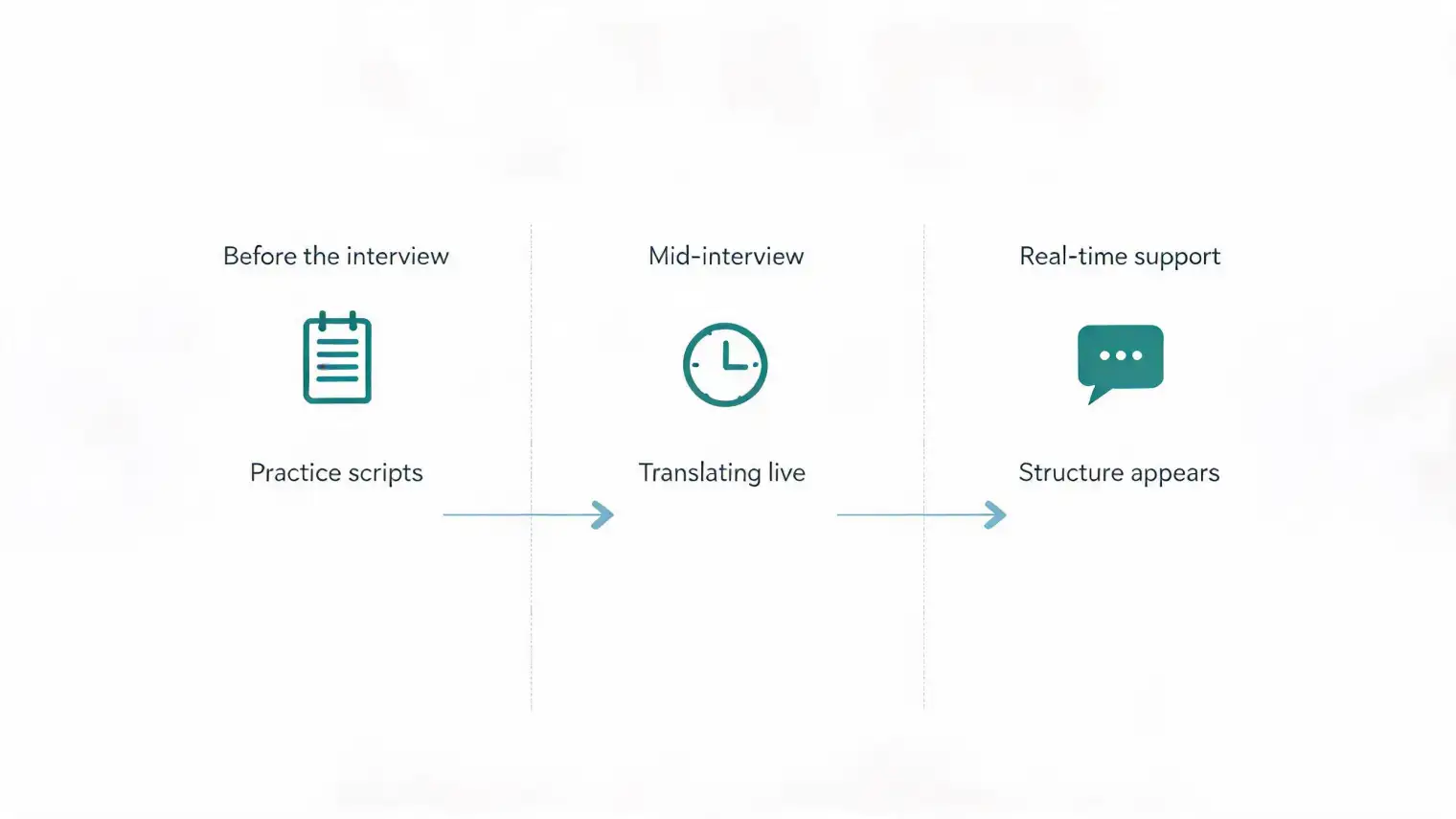
If the freeze happens live, the fix that matters most also has to happen live. A few things make a measurable difference during the interview itself, not just before it:
- Decide your answer's shape before you start talking, rather than composing sentence-by-sentence as you go — this is exactly where a tool that surfaces structure in real time (an outline, a key phrase, a reminder of the point you meant to hit) earns its keep, since it takes the improvisation-under-pressure part off your plate.
- Use your pre-built recovery phrases the moment you stumble, instead of trying to silently patch the sentence in your head — "let me put it another way" buys you a beat without breaking flow.
- Front-load the concrete part of your answer — a number, your specific role, the outcome — in the first sentence. It's the same advice recommended for answering behavioral interview questions well in general, and it matters even more when you're translating on the fly, because a strong opening line covers for a rougher middle.
This is the specific gap AceRound AI is built to close — real-time structure and phrasing suggestions that appear while you're in the actual conversation, not a rehearsal tool you use the night before. It won't fix an accent, and it isn't a script to read word-for-word; it's there for the exact moment your first language shows up before your second one does, so you have something to anchor to instead of losing the thread.
A Simple Framework for the Interview Itself
Put together, here's what actually moves the needle, in order of when it applies:
- Before the call: Build your vocabulary bank from the actual job description, and prepare 2-3 STAR stories you can adapt to multiple questions — not memorized word-for-word, but familiar enough that the shape is automatic.
- In the first ten seconds of any answer: Lead with a concrete detail — a number, a name, a specific action you took — so even a rough middle section still lands as substantive.
- The moment you feel yourself stall: Use a recovery phrase out loud rather than going silent while you translate internally. Silence reads worse than an imperfect sentence.
- If you're using real-time support: Treat it as a structure cue, not a script — glance, don't read. The goal is staying anchored to your point, not reciting.
None of this erases the extra cognitive load of interviewing in a second language, and it won't neutralize accent bias on its own. But it targets the actual moment where non-native candidates lose ground — live, mid-answer — instead of only preparing for the interview that starts ten minutes earlier than the one that actually gives you trouble.
FAQ
As a non-native English speaker, how can I sound confident in job interviews? Confidence in this context is less about eliminating your accent and more about controlling pace and structure. Slowing down by 10-15%, leading answers with a concrete detail, and having a couple of rehearsed recovery phrases ready for when you stumble all measurably help — none of them require sounding like a native speaker.
How do I prepare for an English job interview as an ESL learner? Build a vocabulary bank from the actual job description rather than generic word lists, rehearse 2-3 STAR stories until the shape is automatic (not memorized word-for-word), and record yourself once to check your pace. This covers most of what standard ESL interview prep gets right — the gap it doesn't cover is the live follow-up question you didn't rehearse for.
Will my accent affect my interview? Research suggests it can, independent of whether your English is actually understood — one meta-analysis found non-standard accents associated with roughly half the interview success odds of otherwise similar candidates. This is a bias in the interview process, not a reflection of your competence, but it's worth knowing about so you don't mistake a biased outcome for a personal failing.
How do I stop translating in my head when speaking English? You can't fully stop it — the foreign-language effect is a real cognitive process, not a bad habit. What helps is reducing how much translation you need to do live: pre-build phrases for your most likely topics (your background, your strengths, why you want the role) so those specific sentences don't need to be composed from scratch under pressure.
How can I speak English fluently in a job interview? Front-load the concrete part of your answer — a number, your specific role, the outcome — in the first sentence. Fluency under pressure is less about flawless grammar throughout and more about a strong, clear opening that covers for a rougher middle section, plus a rehearsed recovery phrase for when you stumble. Tools built to surface structure and phrasing in real time — like AceRound AI — help with this exact moment, without eliminating the underlying cognitive load of a second language.
Author · Alex Chen. Career consultant and former tech recruiter. Spent 5 years on the hiring side before switching to help candidates instead. Writes about real interview dynamics, not textbook advice.
Related Articles
OpenAI's AI Interview Policy: Banned, Required, or Team-Dependent
OpenAI sells AI coding agents, then bans most candidates from using one. Here's the round-by-round policy, including the new agentic round that flips it.
Does Harver Detect Cheating? What Its Proctoring Actually Checks
Does Harver detect cheating on its pre-employment assessments? A candidate look at Harver's Proctoring add-on, what gets logged after a flag, and what happens next.
Micro1's Zara AI Interview: What It Actually Tests (And Why Timing Gets Flagged)
Micro1's AI interviewer Zara has run 300,000+ interviews for remote roles. Here's why it flags response latency as a cheating signal, and what that means for AI prep.