Physical Therapist Interview AI Prep Guide
Physical therapist interview questions: clinical-reasoning scenarios, productivity and caseload questions, and how to rehearse both with AI.
TL;DR: Physical therapist interview AI prep matters because the questions split into two buckets most candidates under-prepare for: clinical-reasoning scenarios (walk me through treating a post-op ACL patient, a stroke case, a patient who's plateaued) and the productivity/caseload questions that actually predict job satisfaction more than any behavioral question does. PT hiring demand is growing fast and globally - the US Bureau of Labor Statistics projects 11% growth through 2034 - but almost no interview-prep content covers the clinical-reasoning side at all. Practicing both the reasoning and the delivery out loud, with an AI mock interview if you don't have a colleague handy, closes that gap.
You've rehearsed "tell me about your biggest weakness" a dozen times. Then the interviewer says, "Walk me through how you'd evaluate a patient six weeks post-op ACL reconstruction," and the confident answer you had ready for everything else doesn't apply. That moment - a real clinical scenario dropped into what felt like a standard HR interview - is where most physical therapist interview prep quietly falls short.
Why Physical Therapist Interview Questions Aren't Just Generic Behavioral Questions
Search "physical therapist interview questions" and you'll get the same recycled list everywhere: why PT, biggest strength, difficult coworker, most rewarding part of the job. Real PT interviews layer a second, harder category on top: clinical-reasoning scenarios where you're expected to reason through a case out loud, not recite a protocol from memory.
Interviewers use these scenarios specifically because a memorized answer doesn't survive them - they want to hear you work through history and precautions, then exam findings, then a treatment rationale that fits the actual patient in front of you, not a generic textbook case.
Clinical Reasoning Interview Questions Physical Therapist Candidates Actually Get
The scenarios repeat across settings more than you'd expect:
- Post-op ACL reconstruction, six weeks out. What are you checking before you touch the knee? What's your progression logic, and what would make you slow it down?
- Stroke or geriatric rehab case. How do you balance safety and fall risk against pushing for functional gains? What does "good progress" look like at week two versus week six?
- A patient who's plateaued. This is the one that separates candidates fastest. Interviewers don't want "switch the protocol" - they want you to reassess your assumptions about the diagnosis, the goals, and the patient's actual adherence before changing anything.
The pattern interviewers reward: history and precautions first, exam findings second, treatment logic third - in that order, out loud, every time. Jumping straight to "I'd do X exercise" without that sequence reads as protocol-following, not clinical reasoning, even if the exercise choice is correct.
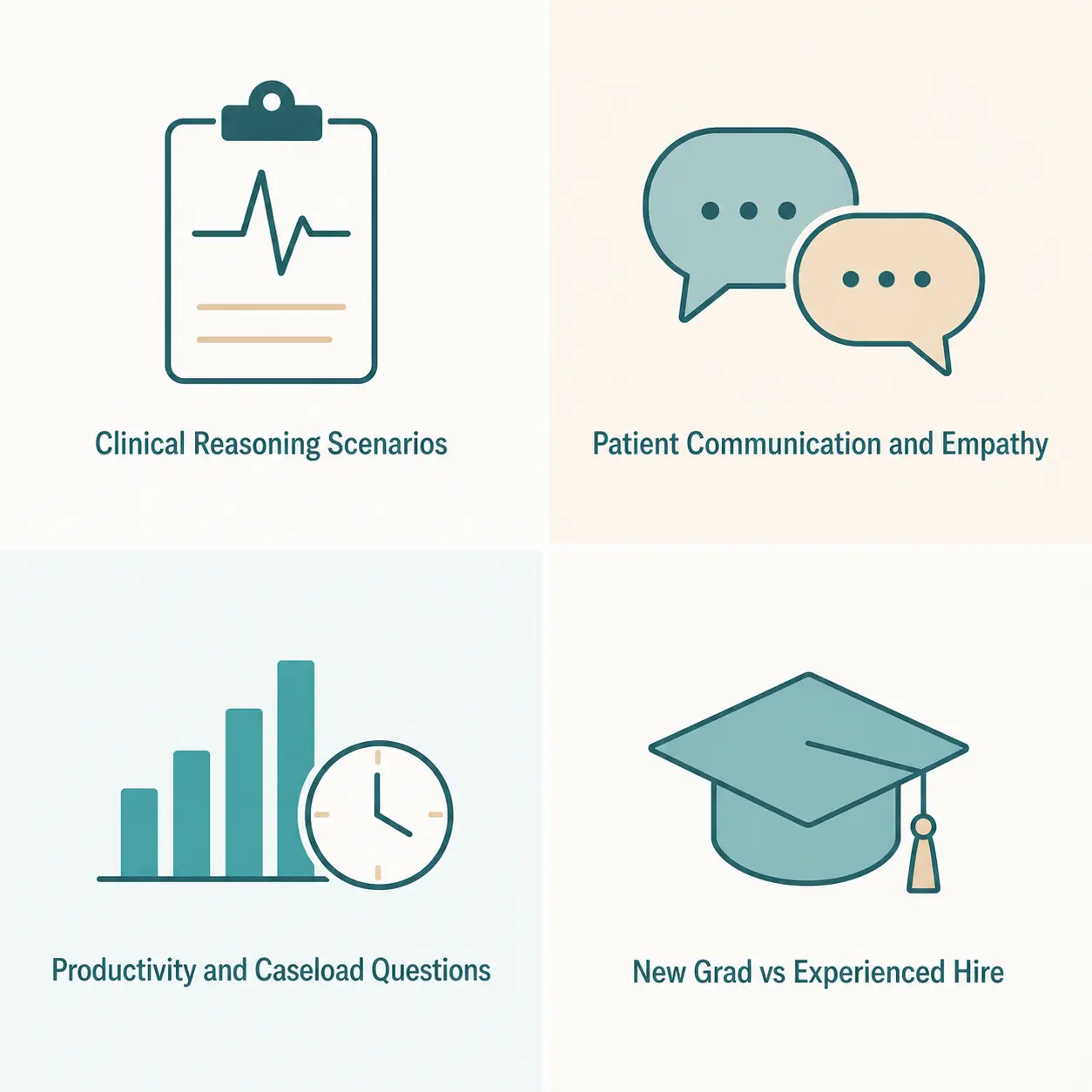
PT Interview Questions and Answers: The Productivity and Caseload Questions That Actually Matter
Here's the split that HR-written listicles consistently miss: the questions PT candidates discuss most on forums like r/physicaltherapy aren't about behavioral fit at all. They're operational, and they predict job satisfaction better than anything else on the list:
- What's the productivity requirement, and exactly how is it calculated?
- What happens if productivity isn't met - is it a conversation, a formal review, or tied to pay?
- What's the patient-to-therapist ratio, and what's the PT-to-PTA staffing mix?
- Is documentation time paid, or is it expected on your own time?
These aren't rude questions to ask an interviewer - they're the ones experienced PTs specifically advise new grads to ask before accepting an offer, because a clinic that can't give you a straight number on any of these is telling you something. Vague answers here, high unexplained turnover, and unpaid documentation time are the physical therapist interview red flags candidates raise again and again.
New Grad vs Experienced Hire: What Changes
If you're a new grad, expect more questions about mentorship availability, what onboarding actually looks like in the first 90 days, and your licensure/NPTE status. Interviewers are checking whether the clinic can actually support someone still building clinical judgment.
If you're an experienced hire, the questions shift toward specialty certifications, continuing education you've pursued, and whether you're expected to mentor newer staff. You'll also more often face a panel interview - several staff members at once - which is less common in a typical office-job interview and worth practicing specifically, since managing multiple interviewers' follow-ups is a different skill than a one-on-one conversation.
Patient Communication and Empathy Questions
The behavioral side of a PT interview still shows up, just with a clinical spin: how do you handle a patient who isn't following their home program, how do you deliver difficult news about a slower-than-expected recovery, how do you handle a disagreement with a physician or a coworker about a treatment plan.
The answer interviewers are listening for isn't "I stay positive" - it's whether you investigate the reason behind non-compliance (pain, fear, confusion, logistics) before adjusting anything, and whether you re-motivate through the patient's own stated goals rather than just repeating instructions louder. That's clinical judgment and communication tested together, which is exactly why generic "tell me about a conflict" prep doesn't fully transfer here.
Why Physical Therapy Job Interview Tips Need to Catch Up to the Hiring Boom
This isn't a niche role getting outsized attention - it's a genuinely underserved gap relative to real demand. The US Bureau of Labor Statistics projects 11% employment growth for physical therapists through 2034, much faster than average, and the American Physical Therapy Association's workforce forecast points to a persistent shortfall through 2037 as demand grows faster than the working-age population, backed by peer-reviewed supply and demand modeling.
That demand driver - an aging population needing more mobility, joint, and stroke rehabilitation - isn't a US-only story. Japan, South Korea, and Taiwan are among the fastest-aging societies in the world, which points toward the same structural hiring pressure in those markets even though local licensure (Japan's 理学療法士 exam, Korea's 물리치료사, Taiwan's 物理治療師) is a separate prerequisite outside the scope of interview prep itself. The clinical-reasoning and communication content candidates actually need to rehearse is the same everywhere - it's just not being written for, anywhere.
How to Rehearse Clinical Reasoning Out Loud With an AI Copilot
The clinical scenarios above are hard to practice alone precisely because there's no answer key - a strong response is about the quality of your reasoning sequence, not a single correct output. If you don't have a colleague or mentor free to run mock scenarios with you, free AI mock interview practice lets you talk through a case - "walk me through evaluating a plateaued post-stroke patient" - and get feedback on whether your reasoning actually followed history-then-exam-then-treatment-logic, or skipped straight to a protocol.
It won't replace clinical experience, and it can't grade you against a real supervisor's standard. What it closes is the specific gap in PT interview prep: rehearsing the sequence of your reasoning out loud, under something resembling interview pressure, before you're doing it live in front of a hiring panel.
For other healthcare-adjacent roles with the same feedback-vacuum problem, see our guides to nurse interview preparation, dental hygienist interviews, and medical assistant interviews. If you want a refresher on structuring the behavioral half of the interview, our STAR method guide still applies to the communication questions above.
FAQ
What is the most common physical therapist interview question? Beyond the standard "why did you choose PT" and "what's your biggest weakness," the question that trips up the most candidates is a clinical-reasoning scenario - being walked through a patient case and asked to reason through your evaluation and treatment plan out loud, not just name a protocol.
What clinical scenarios come up in physical therapist interviews? Common ones include a post-op ACL reconstruction patient, a stroke or geriatric rehab case, and a patient whose progress has plateaued. Interviewers are listening for history and precautions first, then exam findings, then a treatment rationale - candidates who jump straight to naming a protocol tend to score worse than ones who show the reasoning.
What productivity questions should I ask in a physical therapist interview? Ask directly about the productivity requirement and how it's calculated, the patient-to-therapist ratio, whether documentation time is paid, and the PT-to-PTA staffing mix. These come up constantly in PT career forums as the real predictor of job satisfaction, far more than the behavioral questions HR guides focus on.
What are red flags to watch for when interviewing for a PT job? Vague or evasive answers about productivity targets, high staff turnover the interviewer can't explain, unpaid documentation time, and a caseload the clinic can't clearly describe are the red flags PT candidates raise most often. If an interviewer can't give you a straight number on productivity, treat that as information.
What's different about a new grad PT interview versus an experienced hire interview? New grads get more questions about mentorship availability, onboarding timeline, and licensure/NPTE status, while experienced hires are asked about specialty certifications, continuing education, and mentoring others. Panel interviews with multiple staff at once are also more common in hospital and clinic settings than in a typical office interview.
How do I answer a question about handling a non-compliant patient? Show that you investigate the reason for non-compliance - pain, fear, confusion about the home program, logistics - before adjusting the plan, and that you re-motivate through the patient's own goals rather than just repeating instructions. Interviewers are testing communication and clinical judgment together, not just empathy.
Author · Alex Chen. Career consultant and former tech recruiter. Spent 5 years on the hiring side before switching to help candidates instead. Writes about real interview dynamics, not textbook advice.
Related Articles
OpenAI's AI Interview Policy: Banned, Required, or Team-Dependent
OpenAI sells AI coding agents, then bans most candidates from using one. Here's the round-by-round policy, including the new agentic round that flips it.
Does Harver Detect Cheating? What Its Proctoring Actually Checks
Does Harver detect cheating on its pre-employment assessments? A candidate look at Harver's Proctoring add-on, what gets logged after a flag, and what happens next.

Micro1's Zara AI Interview: What It Actually Tests (And Why Timing Gets Flagged)
Micro1's AI interviewer Zara has run 300,000+ interviews for remote roles. Here's why it flags response latency as a cheating signal, and what that means for AI prep.