The Internal Transfer Interview: What Actually Changes at Google and Amazon
Fewer rounds doesn't mean lower stakes. How Google and Amazon's internal transfer mechanics — tenure rules, manager notification, bar raisers — actually differ from an external hire.

TL;DR: Internal transfers trim rounds, not standards — the culture-fit rounds get cut, the technical bar doesn't move, and the one question every internal loop adds that an external one never does is why you're leaving this team. At Google that comes with a roughly 12-month tenure gate before you can even apply, and a manager who can't formally block you but can quietly slow the process. At Amazon, telling your manager before applying is expected, they can request a delay for critical work but can't veto it, and the internal loop skips the bar raiser.
Most advice about internal transfers treats it as a resume exercise: update your internal profile, talk to your target team's manager, prepare like you would for any interview. That's not wrong, but it skips the part that actually determines whether the process goes smoothly — the procedural mechanics that differ by company, and the fact that unlike an external interview, the people involved already know you, which cuts both ways.
The Tenure and Notification Rules Nobody Explains Upfront
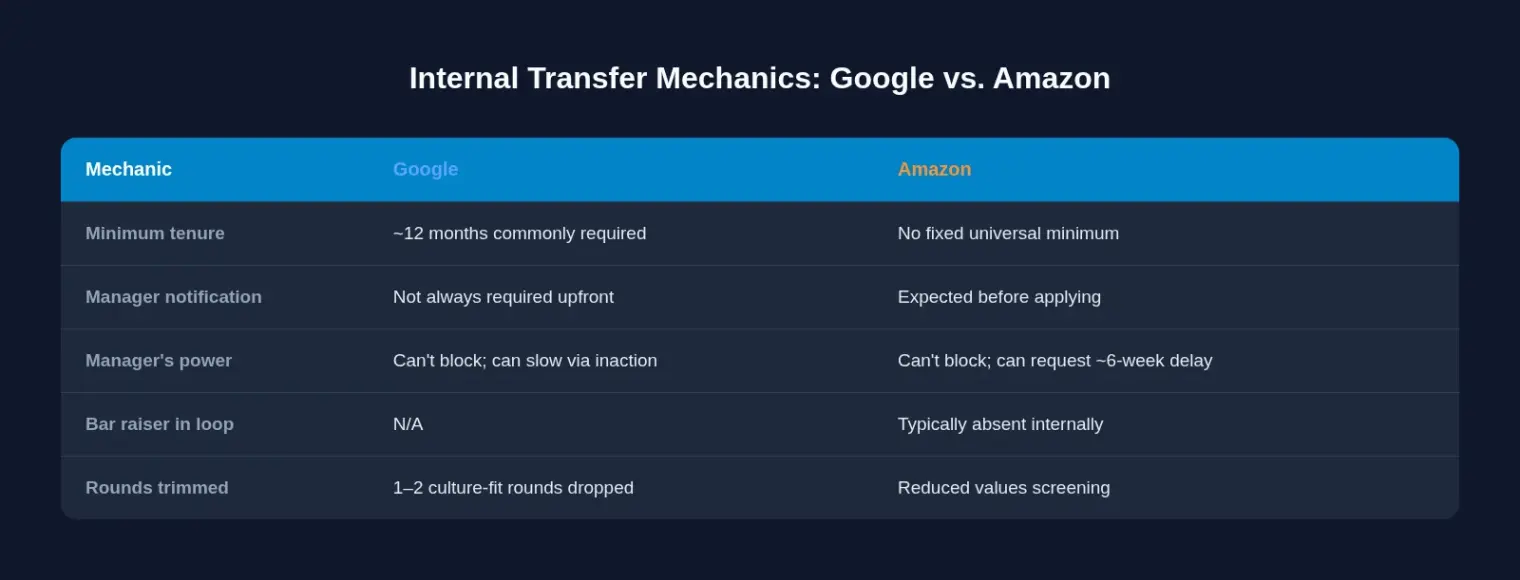
IGotAnOffer's internal-mobility coverage, corroborated by current and former employees on Blind, puts Google's minimum tenure at about 12 months in your current role before you're eligible to apply for most internal transfers. Apply before that window closes and the request typically goes nowhere, regardless of how strong your case is. Once you clear it, your current manager cannot formally block the move — but a manager who doesn't want to lose you can sit on the transfer-team's reference check for a week, deprioritize the handoff conversation, or stay vague in your 1:1s about timing, none of which counts as a "no" on paper.
Amazon runs the notification piece differently, per multiple internal-mobility guides and Blind threads describing recent transfers: telling your current manager before or as you apply is expected practice, serious enough that skipping it is remembered even though it can't block the move. Your manager can request a delay — commonly cited around six weeks — if you're in the middle of work the business considers critical, and that request is expected to be respected rather than ignored on a technicality.
These specifics come from candidate and employee reporting, not a published handbook, and internal policy pages change without leaving any trace outside the company. If you're not at Google or Amazon, the transferable habit is checking with your own HRBP or people-ops contact before you plan around a specific number — not assuming any company runs it exactly like these two.
If you're under a year in your current role and already sure you want to move, the honest options are to start building visible technical credibility with the target team now (so the eventual conversation isn't a cold pitch), have the growth conversation with your current manager early rather than waiting for eligibility, or accept that an external offer may move faster than waiting out an internal clock.
What the Interview Itself Actually Drops
The part that does get lighter: culture and values screening. At Google, internal transfer candidates commonly report loops trimmed by one or two rounds relative to external candidates for the same role, and the rounds that disappear are almost always the ones assessing whether you'd fit the company broadly — you've already answered that by working there for a year-plus. The rounds that survive are the ones specific to the new team: technical depth, role-specific problem solving, sometimes a system design or portfolio review depending on the function. Those aren't softened. The hiring manager on the receiving team still has to justify the headcount to their own leadership, and "we lowered the bar because they already worked here" isn't a sentence anyone wants to be the reason for a bad hire.
One notable structural detail: Amazon's internal transfer loops are reported to skip the bar raiser — the cross-team interviewer whose explicit job in external Amazon loops is to protect hiring standards independent of the hiring manager's judgment. Internally, your track record inside the company substitutes for that function instead.
That cuts both ways depending on which side of the table you're on. As a candidate, it means the hiring manager's read of you carries more direct weight than it would externally — a manager who already rates you highly has an easier path to bringing you in. As a hiring manager on the receiving end, it means you're the one absorbing the standards-check job the bar raiser used to do, without that second signature to point to if leadership later asks why headcount went to an internal move instead of an external search.
The Question an External Candidate Never Gets Asked
Interviewers on the new team will ask a version of "why do you want this role" that external candidates get too — but they'll also ask, directly or indirectly, why you're leaving your current team specifically, in a way that has no equivalent in an external interview. That's not a trick question, but it is one worth having a genuinely honest, non-defensive answer to, because a vague or evasive response reads as a red flag in a way it wouldn't from someone leaving a different company entirely. "I want to grow into X" lands better than "my current team isn't a great fit" — both might be true, but only one gives the interviewer something concrete to evaluate.
Preparing for the Rounds That Remain
Nothing here helps with the manager-notification conversation or the tenure math — those are relationship and timing questions, not something you rehearse. What does need rehearsal is the technical and role-specific rounds that survive the internal loop, because they're held to the same bar as external hiring even though there are fewer of them. Working there for a year proves you know the company; it doesn't prove you can perform a specific round under a clock, and the two get conflated more easily on an internal move than an external one, where nobody assumes familiarity in the first place.
If the new role's technical rounds include a live coding assessment, our breakdown of what a virtual onsite loop typically looks like covers the pacing and round structure independent of whether you're an internal or external candidate. And if you'd rather run the actual round under time pressure a few times before it counts — without asking a coworker to grill you before you've told anyone you're leaving — that's what our mock interview mode is built for.
FAQ
How long do you have to work at a company before you can transfer internally?
Around 12 months at Google before you're even eligible to apply. Amazon has no single published minimum, but moving very early in a role draws more questions about why.
Do you need your manager's permission for an internal transfer?
Not permission — notification. Amazon expects you to tell your manager before or as you apply; skipping that is remembered even though it can't technically block you. Google's manager can't block you either, but can quietly slow the process by not engaging with the transfer team.
What questions are asked in an internal transfer interview?
Mostly the same technical bar as an external loop for the same role. What's new is the direct question external candidates never get: why leave this specific team.
Is an internal transfer interview easier than an external one?
Shorter, not easier. Google candidates report one or two fewer rounds — the culture-fit ones get cut, not the technical ones, since the hiring team still has to justify the headcount.
How do I tell my manager I want to transfer teams without burning bridges?
Have the conversation before you formally apply, frame it as growth rather than a complaint about your current team, and expect Amazon managers specifically to have standing to ask for a several-week delay if you're mid-critical-work.
Does Amazon require manager approval for internal transfers?
Not a veto — a delay request, commonly around six weeks, if the timing conflicts with work the business calls critical. Applying without telling them first is possible but reads badly internally in a way it never would externally.
Author · Alex Chen. Career consultant and former tech recruiter. Spent 5 years on the hiring side before switching to help candidates instead. Writes about real interview dynamics, not textbook advice.
Related Articles

Does Cursor Allow AI in Interviews? Anysphere's Two-Sided Policy
Cursor's maker bans AI in round one to test raw skill, then hands you an 8-hour paid project where using AI well is the entire grade. Here's how the two rounds actually differ.

Databricks Interview: The Concurrency Round Nobody Warns You About
Databricks runs a full hour on multithreading alone, and reportedly grades system design in a Google Doc, not a whiteboard tool. Here's what candidates say.

Razorpay, PhonePe, Swiggy, and CRED: How India's Product Unicorns Interview
Razorpay, PhonePe, Swiggy, and CRED don't run TCS-style aptitude tests or Amazon-style DSA marathons — here's the OA platform, round structure, and ESOP comp each one actually uses.