Does Cursor Allow AI in Interviews? Anysphere's Two-Sided Policy
Cursor's maker bans AI in round one to test raw skill, then hands you an 8-hour paid project where using AI well is the entire grade. Here's how the two rounds actually differ.

TL;DR: Cursor's maker, Anysphere, flips its own AI rules between interview rounds. Round one: a time-boxed technical screen, AI banned beyond autocomplete, meant to isolate raw coding signal. Round two: a paid, 8-hour, remote project on a real Cursor codebase where AI tools are expected — and the grade rests on how well you direct and verify what the model produces, not whether you used it. Get the sequencing backwards and you'll either underperform round one by half-relying on a banned tool, or underperform round two by treating "AI is allowed" as license to stop thinking.
Most AI-adjacent companies pick a lane: either every round is open-book because "that's how we actually work," or every round is locked down because leadership doesn't trust the tools yet during evaluation. Cursor's maker does neither. It runs both policies back to back, on purpose, because the two rounds aren't testing the same thing.
Round One: No AI, By Design
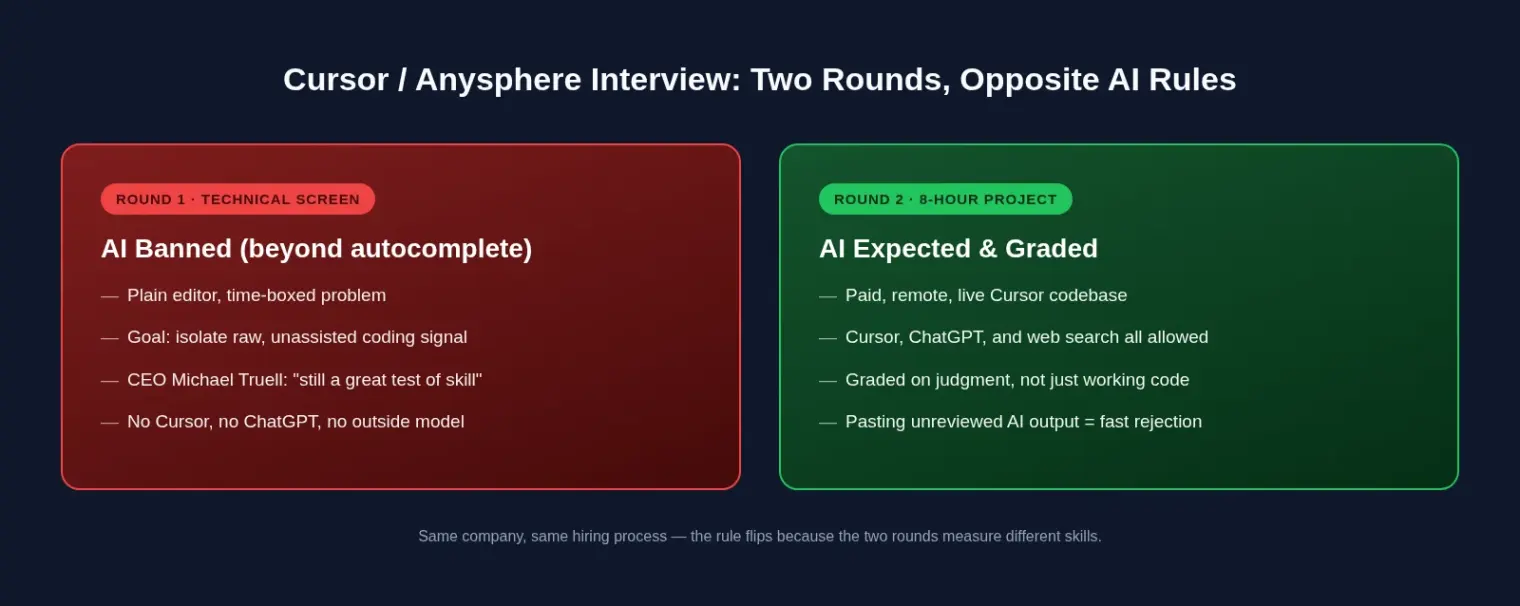
In a June 2025 interview with Business Insider, Anysphere CEO Michael Truell confirmed the company's first technical screen deliberately excludes AI assistance beyond basic autocomplete. His reasoning, per that interview: programming without AI help is still a genuinely useful, time-boxed test of raw skill and intelligence — and that signal is one of the few things that gets harder to read once a language model is doing part of the reasoning for you.
That's a notable position for a company whose entire product exists to have AI write code alongside you. It means the round isn't testing "can you use Cursor" — it's testing the thing Cursor is built on top of: can you actually reason about a problem and produce working code when nothing is filling in the gaps for you. If you walk in assuming a Cursor interview means a Cursor-friendly interview, this round will catch you off guard.
Round Two: An 8-Hour Project Where AI Is the Point
The second stage flips the constraint entirely. Candidates who clear the first round move into a paid, remote assessment — reported at up to eight hours by interview-prep sites techinterview.org and Codemia, both of which have published round-by-round breakdowns based on candidate submissions — working inside a real, live Cursor codebase. Here, AI tools aren't just permitted; they're the expected way of working. Candidates use Cursor itself, general-purpose assistants like ChatGPT, and open web search, the same toolkit they'd have on the job.
What's graded isn't code output alone. Both guides describe reviewers specifically watching for whether a candidate directs the AI with judgment — catching wrong suggestions, pushing back on a bad approach, understanding why a generated fix works before shipping it — versus pasting raw model output into the codebase without scrutiny. Codemia's writeup flags the second behavior as one of the fastest ways to get cut from this round, even though the same round explicitly allows the tools that produced the output in the first place.
That distinction is the entire hiring thesis packed into one round: using AI well and using AI uncritically look identical for about thirty seconds, and this round is built to tell them apart.
Why the Two Rounds Don't Contradict Each Other
Round one isolates a floor: can you code at all, without anything doing part of the work for you. Round two measures a ceiling that only exists once you already have that floor: can you supervise and direct a capable model well enough that its output is something you'd actually ship. Most companies only test one of those two things, usually the first, because a live 8-hour AI-collaboration assessment is expensive to run and hard to grade consistently. Anysphere tests both because the job needs both, and because a company selling AI-assisted engineering has an unusually direct reason to hire for that exact skill.
Neither round's mechanics are officially published by Anysphere — the picture above is built from Truell's on-record comments plus the two independent candidate-sourced guides cited above, not a company rubric. Level, exact round count after the 8-hour project, and pass-rate data aren't public anywhere; treat anything more specific than what's cited here as speculation.
Where Practice Actually Helps — and Where It Doesn't
Round one is a plain-editor, no-AI screen by design, so live support during the window itself doesn't fit the format — the entire point is watching unassisted reasoning. What helps beforehand is deliberate, timed practice on unfamiliar problems without a safety net, the same gap that our mock interview mode is built to close between "I know I can code" and "I can prove it in 45 minutes with someone watching."
Round two is a different animal: a round where "have a tool discreetly helping you" isn't the differentiator, because the tools are already sitting right there, sanctioned, on your screen. The skill being tested is judgment — knowing when to trust a suggestion and when to argue with it — and that's built through repetition: reading AI-generated diffs critically, not just accepting them, until catching a wrong suggestion becomes reflexive.
If you're comparing AI-tool policy across companies before you walk into any of these rounds, our breakdown of OpenAI's own interview AI policy covers a similarly split approach from a different angle.
FAQ
Does Cursor allow AI tools in their interview process?
Only in round two. Round one is a plain-editor screen where anything beyond autocomplete is off-limits. Round two — the 8-hour paid project — is the opposite: Cursor, ChatGPT, and web search are all expected, and what gets graded is whether you use them with judgment.
What is the Anysphere/Cursor software engineer interview process?
A recruiter screen, the no-AI technical round, then the paid 8-hour project on a live codebase. What comes after that (architecture discussion, behavioral rounds) isn't consistently documented across candidate accounts, so treat anything more specific as team- or level-dependent rather than fixed.
Can you use ChatGPT in a Cursor job interview?
No in round one, yes in round two — and in round two, reviewers are watching how you use it, not just whether the code works.
Why doesn't Cursor let candidates use AI if they build an AI coding tool?
Because the two rounds aren't measuring the same thing. Round one checks whether you can code unassisted at all. Round two — which only happens after you've cleared that bar — checks whether you can supervise a model well enough to trust its output.
What is the Cursor 8-hour project interview?
A paid, remote assessment inside a real Cursor codebase, full AI toolkit included. The documented failure mode isn't using AI — it's using it without verifying what it hands you.
How hard is it to get hired at Cursor AI?
Hard, and in an unusual way: passing round one and passing round two draw on different skills, so strong LeetCode performance alone doesn't carry you through the second gate.
Author · Alex Chen. Career consultant and former tech recruiter. Spent 5 years on the hiring side before switching to help candidates instead. Writes about real interview dynamics, not textbook advice.
Related Articles

The Internal Transfer Interview: What Actually Changes at Google and Amazon
Fewer rounds doesn't mean lower stakes. How Google and Amazon's internal transfer mechanics — tenure rules, manager notification, bar raisers — actually differ from an external hire.

Databricks Interview: The Concurrency Round Nobody Warns You About
Databricks runs a full hour on multithreading alone, and reportedly grades system design in a Google Doc, not a whiteboard tool. Here's what candidates say.

Razorpay, PhonePe, Swiggy, and CRED: How India's Product Unicorns Interview
Razorpay, PhonePe, Swiggy, and CRED don't run TCS-style aptitude tests or Amazon-style DSA marathons — here's the OA platform, round structure, and ESOP comp each one actually uses.