Insurance Agent Interview AI: Real Questions and How to Prep
Insurance agent interviews test sales role-play and commission comfort, not just why-insurance small talk. See the real questions and how AI practice helps.
TL;DR: Insurance agent interviews test three things most candidates don't prep for: whether you can handle a cold sales role-play on the spot, whether you understand the real compensation structure (commission-only, licensing costs, "invest your own money" asks), and whether your STAR answers hold up under a skeptical panel. This guide breaks down the real question set with an AI mock interview practice angle for the role-play part specifically.
Twenty minutes into an interview for an insurance sales agent role, the hiring manager stops asking questions and says: "Okay — sell me a policy right now." No warning, no script, no product sheet in front of you.
If you've never rehearsed that moment out loud, it shows immediately — the pitch stalls, the objection-handling gets vague, and the confidence that got you this far in the conversation evaporates. This is one of the most consistently reported moments across real insurance-agent interview experiences, and it's exactly the part most "top interview questions" listicles skip.
What Insurance Agent Interviews Are Actually Testing
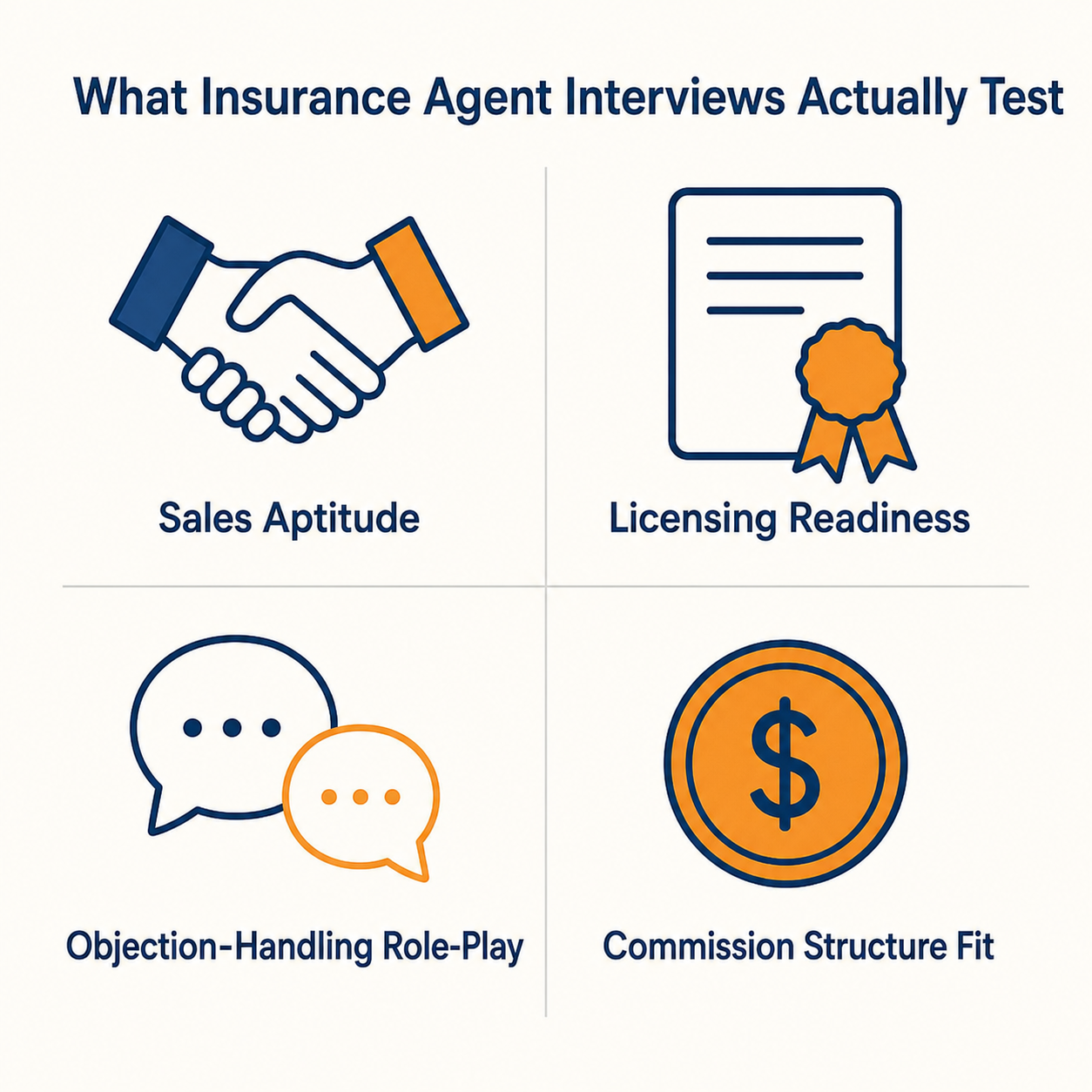
Most insurance hiring — whether captive-agent roles at large insurers, independent agency positions, or MLM-adjacent models like World Financial Group or Family First Life — tests four things in some combination, according to BLS Occupational Outlook data on the role and hundreds of real candidate reports on Glassdoor's insurance agent interview board:
- Sales aptitude — can you actually sell, cold, under mild pressure
- Licensing readiness — do you already hold a state license, or understand the timeline and cost if you don't
- Compensation fit — are you prepared for commission-only or draw-based pay, and licensing self-funding
- Ethics and persistence framing — can you talk about rejection and client trust without sounding either naive or cynical
Large captive insurers like State Farm run a more structured pipeline — application, assessment, then a video or in-person interview stage — closer to a standard corporate hiring process. Independent and commission-heavy models tend to compress everything into one or two conversations, and that's where the compensation and role-play questions hit hardest and earliest.
The Compensation Question Nobody Warns You About
Real, verbatim candidate reports on Glassdoor make this the single biggest recurring theme in insurance-agent interviews — more than product knowledge, more than sales technique:
"Would you be willing to pay for all of your own licensing and recruit your own team?" — reported for a World Financial Group Financial Planner/Insurance Agent interview
"Any experience in sales? Do you understand how insurance works? Are you willing to invest money?" — reported for a Family First Life Insurance Sales Agent interview
These aren't trick questions — they're the employer front-loading a real structural fact about the role. Some agencies genuinely operate on a model where you self-fund your license (often $200–$600 depending on state and line) and, in MLM-adjacent structures, are expected to eventually recruit and "invest" further. That's not automatically predatory, but it is something you need to understand before you accept, not discover after your first unpaid week.
How to handle it in the interview: don't flinch, and don't pretend you already know the answer. Ask directly: "Is there a draw or salary during licensing and ramp-up, and what's the typical time to first commission for someone starting in this book of business?" A hiring manager who respects the question will answer it straight. One who dodges it is telling you something too.
Common Insurance Agent Interview Questions
Beyond compensation, these categories show up across virtually every insurance sales interview, regardless of company:
"Why insurance?" — Weak answers default to "I'm good at sales." Stronger answers anchor to something specific: a personal claims experience, a family connection to the industry, or genuine interest in the protection/advisory side of the work.
"Tell us about a time you failed to meet a customer's need — how did you resolve it?" — This is a direct STAR prompt. Structure it as: the specific gap (Situation/Task), what you did to close it or make it right (Action), and the outcome, including what the customer said or how the relationship held up (Result).
"Are you comfortable entering people's homes and explaining insurance policies?" — Common for door-to-door or in-home consultation models. Answer honestly about your comfort level with in-person, sometimes unscheduled client visits — this is a genuine job-fit question, not a formality.
"How would you generate sales?" — Panels want a specific pipeline, not "networking and hard work." Reference concrete channels: referral asks after every closed policy, community/local-business relationships, or a defined prospecting cadence if you're coming from another sales role.
The Role-Play Test: Rehearsing Objection Handling
Every source on real insurance-agent hiring agrees the role-play moment is coming — "sell me this policy," "handle this price objection," "the prospect says they need to think about it" — and almost none of them help candidates actually rehearse it. That's the gap this guide is built to close.
The three objections that come up in nearly every insurance sales role-play:
- "It's too expensive." Weak response: immediately drop the price or discount. Strong response: reconnect the price to the specific coverage gap it closes for that person's situation, then offer tiered options only after establishing the value.
- "I need to think about it." Weak response: pushing harder on the same pitch. Strong response: asking what specifically they want to think through — cost, coverage, timing — and addressing that one thing directly rather than repeating the whole pitch.
- "I don't really believe in insurance." Weak response: getting defensive or launching into statistics. Strong response: acknowledging the skepticism as reasonable, then asking a genuine question about what experience shaped that view before responding to it directly.
The candidates who handle this well in a real interview are almost always the ones who've said these exact exchanges out loud before — not read about them.
Practicing the Scenario Before It's Live
This is where AI interview practice tools earn their keep for a role like this one. Reading about objection handling and actually running the exchange out loud, with something pushing back on your answer, are different skills — and interview panels can tell which one you've done.
Useful practice modes for insurance-agent prep specifically:
- Cold-pitch rehearsal: state a product, get interrupted with a price objection, and practice recovering the conversation instead of restarting your script
- STAR structuring for the "failed to meet a need" question: this is the one behavioral question almost every insurance interview asks in some form, and it's worth running at least three times with different real examples
- Compensation-conversation practice: rehearsing how to ask about draw, licensing cost, and time-to-first-commission in a way that sounds like due diligence, not distrust
AceRound's real-time interview assistant gives live, structured answer suggestions during video interviews if you're managing several insurance-agency conversations at once and can't hold every company's specific pitch variation in your head — useful in a hiring process where you might be interviewing at three different agencies with three different comp structures in the same week.
Practical Prep Checklist
Before your insurance agent interview:
- Write out your "why insurance" answer anchored to something specific — a claim, a family connection, or a genuine interest, not just "I'm good at sales"
- Prepare one STAR story for "a time you failed to meet a customer's need," with a real number or outcome
- Rehearse the three most common objections ("too expensive," "need to think," "don't believe in insurance") out loud, not just in your head
- Know exactly what you'll ask about compensation structure — draw, licensing cost, and time-to-first-commission
- Confirm your licensing status and timeline before the interview, so you can answer that question directly instead of vaguely
- Run at least one AI mock interview focused specifically on the sales role-play, not just standard behavioral questions
- Prepare 2–3 questions for the panel — see questions to ask the interviewer for structure
Frequently Asked Questions
Is it normal to be asked to pay for my own insurance license before I'm hired?
It happens often enough that you should ask about it directly rather than assume. Some captive-agency models expect you to obtain and fund your own state license, sometimes before your first paycheck. This isn't automatically a scam, but it's a real cost and timing risk you should get in writing before accepting an offer.
What does it mean if the role is commission-only?
It means your income has no floor until you close business — common in independent insurance sales but rare in captive-agent roles at large insurers, which usually pay a draw or salary during ramp-up. Ask specifically about draw structure, its duration, and average time-to-first-commission.
Will they actually make me role-play a sales pitch in the interview?
Very likely, especially for any agent or producer role. "Sell me this policy" or "walk me through how you'd handle a price objection" are near-universal in insurance sales interviews. Panels are testing composure and structure under a cold-start scenario, not perfect insurance knowledge.
Do I need to already have my insurance license to get hired?
Depends on the employer. Large captive insurers often hire pre-license and sponsor exam prep during onboarding. Independent agencies and MLM-adjacent models more often expect you to be pre-licensed or self-fund licensing quickly after an offer — ask directly, it's a fair and expected question.
How do I answer "why insurance" without sounding like I just need any sales job?
Anchor it to something specific: a claim experience in your own life, a family member in the industry, or genuine interest in the advisory/protection side of the work. Panels can tell the difference between "I'm good at sales and this pays well" and a candidate who's thought about why this category of selling fits them.
Author · Alex Chen. Career consultant and former tech recruiter. Spent 5 years on the hiring side before switching to help candidates instead. Writes about real interview dynamics, not textbook advice.
Related Articles

Does TestDome Detect Cheating? What Actually Gets Flagged
Does TestDome detect cheating? Only when an employer turns on proctoring. Here's exactly what its screen/webcam/AI review catches — and what it can't.

Does TestGorilla Detect Cheating? What Actually Gets Flagged
Does TestGorilla detect cheating? Yes, via a three-tier behavior system, webcam snapshots, tab-switching and paste detection. Here's what actually triggers a flag.

How Do You Measure Success? The Interview Answer That Works
How do you measure success interview answer, decoded: what recruiters vs. hiring managers actually screen for, plus role-specific scripts and a freeze-proof framework.