How to Answer 'Give an Example of Giving and Receiving Feedback' in Any Interview
Master the give and receive feedback interview question with cross-cultural STAR examples, the blind spot story that signals EQ, and AI practice techniques.

TL;DR: The give and receive feedback interview question tests emotional intelligence, not just process knowledge. You need two distinct stories: one where you gave feedback — ideally upward or to a peer — and one where you received feedback that caught you off guard. The "blind spot" story is what separates average answers from memorable ones. This guide walks through both scenarios with cross-cultural context and sample structures.
In a final-round debrief at a mid-size tech company, I watched four candidates give nearly identical answers to "describe a time you gave constructive feedback." Same SBI framework. Same "growth mindset" phrase. Same tidy outcome where the other person thanked them. Three made it to final round. One got the offer — the candidate who started with: "The feedback I'm most proud of was one my manager didn't initially agree with."
That's the difference. Not the framework. Not the vocabulary. The willingness to tell a story that has some friction in it.
What interviewers are actually testing
When a hiring manager asks about feedback, they're not looking for evidence that you've read the Radical Candor summary on LinkedIn. They're checking for three things:
1. Emotional regulation. Can you receive hard feedback without becoming defensive or, at the other extreme, collapsing? Self-awareness under pressure is a proxy for how you'll behave when a project fails. The NeuroLeadership Institute identifies identity threat activation as the core barrier — feedback feels like an attack on who you are, not just what you did.
2. Communication maturity. Giving feedback badly — even well-intentioned feedback — damages trust. The way you describe the situation reveals whether you understand this or not.
3. Judgment under social pressure. The highest-signal scenario is giving feedback to someone more senior or in a situation where not giving it was the socially safe choice. Did you do it anyway?
Most candidates optimize for scenario #2 and skip #3 entirely. That's why the answer "I made sure to use the SBI framework and the person really appreciated it" sounds fine but doesn't move the needle.
Structuring your giving feedback interview answer
The standard structure works well here: Situation → Behavior → Impact → Result (SBIR, a variant of STAR specifically suited to feedback stories). MIT's career advising office explains why structured storytelling works — it gives interviewers the specific evidence they need to rate behavioral competencies.
Situation: Set the context briefly. Who was the person, what was the working relationship, what was at stake? Keep this under 2 sentences.
Behavior: Describe what you observed — not what you interpreted, not what you assumed. "I noticed that in the last three client calls, your follow-up emails went out 48 hours late" rather than "I felt like you weren't prioritizing the client."
Impact: The business or team impact, stated specifically. "That delay was contributing to our 18% client satisfaction dip that quarter."
Result: What happened after. Did they change? Did things improve? Did they push back? Include the friction if it was there.
Sample structure (customizable):
"At my previous role, I was leading a cross-functional project with a designer who consistently submitted work without considering accessibility standards. I scheduled a private conversation, referenced three specific instances from the previous sprint, and explained how this was creating rework for the dev team — about 6 hours per sprint. She initially felt blindsided because the accessibility requirements hadn't been explicitly flagged at kickoff. That was fair. We agreed to add accessibility review as an explicit sprint checkpoint, and her work quality jumped noticeably in the next two cycles."
This answer works because the feedback-giver also acknowledges their own partial failure (the requirements weren't explicit). That small detail shows self-awareness — and interviewers notice.
The receiving criticism interview question — lead with your blind spot
Most candidates pick a story where the feedback was obviously valid and they implemented it gracefully. Safe answer. Forgettable answer.
The blind spot feedback interview story is harder to tell and far more persuasive. A blind spot story follows this structure:
- You received feedback you didn't initially agree with — or that challenged how you saw yourself
- You took time to genuinely consider it rather than immediately accepting or rejecting it
- You identified what was true in it, even if the framing was imperfect
- You changed something, and it had a measurable effect
This structure demonstrates exactly the emotional intelligence profile companies pay for: non-defensiveness without being a pushover, genuine reflection rather than performative humility.
What makes it a constructive feedback example interview story:
"During a performance review, my manager told me I was perceived as 'overly detail-oriented' in client meetings. My first reaction was frustration — attention to detail was something I considered a strength. I sat with it for a few days, then went back and asked for specific examples. She pointed out that in client meetings, I was often the one correcting minor inaccuracies mid-presentation, which the clients read as internal disagreement. I hadn't seen that. I started doing a 'pre-flight' review with my manager before key meetings so we'd already aligned on the numbers. The last three client check-ins received the highest satisfaction scores of the project."
Notice what this answer doesn't do: it doesn't pretend the candidate immediately embraced the feedback, or that the conversation was comfortable. That authenticity is the point.
The scenario every guide avoids: when you disagreed with feedback
This is where candidates either distinguish themselves or fade into the crowd.
The question "how do you handle feedback you disagree with?" comes up in roughly 1 in 3 feedback-related interviews — but virtually no prep content walks through how to answer it honestly without either sounding defensive or performing false gratitude.
The answer that works isn't "I always consider all feedback carefully." It's:
- Acknowledge you heard the feedback without immediately agreeing
- Describe the process you used to examine whether it was accurate
- Explain what you concluded — even if that conclusion was "the feedback wasn't valid, and here's why"
- Show what you did about it
Example structure:
"My skip-level manager once gave me feedback that I was 'not visible enough at the senior level.' I thanked him and took time to think through whether that was accurate. When I looked at the data, I realized I was delivering results that my direct manager was presenting upward — I hadn't been vocal about attribution. That was a real gap. But I also concluded that some of the 'visibility' expectation was about social capital-building that wasn't in my job description. I focused on the first problem — started presenting my own analyses in the quarterly review — and let the second one go. Six months later, my visibility rating improved significantly."
This answer is honest. It shows the candidate thought independently rather than immediately capitulating. That's what senior roles actually require.
If you grew up in a high-context feedback culture
Candidates from Japan, Korea, Vietnam, China, Brazil, and many parts of the Middle East often face a specific challenge: their authentic feedback experiences don't map neatly onto the direct, individualistic language that Western interviewers expect.
In high-context cultures, giving critical feedback directly — especially upward — can violate deeply held norms around hierarchy and saving face. Receiving feedback publicly can be genuinely more painful than it is in cultures where workplace directness is normalized.
This doesn't mean your experience is less valid. It means you may need to translate it.
Practical translations:
| Your real experience | How to frame it for a Western interview |
|---|---|
| "I gave feedback indirectly, through a mutual colleague" | "I chose a channel that would preserve our working relationship while still addressing the issue" |
| "I waited until a formal review cycle to raise the concern" | "I identified the right moment — a structured conversation — rather than creating unnecessary friction in the moment" |
| "I received feedback in a group setting, which was difficult" | "I received feedback in a format I found challenging, which pushed me to think carefully about how I give feedback to others" |
The underlying skills — reading context, managing relationships, timing difficult conversations — are genuinely valuable. The translation work is just making those skills visible to an interviewer who may not have the cultural context to recognize them otherwise.
See also: conflict resolution interview answers that work across cultures and the broader behavioral interview questions guide.
Using AI to rehearse feedback answers before the real interview
The give-and-receive scenario is one of the hardest behavioral questions to rehearse with friends because most people default to agreeing with your answer rather than pressing on it. AI tools change that dynamic.
With a tool like AceRound AI, you can:
- Practice both the giving and receiving scenarios with follow-up questions that probe your answer
- Run 5–10 iterations on the same story to tighten the Situation/Behavior/Impact structure
- Get feedback on whether your "blind spot" story lands as authentic vs. scripted
- Practice the "I disagreed with the feedback" scenario, which most candidates never rehearse out loud
One specific thing worth testing: say your answer out loud, then ask the AI to identify any places where you used vague language ("I communicated clearly," "they appreciated it"). Replace those phrases with specifics. That alone typically improves how an answer registers.
The STAR method guide covers the mechanics if you want to build from the ground up before practicing feedback-specific stories.
FAQ
How do you handle feedback that you disagree with?
Acknowledge it without immediately accepting or rejecting it. Take time to genuinely examine whether it's accurate. If you conclude the feedback was wrong or partially wrong, you can say so in an interview — what matters is showing your reasoning process, not just that you always accept feedback gracefully.
Can you share an instance where you had to give feedback to someone more senior than you?
This is the highest-signal scenario for interviewers. The key is choosing a situation where you had a legitimate professional reason to give the feedback, you chose an appropriate moment and channel, and you can describe the outcome honestly — including if the senior person didn't immediately agree.
What is the most valuable piece of constructive feedback you have ever received?
Pick feedback that changed something real about how you work or communicate, not just feedback you implemented once. The answer should have a "before and after" that's specific.
How do you ensure that the feedback you give is constructive and not hurtful?
Focus on behavior and impact rather than character. "The report was submitted three days late, which caused the client to miss their deadline" is observable and actionable. "You're disorganized" is a character judgment and triggers defensiveness. Timing and privacy also matter — most critical feedback lands better in private.
Describe a situation where feedback you received contradicted your self-perception or revealed a blind spot.
This is the hardest version of the question — and the best opportunity to differentiate. Use the blind spot story structure: initial disagreement, genuine reflection, what you found to be true in it, what you changed.
How do you encourage a culture of constructive feedback within your team?
For senior or management roles, this shifts from "tell me your story" to "show me your leadership philosophy." Cite specific mechanisms: regular 1:1 feedback checkpoints, team retrospectives, modeling public self-correction. Concrete practices beat abstract values statements.
Author · Alex Chen. Career consultant and former tech recruiter. Spent 5 years on the hiring side before switching to help candidates instead. Writes about real interview dynamics, not textbook advice.
Related Articles
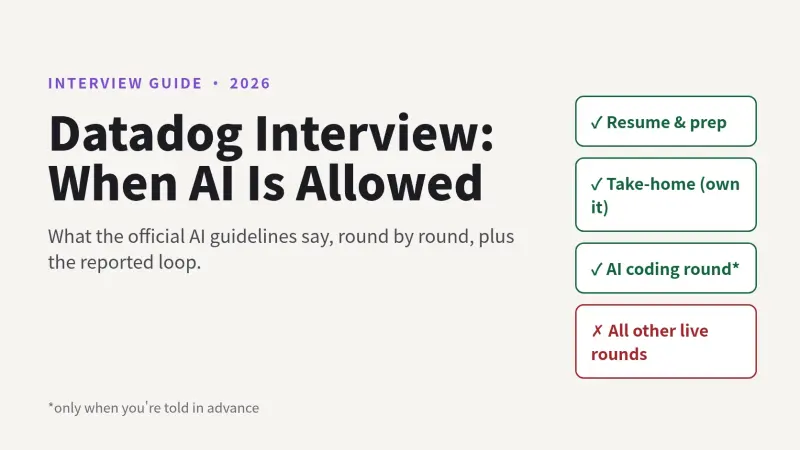
Datadog Interview Process (2026): What's Allowed With AI, Round by Round
Datadog publishes its AI rules for candidates. Here's what they allow, what they ban, the reported loop, and how to prep for the project deep dive.
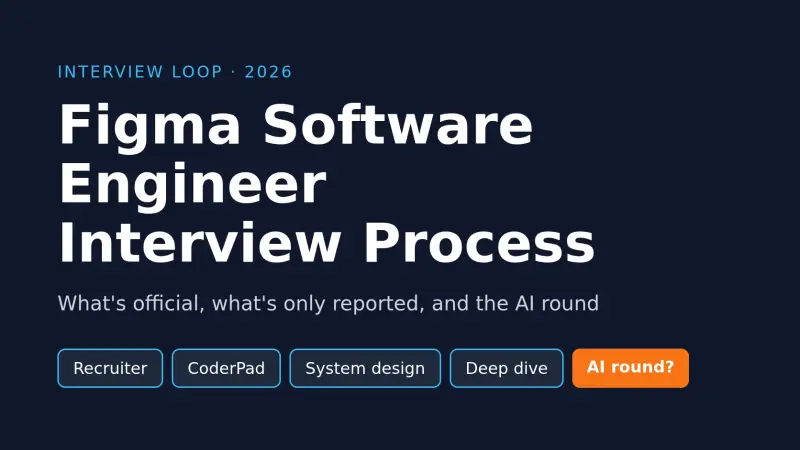
Figma Software Engineer Interview Process (2026): What's Reported
Figma publishes no interview rubric. Here's the loop candidates report, the product-flavored coding and design rounds, and what's known about an AI round.
Oracle and PayPal Fresher Interview Process in India: What Candidates Reported, Year by Year
Oracle India's test moved from aptitude plus core CS to HackerRank with a REST API task. PayPal's cut-offs and platform also differ. Posts compared.