Air Traffic Controller Interview Questions: What the FAA Panel Actually Asks
Air traffic controller interview questions from the real FAA panel round, what the AT-SAT test does and doesn't measure, and how to prep for the 2026 hiring surge.

TL;DR: Air traffic controller interview questions come from a structured panel round that's separate from the AT-SAT cognitive test — evaluators are scoring composure, judgment, and clear communication under pressure, not aviation trivia. With the FAA's 2026 hiring push targeting roughly 2,200 new controllers, more candidates than ever are hitting this stage with almost no idea what to expect. This guide covers what the panel actually asks, what AT-SAT does and doesn't measure, and where honest AI-assisted practice can help.
The FAA opened its latest air traffic controller application window and reportedly took in around 6,000 applications within the first 12 hours. That's the scale of the 2026 push: the agency's workforce plan targets roughly 2,200 new controller hires this fiscal year, climbing toward 2,400 by FY2028, backed by a 30% pay bump for Academy trainees — a surge independent aviation coverage has been tracking closely. If you're one of the thousands who applied, you'll clear the biographical questionnaire and the AT-SAT cognitive test before you ever sit in front of a person — and that panel interview is where most generic prep completely falls apart.
Search "air traffic controller interview questions" and you'll mostly find recycled listicles — five generic questions written for hiring managers, not candidates, with zero mention of what the actual panel round looks like. Meanwhile, actual candidates on r/ATC are asking some version of the same question over and over: what happens in that room, and what do they actually want to hear?
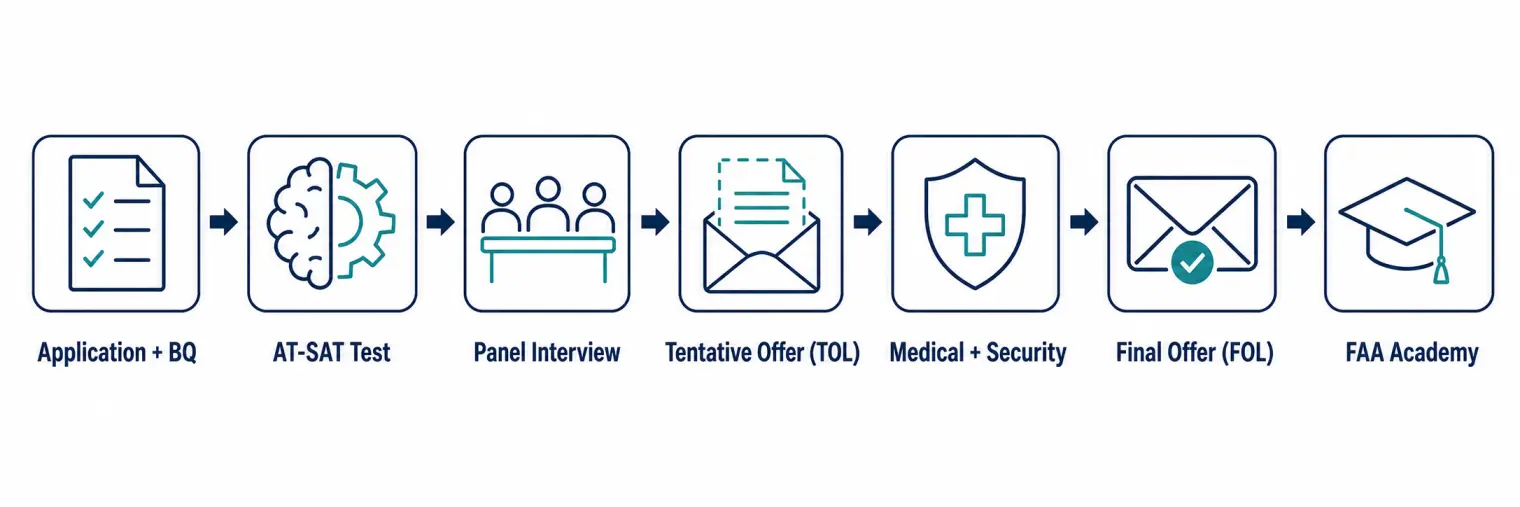
The Real ATC Hiring Pipeline (2026)
Before you get anywhere near a panel, you go through several stages, and mixing them up is the single biggest source of confused prep:
- Application + Biographical Questionnaire (BQ) — a background/experience screen, not an interview.
- AT-SAT (Air Traffic Selection and Training) test — a proctored cognitive-aptitude battery measuring things like multitasking, spatial reasoning, and working memory under time pressure. Scores come back in bands, and only the top bands move forward.
- Panel / situational-judgment interview — a structured, scored conversation with FAA evaluators, for candidates who clear the test.
- Tentative Offer Letter (TOL) — if you're recommended, the FAA emails you a TOL. Despite the name, this is not the job yet: "tentative" means the agency wants to keep evaluating you. You return it with acceptance paperwork (contact details, drug-test notification, the OF-306 declaration) and get moved into clearances.
- Medical and security screening — an SF-86 background investigation plus a second-class FAA medical exam, along with drug and psychological screening.
- Final Offer Letter (FOL) — the actual offer, issued once your clearances come through. It carries your FAA Academy class date (or a facility assignment, if you're a prior-experience hire) and your starting salary.
- FAA Academy in Oklahoma City, followed by on-the-job training at your assigned facility.
Note the two letters people mix up constantly: TOL and FOL are both offer letters, not score notifications. The TOL comes early and buys you a place in the clearance queue; the FOL comes at the very end and is the one that actually puts you in an Academy class.
The panel interview is stage three — after the test that most prep content obsesses over, and before the offer letters, clearances, and training that most career content focuses on. It's the stage with the least honest, candidate-facing coverage anywhere online.
What the AT-SAT Actually Measures (and Why No Tool Should Touch It)
The AT-SAT is a proctored aptitude test, not a knowledge quiz. It's designed to measure innate cognitive abilities — how well you track multiple moving variables, react to changing information, and hold instructions in working memory — under a hard time limit. There's no legitimate way to "prep" your way past what it's actually measuring, and no honest tool should claim to help you cheat it. What you can do is walk in rested, familiar with the test's format and pacing (several official and third-party practice batteries exist), and mentally ready for a test that feels different from anything in school.
This matters for expectation-setting: if you clear AT-SAT, the FAA has already confirmed you have the raw aptitude. The panel interview isn't re-testing that — it's testing something else entirely.
What Actually Happens in the Panel Interview
Real candidate accounts on r/ATC describe the panel as a structured conversation with two to three FAA evaluators, run separately from the cognitive test, usually 20–40 minutes. It is not a technical grilling on aviation procedures — almost nobody at this stage has ATC training yet. Instead, evaluators are listening for:
- Composure under a structured, scored setting. You're being watched and scored in real time by people taking notes — that alone rattles candidates who've never sat in a formal panel before.
- Judgment under ambiguity. Situational-judgment questions ("what would you do if two things needed your attention at once and you could only handle one immediately?") don't have a single correct answer — the panel is scoring how you reason, not which option you pick.
- Clear, specific communication. The job itself is built entirely on saying the right thing, precisely, under time pressure — so a rambling or vague answer here is a direct preview of a trait the panel can't afford to hire around.
Air Traffic Controller Interview Questions You'll Actually Get
Based on the structure candidates describe and the traits the role demands, expect some version of each of these:
- "Tell me about yourself." — Anchor this to why ATC specifically, using one or two concrete moments that show composure and multitasking under pressure, not a chronological life story.
- "Why do you want to be an air traffic controller?" — Evaluators have heard "I love planes" hundreds of times. A specific, honest reason (the pace, the responsibility, the structure of the work) lands better than a rehearsed line.
- "Describe a time you had to manage several urgent things at once." — This is the multitasking-under-pressure question in disguise. Use a real example with a clear structure: what was competing for your attention, what you prioritized, what happened.
- "Tell me about a time you made a decision with incomplete information." — Judgment-under-ambiguity, framed as a story. The panel wants your reasoning process more than the outcome.
- "How do you handle criticism or being told you made a mistake?" — A directness check. ATC is a field where controllers are corrected constantly during training; defensiveness here is a real red flag.
- "What would you do if you disagreed with a supervisor's instruction in a high-pressure moment?" — A pure situational-judgment prompt with no clean answer — the panel is scoring your reasoning, not looking for a specific choice.
How the US Process Differs from UK, Canada, and Australia
If you're applying outside the US, the pipeline shape is familiar even though the agency names change:
- NATS (UK) runs an aptitude test, then an assessment centre with group exercises, then a competency-based interview.
- NAV CANADA uses an online assessment, in-person testing, a same-day pre-screening interview, and a full assessment centre.
- Airservices Australia runs SHL-style aptitude and personality testing, a video interview, then an assessment centre.
The FAA's 2026 hiring surge is the specific news hook driving the volume of "ATC interview" searches right now, but the underlying panel-interview skills — composure, judgment under ambiguity, precise communication — transfer directly across all four countries' processes.
How to Actually Prepare for the Panel Round
The gap real candidates describe on r/ATC isn't "I don't know what to say" — it's freezing the moment a live evaluator actually asks the question, or realizing mid-answer that a memorized paragraph doesn't hold up once a panelist follows up on it. That gap only closes with rehearsal under conditions that resemble the real thing: answering out loud, on a timer, to questions you haven't pre-scripted, with someone (or something) pushing back the way a real panel would.
This is where a structured AI mock-interview tool like AceRound genuinely helps — not by feeding you answers to read off a screen during a scored, in-person federal panel (that's not realistic and isn't the point), but as a rehearsal partner beforehand: running you through composure and judgment-style questions, flagging when an answer rambles instead of lands, and forcing you to practice the "explain your reasoning" muscle the panel is actually scoring. Practicing the follow-up, not just the opening line, is what separates a rehearsed answer from a resilient one.
Other public-safety and civil-service interviews share this same panel-and-judgment format — see our breakdowns of the firefighter oral board and the police officer interview for how the scoring and prep approach carries over.
Author · Alex Chen. Career consultant and former tech recruiter. Spent 5 years on the hiring side before switching to help candidates instead. Writes about real interview dynamics, not textbook advice.
Related Articles
Sonar's AI Interview Rules: Required in One Round, Banned in the Rest
Sonar published a candidate guide that splits AI use by stage: coding tests banned, the technical interview built around it. Here's what each round allows.

Dell and HPE Fresher Interview Process in India: HirePro Tests and Project-Heavy Rounds
Dell and HPE campus drives as candidates describe them: HirePro tests, CGPA cut-offs, funnel sizes, technical and HR rounds, and where posts disagree.

Zapier's AI Interview Policy: Use AI to Prep, Not Live (and the AI Recruiter Screen)
Zapier publishes what AI use is OK at each hiring stage, bans it in live interviews, and may put you in a 15-20 minute screen run by an AI recruiter. Here's how both fit together.