AI Copilot for Interviews: The Full Lifecycle Strategy Most Candidates Miss
An AI copilot for interviews unlocks maximum value across prep, live assistance, and debrief — not just real-time answers. Here's the complete lifecycle framework.

TL;DR: An AI copilot for interviews does its best work across all three phases of the interview process — research and mock drilling before the call, composure support during it, and pattern analysis after. Most candidates only touch one phase. This guide maps the complete lifecycle so you extract maximum value without crossing ethical lines.
Most candidates who discover AI interview tools do the same thing: open the real-time assistant five minutes before the call, glance at suggested answers during the interview, and close the tab when it's over. That's roughly 30% of what an AI copilot can actually do for you.
The remaining 70%? Pre-interview role research, company-specific question prediction, mock drilling with instant feedback, and — most overlooked — post-interview debrief that turns a rejection into a dataset.
This isn't just a more thorough approach. It's a categorically different one: using AI not as a crutch for a single high-stakes moment, but as a partner that works alongside you for the entire process.
What an AI Interview Copilot Actually Is
In aviation, the copilot doesn't fly instead of the captain. They handle checklists, manage systems, flag anomalies, and give the captain bandwidth to make good decisions under pressure.
That's the right mental model here. An effective AI copilot for interviews doesn't answer for you — it prepares you, surfaces information when you need it, and helps you process what happened afterward.
Most tools currently marketed as "AI interview copilots" emphasize live, real-time answer generation during the call. Some are genuinely useful in that mode. But the full value runs from the moment you decide to apply to the moment you accept an offer — or decide to try again.
Phase 1 — Pre-Flight: AI-Powered Interview Preparation
Pre-interview AI preparation is where leverage is highest and the ethical terrain is clearest. No one seriously disputes that using AI to research and practice is legitimate.
Company intelligence. Before any interview, feed your AI tool the job description and anything you know about the company. A good copilot will surface likely question themes based on the role, flag the values most likely to appear in behavioral questions, and identify gaps in your background that the interviewer will probably probe.
Question prediction and mock drilling. Give the AI your resume, the job description, and the company name. Ask it to generate 10–15 questions a hiring manager would ask you. Then answer them — out loud, timed — and ask for feedback on specificity, structure, and whether you actually answered what was asked. This is where an AI interview coach earns its keep. Consistent mock drilling with AI feedback is meaningfully different from reading tips articles. You're building real recall patterns, not just accumulating information.
Resume-to-role mapping. Have the AI identify which of your experiences maps most directly to the role's stated priorities. This isn't about misrepresenting anything — it's about sequencing. Interviewers process what you say through the lens of what they're looking for. A copilot helps you lead with what they care about.
Phase 2 — In-Flight: Live Interview AI Assistance
This is where AI interview tools get controversial — and where the distinction between assistance and deception matters most.
What live AI assistance actually looks like. During a video interview, a real-time tool can display suggested responses, structured answer frameworks, or key company facts alongside your video call in a window the interviewer can't see. Sophisticated tools transcribe the interviewer's question in real time and generate a STAR-formatted response within seconds.
What it does well. For candidates who freeze under pressure — particularly non-native speakers or people with interview anxiety — a live copilot functions as a safety net, not a script. Research published in HBR found that anxiety about being evaluated changes how candidates present themselves in measurable ways. Having a safety net available reduces that anxiety enough that many candidates report looking at the suggestions less than they expected to — because they no longer feel trapped.
What it doesn't do well. Reading AI-generated answers verbatim in real time sounds like reading AI-generated answers in real time. Interviewers notice pacing changes, scripted language, and the particular quality of someone speaking text they didn't write. Live AI assistance is most useful when it surfaces frameworks and key points — not when it drafts full paragraphs for you to recite.
For a closer look at how real-time tools work in practice — including honest limitations — this overview of real-time AI interview helpers covers the mechanics without overselling.
AceRound AI provides real-time answer suggestions during live video interviews — built for Zoom, Google Meet, and Teams. It shows structured pointers rather than full scripts, so your answers stay genuinely yours. Try it free before your next interview.
Phase 3 — Post-Landing: AI-Powered Interview Debrief
This is the most underused phase by a significant margin — and the most unambiguously legitimate.
Reconstruction and pattern analysis. Immediately after an interview, walk through the conversation with your AI copilot while details are fresh. What questions came up? Where did your answer feel weak? Where did you feel confident? A good AI can identify patterns across sessions: Are you consistently getting tripped up on "tell me about a time you failed"? Are your answers too abstract? Are you using the same example for every behavioral question?
Multi-round iteration. Most processes involve three to six rounds. The candidates who perform noticeably better in round 4 than round 1 are the ones who treated each round as a learning input. Post-interview AI debrief turns every round into structured feedback — the kind behavioral interview preparation resources can't provide because they don't know what actually happened in your specific conversation.
Offer evaluation and negotiation. AI tools are genuinely useful for drafting counter-offers, evaluating total compensation packages, and identifying which elements of an offer are negotiable vs. standard. Harvard Career Services' guide on AI for interviews and offers covers this phase specifically — it's the most institutionally credible endorsement of lifecycle-wide AI use.
Rejection analysis. A rejection email tells you nothing. But if you have notes on the interview, an AI can help identify the most likely failure point and what to prepare differently next time. This converts a disappointing outcome into a competitive edge.
The Ethics Spectrum: When AI Copilot Use Is Legitimate
The debate about whether AI in interviews is cheating tends to treat it as a binary. It isn't. The ethics depend on which phase you're in.
Pre-interview AI use is almost universally accepted. Using AI to prepare better is no different from hiring a coach or using flashcards. The ethical question here is essentially nonexistent.
Live AI assistance is where the spectrum matters. Using AI to surface key frameworks and talking points — the way a confident professional uses mental notes — sits in a different ethical category than reading full AI-generated answers verbatim. The first mirrors what experienced professionals do with strong preparation; the second is closer to having someone answer for you. Companies are increasingly aware of AI-assisted live interviews. Some prohibit it explicitly. It's worth knowing the policy before your call.
Post-interview AI use is not meaningfully different from writing up notes or getting coaching feedback. Fully legitimate, widely underused.
The honest summary: use AI most aggressively in phases 1 and 3. Use phase 2 selectively, with awareness of the relevant policies and the genuine limitations of verbatim-answer approaches.
FAQ
Has anyone actually landed jobs using AI interview copilot tools?
Yes. Documented cases appear in consulting communities (PrepLounge forums, consulting candidate discussions) and tech recruiting. The most commonly reported benefit is anxiety reduction as much as information access: knowing the safety net exists changes performance, even when candidates don't use it heavily.
Would using AI during a coding interview be cheating?
For automated assessments (HackerRank OAs, CodeSignal), AI assistance is generally prohibited by the platform's terms and increasingly detectable. For live coding interviews with a human reviewer, the calculus is different — the interviewer is observing your reasoning process directly, which is primarily what they're assessing.
Can interviewers tell when candidates are using AI?
It depends on how. Reading full AI-generated paragraphs verbatim has a recognizable quality — pacing, vocabulary, sentence structure. Using AI to trigger key frameworks and then speaking naturally is much harder to distinguish from thorough preparation.
Do AI copilot tools help non-native English speakers?
This is one of the strongest genuine use cases. Having structured answer frameworks available reduces cognitive load — you're not simultaneously retrieving information, formulating an argument, and translating under pressure. Several tools specifically support multilingual candidates.
What's the difference between an AI interview copilot and an AI interview coach?
Coaches focus on preparation and feedback — primarily useful in phases 1 and 3. Copilots are broader in scope, including live assistance during the interview. In practice, most products combine both functions with varying emphasis.
Do companies scan for AI-generated language during interviews?
Some HireVue-style platforms analyze linguistic patterns. Live video interviews with humans don't involve automated scanning, but experienced interviewers often recognize AI-generated phrasing. The risk is highest when candidates use full-paragraph answers verbatim rather than speaking from structured notes.
Author · Alex Chen. Career consultant and former tech recruiter. Spent 5 years on the hiring side before switching to help candidates instead. Writes about real interview dynamics, not textbook advice.
Related Articles
OpenAI's AI Interview Policy: Banned, Required, or Team-Dependent
OpenAI sells AI coding agents, then bans most candidates from using one. Here's the round-by-round policy, including the new agentic round that flips it.
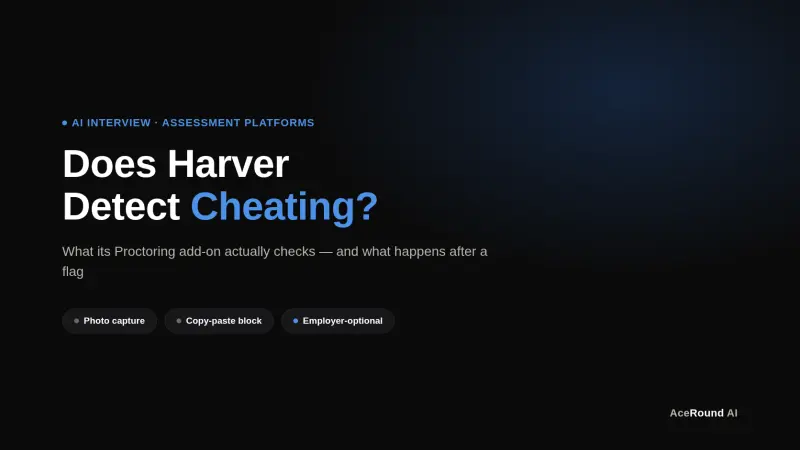
Does Harver Detect Cheating? What Its Proctoring Actually Checks
Does Harver detect cheating on its pre-employment assessments? A candidate look at Harver's Proctoring add-on, what gets logged after a flag, and what happens next.
Micro1's Zara AI Interview: What It Actually Tests (And Why Timing Gets Flagged)
Micro1's AI interviewer Zara has run 300,000+ interviews for remote roles. Here's why it flags response latency as a cheating signal, and what that means for AI prep.