How to Answer Teamwork Interview Questions With Examples That Work
Learn how to craft a strong teamwork example interview answer using STAR, including remote work scenarios and no-experience options. Real examples inside.

The teamwork interview question is one of the most common behavioral questions in any job interview — and one of the most generic in how candidates answer it. This guide shows you how to build a teamwork example interview answer that sounds specific, credible, and memorable, with real examples for remote work scenarios, entry-level candidates, and even introverts.
Three seconds into your answer about "that time you collaborated with a cross-functional team," the interviewer's eyes start to glaze. You're describing the usual story: the tight deadline, the diverse perspectives, the collective win. They've heard it 40 times this week. The 41st version won't move the needle — unless you structure it differently, make it concrete, and address what the question is actually probing.
According to Gallup's research on high-performing teams, the quality of team collaboration is the single biggest predictor of productivity and output — which is precisely why hiring managers ask about teamwork in nearly every behavioral interview. Zippia's workplace collaboration statistics show that 80% of employees consider teamwork "very important" to their work, and organizations that prioritize collaboration achieve up to five times better outcomes. Interviewers know this. They probe collaboration not because it's a checkbox, but because it predicts whether you'll actually succeed on their team.
Here's what they're really testing — and how to give a teamwork example interview answer that sticks.
Why interviewers ask teamwork questions (and what they're actually listening for)
Most candidates think the goal is to show they "work well with others." That's the surface. What interviewers actually evaluate is a combination of three things:
1. Interdependence tolerance — Can you operate effectively when your success depends on someone else's output? This separates high-trust collaborators from people who quietly resent shared accountability.
2. Role clarity under ambiguity — In your story, did you know your role, or did you stumble into one? People who thrive in teams can usually tell you exactly what they owned and why they owned it.
3. Conflict navigation — Every real team hits friction. The question "describe working as a team" is partly designed to see whether your example is suspiciously conflict-free. A sanitized story where everything went smoothly reads as either fabricated or lacking self-awareness.
Knowing this changes how you structure your answer. Your teamwork example shouldn't just demonstrate that you helped — it should demonstrate that you navigated real interdependence, knew your contribution clearly, and handled the messy parts honestly.
The 5 most common teamwork interview questions (and what each tests)
These questions appear in behavioral and competency-based interviews across industries. Each probes a slightly different aspect of your collaborative style.
1. "Tell me about a time you worked on a team."
What it's testing: General collaboration experience. This open-ended version lets you choose your strongest story. Pick one with a clear outcome and a moment of real complexity.
2. "Describe a time when you worked successfully in a team."
What it's testing: Your definition of success in a team context. Note the word "successfully" — they want to see how you measure collective wins, not just personal ones.
3. "How do you feel about working in a team environment?"
What it's testing: Self-awareness and attitude. Be honest but constructive. Saying "I love it always" sounds hollow. Saying "I work well in teams when roles are clear, and I've learned to adapt when they're not" sounds real.
4. "How do you handle conflict within a team?"
What it's testing: Emotional intelligence and constructive disagreement. This is a behavioral question about conflict resolution — they want an example, not a philosophy.
5. "What role do you usually play in a team?"
What it's testing: Self-knowledge and adaptability. There's no wrong answer — but you need a consistent, honest one. Claiming you "flex between roles" only works if you have an example of actually doing that.
STAR method teamwork examples (office, remote, and cross-functional)
The STAR framework (Situation, Task, Action, Result) structures behavioral answers so they're easy to follow and impossible to dismiss as vague. Here's how it applies to teamwork — including scenarios that most interview guides ignore.
Example 1: Office-based project (classic format)
Question: "Tell me about a time you worked successfully on a team."
Situation: At my previous company, we had to launch a new product line with a four-week runway. The team included engineers, a designer, and a marketing manager — none of us had worked together before.
Task: I was responsible for coordinating QA and making sure the engineer and designer handoffs didn't create delays.
Action: I set up a shared Kanban board, ran a 15-minute daily sync to surface blockers, and proactively moved one deadline up by two days after I noticed the designer had capacity before the engineer was ready.
Result: We shipped on time. The product's first-month revenue was 23% above forecast, and the team lead cited coordination as a key factor in the retrospective.
Why this works: Concrete role ("coordinating QA"), specific action (moving a deadline proactively), and measurable result. Not generic.
Example 2: Remote / async collaboration (our differentiation)
Most sample answers assume an office. But if you've worked remotely, your teamwork looks different — and that's fine to say. Interviewers in 2026 know that collaboration happens over Slack, Notion, and Loom as much as in conference rooms.
Situation: I joined a fully distributed team of six people across four time zones. We were redesigning a customer-facing dashboard with an eight-week deadline.
Task: I owned the front-end component library. Our designer was based in Warsaw, our backend engineer in Bangalore — a six-hour gap between us on each side.
Action: I switched to async-first communication: recorded short Loom walkthroughs instead of scheduled calls, wrote detailed spec comments in Figma, and established a "review window" at a time that overlapped with both colleagues for two hours daily.
Result: We cut the average feedback-to-resolution cycle from four days to 18 hours. The dashboard shipped a week early. My designer later sent an unsolicited note to the engineering manager praising the async workflow we'd built together.
Why this works: It demonstrates that you understand modern teamwork — not just physical proximity. Interviewers hiring for remote or hybrid roles will lean in.
Example 3: Cross-functional / cross-cultural team
Situation: I was the only non-technical member on a product security audit team at a SaaS company. The others were engineers; I was a product analyst.
Task: My role was translating technical risk findings into language the business leadership could act on.
Action: I sat in on the engineering standups even when I understood maybe 60% of what was discussed, built a translation layer document mapping technical findings to business impact, and pushed back twice when the engineers' severity ratings didn't match the customer-facing risk I was seeing.
Result: Three of my business-risk re-classifications were adopted by the security lead. The audit findings report was approved by leadership in one round rather than the usual three.
Why this works: Shows comfort with ambiguity, role clarity despite being an outsider on the team, and intellectual confidence (pushing back appropriately).
Teamwork interview answers when you have no work experience
One of the most common questions in career forums is some version of: "How can I answer teamwork questions without work experience?" This is a real pain point for recent graduates, career changers, and anyone interviewing for their first professional role.
The answer: the experience doesn't have to be from a job. Interviewers care about the behavior, not the employer.
Academic group projects: If you worked on a capstone, thesis, or semester project with others — that counts. Describe roles, conflict moments, and outcomes the same way you would a work example.
Volunteer or club work: Organizing events, fundraising, coordinating logistics. These involve real interdependence and often real friction.
Freelance or side projects: If you've collaborated with other freelancers, coordinated deliverables with a client team, or contributed to an open-source project, that's team experience.
Reframe "team" broadly: A research assistant who coordinated with a faculty supervisor and two other assistants has team experience. So does a retail employee who covered for colleagues and resolved customer issues collaboratively with a manager.
The key: be specific about your role, name the challenge, and name the outcome. An honest answer from an academic setting beats a vague answer from a "real job."
What if you're an introvert (or genuinely prefer working alone)?
Here's the honest take: not everyone loves team environments, and interviewers who've been around long enough don't expect you to. What they do expect is self-awareness and adaptability.
Avoid the trap of either overclaiming ("I love teams!") or self-sabotaging ("I prefer to work alone"). Instead, try something like:
"I'm more naturally an independent contributor — I do my best thinking when I have uninterrupted focus blocks. What I've learned is that the best team setups for me are ones with clear ownership and async communication norms. In those environments, I'm consistently one of the more reliable collaborators because I don't let coordination overhead eat into delivery."
Then follow with your STAR example. This answer is honest, shows self-knowledge, and reframes introversion as a strength in the right team structure — rather than a liability.
Practice your teamwork answer with AI before the interview
Reading sample answers helps, but what actually moves the needle is rehearsal under conditions that feel like the real interview. That's harder to do with a script.
AceRound AI gives you real-time answer suggestions during live interviews — including behavioral questions about teamwork, collaboration, and conflict. If you want to rehearse before the interview, the AI mock interview mode lets you run through common teamwork questions with feedback on structure, specificity, and length.
The advantage over memorizing scripts: you learn to adapt your answer on the fly based on what the interviewer follows up with. A good teamwork answer rarely ends at "…and then we succeeded." The follow-up is often where the real evaluation happens.
Practical tip: Before your interview, write out three teamwork examples — one from your most recent role, one from a challenge that didn't go perfectly, and one that involved someone you genuinely struggled to work with. Having three examples ready lets you pivot when the interviewer asks for something specific.
FAQ
How do you answer "Tell me about a time you worked on a team" with no experience?
Use an academic group project, volunteer work, or freelance collaboration. Describe your specific role, a moment of friction or coordination challenge, and the outcome. The context (school vs. job) matters less than the behavioral detail.
Describe a time when you worked successfully in a team — what's the best structure?
Use STAR: Situation (brief context), Task (your specific role), Action (what you actually did, not "we did"), Result (a concrete outcome). Keep it under two minutes if verbal. Focus on one clear story rather than a montage.
What role do you usually play in a team? How do I answer this?
Be specific and honest — "I usually end up as the person who clarifies ambiguity and sets process when there isn't one" is better than "I'm flexible." Then give a short example of a time that showed up. Avoid claiming every role; it reads as evasive.
How do you handle conflict within a team?
Pick a real example where you had a genuine disagreement — not a conflict that resolved itself magically. Show that you addressed it directly, stayed focused on the work outcome, and reached a resolution that the other person could also live with. See our deeper guide on handling difficult coworker interviews.
How long should a teamwork interview answer be?
In a verbal interview: 90 seconds to two minutes. In a written application: 150–250 words. The instinct to keep adding context usually hurts you — lean on the result to signal completeness.
Is it okay to mention a teamwork experience that went badly?
Yes — and it can actually be stronger. A story that shows you navigated a failing project, adapted, and salvaged something real demonstrates more than a story where everything went smoothly. Just don't end on the failure; end on what you learned or changed.
Author · Alex Chen. Career consultant and former tech recruiter. Spent 5 years on the hiring side before switching to help candidates instead. Writes about real interview dynamics, not textbook advice.
Related Articles
Two Sigma Software Engineer Interview: The Hidden Test Case Problem
Two Sigma's HackerRank OA fails candidates who pass every sample case they can see. Here's how the hidden-test-case gate actually works, round by round.

Deloitte USI, EY GDS, KPMG GDC, and PwC AC: India Hiring Process Explained
Deloitte USI, EY GDS, KPMG GDC, and PwC AC run four separate hiring processes — HireVue, group exercises, and Eduthrill included — and none of them match a TCS-style aptitude test.
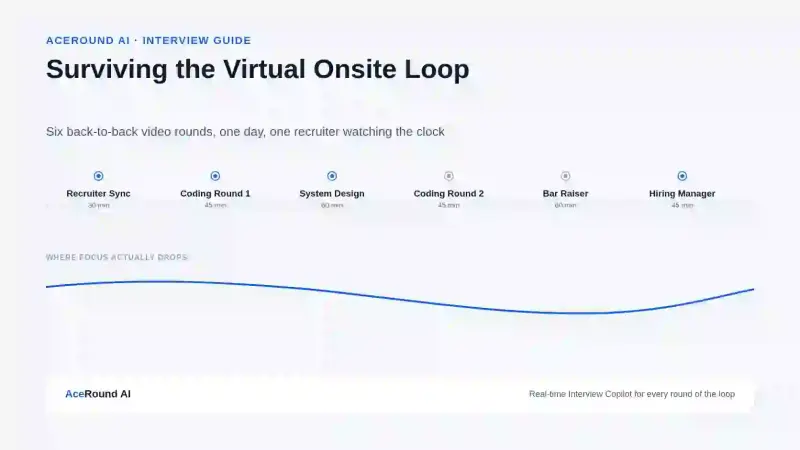
Virtual Onsite Interview Loop: How to Survive 4-6 Back-to-Back Rounds
What a virtual onsite interview loop is, why round 4 is where candidates fall apart, and how to prepare for 4-6 back-to-back video rounds in one day.