Solutions Architect Interview AI: Prepare for Both System Design and Behavioral
How AI tools help solutions architects prepare for the dual challenge of system design and leadership behavioral questions in the same interview day.

TL;DR: Solutions architect interviews are uniquely demanding because they require switching between two cognitively distinct modes — live system design whiteboarding and behavioral STAR storytelling — in back-to-back 60-minute rounds with no reset time. AI tools like AceRound help you prepare and perform in both modes, which is where most SA candidates fall short.
Four interviews in one day. You've just spent 75 minutes walking through how you'd design a distributed message queue for 50 million events per day, fielding trade-off questions on Kafka vs. SQS vs. Kinesis. You think you did well. Now you have 10 minutes before the next round starts, and the subject changes completely: "Tell me about a time you influenced a decision without direct authority."
A Glassdoor reviewer summarized the experience bluntly: "You do 4 back to back interviews in 1 day. It was exhausting."
That's the specific challenge of solutions architect interviews that almost no preparation guide addresses: the cognitive gear shift. You're not just preparing for a hard interview — you're preparing for two fundamentally different types of hard interview, back to back, on the same day.
This guide focuses on that problem.
The Dual-Mode Challenge: Why SA Interviews Are Different
Most technical interview guides treat behavioral and system design as separate categories. For solutions architects, they happen in the same loop — sometimes in the same 60-minute session.
System design mode demands: decomposition thinking, trade-off articulation, estimation (QPS, storage, bandwidth), drawing architecture diagrams while narrating, and fielding follow-up challenges to your choices. The cognitive load is high, outward-facing, and iterative.
Behavioral mode demands: narrative recall, structuring a story with beginning/middle/end (STAR format), quantifying impact, and conveying emotional nuance (conflict, ambiguity, failure) without sounding defensive or vague. The cognitive load is inward-facing and retrospective.
The gear shift between these two modes — especially after an exhausting system design round — is where prepared candidates lose points. The good news: it's a trainable skill. The bad news: most candidates only train one mode.
Before picking your preparation strategy, it's worth understanding which type of SA role you're interviewing for. The title "Solutions Architect" means different things across organizations:
- Pre-sales SA (common at cloud vendors): customer-facing, business translation, light technical depth
- Enterprise SA: internal architecture governance, pattern enforcement, stakeholder management
- Cloud/Infrastructure SA: hands-on design, AWS/Azure/GCP implementation, ops-adjacent
Each has a different behavioral emphasis. A pre-sales SA interview at AWS emphasizes customer obsession and communication; an enterprise SA interview at a bank emphasizes governance, risk, and influence. Know which archetype you're walking into.
System Design: What SA Interviews Actually Evaluate
Solutions architect interview questions on the system design side aren't really testing whether you know the "right" answer — they're testing your reasoning process under uncertainty.
Interviewers are looking for:
- Structured decomposition — do you clarify requirements before designing? (Most candidates jump straight to boxes and arrows)
- Trade-off fluency — can you articulate why you chose NoSQL over SQL, or active-active over active-passive failover, with specific reasoning rather than defaults?
- Estimation instincts — when asked "how would this scale to 10x?", do you have a mental model for where bottlenecks emerge?
- Communication under challenge — when the interviewer pushes back on your design choice, do you defend thoughtfully or cave immediately?
The AWS Well-Architected Framework is the canonical reference for Amazon SA interviews — six pillars (operational excellence, security, reliability, performance efficiency, cost optimization, sustainability) that underpin every architecture decision question. Even if you're interviewing at a non-Amazon company, the framework gives you a vocabulary that signals architectural maturity.
Practically, the best single resource for system design preparation is Alex Xu's System Design Interview, which provides worked examples (URL shortener, chat systems, distributed cache) that SA interviews draw from directly.
Where AI tools help on the system design side: practice sessions where you narrate your design out loud and get feedback on whether your reasoning is clear, not just correct. AceRound's mock interview mode lets you walk through a system design question verbally and flags gaps in your explanation logic — because in the real interview, how you explain your design matters as much as the design itself.
Behavioral (LP Questions): STAR Storytelling for Architects
For solutions architect roles at companies that use leadership principles — most notably Amazon — the behavioral component is evaluated as seriously as the technical component. A candidate who aces system design but can't articulate leadership examples clearly will not get an offer.
The most common SA behavioral questions:
- "Describe a time you had to influence a decision you didn't own." (Influence without authority)
- "Tell me about a time you disagreed with a technical direction and what you did." (Disagree and commit / backbone)
- "Give an example of when you had to simplify a complex technical concept for a non-technical audience." (Communication, customer focus)
- "Describe a situation where you had to make a decision with incomplete data." (Bias for action / judgment)
- "Tell me about a time you received critical feedback on your architecture. How did you respond?" (Earn trust / learn and be curious)
The STAR format (Situation, Task, Action, Result) is well-known. What most guides skip is the SA-specific framing: your examples should show architectural judgment, not just project management. The "Action" in your story should reveal how you thought, not just what you did.
For reference: AWS Training & Certification's official blog on interview preparation covers both STAR methodology and technical toolkit requirements for cloud roles.
Concretely: "I recommended using event streaming instead of batch jobs, which cut processing latency from 4 hours to 8 minutes" is a better behavioral answer for an SA role than "I led the team through the migration." The first answer shows architectural judgment embedded in the story. The second just shows project management.
How AI Copilots Help Solutions Architects in Live Interviews
The live interview is where preparation meets execution — and where the gear shift problem hits hardest.
Here's where an AI interview copilot like AceRound changes the dynamic:
Before the interview: Build a personal story bank. Input your top 8–10 work experiences, tag them by leadership principle or behavioral theme, and practice narrating each one until they're retrievable on demand. When you've just spent 75 minutes on system design and someone asks about a time you handled conflict, you need instant retrieval — not an in-the-moment story construction.
During practice sessions: Run mock behavioral rounds immediately after a mock system design session. This mimics the actual cognitive fatigue of the real interview day. Most people only practice each mode in isolation; the gear shift itself is the skill being tested.
Answer structure feedback: A common SA behavioral failure is too much context (the "situation" expands to fill the whole answer) with not enough action or result. AI feedback tools can flag when your answer runs long on setup and short on substance.
One real constraint: AI copilots work best as preparation tools, not as live cheat sheets. The nuance and judgment required in SA interviews — especially the follow-up probing on your design choices — requires genuine understanding. If you don't actually know why you'd choose one architecture over another, no real-time prompt will save you. Use AI to build and practice, not to substitute.
Japan: Overcoming the Modesty Barrier in SA Behavioral Rounds
For Japanese candidates applying to solutions architect roles at foreign companies — particularly Amazon Japan, AWS Japan, or multinationals — the behavioral round creates a specific cultural friction that technical preparation alone won't solve.
Japanese workplace culture values modesty (謙遜) and team contribution (チームワーク). Asserting individual ownership of outcomes — which is exactly what LP-style behavioral questions require — can feel uncomfortable or even inappropriate.
"I designed the architecture that cut deployment time from 3 days to 4 hours" is the kind of answer that earns high scores in an Amazon SA interview. The same sentence feels uncomfortably self-promotional in a Japanese professional context.
The reframe that works: LP answers at foreign companies aren't bragging — they're providing data. The interviewer can't see your work history. They're asking you to explain what happened so they can evaluate whether your judgment matches the role. Claiming your contribution is giving information, not taking credit.
Japanese SA candidates often underperform behavioral rounds not from lack of experience, but from this cultural instinct to soften ownership language. Specifically:
- Replace "we accomplished" with "I led/designed/recommended" where you were the decision-maker
- Name your specific judgment call, not just the team outcome
- Quantify results even when it feels like boasting — numbers are neutral data
Practical preparation: AWS Japan's career content (including the Japanese-language official blog) covers this STAR methodology, though it doesn't address the modesty tension directly.
Chinese Diaspora: Behavioral Is Your Underinvested Area
For overseas Chinese candidates (留学生, 海外华人) applying to solutions architect roles at US or global tech companies, the pattern is consistent and widely documented in the 一亩三分地 (1point3acres) community: technical preparation is thorough, behavioral preparation is an afterthought.
The typical profile: extensive LeetCode practice, solid system design fundamentals, underprepared on LP/behavioral storytelling in English.
The reason is predictable — system design is learnable from structured materials in any language, while behavioral storytelling requires native-fluency-level comfort with English narrative structure. Most Chinese candidates can describe what they did but struggle with the emotional arc and the "so what" of their stories in English.
What actually helps:
-
Write your stories first, then practice speaking them. For non-native speakers, the structure becomes clearer when you write it before you narrate it. Then practice the verbal version until writing isn't the crutch.
-
Translate the technical content you know into leadership language. Chinese engineers often have deep system design examples that would make excellent LP stories — they just haven't been framed that way. "I disagreed with the team's choice of NoSQL for this use case and proposed a hybrid approach — here's how I made that case" is a great LP story hiding inside a technical memory.
-
Invest in behavioral as heavily as system design. The ceiling for SA offers is often the behavioral round, not the technical one. This is documented in 一亩三分地 forum discussions repeatedly — candidates who were strong on system design but weak on behavioral storytelling received lower leveling offers or did not pass.
For mainland Chinese SA roles: the framing shifts — domestic cloud (Alibaba Cloud, Huawei Cloud, Tencent Cloud) roles use a "售前" (pre-sales) SA model where customer communication and solution selling are as important as architecture. The technical depth bar is lower, but the business case articulation bar is higher. Prepare accordingly.
FAQ
Is familiarity with AWS mandatory for a solutions architect interview?
It depends on the company. For Amazon SA roles: yes, AWS service knowledge is expected and tested. For generic "solutions architect" roles at non-cloud companies: not always. "How do I prepare for a Solutions Architect interview at Amazon? Is familiarity with AWS mandatory?" — at Amazon specifically, yes. At a fintech or healthcare company with "solutions architect" in the title, the role may be more architecture governance than AWS implementation.
Do I have to design with AWS products specifically?
"Is it a must to make a solution with AWS products in a job interview assignment if applying for a solutions architect position?" — For Amazon: yes. For vendor-neutral roles: no. In a vendor-neutral design question, showing that you can name alternatives (GCP Pub/Sub vs. AWS Kinesis) and explain why you'd choose each actually signals broader architectural maturity.
How do you design a real-time chat system for 10 million users?
"How would you design a real-time chat system for 10 million users?" — This is a classic SA design question. The canonical answer involves: WebSocket connections for real-time messaging, a message queue (Kafka or SQS) for reliability, a NoSQL database (DynamoDB or Cassandra) for message storage, CDN for media, and horizontal scaling for the connection layer. More importantly, start by clarifying — single-region or multi-region? Read-heavy or write-heavy? Those clarifying questions matter as much as the architecture.
How do you handle stakeholder requirements that conflict with technical best practices?
"How do you handle stakeholder requirements that conflict with technical best practices?" — This is a behavioral question with a technical flavor. The expected SA answer shows that you: (1) understand the business driver behind the stakeholder request, (2) propose an alternative that achieves the business goal with fewer technical risks, and (3) document the trade-off transparently if overruled. The worst answer is "I just do what the stakeholder wants." The second-worst is "I refuse to compromise on best practices." SA roles exist in that tension — your job is navigating it, not resolving it permanently.
What's the interview process like at Amazon for SA roles?
Typically: recruiter screen → phone screen (technical + LP) → virtual onsite with 4–6 rounds (system design, LP, bar raiser, team/manager). "A long, opaque, multi-round process with poor communication and no meaningful feedback before rejection" — this candidate experience is accurate. The Bar Raiser is the round most candidates don't anticipate; it's conducted by someone outside the hiring team whose explicit job is to raise the hiring bar. They may probe any topic.
How should I split my prep time between system design and behavioral?
For most SA candidates: 60% system design, 40% behavioral — but adjust based on your honest self-assessment. If you have 20 years of architectural experience and have never done LP prep, flip those numbers. The ceiling in SA interviews is usually determined by your weaker area, not your stronger one. For a structured approach to behavioral prep, see our guide on behavioral interview questions with AI practice.
The solutions architect interview is genuinely hard — not because the questions are unfair, but because they test two fundamentally different skills simultaneously under time pressure. The candidates who get offers aren't necessarily the best architects in the room. They're the ones who prepared both modes deliberately and can switch between them without losing momentum.
AceRound AI offers mock SA interview sessions that combine system design walkthroughs with behavioral practice — so you can experience the gear shift in a low-stakes environment before the real interview. It won't design the architecture for you. It will help you explain it clearly, and help you tell the stories that prove you've actually done this before.
For related preparation, see our guides on software engineer behavioral interview prep and consulting interview AI for case-heavy technical interviews.
Author · Alex Chen. Career consultant and former tech recruiter. Spent 5 years on the hiring side before switching to help candidates instead. Writes about real interview dynamics, not textbook advice.
Related Articles
OpenAI's AI Interview Policy: Banned, Required, or Team-Dependent
OpenAI sells AI coding agents, then bans most candidates from using one. Here's the round-by-round policy, including the new agentic round that flips it.
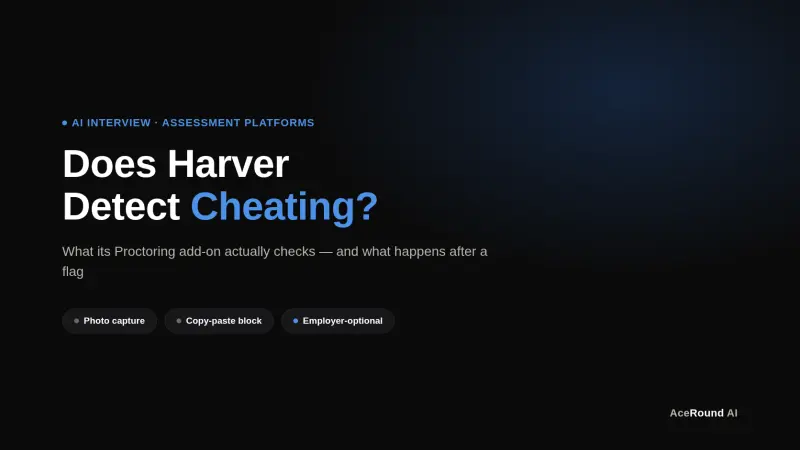
Does Harver Detect Cheating? What Its Proctoring Actually Checks
Does Harver detect cheating on its pre-employment assessments? A candidate look at Harver's Proctoring add-on, what gets logged after a flag, and what happens next.

Micro1's Zara AI Interview: What It Actually Tests (And Why Timing Gets Flagged)
Micro1's AI interviewer Zara has run 300,000+ interviews for remote roles. Here's why it flags response latency as a cheating signal, and what that means for AI prep.