Retail Manager Interview AI: What to Say When the KPI Question Lands Live
Retail manager interview AI prep that goes beyond question lists — shrink rate and conversion math, behavioral stories, multi-unit questions, and live-interview help.

TL;DR: Retail manager interviews mix behavioral storytelling with hard KPI math — shrink rate, conversion rate, labor cost percentage — and a live scenario roleplay most candidates don't expect. A retail manager interview AI copilot like AceRound gives real-time structure during the actual conversation, when a surprise follow-up catches you off guard, not just a list of questions to memorize the night before.
The Question That Isn't on Any List
"Your shrink went from 1.2% to 2.1% last quarter. Walk me through your first three actions this week."
That's not a question you'll find phrased exactly that way in most prep guides. It's also exactly the kind of follow-up that turns a strong candidate's confident opening answer into a long pause. You knew your shrink numbers on the job. You've just never had to produce them, cold, while someone with a scorecard watches you think.
Retail manager interviews are unusual because they demand two different skills in the same 45 minutes: tell a compelling leadership story, and speak fluently in the operational math that store P&Ls run on. Most candidates prepare for one and get blindsided by the other.
What Retail Manager Interviews Actually Test in 2026
Hiring managers at single-store retailers and multi-unit chains alike structure retail manager interviews around a consistent set of pressure points, drawn from real candidate reports on Indeed and Glassdoor:
- Leadership and motivation — how you develop and correct underperforming staff
- Shrink and loss control — your process for identifying and reducing inventory loss
- Customer escalation — de-escalating an angry or demanding customer live, often roleplayed
- KPI fluency — whether you can explain sales-per-labor-hour, conversion rate, and labor cost percentage without hesitating
- Operational judgment — scheduling, seasonal staffing, and budget trade-offs under pressure
Retail turnover runs around 26.7% annually, and replacing an hourly worker costs employers roughly $1,500 on average, according to SHRM. That's the uncomfortable subtext behind every "tell me about a time you managed an underperforming employee" question — interviewers aren't just curious about your leadership philosophy, they're pricing the cost of getting your hire wrong.
Store Manager Interview Questions You'll Actually Get
The specific phrasing varies by company, but the substance repeats across nearly every retail manager interview:
- "Walk us through your process for controlling shrink and loss."
- "Tell me about a time you turned around an underperforming employee."
- "What steps do you take to de-escalate a difficult customer situation?"
- "How do you handle it when profits suddenly decline?"
- "One of your employees is underperforming. How do you handle this situation?"
- "Can you describe a mistake you made at work and how you handled it?"
Notice that four of these six are scenario or behavioral questions, not knowledge checks. That's deliberate — retail hiring managers have learned that a candidate who can recite loss-prevention theory but can't tell a real story about handling it usually can't do the job either.
Retail Manager KPI Interview Questions: The Math You Need to Speak Fluently
This is the gap that trips up otherwise strong candidates. Every retail manager prep article tells you to "know your numbers." Almost none tell you what the actual benchmark ranges are, so you can speak about your own store's performance with context instead of a bare number that means nothing to the interviewer without one.
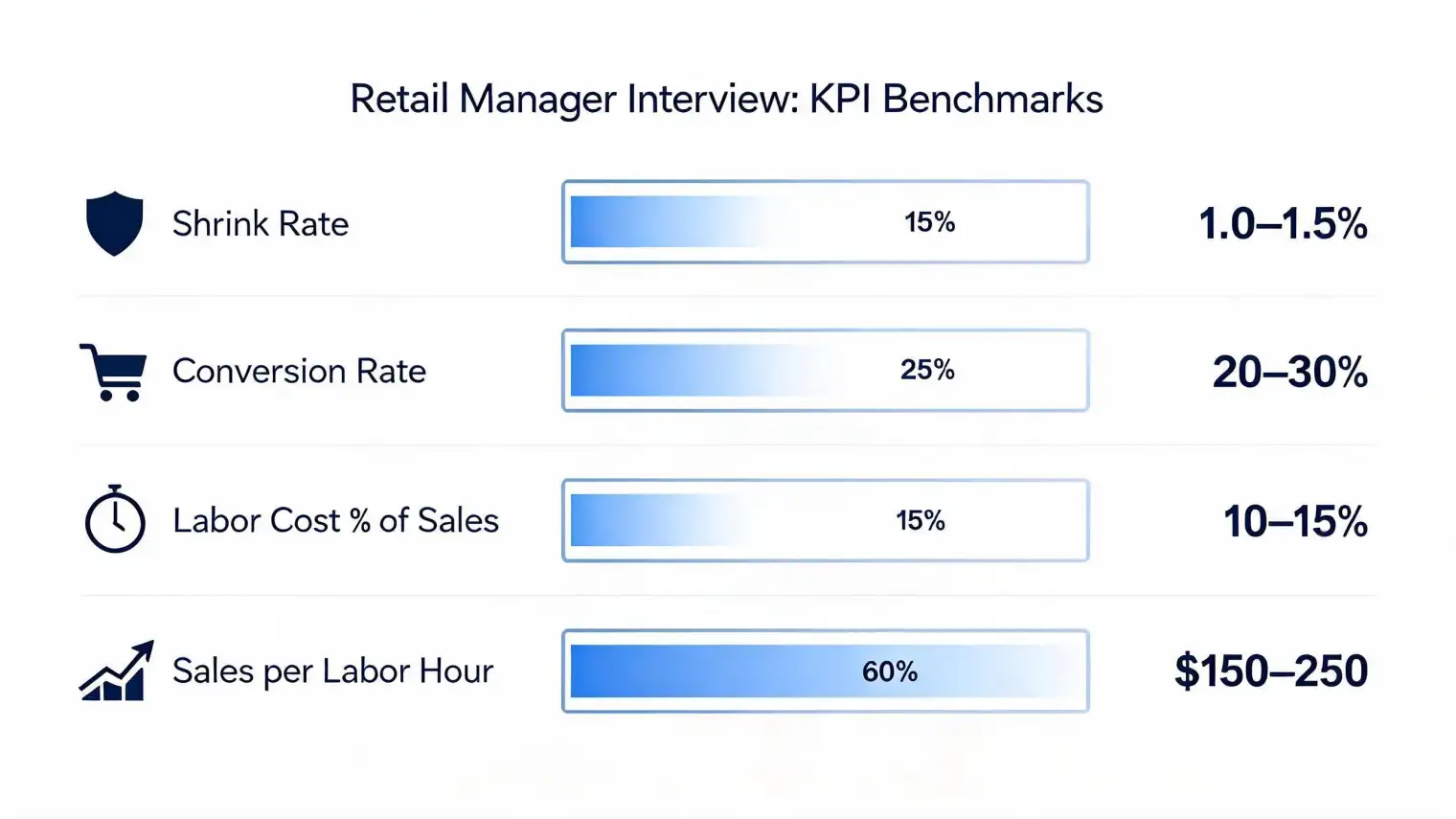
The four numbers interviewers expect you to discuss fluently, with healthy benchmark ranges drawn from Lightspeed's retail KPI guide:
- Shrink rate (inventory loss as % of sales): healthy range is roughly 1.0–1.5%. If you're citing a number, say what's driving it — external theft, internal loss, or administrative/counting error — not just the percentage.
- Conversion rate (visitors who make a purchase): 20–30% is a solid range for most specialty retail; know how your store compares and one lever you pulled to move it.
- Labor cost as % of sales: 10–15% is typical. Interviewers use this to gauge whether you can staff for service level without bleeding margin.
- Sales per labor hour: roughly $150–250 depending on category; this is the number district managers actually watch weekly.
When a KPI question lands, don't just state the number — state the number, the driver behind it, and the one action you took in response. "Shrink was at 1.8%, driven mostly by a receiving-accuracy gap at one register, so I retrained receiving staff on a two-person verification step and brought it to 1.3% within two months" answers the question interviewers are actually asking, which is never really "what's the number" — it's "can you diagnose and fix a problem."
Retail Manager Behavioral Interview Questions: Structuring the Story
The STAR method still applies here, with one retail-specific adjustment: lead with the metric or customer impact, not the internal process.
For "tell me about a time you turned around an underperforming employee":
- Situation: what the performance gap looked like and how you noticed it (not just "sales were down" — specific: missed upsell attempts, late arrivals, customer complaints)
- Task: what standard you needed them to hit and by when
- Action: the specific coaching or accountability steps — not "I talked to them," but the cadence and structure
- Result: the measurable change, and what happened if it didn't work (this is where candidates often go quiet — be ready to talk about the case where coaching didn't work and you had to make a harder call)
For general behavioral framing across formats, our behavioral interview questions guide covers the broader structure this builds on.
District Manager and Multi-Unit Retail Manager Interview Questions
If you're interviewing for a district, regional, or multi-unit role, the questions shift in scope without changing in format:
- "How do you maintain consistent execution across stores with different manager tenure and team maturity?"
- "Walk me through how you'd triage your time across five stores if two are underperforming simultaneously."
- "How do you handle a store manager who resists a company-wide initiative?"
The tell that separates strong multi-unit candidates: single-store managers talk about "my team." District-level candidates talk about systems — the cadence of store visits, the scorecard they use to prioritize which location gets attention this week, how they replicate what works at the best-performing location without forcing an identical playbook everywhere. If you're moving from single-store to multi-unit, practice reframing your examples from "what I did" to "what I built that other managers could run without me."
How to Answer Retail Scenario Interview Questions Live
The customer-escalation roleplay is where most interview prep completely falls apart, because it's not a question — it's a live, unscripted exchange where the interviewer plays an increasingly difficult customer and watches how you adapt in real time.
A typical exchange escalates in steps: initial complaint, then a demand you can't fully meet, then an escalation ("I want to speak to your manager" — even though you are the manager), then sometimes a threat to leave a bad review. Candidates who prepared one canned response usually handle step one fine and freeze at step three, because they rehearsed an answer, not a structure.
The structure that holds up under an unscripted twist: acknowledge specifically (not "I understand your frustration," but naming the actual issue), offer the most generous resolution within your actual authority, and — critically — have a fallback ready for when your first offer isn't enough. Interviewers escalate specifically to see if you have a second move.
How AceRound AI Works During a Retail Manager Interview
Every retail interview guide, including this one, ends at preparation. You read the questions, you rehearse your stories, you memorize the KPI ranges — and then the actual conversation still has room to surprise you, because live interviews don't run on scripts.
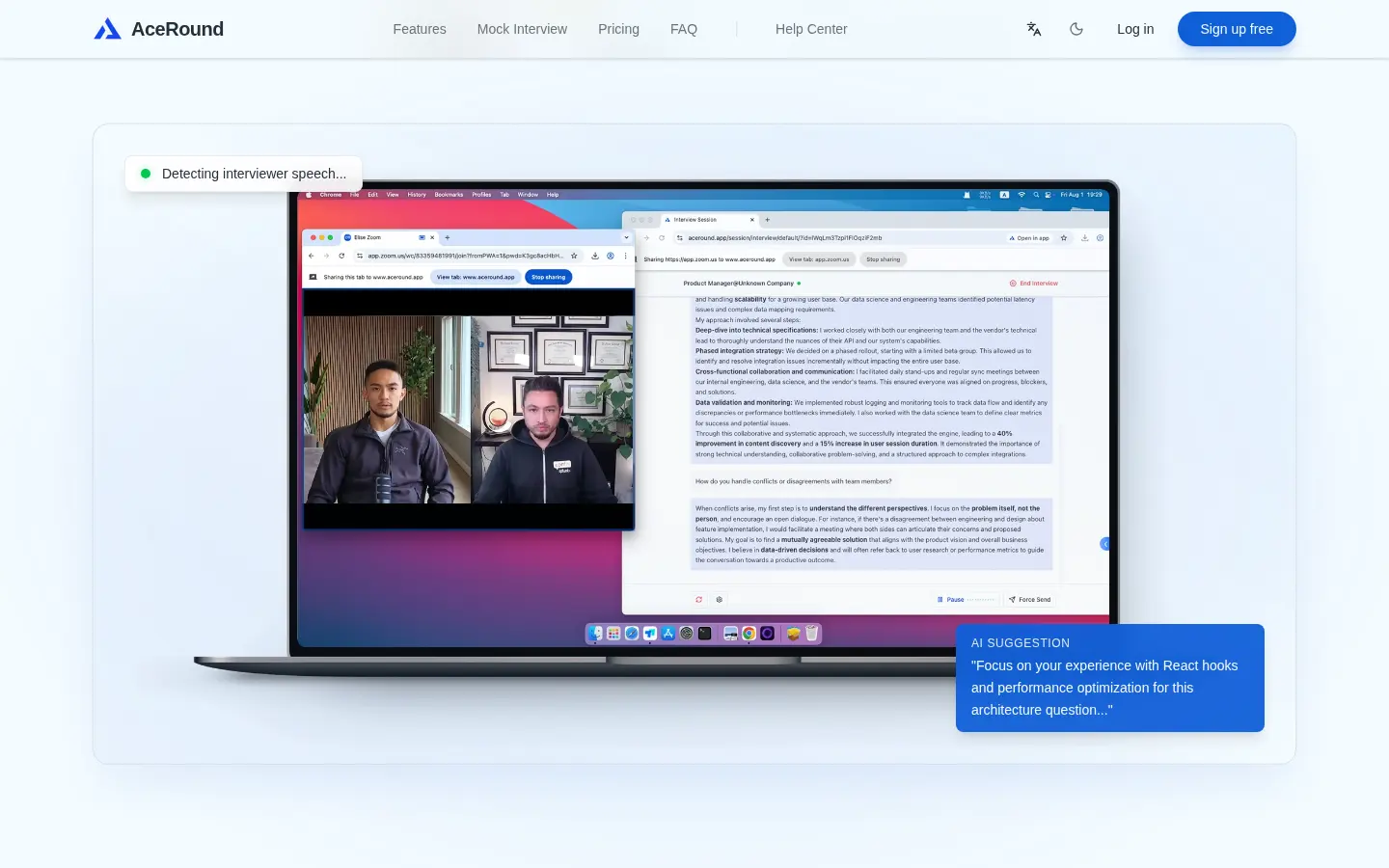
AceRound AI runs in the background on your desktop during the actual interview — on Zoom, Google Meet, Microsoft Teams, or any video platform — and listens for the question as it's being asked. When the interviewer's shrink-rate follow-up gets specific in a direction you didn't rehearse, or the customer-escalation roleplay adds a twist mid-conversation, it surfaces a structured response cue in real time: the KPI framework to reach for, the STAR beat you're missing, or the de-escalation move that fits what was just said.
It doesn't write your answer for you, and it won't invent a shrink number you don't actually know. What it does is keep the structure available when your own working memory is busy tracking the interviewer's tone, the time on the clock, and your own nerves — which is exactly when candidates who know the material still go blank.
Retail Manager Interview Questions: Common Questions Answered
What are the most common store manager interview questions? Leadership and coaching (turning around an underperforming employee), shrink and loss control, customer de-escalation, handling declining profits, and a personal accountability question ("describe a mistake you made"). Expect at least one to be roleplayed live rather than asked as a straightforward question.
What KPIs should I know for a retail manager interview? Shrink rate (1.0–1.5% is healthy), conversion rate (20–30% for most specialty retail), labor cost as a percentage of sales (10–15%), and sales per labor hour ($150–250 depending on category). Know the driver behind your number, not just the figure itself.
How is a district or multi-unit manager interview different from a single-store interview? The format is similar, but strong answers shift from "what I did with my team" to "what system I built that other managers could run without me" — prioritization across locations, consistency without rigidity, and how you triage attention when multiple stores need it at once.
How do I handle the customer-escalation roleplay? Treat it as a structure, not a script. Acknowledge the specific issue, offer your best resolution within actual authority, and have a second move ready for when the first offer isn't enough — interviewers escalate specifically to test whether you have one.
Can an AI tool actually help during a live retail interview? It can surface structure — a KPI framework, a STAR beat, a de-escalation move — in the moment a live question gets specific in a direction you didn't rehearse. It can't invent facts about your own work history, so the preparation still matters; the copilot fills the gap between "I know this" and "I can say this clearly under pressure."
What's the biggest mistake candidates make in retail manager interviews? Treating the KPI questions and the behavioral questions as separate tracks to prepare independently. The strongest answers connect them — cite the number, then tell the story of what you did about it, in the same breath.
Author · Alex Chen. Career consultant and former tech recruiter. Spent 5 years on the hiring side before switching to help candidates instead. Writes about real interview dynamics, not textbook advice.
Related Articles
OpenAI's AI Interview Policy: Banned, Required, or Team-Dependent
OpenAI sells AI coding agents, then bans most candidates from using one. Here's the round-by-round policy, including the new agentic round that flips it.
Does Harver Detect Cheating? What Its Proctoring Actually Checks
Does Harver detect cheating on its pre-employment assessments? A candidate look at Harver's Proctoring add-on, what gets logged after a flag, and what happens next.

Micro1's Zara AI Interview: What It Actually Tests (And Why Timing Gets Flagged)
Micro1's AI interviewer Zara has run 300,000+ interviews for remote roles. Here's why it flags response latency as a cheating signal, and what that means for AI prep.