How to Pass a Police Oral Board Interview
What a police oral board panel really scores, the questions that catch candidates off guard, and how AI mock practice preps you to pass.
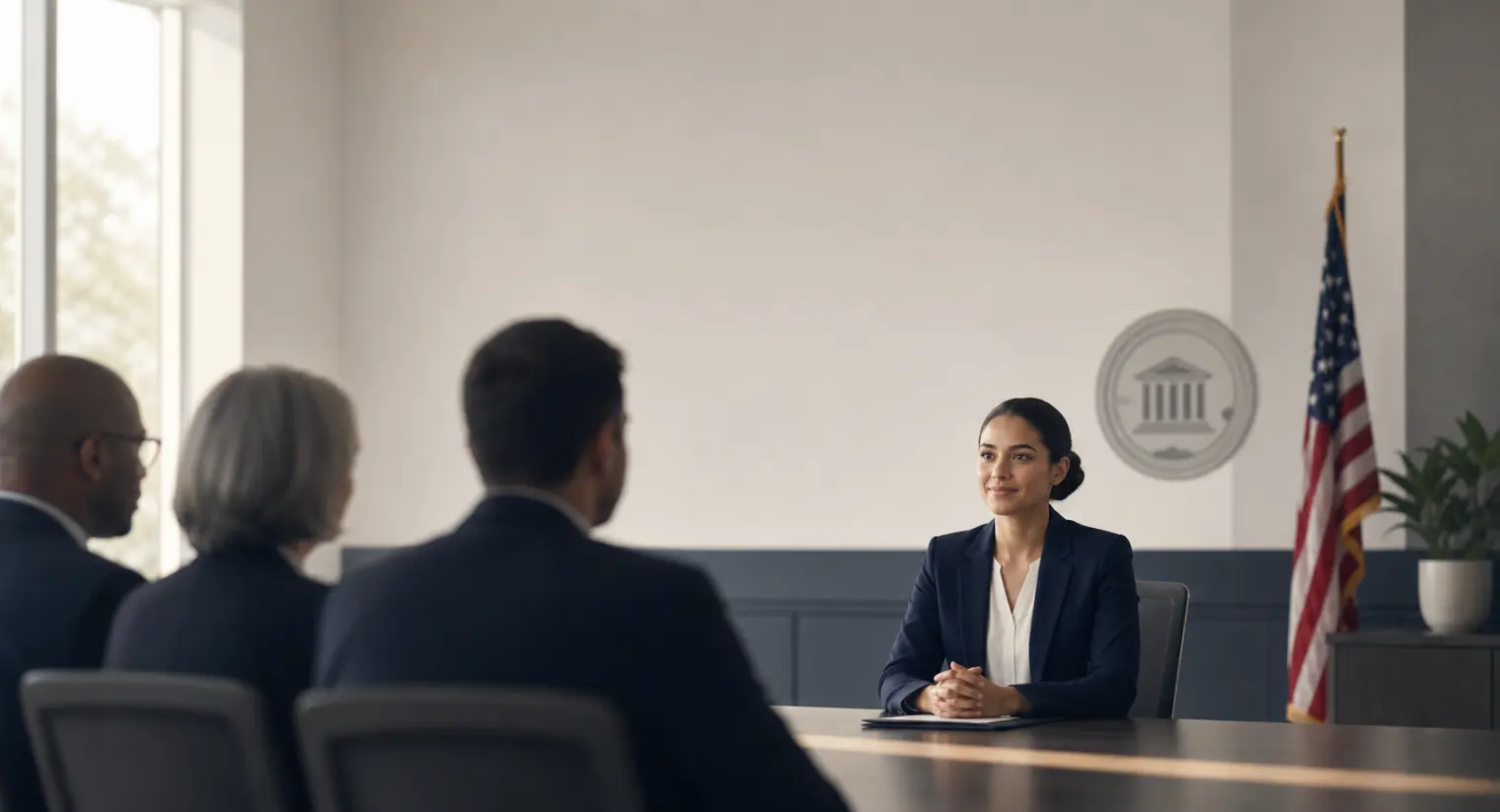
TL;DR: A police oral board is a scored panel interview, not a conversation — 3 to 5 raters, 20 to 40 minutes, judging you against a fixed rubric across two phases: background questions, then judgment scenarios. Most police officer interview AI prep tools and guides stop at a list of sample questions. The candidates who actually pass practice the part nobody warns them about: the unscripted follow-up question that comes right after you think you're done answering.
"My police oral board interview is in 5 hours. Do you have any tips or advice?" — that's a real question posted on Quora, and it's not an outlier. Departments give candidates weeks of notice for the oral board, and a large share of them still show up having only read a Q&A list the night before. The problem isn't a lack of information. It's that reading questions and being interrogated by four strangers scoring your every word are two completely different skills.
Here's what the board actually looks like, what it's really scoring, and where AI-assisted practice fills the one gap that generic prep content leaves wide open.
What a Police Oral Board Actually Looks Like
Most candidates picture a friendly chat. It's closer to a structured exam with a human interface.
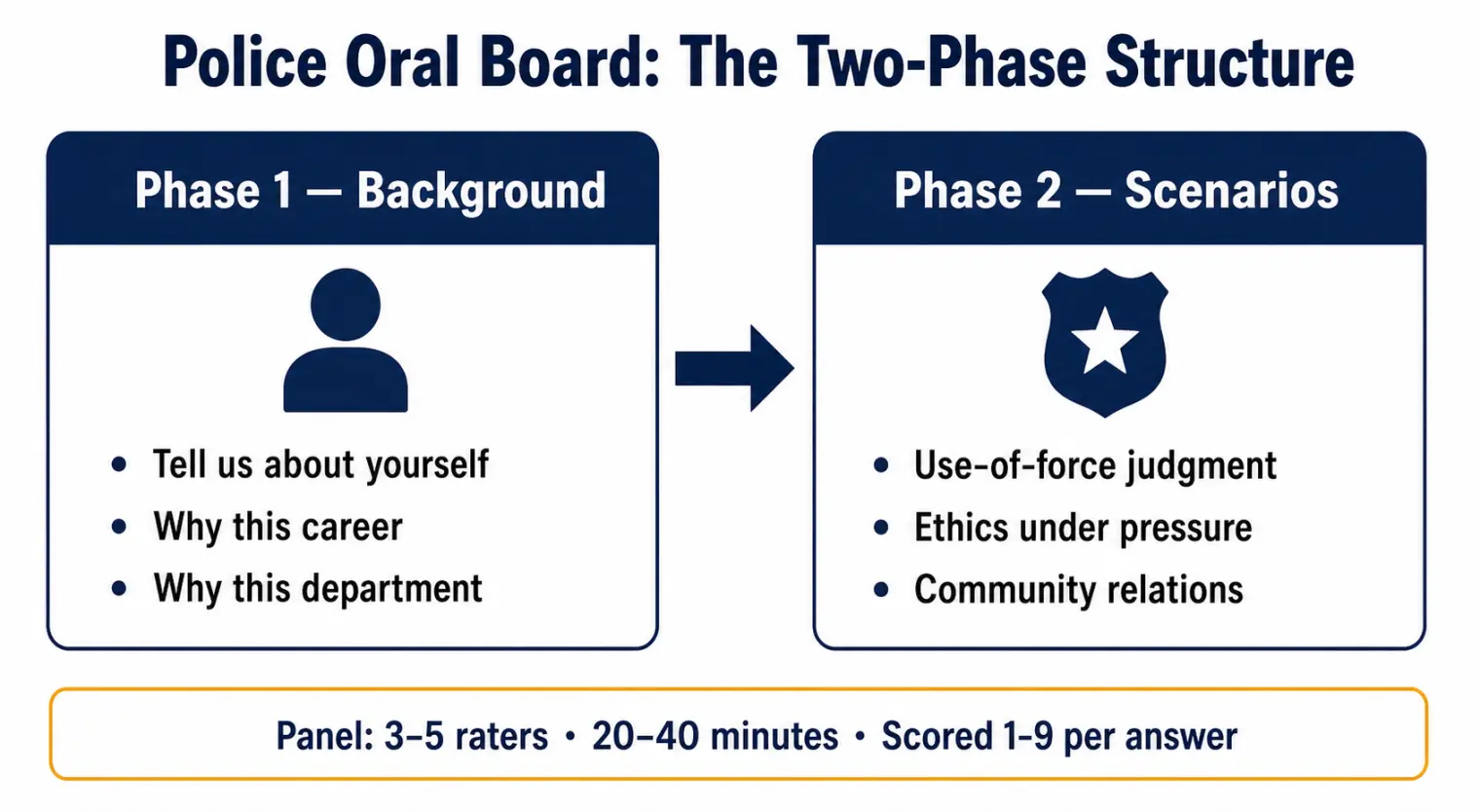
The panel: typically 3 to 5 members — sergeants or lieutenants, a field training officer, sometimes HR or a community representative. Smaller agencies may run it with a single interviewer, but the scoring structure is the same.
The duration: 20 to 40 minutes. Finishing in under 15 minutes is generally read as a red flag — it usually means answers were too short or too vague to probe further.
The structure: almost every department runs a consistent two-phase format:
- Background and motivation — who you are, why law enforcement, why this department specifically.
- Scenario-based judgment — hypothetical situations testing how you'd actually act, not what you know in theory.
The scoring: each panelist rates your answers independently — often on a 1-9 scale — against a rubric fixed before you walk in. Scores are averaged into a total, frequently out of 100. A 70 is a typical pass line, but 90+ is usually needed to be competitive against other candidates in the same hiring cycle. In California, POST (the state's training and certification commission) formally mandates six specific factors be assessed in every peace-officer oral interview, and maintains an official Oral Interview Question Bank that many agencies model their process on — this is the closest thing to a national ground truth for what's actually being tested.
Real Police Oral Board Interview Questions (and What They're Testing)
This set of law enforcement interview questions and answers recurs across departments and hiring cycles — organized by which phase they belong to and what's actually being measured.
Phase 1 — Background
- "Tell us about yourself." A 60-90 second self-pitch. Assesses articulation and preparation, not biography — panels have heard hundreds of these and can spot a memorized paragraph in the first ten seconds.
- "Why do you want to be a police officer?" Panels are trained to penalize clichés ("I've wanted this since I was a kid") and reward specific evidence — a ride-along, a citizen's academy, a named officer who influenced you.
- "Why this department, specifically?" Generic answers ("good benefits," "good reputation") score near the bottom. This is a research question in disguise.
Phase 2 — Judgment scenarios
- Use-of-force / de-escalation: e.g., "A man staggers out of a bar bleeding, and another man punches him — what do you do?" Panels are scoring your sequencing (safety first, then first aid, then securing the scene, then notifying a supervisor), not just your instinct.
- Ethics under pressure: situations involving a partner's misconduct, or being offered something you shouldn't accept. This tests integrity when the "easy" answer would protect a colleague instead of doing the right thing.
- Community relations: e.g., "A resident complains about reckless driving in their neighborhood — how do you respond?" Scored on cultural sensitivity and whether you treat the public as a partner rather than a problem.
- The no-easy-answer supervisory question: a real example from a former candidate — "Give an example where you had to make a supervisor's decision without the aid of a supervisor." Described as the hardest question they faced, delivered in front of seven or eight panelists with no time to prepare.
The part nobody warns you about: follow-up probing. Panels routinely ask "why would — or wouldn't — you do that?" immediately after your answer, unannounced. It's rarely covered in prep content, and it's exactly where memorized answers fall apart.
How Police Oral Board Scoring Actually Works
Underneath the specific police interview panel questions, panelists are rating you against fixed categories — roughly: judgment, integrity, communication, stress tolerance, and community orientation. Knowing this changes how you prepare: instead of collecting more sample answers, pick one or two real stories per category and make sure each one gives the panel clear evidence for that specific trait.
This is also why static "100 police interview questions" listicles top out fast. They're accurate, but they treat the interview as a trivia test instead of a skills test. The real skill being scored — thinking clearly out loud, under time pressure, while being watched by strangers with clipboards — can't be built by reading.
How AI-Assisted Practice Actually Helps Here
One honest caveat first: a police oral board is in-person and unscripted by design, so a real-time screen overlay isn't the right tool for the room — you can't glance at a screen while five people are watching you across a table. Where AI-assisted prep genuinely helps is before you walk in, not during.
1. Rehearse the follow-up, not just the opening answer.
Load your background stories and scenario responses into an AI mock interview tool and have it fire the unscripted "why would/wouldn't you do that?" probe after each one — the exact skill the board tests and the one thing static question lists can't simulate. AceRound AI can run this kind of back-and-forth practice loop and flag answers that sound rehearsed rather than reasoned.
2. Pressure-test your scenario judgment.
Describe a use-of-force or ethics scenario, give your answer, then ask an AI tool to challenge your sequencing the way a panelist would ("you said you'd secure the scene first — what if the second man is still swinging?"). This surfaces the gaps in your reasoning before a real panel does.
3. Time your answers.
Background answers should land around 60-90 seconds; scenario answers typically run a bit longer. Practicing with a timer — human or AI — prevents both the ten-second non-answer and the rambling three-minute answer that loses the panel halfway through.
4. Get honest feedback on delivery, not just content.
It's hard to hear your own filler words, pacing, or hedging language in the moment. An AI practice partner that reviews your recorded answer can flag "you said 'kind of' six times" in a way a mirror can't.
A Practical Two-Week Prep Plan
If you're wondering how to pass a police officer interview on a deadline, this is the compressed version of everything above, laid out day by day:
- Days 1-3: Write out one specific, evidence-backed story for each rubric category — judgment, integrity, communication, stress tolerance, community orientation. Research the department specifically (recent initiatives, community programs, named leadership) so "why this department" has real substance.
- Days 4-7: Say every answer out loud, timed. Record yourself once and listen back for filler words and pacing.
- Days 8-11: Practice the follow-up loop — have someone (or an AI tool) fire an unscripted "why" or "what if" after each answer, and answer it without pausing to reset.
- Days 12-13: Run a full mock board: all questions, both phases, back to back, at interview length (20-40 minutes), with no breaks between questions.
- Day 14: Rest. Review your notes once, lightly. Don't cram new material the night before — it produces memorization, not readiness.
Frequently Asked Questions
What is the hardest question asked in a police oral board interview?
Candidates most often cite unscripted supervisory or judgment scenarios, such as being asked to describe a time they had to make a decision normally reserved for a supervisor, with no one to consult. The difficulty isn't the topic — it's that the panel follows up in real time with "why would you do that?" and there's no script for it. The fix is practicing the follow-up loop, not memorizing more sample answers.
My police oral board interview is in a few hours. What should I do right now?
Don't try to learn new material. Re-read your own background notes (why this department, specifically), pick one clean example each for a strength, a mistake you learned from, and a values-under-pressure moment, and say them out loud once. Panels can tell when someone is reciting versus recalling — reviewing calms nerves more than cramming new content.
What questions are asked in a police officer oral interview?
Expect two phases: background questions (tell us about yourself, why law enforcement, why this department) and scenario questions (use-of-force and de-escalation judgment, ethics and integrity under peer pressure, community relations). Almost every board also asks at least one supervisory or no-easy-answer scenario, and follows any answer with unscripted "why" or "what if" probes.
How can I ace a police oral board interview?
Treat it as a scored panel evaluation, not a conversation. Know the rubric categories (judgment, integrity, communication, stress tolerance, community orientation), prepare specific evidence-backed stories for each, and rehearse out loud with someone who will interrupt you with follow-ups — that's the skill the format tests and the one static question lists don't build.
How is a police oral board interview scored?
Each panelist — typically 3 to 5 raters — scores every answer independently, often on a 1-9 scale against a predetermined rubric, then scores are averaged into a total, frequently out of 100. A 70 is a common pass line, but 90+ is usually needed to be competitive against other candidates in the same hiring round.
Related reading: panel interview tips and the STAR method for interview answers go deeper on structuring the stories you'll use in both phases of the board.
For the official framework many US departments model their oral interview on, see California POST's Oral Interview Question Bank overview and Police1's breakdown of the toughest oral board questions.
Author · Alex Chen. Career consultant and former tech recruiter. Spent 5 years on the hiring side before switching to help candidates instead. Writes about real interview dynamics, not textbook advice.
Related Articles
Figma Software Engineer Interview Process (2026): What's Reported
Figma publishes no interview rubric. Here's the loop candidates report, the product-flavored coding and design rounds, and what's known about an AI round.
Oracle and PayPal Fresher Interview Process in India: What Candidates Reported, Year by Year
Oracle India's test moved from aptitude plus core CS to HackerRank with a REST API task. PayPal's cut-offs and platform also differ. Posts compared.
Airbnb Software Engineer Interview: The Core Values Round, Explained
Airbnb's four core values are public, but the interview round built on them isn't documented. Here's what's official, what candidates report, and how to prepare.