Figma Software Engineer Interview Process (2026): What's Reported
Figma publishes no interview rubric. Here's the loop candidates report, the product-flavored coding and design rounds, and what's known about an AI round.
TL;DR: Figma has not published its engineering interview stages, rubric, or any AI-tool policy that we could find. What exists is candidate reporting: a recruiter call, a hiring manager call, a one-hour CoderPad screen, then a virtual onsite of four to five rounds (coding, two system designs, behavioral, and a project deep dive). The coding and design prompts are reportedly flavored by Figma's product. A newer AI-assisted round is mentioned in a few places, but with almost no detail.
Source note: the only official statement we could verify is that candidates keep cameras on in video interviews (from a Figma job posting). Everything else below is labeled as reported and comes from interviewing.io (last updated April 2025), TechPrep, and one detailed July 2026 candidate account.
Most Figma interview guides read as if someone at Figma wrote them. Nobody did. We checked Figma's careers page and a current engineering job posting, and neither describes the stages, the scoring, or whether AI tools are allowed. So this guide separates what's official (very little) from what candidates keep reporting, and flags the places where the reporting is thin.
The Loop as Candidates Describe It
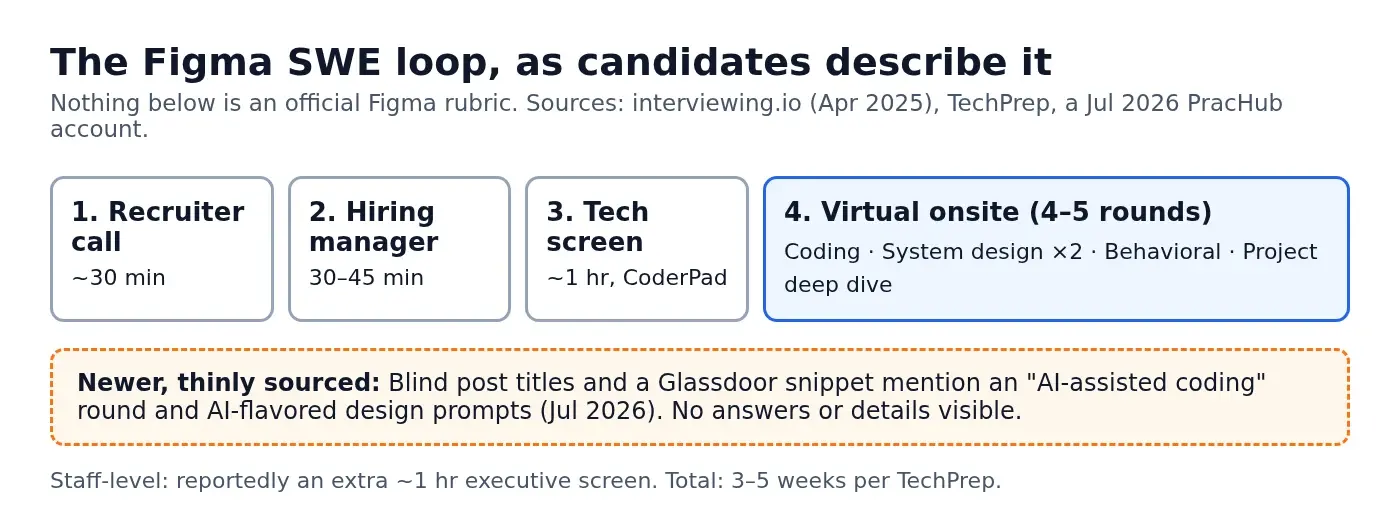
According to interviewing.io, which says it's based on conversations with Figma engineers, the sequence is:
- A recruiter call of about 30 minutes.
- A hiring manager call of about 45 minutes.
- A technical phone screen of about an hour in CoderPad, at roughly LeetCode-medium difficulty, language-agnostic.
- An onsite totaling about four hours: one coding round, two system designs, one behavioral, and one project deep dive.
- For Staff-level candidates, an additional executive screen of about an hour.
TechPrep gives a similar shape and says the process runs three to five weeks with four to six rounds. A July 2026 account on PracHub, from a candidate on an AI team, describes the virtual onsite as five rounds spread over three days. These sources agree on the skeleton and disagree on details like round count, which is a good reason to ask your recruiter for your own loop in writing.
One thing interviewing.io notes that's easy to miss: interviewers are reportedly drawn from a pool rather than from the hiring team, apart from the hiring manager and executive screens. In practice that means you shouldn't expect any one interviewer to know your background.
Coding Rounds: Product-Shaped Problems
The pattern across sources is that the coding prompts sound like pieces of a design tool, not generic puzzles. interviewing.io lists prompts such as implementing a Figma-like document with layers and properties, and printing 2D canvas objects in order. TechPrep says to expect complex state, tree structures, or undo/redo logic. The July 2026 candidate on the AI team describes a different flavor: validating INDENT/DEDENT tokens, then writing a read_rich_text function that returns nested lists.
What this means for prep:
- Practice tree and state problems, not just arrays. A layer hierarchy is a tree. Undo/redo is a command history. If those feel unfamiliar, they're more likely to cost you time than a classic two-pointer problem.
- Read the prompt twice. When the vocabulary is product-specific (layers, frames, properties), the first few minutes go to translating it into a data structure you know. Say that translation out loud.
- Expect a single good problem, not a speed run. The round is about an hour, and the reported prompts look built for depth and follow-ups.
TechPrep also lists frontend-flavored topics for relevant roles: IME events, focus management, and rendering performance. It's a prep guide's list rather than a Figma statement, so use it as a hint about what to review, not a syllabus.
System Design: Two Rounds, Some Run in Figma
The reported design rounds lean toward collaborative, real-time software. TechPrep names real-time collaboration (CRDT/OT), a plugin API, and versioning and caching. interviewing.io says the two system design rounds are run in Figma, and that the first is about Figma components. It also lists a poll system for concurrent users as a sample prompt. The 2026 AI-team candidate reports an agent evaluation platform and retrieval and ranking over files with hierarchical access.
If you've only practiced backend-style designs (URL shortener, news feed), add at least one collaborative-editing design to your rotation. Our general system design interview guide covers the five-step structure; the Figma-specific part is being ready to talk about conflict resolution when two people edit the same thing.
The Project Deep Dive
This is the round candidates seem least prepared for. interviewing.io describes it as about an hour with one interviewer and says to prepare slides. The July 2026 account adds a useful detail: the recruiter reportedly suggested the candidate use a larger, older project because a small startup's user base was too small for the deep dive.
Pick a project where you can answer, without notes: what were the alternatives you rejected, what broke, what would you change, and what did you personally decide versus inherit. A project you only contributed to is harder to defend than one you owned a part of.
The AI-Assisted Round: What We Can and Can't Say
This is where the evidence is thinnest, so here's exactly what we found. On Blind's Figma page there are post titles from July 2026, "Figma AI assisted interview" and "Figma AI Interviews," with teasers mentioning "AI Assisted Coding" and "AI Design Architecture and AI Live Coding." A Glassdoor snippet from a reviewer mentions an AI coding round. We could see titles and teasers, not discussion, so we can't tell you what the round contains, which tools are allowed, or how it's scored.
What we can say: Figma has not published an AI-in-interviews policy that we could find, and the older guides above predate these mentions entirely. Treat the AI round as possible, not confirmed for your loop. The sensible approach is the one other AI-forward companies' rounds have reportedly rewarded: plan before you prompt, read what the tool gives you like a diff you didn't write, and be able to explain every line. Our write-ups on Ramp's AI-assisted coding round and LinkedIn's AI-enabled coding interview describe that workflow in more detail, with the same caveat that those are candidate reports too.
One official rule is worth knowing: Figma's job posting says all candidates must keep their cameras on during video interviews. Set up your lighting and framing the day before, not ten minutes in.
How to Prepare
- Week 1: Tree, graph, and state-machine problems. Build an undo/redo stack and a layer tree from scratch.
- Week 2: Two collaborative system designs out loud, timed, with someone interrupting you. Reading designs and defending them are different skills.
- Week 3: Your project deep dive. Write the slides, then present them to a friend who's allowed to say "why?" at every slide.
- Throughout: Ask your recruiter which rounds allow tools and which don't. It's a logistics question, and a normal one.
If you want somewhere to rehearse the talking parts, a mock interview session is built for exactly the narrated, interrupted format that the system design and deep dive rounds use. For the CoderPad rounds, practice unassisted and timed; nothing reported suggests the early screens are different.
FAQ
How many rounds are in the Figma software engineer interview?
Candidates describe a recruiter call, a hiring manager call, a one-hour technical screen, and a virtual onsite of four to five rounds. TechPrep says three to five weeks overall. Figma hasn't published its stages, so confirm yours with your recruiter.
What kind of coding questions does Figma ask?
Reportedly product-flavored: layered documents with properties, ordering canvas objects, undo/redo, tree and state manipulation. interviewing.io puts the screen at roughly LeetCode-medium in CoderPad.
Does Figma allow AI in coding interviews?
We couldn't find an official policy. Mid-2026 Blind post titles and a Glassdoor snippet mention an AI-assisted coding round, but without details. Ask your recruiter which rounds allow tools.
What is the Figma project deep dive?
About an hour presenting a past project to one interviewer. Prepare slides, and choose a project large enough to be interrogated.
Does Figma require cameras on during video interviews?
Yes. Figma's own job posting for a Software Engineer role says all candidates must keep their cameras on during video interviews.
Author · Alex Chen. Career consultant and former tech recruiter. Spent 5 years on the hiring side before switching to help candidates instead. Writes about real interview dynamics, not textbook advice.
Related Articles
Oracle and PayPal Fresher Interview Process in India: What Candidates Reported, Year by Year
Oracle India's test moved from aptitude plus core CS to HackerRank with a REST API task. PayPal's cut-offs and platform also differ. Posts compared.
Airbnb Software Engineer Interview: The Core Values Round, Explained
Airbnb's four core values are public, but the interview round built on them isn't documented. Here's what's official, what candidates report, and how to prepare.
Cisco and Intuit Fresher Interview Process in India: Official vs Reported
Cisco's own Code with Cisco page, a third-party guide and one Intuit SDE-1 account differ on rounds and timing. What each says, and how to prep.