ML Engineer Interview Preparation: The 3-Pillar Guide Most Candidates Ignore
ML engineer interview preparation requires mastering three distinct rounds: ML fundamentals, MLOps system design, and behavioral. Most guides cover only one. Here's how to tackle all three.

TL;DR: ML engineer interview preparation fails when candidates treat it as a single-dimensional problem. The real format has three distinct pillars — ML fundamentals, MLOps system design, and behavioral rounds — and most candidates optimize for only one. An AI interview assistant helps you hold all three simultaneously during live interviews where recall and articulation both matter.
Only 3.6% of ML engineer candidates in the Bay Area receive offers from the roles they apply to. That number drops to 1.4% outside major tech hubs. A 2024 Towards Data Science analysis of hundreds of ML interview processes found that 72% of job postings don't even specify the experience level they're hiring for — which means candidates have no reliable signal about which interview format to expect until they're already in the room.
The candidates who make it through have one thing in common: they prepared for all three rounds, not just the one they were already comfortable with.
The 3-Pillar Problem: Why 60% of ML Engineers Fail System Design
Every ML engineer interview process has the same structural problem that no prep guide addresses directly. The three rounds require completely different thinking modes:
Pillar 1 — ML Fundamentals: Statistical derivations, algorithm mechanics, evaluation metrics, bias-variance tradeoff. This is recall under pressure. You either remember the gradient descent update rule or you don't.
Pillar 2 — MLOps System Design: Production system architecture, feature stores, model serving infrastructure, A/B testing frameworks, monitoring and drift detection. This is judgment under ambiguity. There's no single right answer — just better or worse trade-off reasoning.
Pillar 3 — Behavioral: Ownership signals, impact framing, collaboration under constraints, failure handling. This is narrative under structure. Interviewers want to hear specific decisions you made and specific outcomes that followed.
Most candidates spend 80% of their prep time on LeetCode (which bleeds into Pillar 1) and 20% on system design. They give the behavioral round fifteen minutes the night before. This is exactly backwards from where the failure modes actually sit.
The pattern that shows up repeatedly in hiring manager feedback: junior ML engineers who can recite the math ace the fundamentals round, get through coding, and then collapse when asked "design an ML system for real-time fraud detection" — because they've never had to reason about model latency, feature freshness, feedback loops, and monitoring all at once. Or they pass system design and then fail behavioral because they can't articulate ownership signals ("what specifically did you decide?") under interview pressure.
Machine Learning Engineer Interview Questions: What Actually Gets Asked
The machine learning interview questions that matter most don't appear on generic Q&A lists. Here's what shows up repeatedly in real ML engineer interviews at companies from FAANG to mid-stage startups:
Fundamentals questions that trip up experienced candidates:
- "Walk me through the intuition behind L1 vs L2 regularization and when you'd choose each." (Most candidates recite the math; interviewers want the intuition behind when sparse weights are desirable.)
- "Your model achieves 95% accuracy on your validation set but underperforms in production by 12%. Walk me through your diagnostic process." (This is a data leakage / distribution shift question dressed as an accuracy question.)
- "How do you handle class imbalance in a dataset where the positive class is 0.1%?" (Multiple valid answers; what's being tested is whether you know why each approach has costs.)
- "Explain the bias-variance tradeoff in terms of what you'd actually observe in your error curves." (Rote definition vs. observable pattern — different question.)
What's conspicuously absent from most question lists:
- Questions about production failure modes (what happens when your feature pipeline has upstream delays)
- Questions about model behavior under distribution shift over time
- Questions about business metric vs. ML metric conflicts ("your precision improved but conversion dropped — what do you do?")
The machine-learning-interview GitHub repo compiled by an engineer with verified FAANG offers is the best practitioner-built resource for the fundamentals layer. The alirezadir/Machine-Learning-Interviews repo covers coding, fundamentals, and system design in one place. Use both, and pay more attention to the questions you can't immediately answer than to the ones you can.
MLOps System Design Interview: Where Junior Candidates Lose Seniority Points
The MLOps system design interview is the round that separates candidates who have shipped ML systems from candidates who have trained models in notebooks. Interviewers know this. The tell is in how candidates handle the first five minutes of any system design question.
A junior candidate given "design an ML system for content recommendation" jumps immediately to model architecture: "I'd use a two-tower model with embeddings..." A senior candidate starts differently: "What's the latency requirement? What's the data freshness requirement? Are we optimizing for engagement or for a specific downstream business metric?"
The questions that signal production maturity:
- Feature store design: How do you handle training-serving skew? What's your approach to feature backfilling?
- Model serving: What's the latency budget, and how does that affect your inference strategy (batch vs. real-time vs. streaming)?
- A/B testing: How do you handle novelty effects? What's your minimum detectable effect size, and how does that drive your experiment duration?
- Monitoring and drift detection: How do you distinguish data drift from concept drift, and what's your alert-to-action process?
- Feedback loops: What happens to your model quality when your model's own outputs influence future training data?
The approach that consistently works in MLOps system design interviews: lead with constraints before architecture. Every trade-off you make should be visibly tied to a specific constraint you surfaced earlier. "I'm choosing offline batch inference here because you told me latency can be up to 10 seconds — if that changes, we'd move to a different serving strategy."
For ML-specific system design prep, the Backprop ML System Design guide (trybackprop.com) is the most rigorous resource currently available. It's also the guide that specifically identified the failure mode where junior candidates "jump straight to feature engineering without business context" — which is exactly the pattern interviewers are calibrating for.
See also: data scientist interview preparation for overlap areas between DS and MLE system design rounds.
Behavioral Interview for ML Engineers: The Round Everyone Underestimates
The behavioral round is where ML candidates lose offers they had secured technically. Here's why: ML engineers spend their careers working in long feedback loops. A model takes weeks to train, weeks to deploy, weeks to validate in production. The causal chain between a decision you made and an outcome you can attribute to it is genuinely long and often noisy. This makes it hard to construct crisp behavioral stories.
Interviewers are specifically listening for ownership signals — evidence that you made a specific decision (not your team, not the algorithm, not the product requirements) and that you can describe the reasoning and the result with specificity. The most common failure mode is candidates who describe what "we" did without ever articulating what "I" decided.
The framework that actually works:
Before the interview: Write out 5-8 ML-specific situations where you made a consequential decision — not just "I trained a model" but "I chose to use offline instead of online evaluation because the feedback loop was 3 weeks and A/B testing would have taken 6 months to reach significance." The decision-reasoning-outcome chain is what matters.
During behavioral questions: Structure your answer around the decision, not the outcome. Interviewers can evaluate your reasoning even when the outcome was mixed. What they can't evaluate is generic team accomplishments with no individual decision-points.
For senior/staff ML roles: Expect behavioral questions about failure, specifically. "Tell me about an ML system you built that didn't work and what you did about it" is common. The answer should include what you diagnosed, what you decided to change, and whether it worked — with the honest admission of what remained unresolved.
For deeper work on behavioral interview structure, STAR method for ML engineer interviews and behavioral interview questions and answers cover the framework in detail. Apply that structure, but populate it with ML-specific content that demonstrates production judgment rather than academic knowledge.
How an AI Interview Assistant Changes ML Interview Prep
This is the specific gap that traditional ML interview prep misses: the difference between knowing an answer in your notes and articulating it clearly under interview pressure, in real time.
ML engineers preparing for system design rounds often know the concepts — feature stores, model monitoring, drift detection — but stall when asked to explain a trade-off they haven't verbalized recently. The mental model is there. The articulation under pressure isn't.
An AI interview assistant like AceRound AI addresses this differently from flashcard apps or mock interview sites. During a live technical interview, when an interviewer asks "how would you handle concept drift in a deployed recommendation model?", the gap isn't knowledge — it's articulation speed. Having an AI tool that can surface the relevant framework in the moment (data drift vs. concept drift distinction, monitoring approach, retraining trigger strategies) lets you structure your verbal answer while the context is fresh.
For behavioral rounds, the assistance is different: helping you locate the right story from your own experience quickly, rather than freezing when asked "tell me about a time you disagreed with your team's technical direction." The answer is in your history — the AI helps you surface and structure it faster than internal recall under pressure.
This is especially high-value for ML engineers in non-English markets (Brazil, Vietnam, Turkey, Korea, Taiwan) who interview in English as a second language. Holding the ML technical content in mind while simultaneously navigating English expression and interview format is a real cognitive load — real-time AI assistance reduces that load substantially.
Prep Timeline by Seniority Level
Junior ML Engineer (0–3 years experience):
- Weeks 1–3: ML fundamentals deep dive (statistics, classical ML algorithms, evaluation metrics, coding)
- Weeks 4–5: MLOps basics — understand what a feature store is, what model serving looks like, how A/B testing works at a conceptual level
- Week 6: Behavioral — write 5 stories from internship/project work with specific decision-points
- Ongoing: ML interview coding questions (LeetCode medium, plus ML-specific coding: implement k-means, write a gradient descent update)
Senior ML Engineer (3–7 years experience):
- Weeks 1–2: Refresh fundamentals — especially anything you haven't needed recently
- Weeks 3–5: MLOps system design intensive — do 10 end-to-end design problems with the constraints-first approach; get feedback from someone who has shipped production ML systems
- Week 6–7: Behavioral audit — map your career to 8-10 specific decisions with outcomes; practice explaining trade-offs without hiding behind "we"
- Week 8: Full mock interviews across all three pillars, ideally with recording and review
Staff / Principal ML Engineer:
- The fundamental and coding bars are assumed to be met — don't over-invest there
- System design focus: emphasize cross-functional trade-offs, organizational constraints, long-term maintainability vs. short-term performance — not just technical architecture
- Behavioral focus: "driving alignment" and "influencing without authority" stories — staff roles are evaluated heavily on organizational impact, not just technical decisions
- Timeline: 4–6 weeks of targeted prep is typically sufficient at this level
FAQ: Real Questions ML Engineers Ask Before Their Interviews
"If I'm already building sophisticated models in my current role, why do I need extensive interview prep?"
Because interviews test whether you can articulate your knowledge, not just apply it. Senior ML engineers who've been in one company for 3+ years often find that their in-house intuitions don't translate into clean verbal answers when context-shifted. Prep isn't about learning new things — it's about making what you know sayable under pressure.
"Many people solve thousands of LeetCode problems but fail to recognize patterns. What's the right coding prep strategy for ML engineers?"
Focus on pattern recognition, not problem volume. The ML interview coding bar is lower than for SWE roles at most companies — you need to be solid at data manipulation, basic algorithm implementation, and ML-specific coding (implement a simple model, write an evaluation metric). 50 well-understood medium problems beats 300 problems you couldn't explain without looking up the solution.
"The market has turned toward an employer's market. How do I stand out as an ML engineer candidate right now?"
Production deployment experience is the single highest-signal differentiator in the current market. Candidates who have pushed models to production, dealt with feedback loops, handled monitoring failures, and made retraining decisions outcompete candidates with stronger academic backgrounds at most hiring companies. If your experience is mostly research or experimentation, spend 2-3 months contributing to production ML projects before your job search.
"Junior candidates jump straight to feature engineering without business context. How do I avoid this in system design?"
Lead with constraints, not architecture. Your first five minutes should be questions: What's the latency requirement? What's the business metric we're optimizing? How frequently is retraining feasible? What's the cost of a false positive vs. false negative? Only after you've established the constraints should you start proposing an architecture — and when you do, tie every major decision back to a constraint you surfaced.
"How is the ML engineer interview different at a startup vs. FAANG?"
At FAANG: structured rounds, large-scale assumptions (billions of users), emphasis on ML fundamentals and big-system design. At a startup: often a take-home project, emphasis on shipping speed and pragmatic trade-offs, behavioral questions focus on "can you do this alone or with a very small team?" The coding bar is similar; the system design assumptions are completely different.
"Where do you see yourself in 5 years" — is this really asked in ML engineer interviews?
Yes, especially at senior+ levels. The expected answer isn't a career confession — it's a signal about whether your growth trajectory aligns with the role's scope. For a principal MLE role, saying "I want to lead an ML platform team" signals organizational alignment. For a pure IC role, saying "I want to deepen expertise in LLM fine-tuning" signals appropriate focus. Match your answer to the actual scope of the role.
Author · Alex Chen. Career consultant and former tech recruiter. Spent 5 years on the hiring side before switching to help candidates instead. Writes about real interview dynamics, not textbook advice.
Related Articles
OpenAI's AI Interview Policy: Banned, Required, or Team-Dependent
OpenAI sells AI coding agents, then bans most candidates from using one. Here's the round-by-round policy, including the new agentic round that flips it.
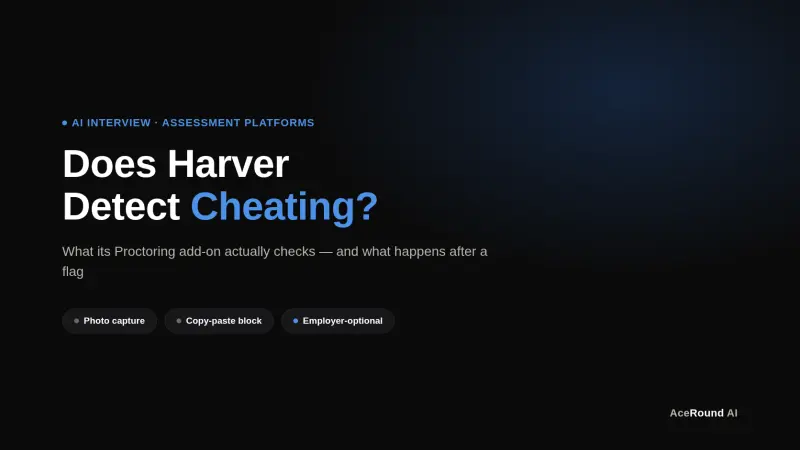
Does Harver Detect Cheating? What Its Proctoring Actually Checks
Does Harver detect cheating on its pre-employment assessments? A candidate look at Harver's Proctoring add-on, what gets logged after a flag, and what happens next.

Micro1's Zara AI Interview: What It Actually Tests (And Why Timing Gets Flagged)
Micro1's AI interviewer Zara has run 300,000+ interviews for remote roles. Here's why it flags response latency as a cheating signal, and what that means for AI prep.