AI Mock Interview Free: Which Tools Are Actually Worth Your Time in 2026
Honest breakdown of the best free AI mock interview tools in 2026 — what each actually gives you for free, how many sessions you need, and which works best for non-native speakers.

TL;DR: The best AI mock interview free tools in 2026 include AceRound AI (real-time live interview assistance), Interviews by AI (unlimited free behavioral practice), and X-Interview (strong multilingual support). Most tools give you 3–5 free sessions before hitting a paywall — this guide maps exactly what you get for nothing, how many sessions research says you actually need, and which tool wins for non-native English speakers.
You have a job interview in four days. You haven't practiced out loud in months. Every "interview prep" service you find costs $49/month before you even see the product. That's the reality for most job seekers right now — and it's why searches for "AI mock interview free" have exploded.
The good news: there are legitimate free options. The bad news: most free tiers are designed to frustrate you into paying, not to actually help you prepare. After testing a dozen tools and reading through the research on what makes AI interview practice effective, here's what I found.
What "Free" Actually Means for AI Mock Interview Tools
When a tool says "free," it almost always means one of three things:
Free trial (3–5 sessions): You get full access briefly, then it's gone. This is what most tools do — Final Round AI, Huru, and several others follow this model. These are only useful if your interview is in the next week and you're disciplined about using every session.
Free tier (limited features forever): You get a restricted version permanently. No expiration, but core features are locked. Interviews by AI and X-Interview work this way. These are better if you're in an extended job search.
Freemium with limits: A mix — some features are free forever, others have monthly usage caps. AceRound AI falls here: you can use the real-time coaching mode for live interviews with a limited number of sessions per month, and the practice mode has more generous limits.
What's always behind the paywall: Advanced analytics, unlimited history, company-specific question banks, feedback on tone/pacing, and any kind of personalized coaching. If you see those features listed as "free," read the fine print.
The honest summary: AI interview practice free options exist, but you need to pick the right tool for your timeline and job search stage.
The 5 Best Free AI Mock Interview Tools in 2026
Here's what the AI interview practice landscape actually looks like when you strip away the marketing. I tested each tool and checked their free tier terms as of May 2026.
1. AceRound AI — Best for Live Interview Support
Free tier: Real-time AI coaching during live video interviews (limited sessions/month), behavioral practice questions, answer feedback.
What makes it different: AceRound sits in the corner of your screen during an actual interview — Zoom, Google Meet, Teams — and suggests answers in real time based on what the interviewer says. That's a different category from "practice" tools; it's preparation plus live support.
For free AI mock interview use specifically, AceRound's practice mode generates behavioral and technical questions, scores your answers on STAR structure, and flags filler words. The feedback is more calibrated to real rejection criteria than most tools — it doesn't just say "great answer," it tells you where a real interviewer would lose interest.
Limitations: The free tier has session limits, and the real-time feature is where AceRound really shines — which requires a paid plan for unlimited use.
Best for: Job seekers who want to practice AND want AI support during the actual interview, non-native English speakers (strong multilingual support).
2. Interviews by AI — Best Free Behavioral Practice
Free tier: Unlimited practice questions, basic feedback, no sign-up required for a trial session.
What makes it different: The free tier is genuinely generous for behavioral question practice. You can run through STAR-format questions for dozens of common job roles without hitting a paywall. The UI is simple — you record your answer, the AI scores it, you move on.
Limitations: Feedback quality is fairly generic. It scores structure well but doesn't pick up on content nuance (saying something factually weak but grammatically correct will still score well). No real-time capability — this is strictly a practice tool.
Best for: Students and early-career candidates who need volume reps on behavioral questions.
3. X-Interview — Best for Non-English Speakers
Free tier: Unlimited sessions in both Vietnamese and English, multilingual feedback.
What makes it different: Most AI mock interview tools are English-only. X-Interview supports Vietnamese and English natively, with 30,000+ users and genuinely unlimited free sessions. For Vietnamese job seekers preparing for international roles, this is the strongest free option available.
Limitations: Limited to Vietnamese and English; doesn't support Japanese, Korean, or Spanish.
Best for: Vietnamese candidates, candidates preparing for bilingual interviews.
4. Google Interview Warmup — Discontinued April 2026, See Alternatives
Status: Google shut it down in April 2026; the original URL now redirects to broader Google products. Listed here because it still surfaces in interview-prep search results.
What it was: A free browser tool that transcribed your spoken answer and highlighted talking points, job-specific terms, and filler words across six tracks (UX design, data analytics, IT support, digital marketing, project management, general).
Limitations (while it ran): Limited to those six tracks, no real-time capability, no STAR evaluation, no follow-up questions.
What to use instead: For the closest free replacements plus a representative Google Interview Warmup questions list by track, see our Google Interview Warmup alternatives review.
5. Huru — Best Free Trial for Technical Roles
Free tier: 3 free sessions, then paid. The free sessions are full-featured — no artificial limits during trial.
What makes it different: Huru's free sessions cover both behavioral and technical questions, with feedback on pacing, filler words, and answer structure. If you have an interview coming up in the next week, three full-quality sessions might be enough to diagnose your biggest gaps.
Limitations: Three sessions go fast if you're testing different question types. Once the trial ends, it's one of the pricier options.
Best for: Candidates with an interview imminent who want high-quality feedback in a short window.
Already using AI for interview prep? See how real-time AI interview helpers differ from practice tools — and when each one makes sense.
How Many Practice Sessions Do You Actually Need?
This is the question no AI interview tool answers honestly, because the answer makes their free tier look worse.
A 2025 study on AI mock interview effectiveness (ISCAP Conference proceedings) found that building genuine interview confidence requires 10–20 practice sessions across a span of at least one week. Single-session cramming produced minimal improvement in actual interview performance; distributed practice over days produced significantly better results.
What this means practically:
- 3-session free trials are enough to identify your weaknesses, not eliminate them
- Unlimited free tiers are where real preparation happens
- One session before an interview is better than nothing but shouldn't be your plan
The research also found something counterintuitive: candidates who over-practiced in the 24 hours before an interview scored lower than those who practiced moderately and then rested. The optimal pattern was 2–3 sessions per day for 5+ days, not marathon prep sessions.
If you're two weeks out from an interview, you want a tool with a generous free tier you can use consistently. If you're two days out, a full-featured free trial is more useful.
A 2025 study published in Humanities and Social Sciences Communications (Nature portfolio) also found that AI-enabled interview practice reduced candidate anxiety significantly — but only when candidates felt the AI feedback was credible. Generic "great answer!" responses had no anxiety-reduction effect. The quality of the feedback matters as much as the volume of practice.
Can AI Feedback Tell You Where You'd Actually Get Rejected?
Short answer: sometimes, but not reliably, and almost never for free.
The core problem is what you might call the "encouragement trap." Most AI interview tools are trained to be supportive — they're trying to keep users engaged, not to simulate a skeptical hiring manager. A real interviewer will stop listening to your answer after 90 seconds if it's not going anywhere. AI tools rarely replicate that pressure.
Here's how to test whether an AI tool's feedback is actually calibrated to reality:
Give a deliberately weak answer. Take a behavioral question like "Tell me about a time you handled a difficult stakeholder." Give a vague, meandering answer that buries any specific result. If the tool scores this positively, its feedback isn't useful.
Check if it scores length correctly. A 4-minute answer is almost always too long. A 45-second answer is probably too short. Good feedback penalizes both extremes. Many free tools don't.
Look for content critique, not just structure. STAR format is easy to score — it's just grammar. Whether your "result" is actually impressive is harder to evaluate. The better free tools (AceRound, Interviews by AI's more detailed mode) will flag when your "result" is vague or unquantified.
For practice interview questions AI free tools, the structural feedback is reliable. The content feedback is hit or miss. That's a real limitation worth knowing before you walk into an interview thinking you've been well-prepared.
For a deeper comparison of AI tools on this axis, see our guide to the best AI interview tools in 2026.
For Non-Native English Speakers: Which Free AI Mock Interview Tool Works Best
This is the most underserved part of the AI interview prep market. Most tools are built for native English speakers in the US and UK, and their "free tiers" reflect that.
If English is your second (or third) language and you're preparing for interviews in English, here's what actually matters:
Speed recognition: Some AI tools struggle with non-native accents. Test this before your actual interview — record a practice answer and see if the transcript is accurate. If the tool can't transcribe you accurately, its feedback on your content is unreliable.
Language support: AceRound AI supports multiple languages including Japanese, Korean, Vietnamese, Brazilian Portuguese, Spanish, Turkish, and Chinese — rare among AI mock interview tools. X-Interview is the strongest free option for Vietnamese speakers. For Korean-speaking candidates, Google Interview Warmup used to have limited Korean support, but since its April 2026 shutdown you'll need one of the Google Interview Warmup alternatives instead.
Feedback on phrasing: Native-speaker feedback on English phrasing requires tools trained on non-native speech patterns. Most aren't. The more honest tools tell you this upfront; the ones that don't are giving you false confidence.
The real advantage of non-English AI mock interview practice: If you can practice answering behavioral questions in English at scale for free, you build fluency specific to interview language — vocabulary like "stakeholder," "cross-functional," "deliverable" — that's different from everyday English. Volume practice matters more here than feedback precision.
For AI mock interview online no sign up options: Interviews by AI lets you run a trial session without creating an account. Google Interview Warmup used to be the no-account-required default; since its April 2026 shutdown, the closest commitment-free options are listed in our Google Interview Warmup alternatives review.
See how ChatGPT compares as an interview practice tool — it's free and handles non-native speakers better than most purpose-built tools, with obvious tradeoffs.
FAQ
Is AI mock interview practice actually effective?
Research says yes — with caveats. A 2025 study on AI-driven mock interviews found that 80% of participants found the AI interviewer realistic enough to generate genuine anxiety (a prerequisite for effective practice), and 65% reported reduced anxiety after consistent practice sessions. The key word is "consistent" — occasional use showed minimal effect. Plan for 10+ sessions over at least a week.
Can I use AI mock interview free tools without a camera?
Yes. Most tools work with audio only — you record your voice, the AI transcribes and evaluates. A few (including AceRound's more advanced modes) also analyze video for eye contact and body language, but that's typically a paid feature. For free tiers, audio-only practice is the norm.
Will my interviewer know I practiced with AI?
They can't tell — AI practice makes your answers more structured and practiced, which is what preparation is supposed to do. The concern some candidates have is sounding "too scripted." The solution is to practice the STAR structure until it's natural, not to practice specific word-for-word answers. Read more about the ethics and detection questions around AI interview tools.
What's the difference between AI mock interview free tools and AI interview copilots?
Practice tools work before the interview — you simulate questions, get feedback, improve your answers. AI interview copilots (like AceRound's real-time mode) work during the actual interview — they listen to your interviewer and suggest answers in real time. Both have free tiers, but they solve different problems. See our AI copilot for interviews guide for a full breakdown.
How many free sessions do I need before a real interview?
More than most free trials give you. Research suggests 10–20 sessions for a meaningful confidence improvement. If you only have 3 free sessions, use them diagnostically — record your answers, identify your three biggest weaknesses (usually: too long, too vague on results, too little structure), and focus on those specifically in your remaining practice.
Do free AI mock interview tools work for technical interviews?
For behavioral questions: yes, mostly. For actual coding challenges: no — tools like HackerRank and CodeSignal have their own practice environments that are better suited. Most AI mock interview free tools are optimized for behavioral and situational questions, not live coding. Huru covers some technical system design questions, but it's a small part of their offering.
Author · Alex Chen. Career consultant and former tech recruiter. Spent 5 years on the hiring side before switching to help candidates instead. Writes about real interview dynamics, not textbook advice.
Related Articles
OpenAI's AI Interview Policy: Banned, Required, or Team-Dependent
OpenAI sells AI coding agents, then bans most candidates from using one. Here's the round-by-round policy, including the new agentic round that flips it.
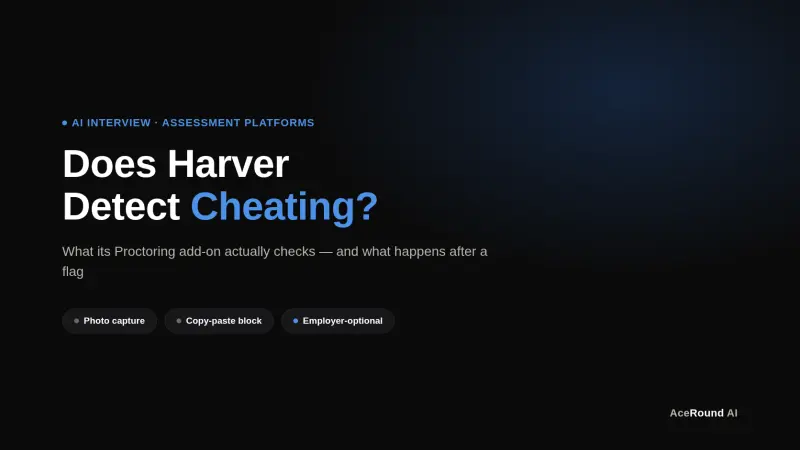
Does Harver Detect Cheating? What Its Proctoring Actually Checks
Does Harver detect cheating on its pre-employment assessments? A candidate look at Harver's Proctoring add-on, what gets logged after a flag, and what happens next.
Micro1's Zara AI Interview: What It Actually Tests (And Why Timing Gets Flagged)
Micro1's AI interviewer Zara has run 300,000+ interviews for remote roles. Here's why it flags response latency as a cheating signal, and what that means for AI prep.