Welder Interview Questions: The Weld Test No One Warns You About
Welder interview questions and answers, what the weld test actually grades, what to bring, and where AI prep genuinely helps versus where it can't.
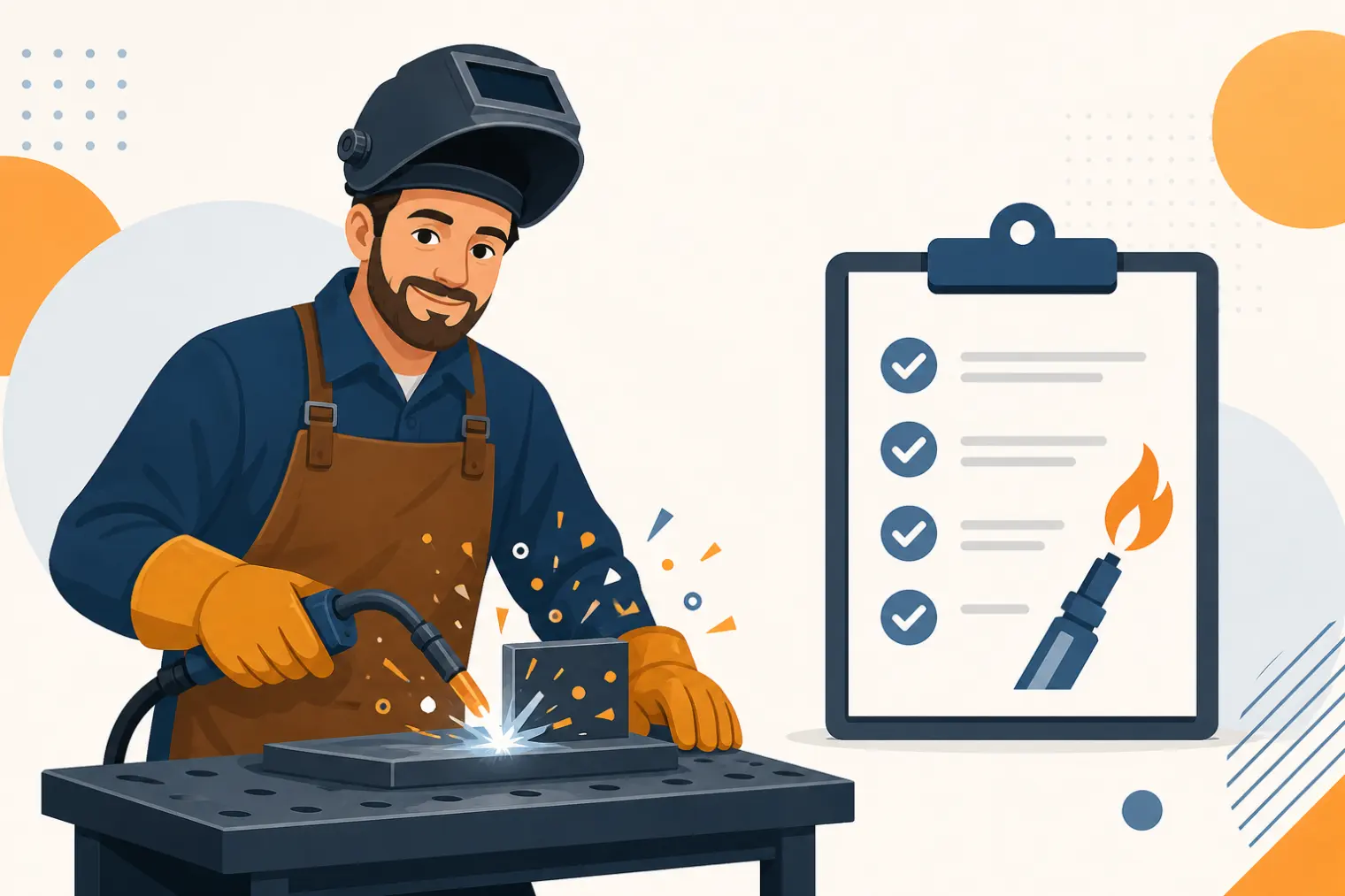
TL;DR: Welder interview questions only cover half the interview. Most shops pair a short verbal Q&A (experience, safety, blueprint/WPS reading) with a live weld test — a fillet or groove weld on scrap plate, graded on stick-out, travel speed, bead profile, and defect avoidance — that often sets your starting pay on the spot. This guide covers both halves, plus the gear-etiquette mistake that quietly costs candidates offers.
You show up for a "welder interview" expecting a conversation, and twenty minutes in, someone hands you a scrap plate and a hood and tells you to run a bead. If that catches you off guard, you're not alone — trade-school forums and welding message boards are full of candidates asking some version of "wait, is there a test?" Every generic "welder interview questions" listicle online treats this like a normal desk-job interview: a list of behavioral questions with sample answers, no mention of the part that actually decides whether you get hired.
The Two Parts of a Welder Interview
Almost every welding interview, from a small fab shop to a large manufacturer, runs two stages in the same visit:
- The verbal round — your experience, the processes you're certified or practiced in (stick, MIG, TIG, flux-core), safety habits, and how well you read a blueprint or a Welding Procedure Specification (WPS).
- The weld test — a live, hands-on demonstration where you actually run a bead in front of whoever's hiring, usually on scrap plate, sometimes progressing from a simple fillet weld to a groove weld if the role demands it.
Shops run it this way because welding is a skill you either have or don't — no amount of a polished verbal answer substitutes for a clean bead. It's also why the hiring market has stayed tight even as demand holds steady: the Bureau of Labor Statistics projects roughly 45,600 annual welding job openings through 2034 nationally, driven mostly by retirements — the average welder is around 55 years old — rather than growth, which means shops are constantly re-testing a rotating pool of candidates rather than hiring once and moving on.
Common Welder Interview Questions (Verbal Round)
Experience and background
- Walk me through your welding experience and the processes you're strongest in.
- What certifications do you currently hold, and when were they last renewed?
- Have you worked with [specific material — stainless, aluminum, structural steel]?
Safety and process knowledge
- Walk me through your PPE routine before you strike an arc.
- How do you read a WPS, and what do you check first?
- Tell me about a time you caught a safety issue before it became a problem.
Scenario and troubleshooting
- You get porosity in a weld you thought was clean — what's your first move?
- A blueprint calls for a joint type you haven't run before. What do you do?
- Tell me about a project where the tolerances were tighter than usual.
The Weld Test: What They're Actually Grading
This is the part almost no other "welder interview questions" article walks through in detail. A shop supervisor or lead welder hands you a coupon of scrap plate and watches — sometimes from across the shop, sometimes standing right over your shoulder — while you run a bead, most often a fillet weld first. They're not grading raw speed. They're checking the same handful of things a certification test checks:
- Stick-out and electrode/torch angle — consistent distance and angle from the start of the bead to the end, not just the first two inches.
- Travel speed — steady and even, not rushed because someone's watching.
- Bead profile — a clean, even, appropriately-sized bead rather than one that's ropy, undersized, or piled up.
- Clean starts and stops — no cratering or restart flaws where you paused and picked the arc back up.
- Defect avoidance — no porosity (trapped gas pockets), undercut (the base metal eaten away along the weld edge), or lack of fusion (the weld sitting on top of the metal instead of bonding into it).
If you fail, it doesn't always mean you're not a competent welder — nerves, an unfamiliar machine's settings, or a joint type you don't run often can trip up someone with years of real experience on a one-shot test. Some shops will let you try again on the spot; most won't, so treat every weld test like it's your only attempt.
What to Bring to a Welding Interview
This is the gear-etiquette mistake that costs candidates offers before they ever strike an arc: showing up without your own hood, gloves, and jacket. One shop owner, quoted describing what actually happens at their interviews, called it flatly "the absolute worst offense" — worse, in their telling, than a shaky weld. Even when a job posting says equipment is provided, a working welder is expected to own basic PPE the way a carpenter owns a tape measure, and arriving without it signals you're not currently working the trade.
Bring, at minimum:
- Your own welding hood, gloves, and jacket if you own them
- Safety glasses
- Any certification cards (AWS Certified Welder, process-specific qualifications) or copies of recent test results
- A resume that lists specific processes and materials, not just "welding experience"
AWS Certification and How It Changes the Conversation
The American Welding Society's Certified Welder (CW) program is a performance-based credential — no coursework prerequisite, just a hands-on test at an AWS Accredited Testing Facility. Holding an active CW card, or a recent qualification test result from a previous employer, can sometimes let you skip a shop's own in-house weld test entirely, or at least shorten it. If you're actively job-hunting and haven't tested recently, it's worth checking your certification's expiration and renewal window before you start applying — a lapsed card puts you back in the "test everyone" pool.
Where an AI Interview Copilot Helps — and Where It Can't
Be honest about this split, because a welder interview is one of the clearest cases where an AI copilot's usefulness has a hard boundary. For the verbal round — a phone screen, a video pre-screen, or the sit-down conversation before the weld test — a structured tool like AceRound genuinely helps: rehearsing how you talk about your process experience, practicing WPS and safety terminology so you don't blank on it live, and getting real-time phrasing help if the conversation moves faster than you expected.
The weld test is different, and no honest tool should pretend otherwise. It's a live, offline, physical skills demonstration — there's no earpiece or screen that helps you run a straighter bead. The real prep for that half is bringing your own gear, running practice beads on your own machine beforehand, and treating certification renewal as part of your job search, not an afterthought.
Other blue-collar trades share this same two-part structure — a verbal round plus a hands-on evaluation — where AI prep helps on one side and stops cold on the other. Our breakdowns of the electrician interview and the truck driver interview cover the same honest split for their respective trades.
Questions to Ask Before You Leave
- What process will the weld test use, and what joint type should I expect?
- Is there a chance to redo the test if the first attempt doesn't go well?
- What's the typical timeline between the test and a hiring decision?
Asking these isn't just about your own prep — a shop that can't answer clearly often runs an inconsistent hiring process, which tells you something about how the shop floor itself is run.
FAQ
What should I expect at my first welding job interview?
Expect two distinct stages in the same visit: a short verbal conversation covering your experience, safety habits, and blueprint or WPS reading, followed by a hands-on weld test — usually a fillet weld on scrap plate, sometimes progressing to a groove weld. Shops decide fast, and it's common for the weld test result to set your starting pay rate on the spot, so treat both halves as equally graded.
What actually happens during the weld test?
A shop supervisor or lead welder hands you a coupon of scrap plate, tells you the process (usually stick, MIG, or TIG depending on what the job needs), and watches you run a bead — sometimes alone, sometimes standing right over your shoulder. They're not timing you for speed; they're checking whether your technique holds up under a little pressure, which is closer to what a real production day looks like than a quiet practice run at home.
What happens if I fail the weld test?
It varies by shop — some will tell you on the spot and end the interview there, others will let you know later, and a few offer a second attempt if your first coupon was close. A failed test isn't necessarily about your general skill; nerves, an unfamiliar machine setting, or an unfamiliar joint type trip up plenty of experienced welders on a one-shot evaluation. If a shop offers feedback on what went wrong, take it seriously before your next interview.
What should I bring to a welding interview?
Bring your own hood, gloves, and jacket if you have them, even if the shop says they'll provide gear. Employers who run weld tests regularly report that showing up without your own basic PPE is one of the fastest ways to look unprepared, since a working welder is expected to own their gear the way a carpenter owns a tape measure. Bring your certifications too — an AWS Certified Welder card or a copy of a recent qualification test result can move you straight past a shop's own test in some cases.
Do I need to bring my own tools to a welder interview?
At minimum, bring your PPE (hood, gloves, jacket, safety glasses) even when a shop says equipment is provided — it's the single most common gap experienced hiring supervisors flag. Whether you need your own hand tools (chipping hammer, wire brush, pliers) depends on the shop; if the job posting or the person who scheduled you doesn't say, it's a fair and expected question to ask ahead of time.
What's a good answer for salary expectations in a welding interview?
Give a realistic range based on your process certifications and the region's going rate rather than a single fixed number, and be aware that your weld-test performance can move you up or down that range on the spot — a clean test sometimes bumps a starting offer, a shaky one can pull it toward the bottom. Research the local range beforehand (BLS puts the 2024 national median at $51,000, but shop-to-shop and region-to-region variation is significant) so your number reflects the market, not a guess.
Author · Alex Chen. Career consultant and former tech recruiter. Spent 5 years on the hiring side before switching to help candidates instead. Writes about real interview dynamics, not textbook advice.
Related Articles
OpenAI's AI Interview Policy: Banned, Required, or Team-Dependent
OpenAI sells AI coding agents, then bans most candidates from using one. Here's the round-by-round policy, including the new agentic round that flips it.
Does Harver Detect Cheating? What Its Proctoring Actually Checks
Does Harver detect cheating on its pre-employment assessments? A candidate look at Harver's Proctoring add-on, what gets logged after a flag, and what happens next.
Micro1's Zara AI Interview: What It Actually Tests (And Why Timing Gets Flagged)
Micro1's AI interviewer Zara has run 300,000+ interviews for remote roles. Here's why it flags response latency as a cheating signal, and what that means for AI prep.