Scrum Master Interview AI: How to Handle the Questions Static Lists Miss
Scrum master interview AI guide to scenario questions, servant-leadership answers, CSM vs. PSM, and real-time help when static lists fall short.
TL;DR: Scrum Master interview questions are almost entirely scenario-based — a blocked sprint, a stalled retro, a Product Owner with unrealistic asks — and interviewers are listening for servant-leadership language (removing obstacles, asking questions) instead of authority language (telling the team what to do). Certification literacy (CSM vs. PSM) and STAR-structured stories carry real weight. Static question lists tell you what to expect; they can't help when you freeze mid-answer, which is where live, real-time help actually earns its keep.
You're asked: "Walk me through a time your sprint got completely blocked two days before the demo." There's a beat of silence. You know the shape of a good answer — you've read the lists, you've got stories — but under pressure, the story that comes to mind is messy, half-finished, and doesn't land the way it did in your head last night.
That gap between "I know what a good answer looks like" and "I can produce one live, on the spot" is the actual problem in Scrum Master interviews, and almost nothing written about them addresses it. Most guides are variations on the same format: a list of 40, 60, sometimes 90 questions with sample answers to memorize beforehand. Useful for orientation. Useless the moment the real conversation goes somewhere the list didn't cover.
What Makes a Scrum Master Interview Different From a Generic PM Round
A project manager interview tests planning, stakeholder juggling, and delivery tradeoffs. A Scrum Master interview tests something narrower and more values-driven: can you facilitate a team without directing it.
Three things show up in Scrum Master interviews specifically that don't show up the same way in adjacent PM or engineering-manager rounds:
- Servant-leadership framing, explicitly tested. Interviewers are listening for whether you default to "I decided" or "I helped the team decide." The second one is the correct instinct almost every time, even in stories where you clearly drove the outcome.
- The five Scrum values as interview criteria. Courage, focus, openness, respect, and commitment aren't just poster language — interviewers map your stories against them, often without saying so directly.
- Ceremony-specific scenario questions. Not "tell me about a conflict" in the abstract, but "a teammate keeps derailing your daily stand-up" or "your retro has turned into a complaint session nobody takes seriously anymore." These are Scrum-specific enough that generic behavioral-interview prep doesn't fully cover them.
The Questions You'll Actually Get
Scrum.org's own community forum and blog — a good proxy for real practitioner language rather than recruiter-written copy — surface the recurring shape of these questions well. Expect some version of each:
- The blocked-sprint scenario: "Tell me about a time you removed a significant impediment for your team." This is the single most recurring prompt across ranking guides, almost always phrased with the word "impediment" or "blocker."
- The stand-up conflict scenario: how you handle a team member who dominates or derails the daily stand-up without shutting them down publicly.
- The retro-that-nobody-takes-seriously scenario: what you'd change about a retrospective format the team has quietly stopped engaging with.
- The unrealistic-Product-Owner scenario: coaching a PO who keeps adding scope mid-sprint, without turning it into a power struggle.
- The certification-literacy question: "What's the difference between CSM and PSM, and why did you choose the one you have?" — increasingly common as more candidates hold one or the other.
- The 2026-specific question: "How has the Scrum Master role changed with AI tools on your team?" Scrum.org has flagged this directly as an emerging prompt, and it's worth having an honest, non-defensive answer ready — one that shows you see AI as a tool your team uses responsibly, not a threat to facilitation.
One direct AI-copilot competitor already ranks for this keyword with a "Top 30 Scrum Master interview questions" page — same static-list format as everything else, no coverage of certification nuance or live in-call help. It's worth knowing that gap exists, because it means most of what's published treats this as a memorization problem rather than a live-performance one.
Answer Structure: STAR, But Servant-Leadership-Flavored
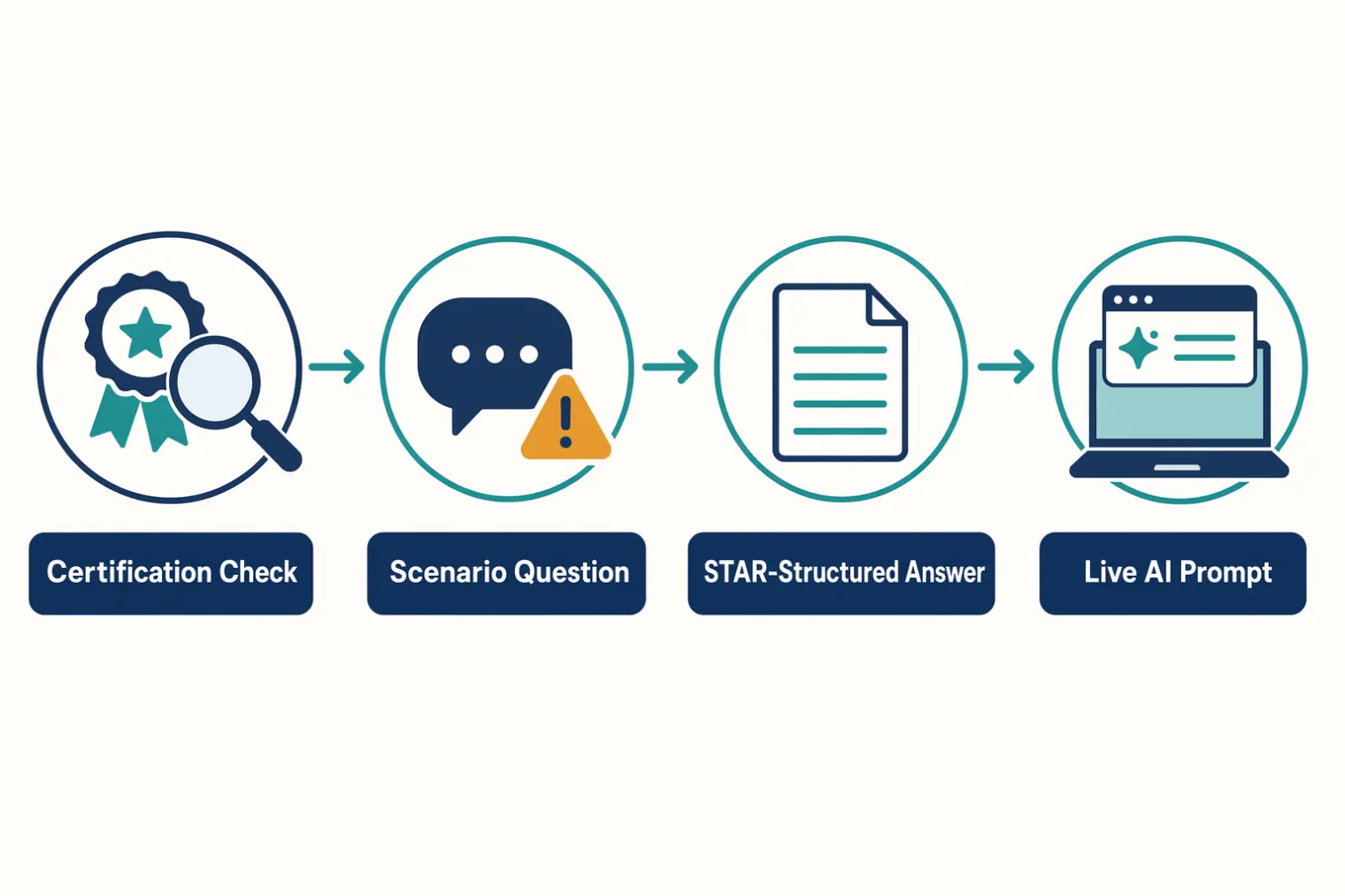
STAR (Situation, Task, Action, Result) is table stakes for every guide on this topic, and for good reason — structured behavioral interviews have one of the strongest predictive-validity track records in hiring research. What's specific to Scrum Master interviews is the language inside each STAR beat:
- Situation/Task: name the ceremony or mechanism (sprint, stand-up, retro, backlog refinement) rather than describing it generically as "a meeting."
- Action: favor verbs like facilitated, surfaced, coached, asked over decided, told, assigned. This single word-choice shift is what separates a servant-leadership answer from an authority answer covering the exact same underlying event.
- Result: tie the outcome back to the team's ownership of the fix, not just the metric. "The team agreed to cap WIP at three" lands better than "I capped WIP at three," even if you're the one who proposed it.
Why the 90-Question List Isn't the Failure Point
Here's the uncomfortable truth about Scrum Master interview prep: the questions themselves are genuinely predictable. Blocked sprint, stand-up conflict, PO overreach, CSM-vs-PSM — these show up across nearly every published list, and if you've read three of them, you've seen the full range. Reading more lists past that point has diminishing returns.
The actual failure point is live delivery — going blank mid-story, losing the servant-leadership framing under pressure and slipping into "I told them," or forgetting the specific number that made your impediment story concrete. A static list can't fix that, because the problem only shows up in the moment, not while you're studying beforehand.
This is the gap AceRound AI is built around — not another list to memorize, but real-time structure prompts while you're mid-answer in the actual call, surfacing the STAR shape and the servant-leadership framing as a live cue instead of something you're trying to hold entirely in your head under pressure. It won't invent a story you don't have, and it won't make a hollow answer sound substantive — what it does is help you stay organized when the pressure of a live conversation scrambles a structure you genuinely know.
If you're facing more interviews conducted or scored by AI rather than a human panel, our guide on how to pass an AI interview covers that adjacent format, and if this round sits inside a broader PM-track search, project manager interview AI prep and engineering manager interview AI prep cover the neighboring roles.
FAQ
What's the difference between CSM and PSM for interview purposes? CSM (Certified ScrumMaster, from Scrum Alliance) requires an instructor-led course and renews every two years with continuing-education credits. PSM (Professional Scrum Master, from Scrum.org) is exam-only, self-study friendly, and doesn't expire. Interviewers who know the difference sometimes ask which one you have and why — have a one-sentence answer ready that isn't defensive either way.
How should I prepare for a Scrum Master interview if I'm a fresher with no formal title? Reframe your existing agile-adjacent experience using STAR: even if you weren't titled "Scrum Master," any time you facilitated a meeting, unblocked a teammate, or mediated a disagreement counts as evidence. Say so explicitly rather than waiting for the interviewer to infer it.
Will I be asked about AI in a Scrum Master interview? Increasingly, yes. A common 2026 prompt is some version of "How has the Scrum Master role evolved with AI tools?" — interviewers want to hear that you see AI as something your team uses responsibly, not something that replaces facilitation and trust-building.
What's the most common mistake candidates make in these interviews? Answering scenario questions (blocked sprint, stalled retro, conflicting stakeholders) with authority-based language — telling the team what to do — instead of servant-leadership language: removing obstacles, asking questions, and letting the team own the decision.
Do Scrum Master interviews use behavioral or technical questions? Almost entirely behavioral and scenario-based. There's rarely a coding component. The "technical" knowledge being tested is your grasp of Scrum mechanics — sprint ceremonies, the Scrum values, definition of done — applied to a people situation, not a system.
Author · Alex Chen. Career consultant and former tech recruiter. Spent 5 years on the hiring side before switching to help candidates instead. Writes about real interview dynamics, not textbook advice.
Related Articles
Does Harver Detect Cheating? What Its Proctoring Actually Checks
Does Harver detect cheating on its pre-employment assessments? A candidate look at Harver's Proctoring add-on, what gets logged after a flag, and what happens next.

Micro1's Zara AI Interview: What It Actually Tests (And Why Timing Gets Flagged)
Micro1's AI interviewer Zara has run 300,000+ interviews for remote roles. Here's why it flags response latency as a cheating signal, and what that means for AI prep.
Does CoCubes Detect Cheating During the Online Assessment?
CoCubes (an Aon platform) proctors off-campus drives with real AI monitoring — what it actually watches, what candidates report, and where prep helps.